THE SHORT ANSWER
A stolen car ends up in one of a few places. Many are found again, dumped on a street or held in an impound lot. Others are stripped for parts, loaded onto a ship, or given a cloned VIN and sold to a buyer who suspects nothing. A few are paid off by an insurer and resold after recovery. A VIN check against theft, lien and impound records shows which path a car took.
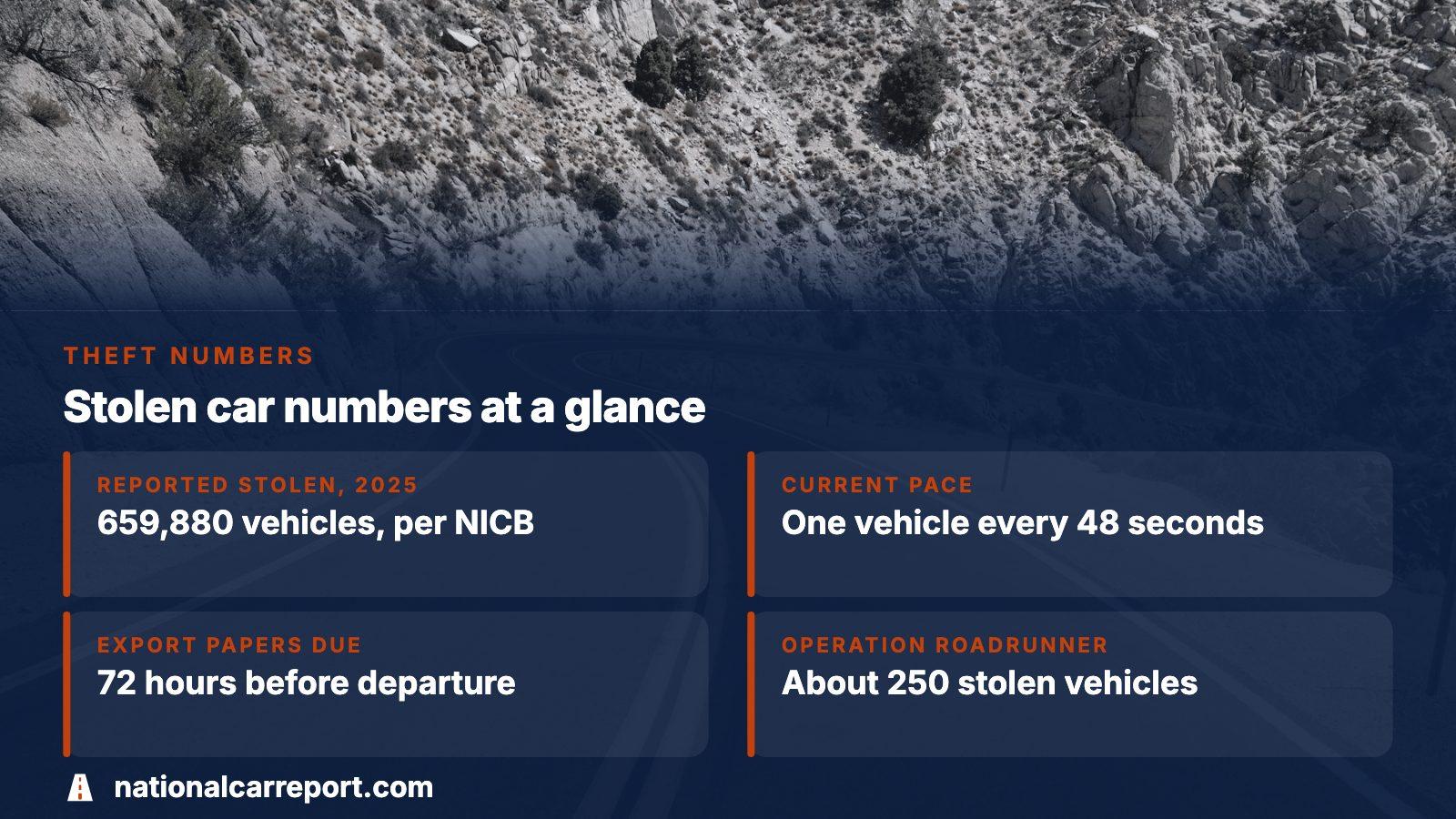
- Reported stolen, 2025
- 659,880 vehicles, per NICB
- Current pace
- One vehicle every 48 seconds
- Export papers due
- 72 hours before a ship or plane leaves
- Cloned-car case
- About 250 stolen vehicles in Operation Roadrunner
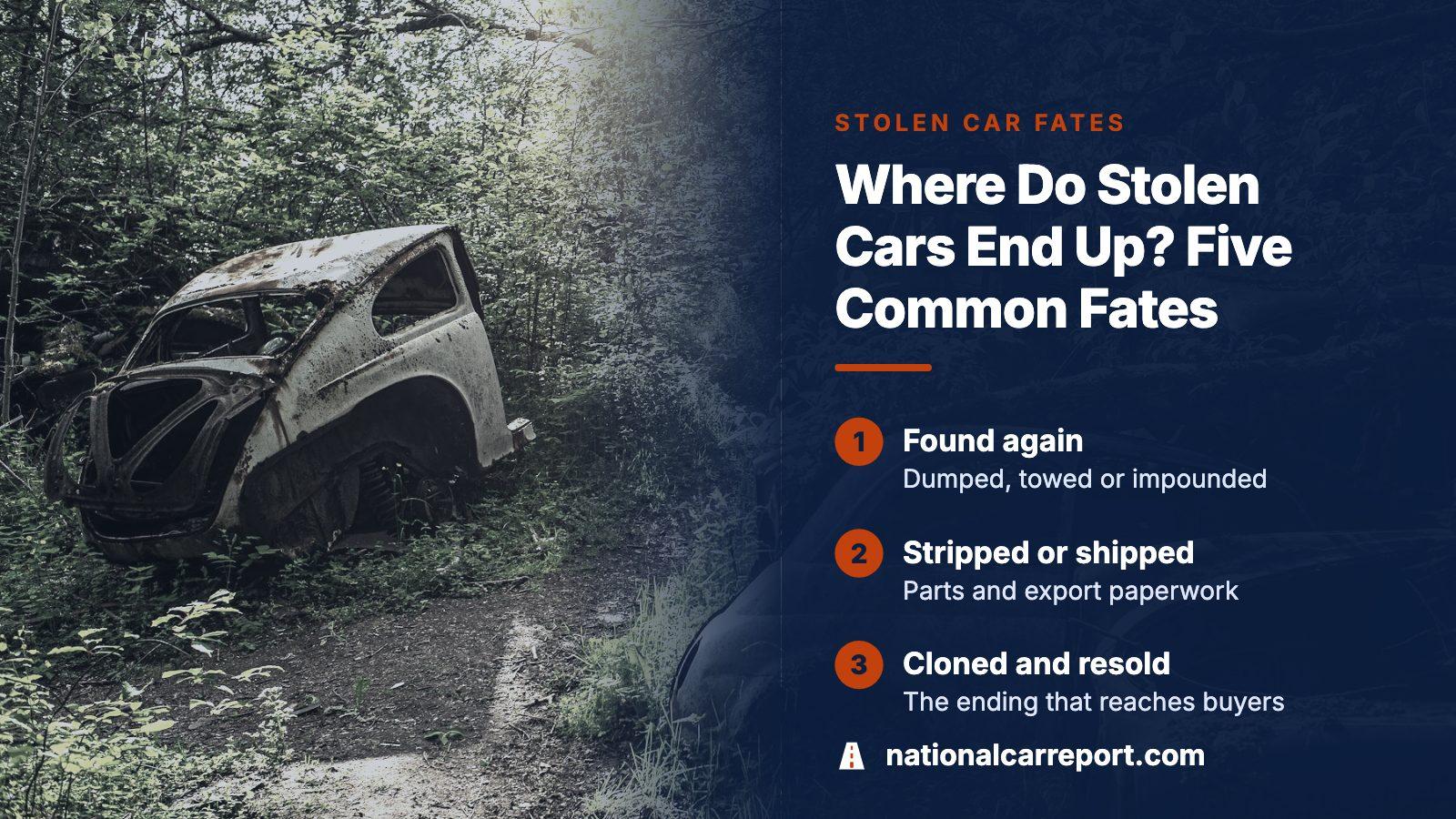
Five places a stolen car can end up
NICB counted 659,880 vehicles reported stolen across the country in 2025, down 23% from the year before and the lowest total in several decades. Even so, it puts the pace at one vehicle every 48 seconds, and more than one-third of the thefts cluster in ten metro areas.
NICB's own theft brochure names three fates for cars that police never recover: sold overseas, stripped at a chop shop, or resold to an unsuspecting buyer. Add the cars that are found and the cars an insurer pays for, and the table covers the endings a used-car buyer is likely to meet.
| Ending | What happens to the car | What it can leave behind |
|---|---|---|
| Dumped and found | Driven, then left on a street or towed to a lot | A theft report, a recovery, an impound entry, repair bills |
| Stripped | Sold off in pieces | Missing parts, swapped panels, sometimes a total loss |
| Exported | Loaded onto a ship at a port | A theft report and a car out of reach |
| Cloned and resold | Given another car's VIN and papers | A clean-looking car that two owners claim |
| Paid off, then resold | Insurer settles, car surfaces later | Total-loss or salvage records, sometimes a clean title |
Found again: dumped, towed, impounded
One ending is the dull one. Thieves take a car for a ride or for another crime, then leave it, and police or a tow crew find it. The owner gets a phone call, and the car may already be sitting behind a fence.
From an NHTSA owner complaint
The owner of a 2018 Hyundai Elantra told NHTSA that the car vanished from a senior living community's lot one afternoon, with a rear door broken and the ignition harness torn apart. Police rang four days later: a St. Paul impound lot was holding the car. It came back with a blown tire, a badly damaged wheel, scratches on the rear body and a stained seat, then waited at a dealer for parts.
A recovered car is not a repaired car. If a seller admits to a theft recovery, ask for the repair invoices and the impound release paperwork before you talk price.
Stripped for parts: the chop-shop ending
Some cars never come back whole. NICB's brochure describes stolen vehicles taken apart at chop shops, with the pieces sold or fitted to other vehicles. What is left, if it is found at all, can be rebuilt and listed for sale.
From an NHTSA owner complaint
Another 2018 Elantra owner reported that thieves drove the car 30 to 40 miles before leaving it behind. It was found with parts removed, the catalytic converter included.
A rebuilt car can look fine from the driver's seat. Ask for invoices that name every part replaced, match the car's VIN against the title and the state record, and treat a swapped hood, door or engine with no paper trail as a reason to stop and run the VIN.
Shipped abroad: where the export paperwork matters
NICB's brochure lists shipping overseas and selling on the black market among the fates of unrecovered cars. Federal export rules show where that route is supposed to be checked. Anyone exporting a used vehicle must present the car, plus papers that give its VIN, at the port. By ship or plane, both are due at least 72 hours before departure.
- A car with a U.S. title needs the original title or a certified copy.
- A lien or lease means a signed letter from the lender or lessor saying the car may leave.
- An owner whose title is no longer in force must certify in writing that the car is not stolen.
For a buyer here, this ending matters less than the next two, because a car that has left the country is not sitting on a local lot.
Cloned and resold: the ending that reaches buyers
A clone is a stolen car wearing another car's identity. NICB describes the recipe: lift a VIN off a legally registered car, print a fake tag and matching ownership papers, steal a similar car, swap the tag, and sell. Thieves rarely get caught, NICB says, because most licensing offices do not look for a second owner of record when an out-of-state title is turned in.
The Justice Department's NMVTIS site recounts Operation Roadrunner, where South Florida police tracked down about 250 cloned cars spread across the country. Because the forged titles carried genuine VINs, buyers, state title offices and police alike could not detect the theft.
What a clone costs the buyer
A buyer who pays for a clone does not become its owner. Once the VIN swap surfaces, the car is seized and goes back to its original owner, or to whichever insurer paid for the theft.
Paid off by the insurer, then resold
NMVTIS says insurers may write off a stolen car as a total loss once 30 days pass without a recovery. A car that reappears afterward in perfect shape keeps that label, and the insurer or an auction pool may try to sell it as a running car.
A car sold this way may be perfectly sound. The catch is that the history now reads as theft, total loss and recovery, in an order a seller may not volunteer. Federal title data can also show an insurer's salvage ruling, plus any sign that the car went to a salvage yard, a junk yard or a recycler.
Signs a car may have taken one of these roads
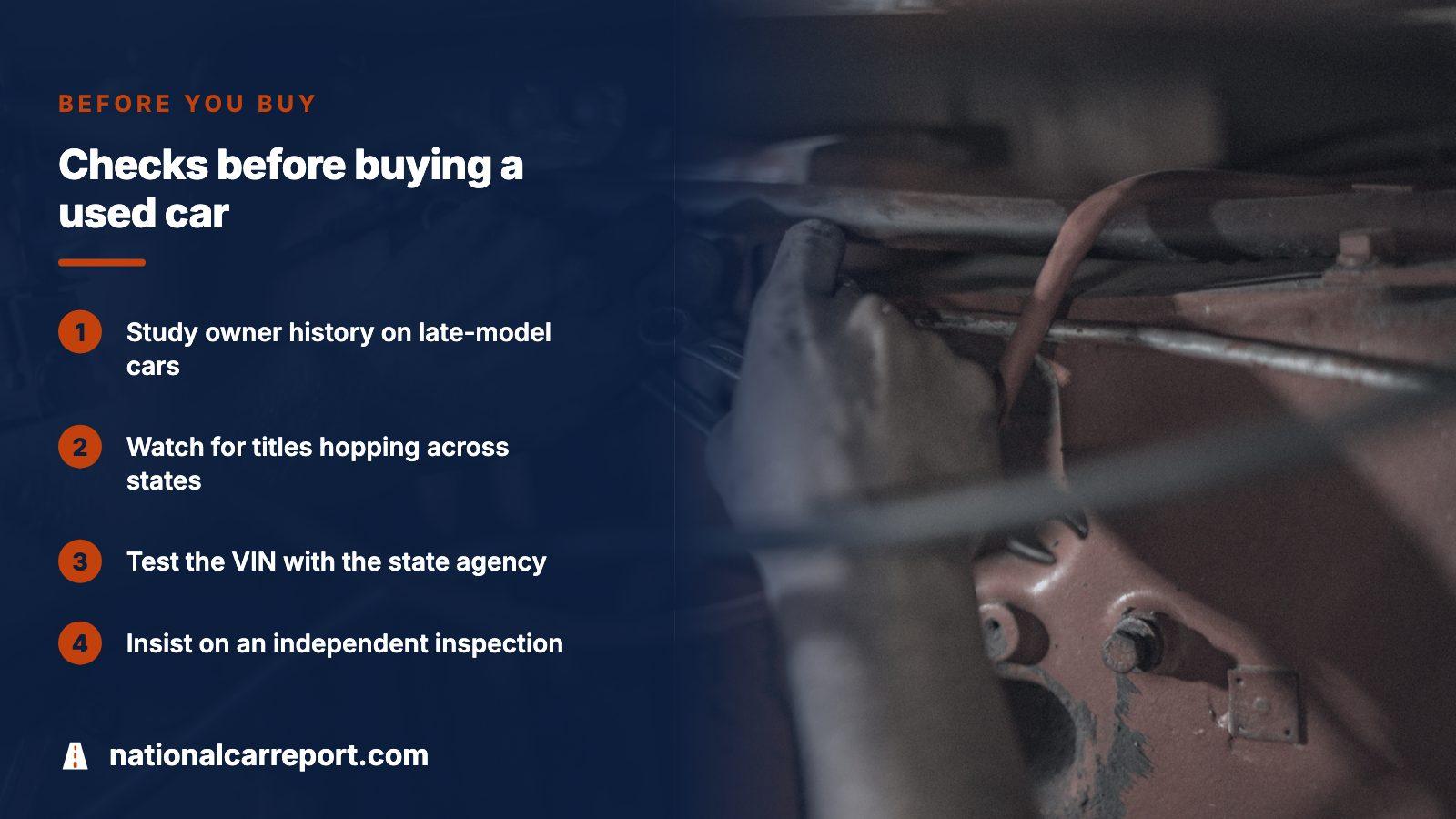
- A late-model car shows no lienholder. NICB advises studying the ownership pattern of such cars.
- The title history hops through several states, the pattern NICB ties to title washing.
- The VIN on the car fails a check with the state motor vehicle agency, or the seller will not let you run one.
- The seller refuses an inspection by your mechanic or your insurer, both of which NICB suggests.
- A salvage or total-loss record turns up that the seller never mentioned.
None of these proves a theft. Each is a reason to run the VIN before money moves.
What the checks can and cannot show
Start with NICB's VINCheck. Enter a VIN and it says whether participating insurers flagged that vehicle as an unrecovered theft, a salvage car or a flood car. It allows five searches per IP address in 24 hours. It reflects insurer reports only, and a car that was found again and sold on may return no theft flag, so NICB recommends a full history report whenever something is flagged.
The federal title system is the next layer. NMVTIS holds title, brand, odometer, total-loss and salvage data, but not every state reports, so pair it with the state's own title record.
NationalCarReport starts with a free preview from the VIN, then offers one payment for the full report, which sets theft entries beside lien and impound records and title brands. The pricing page lists the options.
Where this information comes from
- NICB: U.S. vehicle thefts decline in 2025 — 2025 theft count, the yearly change and where thefts cluster
- NICB: Vehicle theft brochure (PDF) — three fates listed for cars that are never recovered; an older printed piece
- NICB: Buying a used vehicle — how cloning works, what happens to a buyer of a clone, and how VINCheck is used
- NMVTIS (Department of Justice): For consumers — Operation Roadrunner, the 30-day total-loss label and gaps in state reporting
- eCFR: 19 CFR Part 192, export control — what exporters of used vehicles must present at a port
- NHTSA owner complaint 11490273 — owner experience, paraphrased
- NHTSA owner complaint 11751074 — owner experience, paraphrased
Sources and photos: Facts checked against the sources above in November 2026. Photos by Patrick von der Wehd, Nina Mercado and Will Truettner on Unsplash; diagrams by NationalCarReport.
Keep reading
- Stolen Car Check by VIN: Nationwide Theft, Lien and Impound RecordsRun the theft, lien and impound check on a car before you pay for it.
- Theft Recovery Vehicle: Stolen, Lien and Impound Checks Before You BuyWhat a recovered theft leaves on a title, and why the label says so little.
- Impound Lookup: Find a Towed Car, Then Check Its VIN for Impound RecordsHow to find a towed car and what an impound entry means in a history.
- Report a Stolen Car: Police Steps, Insurance and a VIN Theft CheckThe police and insurer steps that start a stolen car's record.
Frequently asked questions
Do stolen cars get recovered?
Many do, and the condition ranges from a broken ignition to a stripped shell. A count of reported thefts is not a count of recoveries, so the only way to learn how one car ended is to read its own record by VIN.
Can a stolen car be sold with a clean title?
Yes, two ways. A clone carries another car's VIN and forged papers. A car paid off by an insurer and recovered later can be sold with its total-loss label, though state laws differ on what gets branded, so the title may not show it.
How long before an insurer writes off a stolen car?
NMVTIS notes that a car not recovered within 30 days may be labeled a total loss. The date that applies to a given claim comes from the policy and the adjuster, and the label does not disappear if the car is found afterward.
Is NICB's VINCheck enough to rule out theft?
It is a sound first screen, with five searches per IP address in 24 hours. It reflects reports from participating insurers only. A theft that was never reported to one of them would not show, and a clean result is a screen, not proof.
What should I do if I think I bought a cloned car?
Stop using the car and contact the police, then report the sale to NICB, which takes reports online and by phone. Keep the ad, the messages, the bill of sale and the title, because investigators are likely to want them.
Now check the car itself
The guide explains what to look for. The report shows what this VIN has on record.