THE SHORT ANSWER
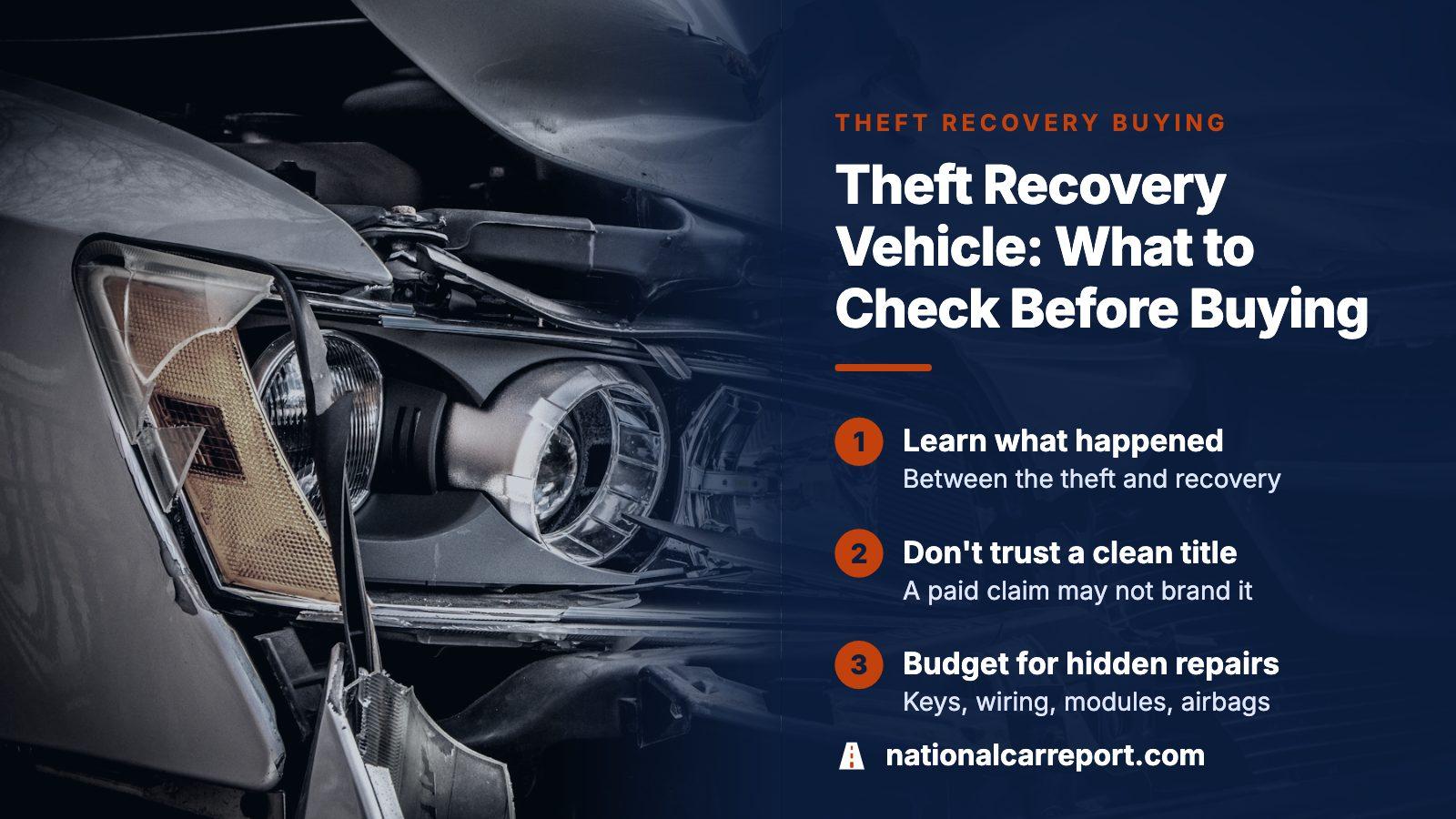
Buy a theft recovery vehicle only once you know what happened between the theft and the recovery. A paid theft claim does not always brand a title, so a clean title proves little. Search the VIN for theft, lien and impound records, read the repair invoices, and have the keys, wiring and airbag module inspected. Start with the free NICB search, then the NationalCarReport preview.
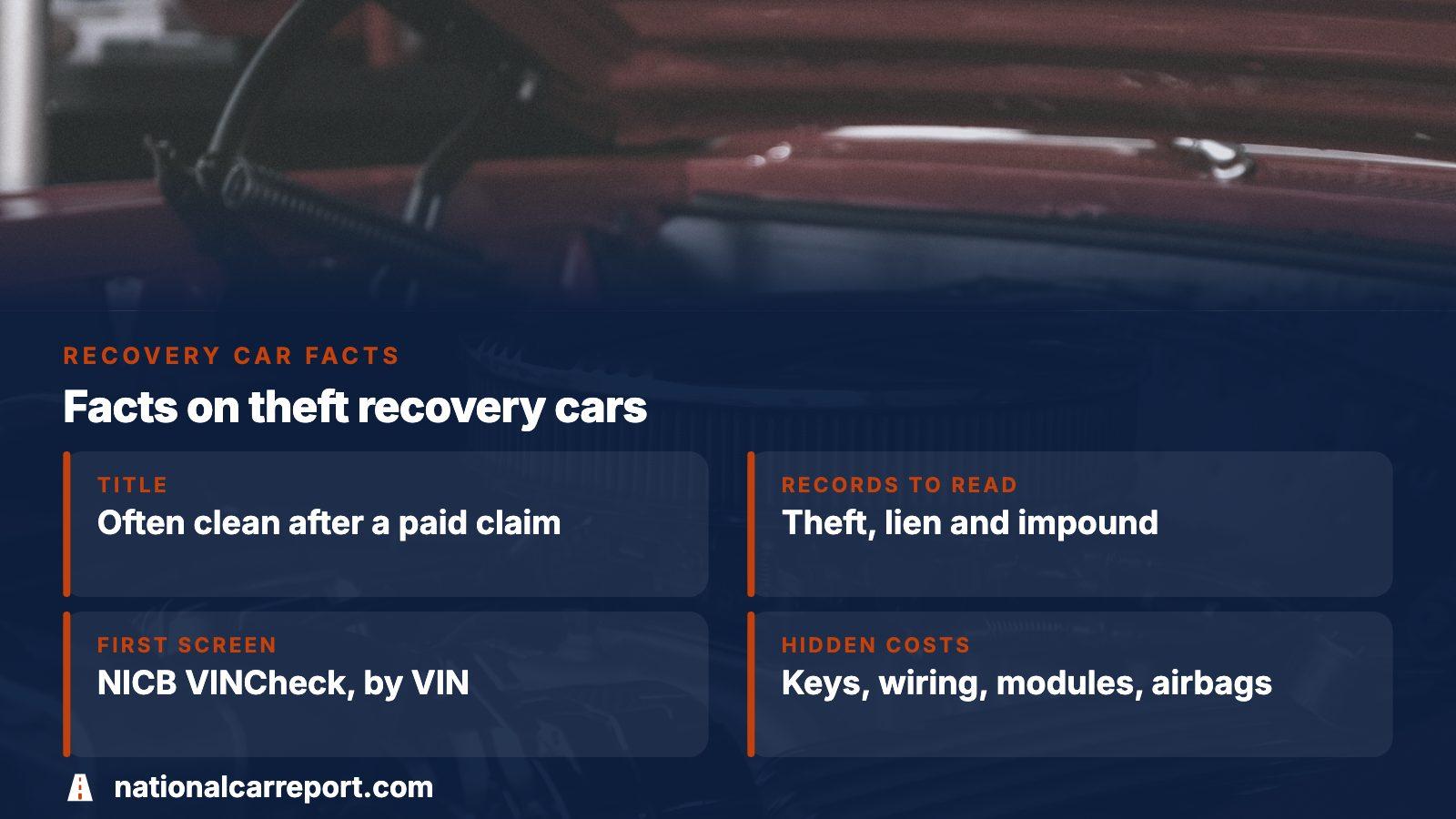
- Title
- Often clean after a paid theft claim
- Records to read
- Theft, lien and impound
- First screen
- NICB VINCheck, by VIN
- Hidden costs
- Keys, wiring, modules, airbags
What a recovered theft leaves in three places
The active stolen flag normally comes off once a car is found, so a search for an open theft report can come back empty on a recovered car. The story does not vanish. It scatters across several records, and a nationwide check reads them side by side.
| Record | What it can show | The question it raises |
|---|---|---|
| Theft record | The car was reported stolen, often by an insurer that paid the loss | When was it taken, and when did it come back? |
| Impound entry | The car sat in a police or tow lot after it was found | Who collected it, and what changed while it sat? |
| Lien | A lender may still hold a claim on the car | Is there a written release? |
| Title brand | The damage triggered a salvage or total-loss record | Or was the line simply never crossed? |
Why a clean title proves little on a stolen car
Texas publishes its salvage rules, and they show the problem. A claim paid for theft is not salvage in itself. The car crosses into salvage only when damage done during the theft, before anyone found the car, would take a repair bill larger than the car's value just before that damage.
That means an insurer can pay a theft loss, the car can reappear and be resold, and the title stays clean by design. Damage in a tow yard after recovery does not count toward the test. Other states word their rules differently, so read the salvage definition in the state that issued the title.
Clean is not the same as untouched
On a collision car, a clean title at least hints that the damage stayed small. On a theft recovery, the paperwork can be clean because the rule never asked for a brand.
One label, four very different cars
- The joyride: taken from a driveway, found two streets away with a damaged ignition and little else.
- The fast strip: wheels, airbags and the catalytic converter gone, wiring cut where parts were yanked out.
- The wreck: crashed during the theft, the one case where the repair bill can pass the car's value.
- The held car: recovered intact but left in a lot for weeks before anyone collected it.
A listing calls all four a theft recovery. The words say that the car came back, not what shape it was in.
The impound and lien records most buyers skip
An impound entry says the car was held somewhere after it was found. Ask who collected it, whether storage fees were paid, and whether it was driven or moved afterward. A car that waited in a lot can pick up scrapes or missing parts that nobody logged as part of the theft.
A lien entry says a lender may still be owed, because theft does not erase a car loan. When an insurer pays a theft claim, the lender is usually paid first, and the car may later be sold on through the insurer or at auction. If the seller cannot show how they came to own it, ask for the paper trail. If a lien appears, insist on a lender's release before any money moves.
Where the repair bill hides
The broken door lock is the damage everyone sees, and usually the cheapest to fix. The costly items sit out of sight.
- Keys and immobilizer: a transponder key must be programmed to the car, and a replaced control unit must be paired with the car's other electronics.
- Wiring: cut and spliced where a part came out in a hurry, with connectors that do not match.
- Control modules: expensive on their own, and often needing coding to this vehicle.
- Airbags: a favorite target, and a dash warning lamp is not a test, so ask for a module scan.
Ask how many keys exist and whether the pre-theft ones were wiped from the car's memory. A key from before the theft that still starts the car is a problem for the new owner.
Running the check before you pay
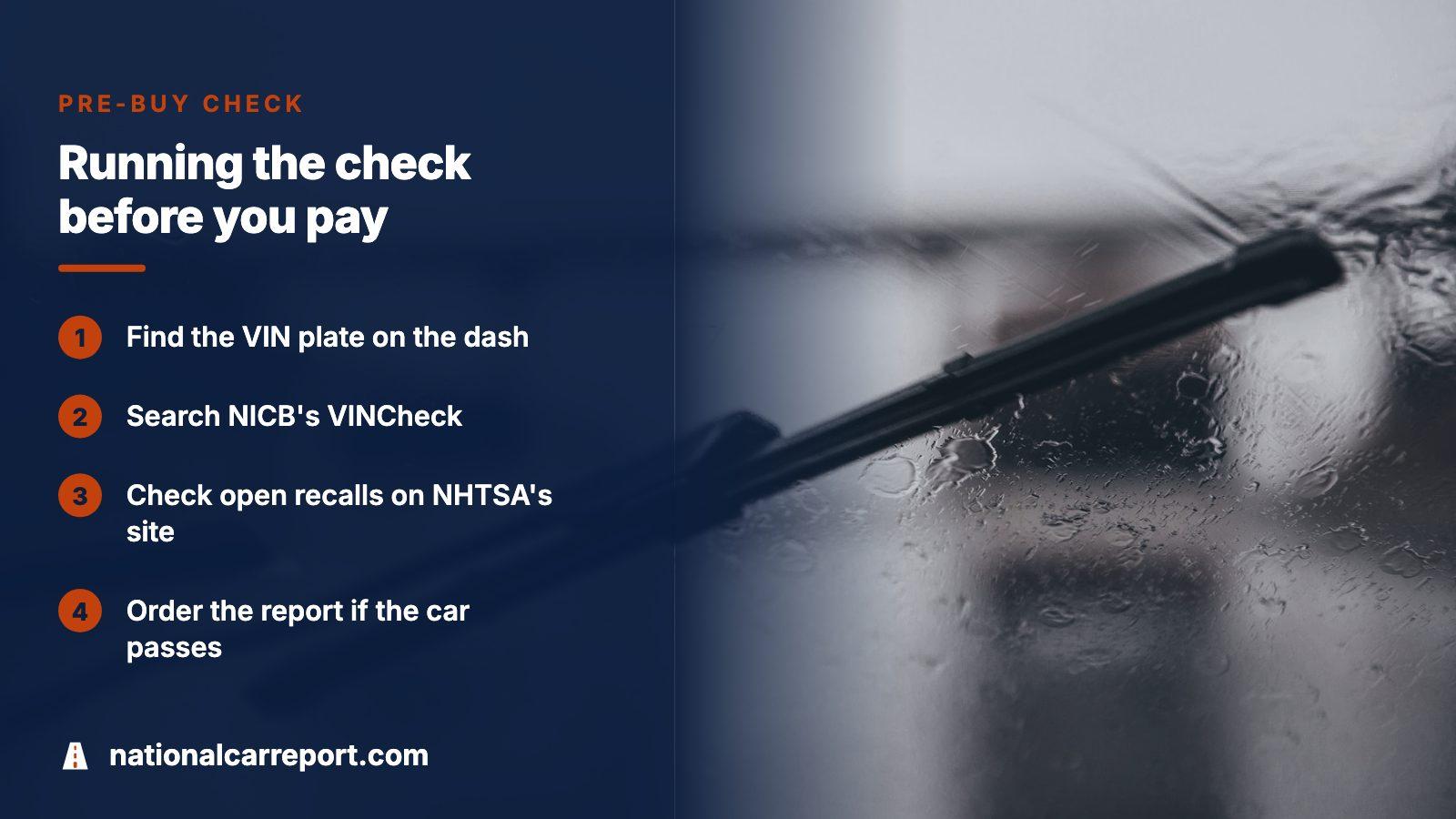
- Find the VIN plate on the dash near the windshield's driver-side corner and the sticker on the door edge. Both should match the title.
- Search the VIN in NICB's VINCheck. It costs nothing and returns theft and total-loss entries filed by contributing insurers.
- Check open recalls on NHTSA's site, also at no cost.
- Enter the VIN at NationalCarReport for the free preview, which confirms the car before you spend anything.
- If the car survives that screening, order the report. It sets theft, lien and impound entries beside title brands, damage and accident records, odometer readings, insurance records and auction photos where they exist.
A single report is paid once, with no recurring charge. Multi-report packs come in sizes of 3, 5 and 10 for people comparing several cars, and the pricing page lists them.
Reading what comes back
| You see | What it suggests | Your next move |
|---|---|---|
| No theft record, clean title | The ordinary case, since most cars are never stolen | Inspect the car and compare odometer readings |
| Theft record with a recovery date | A stolen history to compare with the seller's story | Ask for repair invoices and photos |
| Impound entry | The car was held, so time and release both matter | Ask who released it and when |
| Open lien | A lender may still have a claim | Get a written release before paying |
| Salvage entry with auction photos | The damage crossed a threshold; the photos show intake condition | Compare the photos with the car and price it as branded |
| VIN on the car differs from the papers | A mismatch with no innocent default explanation | Stop until it is explained |
A search that finds nothing is a screen, not a guarantee. A theft that was never reported, or was reported after your search ran, will not appear.
What to ask the seller and what to inspect
- When was it stolen, when was it found, and which department holds the report?
- What was missing or damaged, and where are the repair invoices, including key and module work?
- May an independent mechanic inspect it and scan the airbag module?
Then look at the car. Pry marks around the driver's door, a steering column cover that sits wrong and taped wiring under the dash all point to a rushed job. A federal rule requires the vehicle's identifying number on major parts of many cars, so a panel carrying a different number, or torn label residue where one belongs, deserves a direct question. Coverage depends on the car's type and rating, and the rule is public in 49 CFR Part 541.
When a theft recovery is worth buying
Often, with evidence in hand. A car recovered whole, repaired with receipts that cover the security work, with a clean scan and no open lien, is an ordinary used car with one bad week in its past. A car where nobody can say what was missing, or where the keys, modules and airbags are unexplained, should be priced as a gamble or left alone.
Where this information comes from
- TxDMV: Salvage and Nonrepairable Motor Vehicle Manual — Shows how Texas defines salvage and carves out paid theft claims unless the theft damage passes the car's value.
- eCFR: 49 CFR Part 541, Theft Prevention Standard — The federal rule on marking major parts and replacement parts with identifying numbers.
- NICB: VINCheck — A no-cost screen for theft and total-loss records that participating insurers have reported.
- NMVTIS: Vehicle History Records — The federal title record covering brands and reported total losses, plus the list of approved providers.
- NHTSA: Recalls — Open safety recalls by VIN, free to search whatever the car's title says.
Sources and photos: Facts checked against the sources above in November 2026. Photos by Clark Van Der Beken, Thibault Valjevac and Victor Hughes on Unsplash; diagrams by NationalCarReport.
Keep reading
- Report a Stolen Car: Police Steps, Insurance and a VIN Theft CheckThe police, insurer and lender steps if the stolen car is yours.
- Vehicle Lien Check by VIN: Nationwide Lien, Theft and Impound RecordsHow lien records work and what to do when one appears.
- Most stolen cars: the national list and how to check a VIN for theftWhich models thieves go after and why that matters when you shop.
- Sample reportSee how a finished report lays out theft, lien and impound records.
Frequently asked questions
Will a recovered stolen car have a salvage title?
Often not. In Texas a paid theft claim sits outside the salvage category, unless theft damage done before recovery would need repairs above the car's pre-damage value. So a recovered car can carry a clean title with nothing concealed. Check the rules in the state that issued the title.
Should I buy a car that was stolen and recovered?
Not by default. The label records an event, and the outcomes range from a car found a day later with a broken lock to one rebuilt from a stripped shell. Price it from the repair invoices, any auction photos, an inspection and a module scan, not from the two words in the listing.
Does a theft record mean the car is still stolen?
Not once it has been recovered. The active stolen flag normally comes off then, but the history survives in insurer-reported theft records, auction listings, impound entries and title records. A recovered car can look clean in one search and still show a past in a wider one.
Can I insure and finance a recovered stolen car?
With a clean title, usually on ordinary terms, which is why the category is easy to underrate. If the theft brought a brand, the harder insurance and financing questions of any branded car apply. Get a quote on the VIN, and ask your lender, before you agree to a price.
What does a theft check cost at NationalCarReport?
The preview from the VIN costs nothing. A full report is bought once, with no subscription, and larger packs exist for people checking several cars. The pricing page has the current options, so read them there.
Now check the car itself
The guide explains what to look for. The report shows what this VIN has on record.