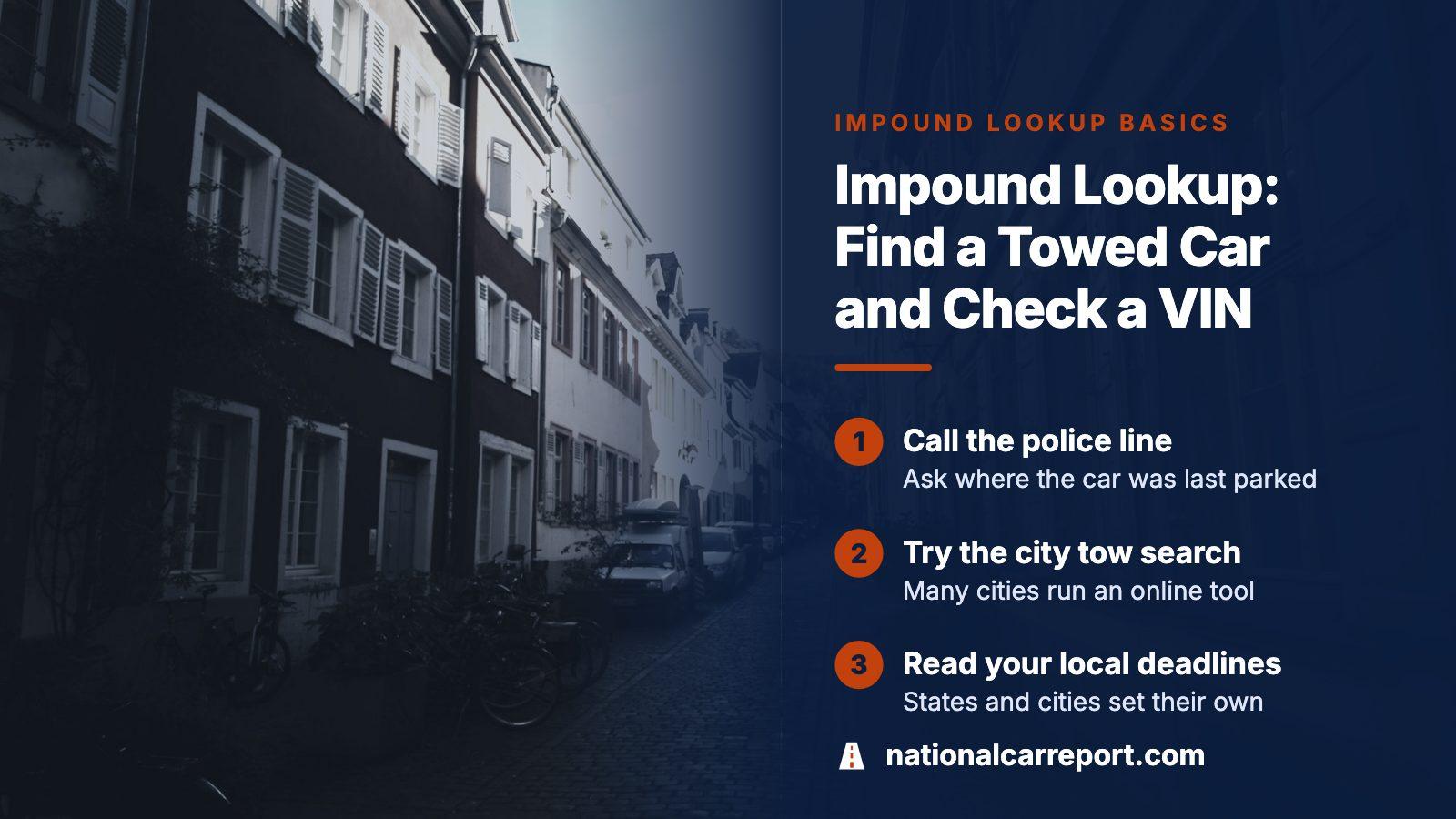
THE SHORT ANSWER
To look up an impound, call the police non-emergency line for the area where the car was last parked and ask whether it was towed, by which company, and to which yard. Many cities also run a towed-vehicle search. To learn whether a car already carries an impound entry in its past, enter the VIN in the NationalCarReport preview. One route finds a car today, the other reads its history.
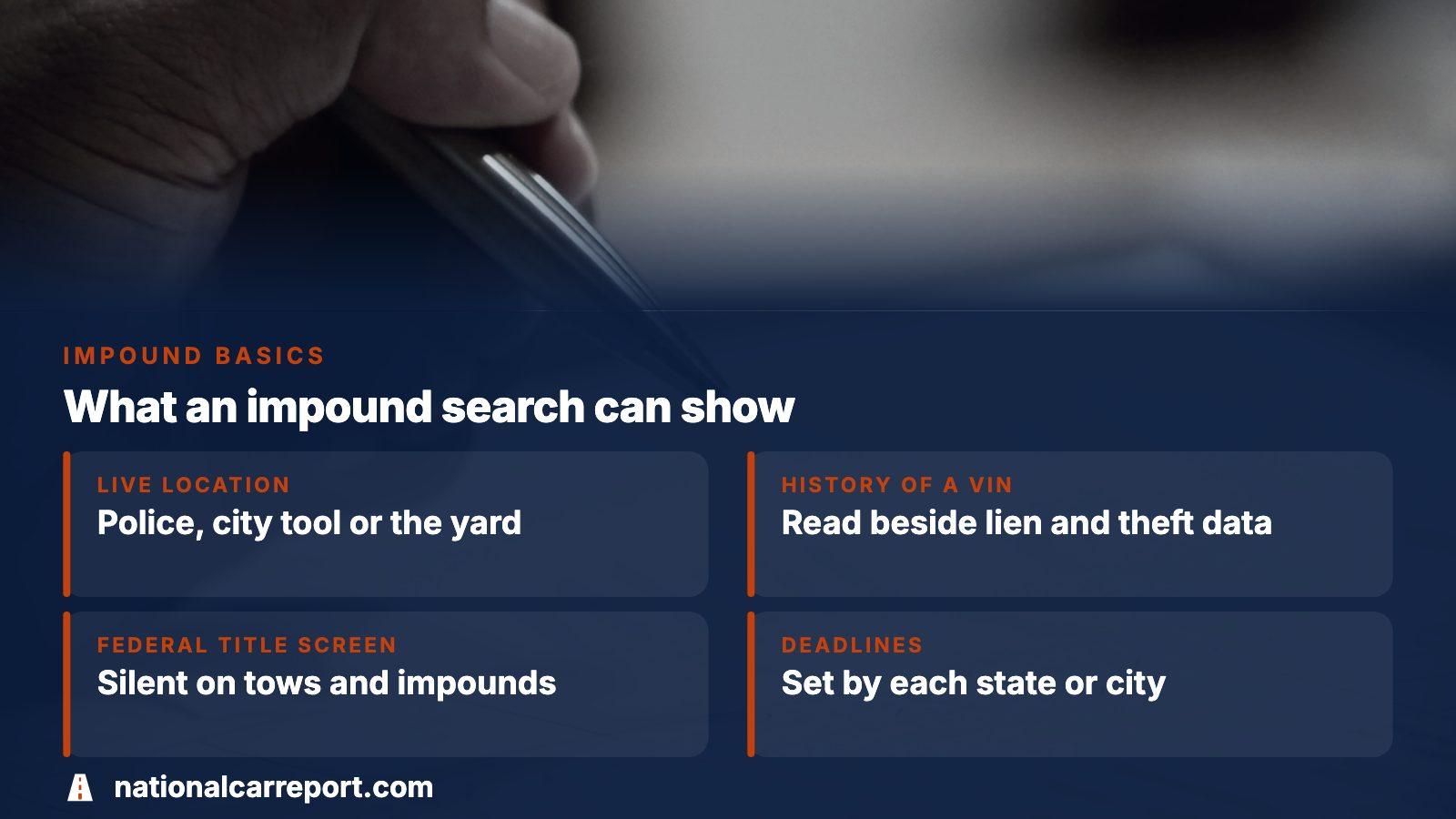
- Live location
- Police, city tool or the tow yard itself
- History of a VIN
- Impound entries read beside lien and theft data
- Federal title screen
- Silent on tows and impounds
- Deadlines
- Set by each state or city, so read yours
Why no national impound database exists
People type the phrase for two jobs. One is urgent: the car is gone from where it was parked and you need to know whether it was towed. The other is slower: a car is for sale and you want to know whether it was ever held. Both hit the same wall. A tow is logged where it happens, and the federal title screen does not list it.
The Justice Department's consumer page for its title system shows the point. It covers titles, brands, mileage and insurer write-offs, never mentions tows or impounds, and calls itself deliberately short. A nationwide impound view has to be pieced together elsewhere.
A car has vanished: the call sequence that works
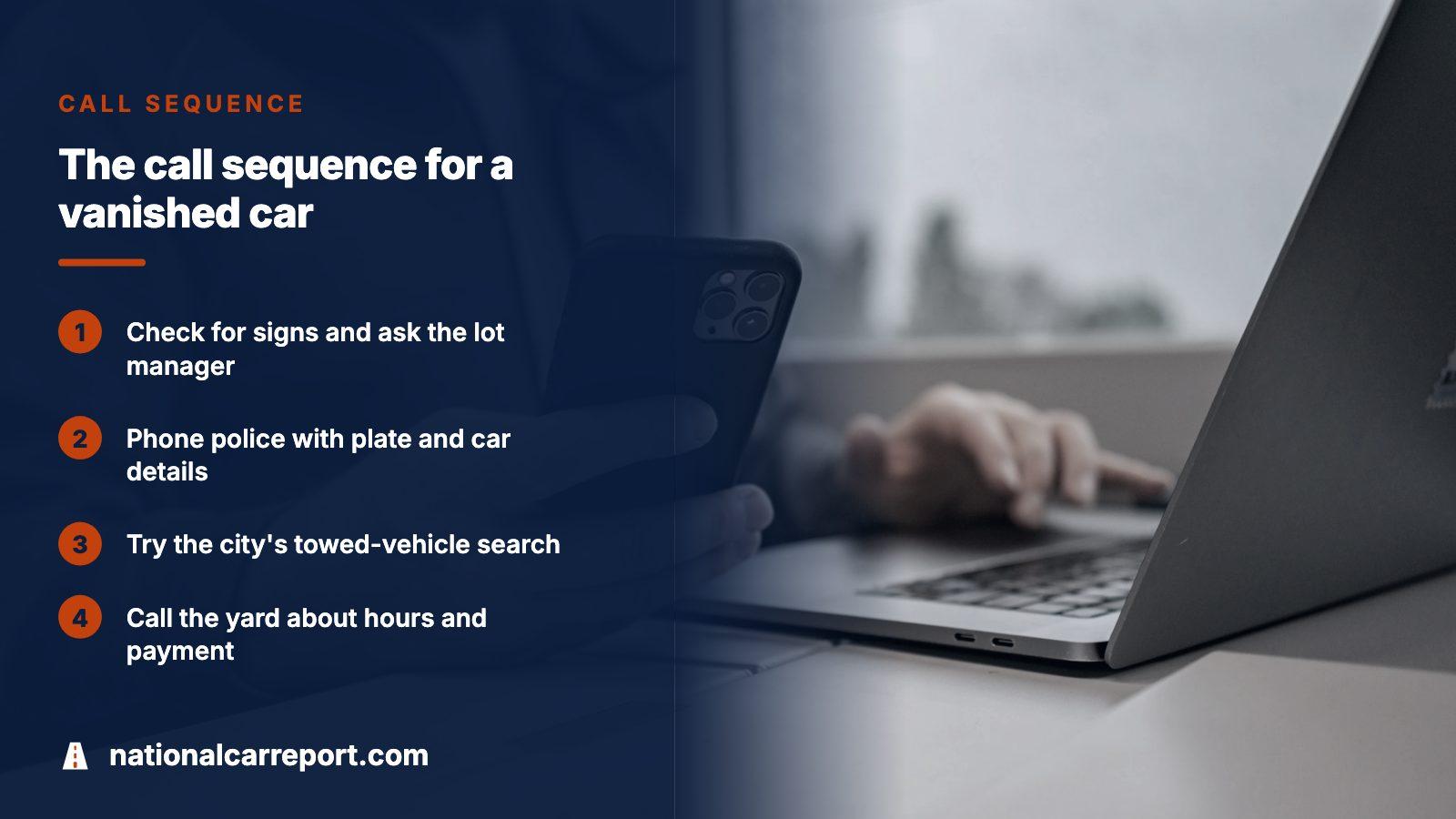
- Check for signs at the spot and ask whoever manages the lot, since a private tow may involve no police at all.
- Phone the police non-emergency number for that area with the plate, make, exact address and last-seen time, and ask whether it was towed on police order and where it went.
- Try the city's own towed-vehicle search if one exists. New York City sends owners to a Department of Finance lookup or its 311 line.
- Call the yard either office names and confirm its address, hours and payment methods before you travel.
- If nobody has a record, treat the car as possibly stolen and file a police report; theft and tow files are separate.
A letter should follow the tow, but not in time to help on day one. Washington requires first-class mail to owners within a day. Minnesota allows five days, weekends and holidays excluded. Florida sets five business days by certified mail.
Who took it, and how that changes where you ask
| Who took the car | Typical trigger | Where to ask |
|---|---|---|
| Police tow | Illegal parking, or registration or insurance that is not valid (the NYPD's criteria) | Police non-emergency line, or the city's towed-vehicle search |
| Marshal or sheriff tow | Unpaid parking or camera judgments above $350 in New York City | The city finance office and its marshal and sheriff phone line |
| Impound after a license problem | A suspended license; Washington's hold runs up to 30 days, longer after repeat offenses | The tow operator named in the mailed notice |
| Private storage yard | A property owner or agency authorized the pickup | The yard itself; Florida and Washington notices must name who authorized the tow |
In Texas, tow companies, trucks and operators need a license from the state agency TDLR, which also takes complaints. Whatever the state, the agency behind the tow sets your fees and deadlines.
The clock on a stored car, in four places
Daily charges pile up, and the law gives an owner a limited window before the car can be sold. Four samples show how far the windows differ.
| Place | Notice to the owner | Earliest sale or disposal |
|---|---|---|
| Washington | Mailed within a day of an impound | A car classed as abandoned goes to auction if still unredeemed 15 days after the mailed notice |
| Minnesota | Five days, weekends and holidays not counted | 15 days after notice in some cases, 45 days in others |
| Florida | Certified mail within 5 business days | 35 days for an older model, 57 for a newer one |
| New York City, marshal or sheriff tow | Not stated; ask the finance office or 311 | Auction possible from 10 days after the tow if unclaimed after 72 hours |
Buyers should note the far end of this clock. Florida lets a stored car be sold free of earlier liens, so a car from a yard sale deserves a close look at its prior owners and title.
Getting it back: papers, payment and belongings
- Proof you may take the car. New York City wants the original title in the owner's name, or a notarized letter of authority plus the titleholder's license when someone else collects.
- Valid registration and insurance after a tow tied to either, with every unpaid judgment cleared.
- A payment method the yard accepts. Washington names cash, bank cards and some personal checks; New York City adds certified checks and money orders.
- Written permission if you are not the registered owner. Washington accepts a person the owner authorizes in writing, and insurers.
Belongings are handled apart from the car. Washington's mailed notice promises no-charge storage of personal items once the owner collects them and files a signed request ahead of the auction. Florida expects the yard to release the car and loose property within an hour of a qualifying document. Minnesota lets an owner who can document homelessness, need-based assistance or legal-aid status take contents back at no cost.
When the tow looks wrong: hearings and bonds
A tow can be contested, but deadlines are short. A Washington owner who wants a hearing must get a written request to the court inside 10 days of the notice, and still more than five days ahead of the auction; a late request forfeits it. If the court finds the impound improper, the owners pay no towing or storage fees, and the authorizing agency covers them plus damages for loss of use.
Florida offers a court case in the county of storage, or release before the sale on a cash or surety bond posted with the clerk. Keep the invoice and the mailed notice either way, because a hearing runs on those papers.
Impound entries in a car's history: what a buyer should read
A used-car buyer wants to know whether the car was ever held, and what was settled to get it out. A VIN report reads recorded history, so impound entries appear beside liens, theft records and title brands. It is a history tool, not a live finder, and cannot say which yard holds your car now.
- Read the date and any reason on the entry, then ask the seller to fill the gaps.
- Ask who released the car and when. A hold with no release story is a reason to pause.
- Look for a lien or a title change soon after the entry. Unpaid storage can become a claim.
- An empty result covers recorded history only, so still match the stamped VIN to the title.
Running the VIN search
- Read the 17-character VIN off the vehicle, not the ad, and photograph it beside the title.
- Enter it at NationalCarReport. The preview costs nothing and lists the record types held for that VIN before you pay.
- If impound, lien or theft entries show up, the report itself is a paid, one-off purchase with no monthly plan.
- Compare the result with the title and the seller's story, and phone any agency an entry names.
A seller who says the car sat in a lot for a week should name the lot, the release date and the fee.
Cost and next steps
The preview is free. Bundles of 3, 5 or 10 are sold to people weighing several vehicles; see the pricing page for figures. Run the preview before a test drive or deposit, while walking away is still cheap.
A theft flag means stepping away and calling the police agency named in the record. A lien means getting the lender's release in writing before money moves. An impound means asking for the release paperwork. A clean result still leaves the physical inspection.
Where this information comes from
- NYC Department of Finance: towed vehicles — Lookup options, which agency tows, documents to bring and the unclaimed-tow timeline.
- NMVTIS: for consumers — What the federal title system lists, and that impounds are not among the items described.
- Washington RCW 46.55.110: notice after an impound — The mailed notice, its contents and the belongings rule.
- Washington RCW 46.55.120: redemption and hearings — Who may redeem, hearing deadlines and what happens when an impound is improper.
- Minnesota Statutes chapter 168B — Notice timing, reclaim windows and the contents rule.
- Florida Statute 713.78: towing and storage liens — Certified-mail notice, sale timing, bond release and the one-hour release rule.
- Texas TDLR: towing and vehicle storage — That tow companies, trucks and operators need a state license, and where complaints go.
Sources and photos: Facts checked against the sources above in November 2026. Photos by Karwin Luo, Anastasiia Nelen and Masjid MABA on Unsplash; diagrams by NationalCarReport.
Keep reading
- Impound Lookup NYC: Find a Towed Car, Release It, Check a VINA city walk-through: which agency tows in New York and how to get a car out.
- Minneapolis Impound Lookup: Find a Towed Car, Then Check Its VINHow the Minneapolis impound process and its reclaim windows work.
- Stolen Car Check by VIN: Nationwide Theft, Lien and Impound RecordsWhen nobody has a tow record, how to test whether the car was stolen.
- Vehicle Lien Check by VIN: Nationwide Lien, Theft and Impound RecordsHow unpaid storage or a lender's claim shows up before you buy.
Frequently asked questions
How can I check if my car has been impounded?
Call the police non-emergency line for the area and ask whether the car was towed on their order. Then try the city's towed-vehicle search if it has one. With no record from either, ask the property manager about a private tow, and report the car stolen if the trail ends.
How do I find out who impounded my car?
The agency or the yard will tell you, and the mailed notice should name the firm and who authorized the pickup. In New York City the NYPD, a marshal and the sheriff each use a different release route, so ask which took it.
Can I do an impound search by VIN?
Not as a live nationwide yard finder, because tows are logged locally. A VIN report reads recorded history, including impound entries where they exist. City and police tools pick their own search fields, so check yours.
How long can an impound lot keep my car?
No single national limit applies. Washington can auction a car classed as abandoned if it is still unredeemed 15 days after the notice is mailed. Florida allows a sale after 35 or 57 days, by model age. Minnesota uses 15 or 45 days. Read your own state's rule and act early.
What does an impound check cost at NationalCarReport?
No charge applies to the preview. Buying the report is a single payment without a plan attached, and bundles exist for shoppers comparing several cars. The pricing page has current amounts.
Now check the car itself
The guide explains what to look for. The report shows what this VIN has on record.