THE SHORT ANSWER
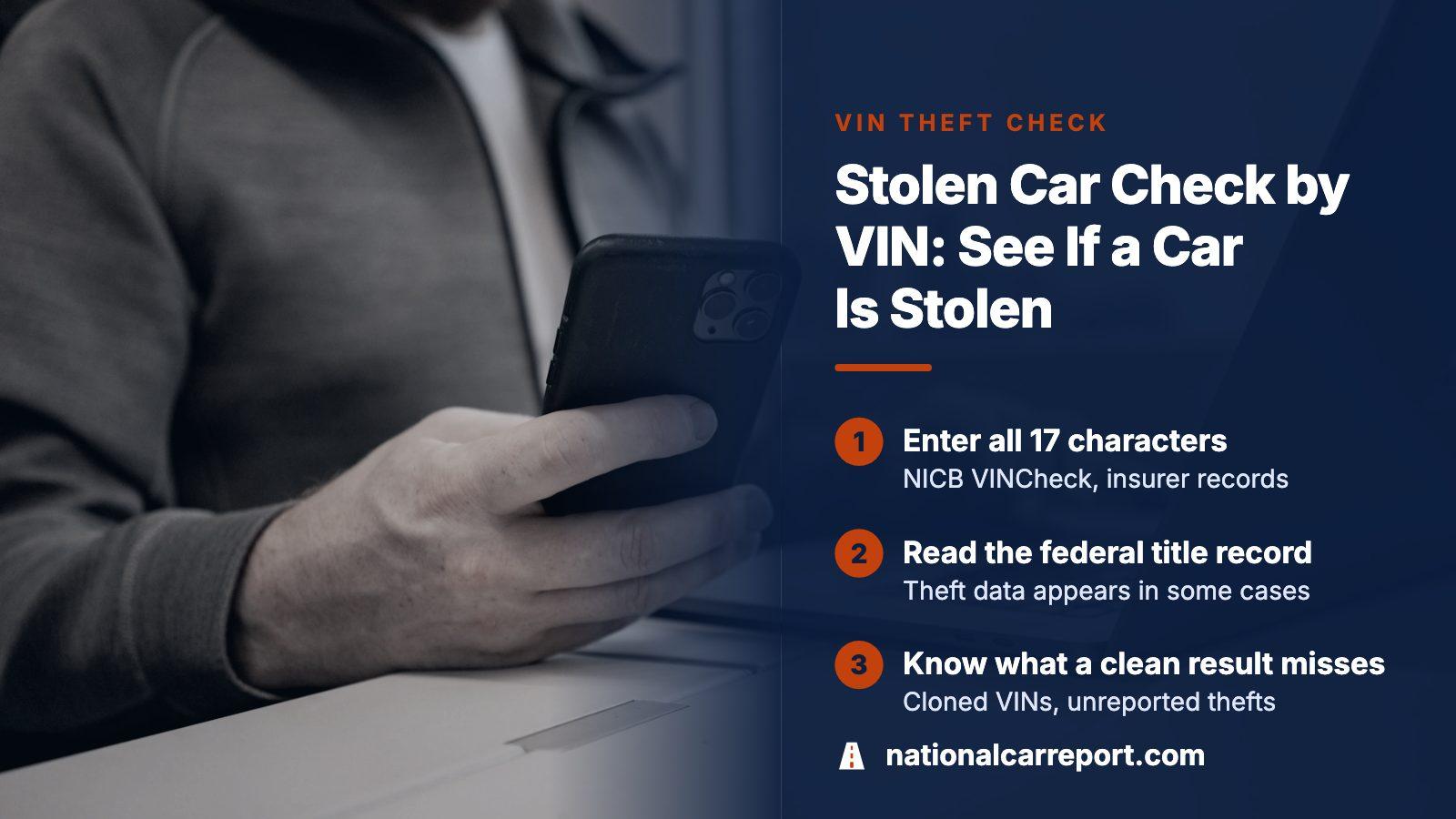
To see whether a VIN has been reported stolen, enter all 17 characters into NICB's VINCheck, which searches insurer theft, salvage and flood records. Then read the federal title record and any police lookup your state offers. A clean result is a screen, not proof: it misses unreported thefts and cars wearing a cloned VIN. Check the stamped VIN against the title, and use the NationalCarReport preview for theft, lien and impound entries side by side.
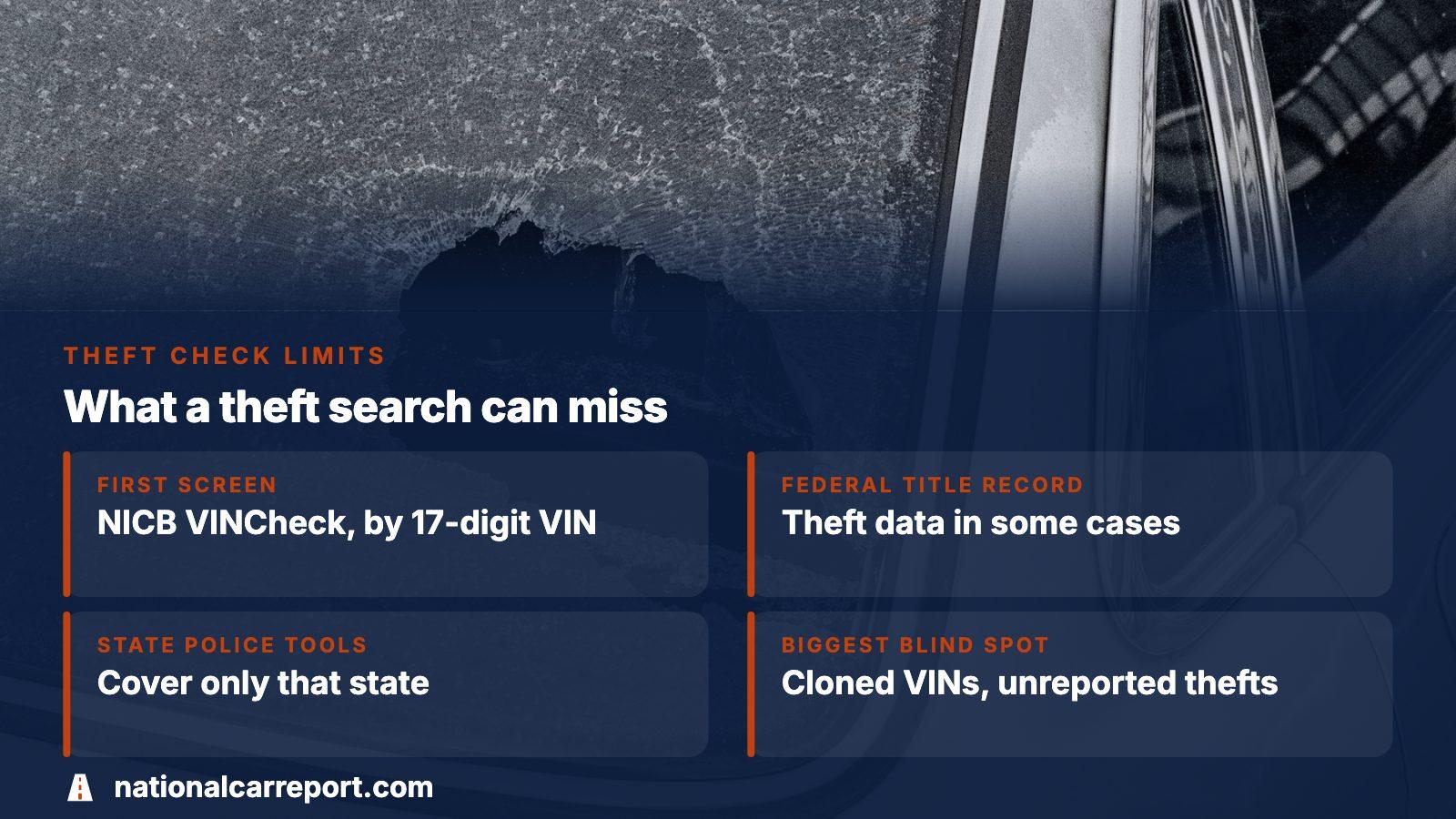
- First screen
- NICB VINCheck, no charge, by 17-digit VIN
- Federal title record
- Theft data only in some cases
- State police tools
- Cover only that state's records
- Biggest blind spot
- Cloned VINs and unreported thefts
Where theft records live, and what each one covers
Theft data sits with several holders, and none of them sees the whole picture. A VIN search draws on one or more of these.
| Source | Run by | What it can show | Where it stops |
|---|---|---|---|
| NICB VINCheck | An insurance-industry nonprofit | Thefts reported and not recovered, plus salvage and flood records, from participating insurers | No police files; insurers outside the program are missing |
| NMVTIS | The U.S. Department of Justice | Title, brands, latest odometer reading, insurer total losses, and theft history in some cases | Theft is not a standard field; buyers reach it through approved providers |
| State police lookups | A state agency, such as Arizona's attorney general | Whether a vehicle sits in that state's stolen file | One state's records; Arizona's returns status only |
| NationalCarReport report | A private reporting service | Theft, lien and impound entries beside title brands and auction photos | Limited to what each source has reported |
Government and police checks: what exists
The federal piece is NMVTIS, a title system run through the Department of Justice and sold to the public by approved providers. It aims to keep stolen vehicles from being resold, yet its consumer page lists theft history only in some cases. Read it as a title and brand screen.
States run their own tools. In Arizona, the attorney general's TheftAZ site takes a plate or VIN and returns a status, plus the police agency to call if the car is flagged. It holds only vehicles stolen in Arizona, refreshes twice daily, and warns that results are not definitive proof.
For a police check, NICB advises having authorities check the title and VIN before money moves, and meeting the seller somewhere very public, ideally a police station. Departments differ on whether they run a VIN for a private buyer, so phone the non-emergency line first.
How to check a VIN number to see if it's stolen
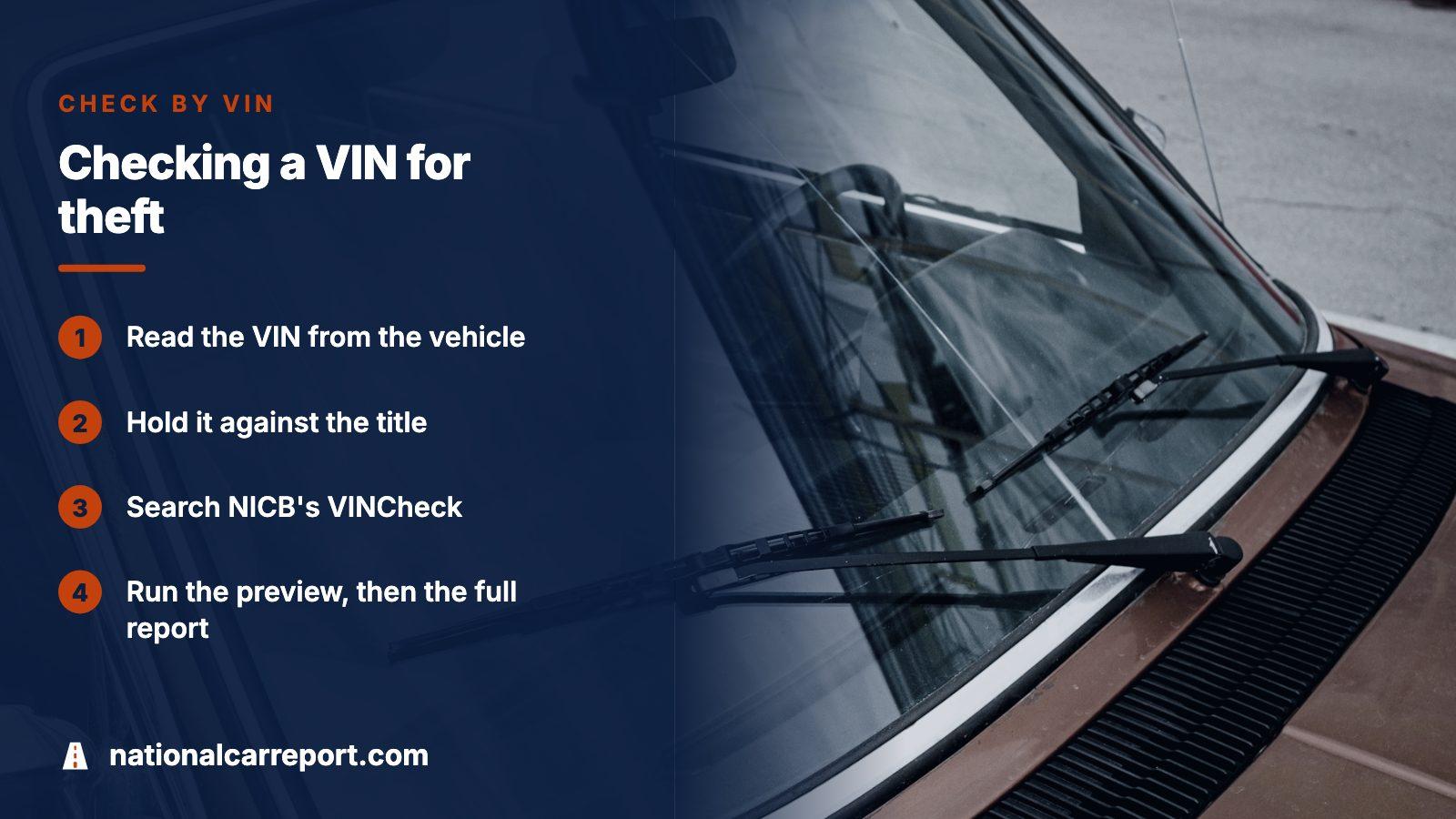
- Read the VIN from the vehicle, not the listing. NHTSA points to the windshield's lower left corner, and the registration card carries it too. All 17 characters must be exact, because a typo can hide a real match.
- Hold it against the title. Any difference between the plate and the paper, even one character, ends the deal until it is explained.
- Search NICB's VINCheck. It costs nothing, allows five searches per IP address in 24 hours, and flags insurer theft, salvage and flood records.
- Try your state's police lookup if it has one, and the state where the car was last titled.
- Enter the VIN at NationalCarReport for the free preview, which confirms the vehicle and shows which records exist before you pay.
- A car that survives those screens deserves the full report, where theft, lien and impound entries sit beside brands, salvage records and auction photos.
What a clean result still misses
A search returns what someone reported. It cannot return what nobody reported, and it cannot tell whether the VIN on a car really belongs to it.
- Thefts that were never reported, or were reported after your search ran.
- Insurers outside NICB's program. Participants account for 92.49% of earned premium, so the rest do not appear.
- Police-only records, which VINCheck does not query.
- Cloned VINs, where a stolen car wears a number copied from a similar car that was never stolen.
Cloning is how stolen cars pass a clean search. NICB describes thieves copying a VIN from a lawful vehicle, making a counterfeit tag with forged papers, and selling the match. In Operation Roadrunner, officers in South Florida recovered about 250 cloned stolen cars nationwide. Both the cars and their paperwork showed legitimate VINs, so buyers, titling agencies and police could not see the true status. Hence step two.
A cloned truck, in one buyer's case
A buyer's case documented by NICB
A Florida buyer paid $20,000 in cash for a 2017 Ford F-150 found on a marketplace app. At registration, officials said the title was fake, and the seller's phone was already dead. Three further plates turned up glued beneath the one on the dash, and the genuine VIN traced to an F-150 reported stolen that March and written off as a total loss. The insurer had paid its claim, so police took the truck and the buyer could not recover the money.
The visible plate carried one number while the truck's real identity sat underneath, and a search of the visible number speaks for that number alone. Look closely at the plate for glue, scratches or an odd fit, treat any mismatch with the title as a stop sign, and pay only after authorities have checked the title and VIN.
Reading the results and the red flags
| What comes back | What it suggests | Your move |
|---|---|---|
| Reported stolen, not recovered | The car sits on an active theft list | Do not buy or confront the seller; call the police agency that holds the record |
| Theft record with a recovery | The car came back, in unknown shape | Ask for repair invoices and book an inspection |
| Impound entry | The car was held in a lot | Ask who released it and on what date |
| Lien listed | A lender may still have a claim | Get the lender's release in writing first |
| Salvage or flood flag | An insurer wrote the car off | Price it as branded; it can legally be rebuilt and re-titled |
| Plate differs from the papers | Possible tampering or a clone | Stop until the seller explains in writing |
| Clean result | Nothing found in the sources searched | Still inspect it and compare the VIN with the title |
What the national theft numbers say and leave out
NICB counted 659,880 vehicles reported stolen across the country in 2025, a 23% drop from 2024 and the lowest total in several decades. It still works out to one vehicle every 48 seconds. California alone had 136,988, more than 20% of the total, and the Hyundai Elantra topped the model list at 21,732, ahead of the Honda Accord at 17,797.
Those counts describe where thieves worked last year and say nothing about the specific vehicle you are viewing. A favorite target can be spotless and an unlisted model can be a clone. Where the model is a common target and the price sits well under market, check the VIN harder.
Liens, impounds, cost and next steps
A car can be unstolen and still not the seller's to hand over. A lender's claim or an impound hold lives in different records than a theft flag, so a nationwide check reads them together. NICB also suggests studying the ownership pattern of any late-model car with no lienholder.
Start with the free preview at NationalCarReport: enter the VIN and see which records exist before paying. Buying a report is a one-off payment, not a subscription, and multi-report packs come in sizes of 3, 5 and 10. Amounts live on the pricing page.
If a search flags a theft, walk away and hand the VIN and listing to the police agency named in the result. If you already paid for a cloned car, NICB says it was never legally yours, and it goes back to the legitimate owner or the insurer that settled the theft claim.
Where this information comes from
- NICB: VINCheck — The insurer-fed theft, salvage and flood search, its daily limit and its stated blind spots.
- NICB: Buying a Used Vehicle — How VIN cloning works, the protection steps NICB lists and what happens to an unwitting buyer.
- NICB: Truck sold with a fake title and VIN — The documented case of a buyer sold a truck with a false title and stacked VIN plates.
- NICB: U.S. vehicle thefts decline in 2025 — National theft totals, top states and the most stolen models for 2025.
- NMVTIS: For Consumers — What the Justice Department's title system reports, when theft data appears and the cloning ring it describes.
- Arizona Attorney General: TheftAZ FAQ — One state's public stolen-vehicle lookup and the limits it states.
- NHTSA: Check for Recalls — Where NHTSA says the 17-character VIN appears on a vehicle.
Sources and photos: Facts checked against the sources above in November 2026. Photos by Anastasiia Nelen, Max Tokarev and Kenan Reed on Unsplash; diagrams by NationalCarReport.
Keep reading
- Theft Recovery Vehicle: Stolen, Lien and Impound Checks Before You BuyWhat a recovered stolen car leaves behind and how to price one.
- Vehicle Lien Check by VIN: Nationwide Lien, Theft and Impound RecordsHow a lender's claim shows up and what to do when one does.
- Impound Lookup: Find a Towed Car, Then Check Its VIN for Impound RecordsFinding out whether a car was held in an impound lot.
- Most stolen cars: the national list and how to check a VIN for theftWhich models thieves target and what that means when you shop.
Frequently asked questions
Can I check if a car is stolen with just the VIN?
Yes, for reported thefts. A VIN search of insurer files, the federal title system and state police tools can flag a car reported stolen and not recovered. It cannot flag an unreported theft or a stolen car wearing a copied VIN, so read the stamped VIN against the title as well.
Is there a stolen car check on a government website?
Some states run one. Arizona's attorney general offers TheftAZ for vehicles stolen in that state. Federally, the Justice Department's title system lists approved providers, and theft history appears only in some cases. Neither replaces a nationwide search or a look at the VIN plate.
Will the police tell me if a car is stolen?
Possibly. NICB advises buyers to have authorities check the title and VIN before paying, but practice differs by department. Call the non-emergency line, say you are buying privately and ask whether they run VINs for buyers. Note who checked and when.
How many times can I use NICB VINCheck?
Five searches per IP address in any 24-hour window, with no cap over time. The VIN has to be complete and correct, or a real match can be missed. Anyone comparing several cars in one afternoon can hit the daily limit fast.
What does a stolen car check cost at NationalCarReport?
Entering a VIN for the preview costs nothing. The report itself is a single purchase, with bundles for shoppers weighing several cars. See the pricing page for the current options.
Now check the car itself
The guide explains what to look for. The report shows what this VIN has on record.