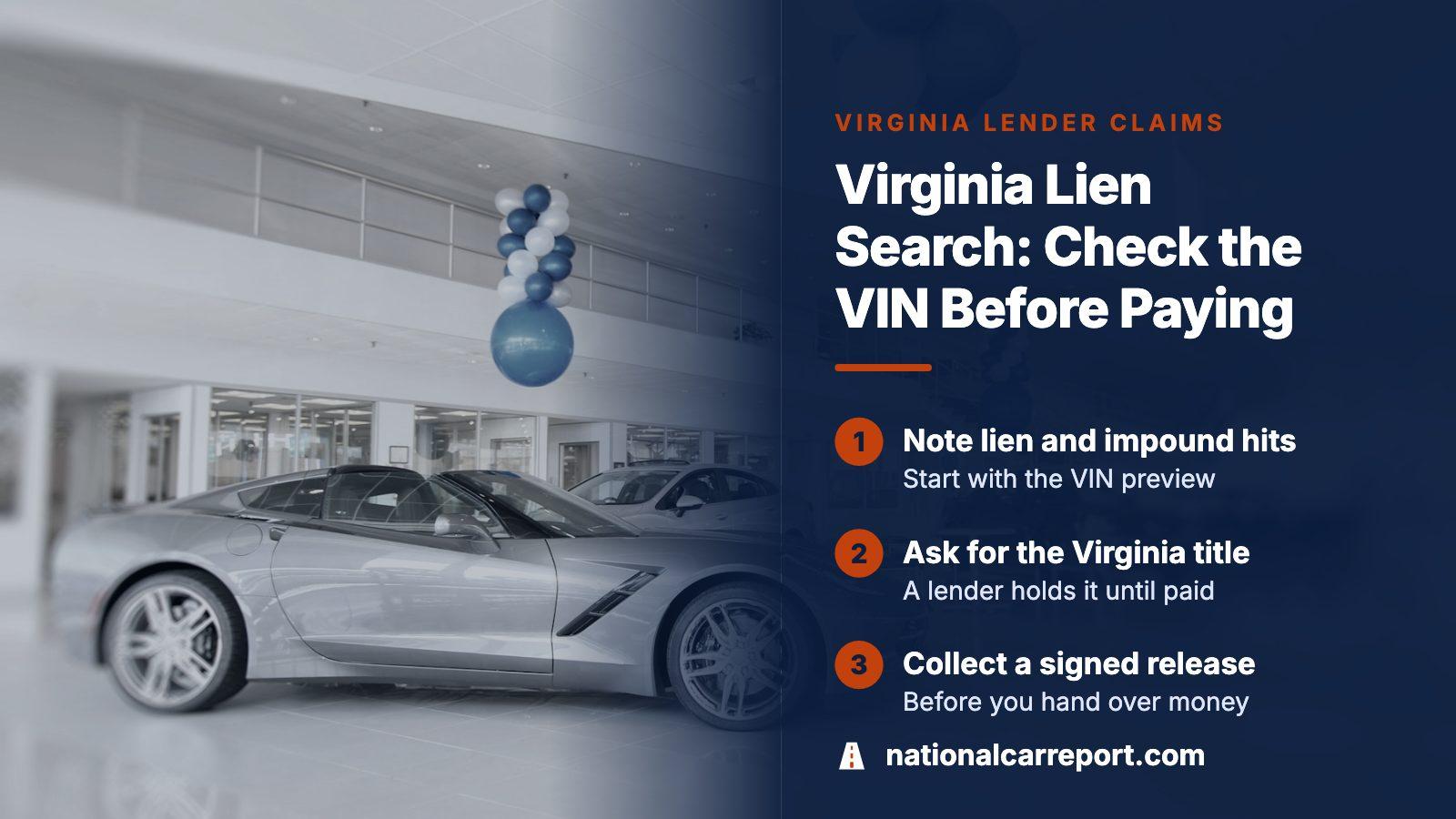
THE SHORT ANSWER
To check a Virginia car for liens, run its VIN through the preview and note any lien, theft or impound entry. Then ask the seller for the Virginia title. If it names a lender, that lender holds the paper until it is paid, so get a signed release before you hand over money. A blank preview narrows the odds but does not replace the title.
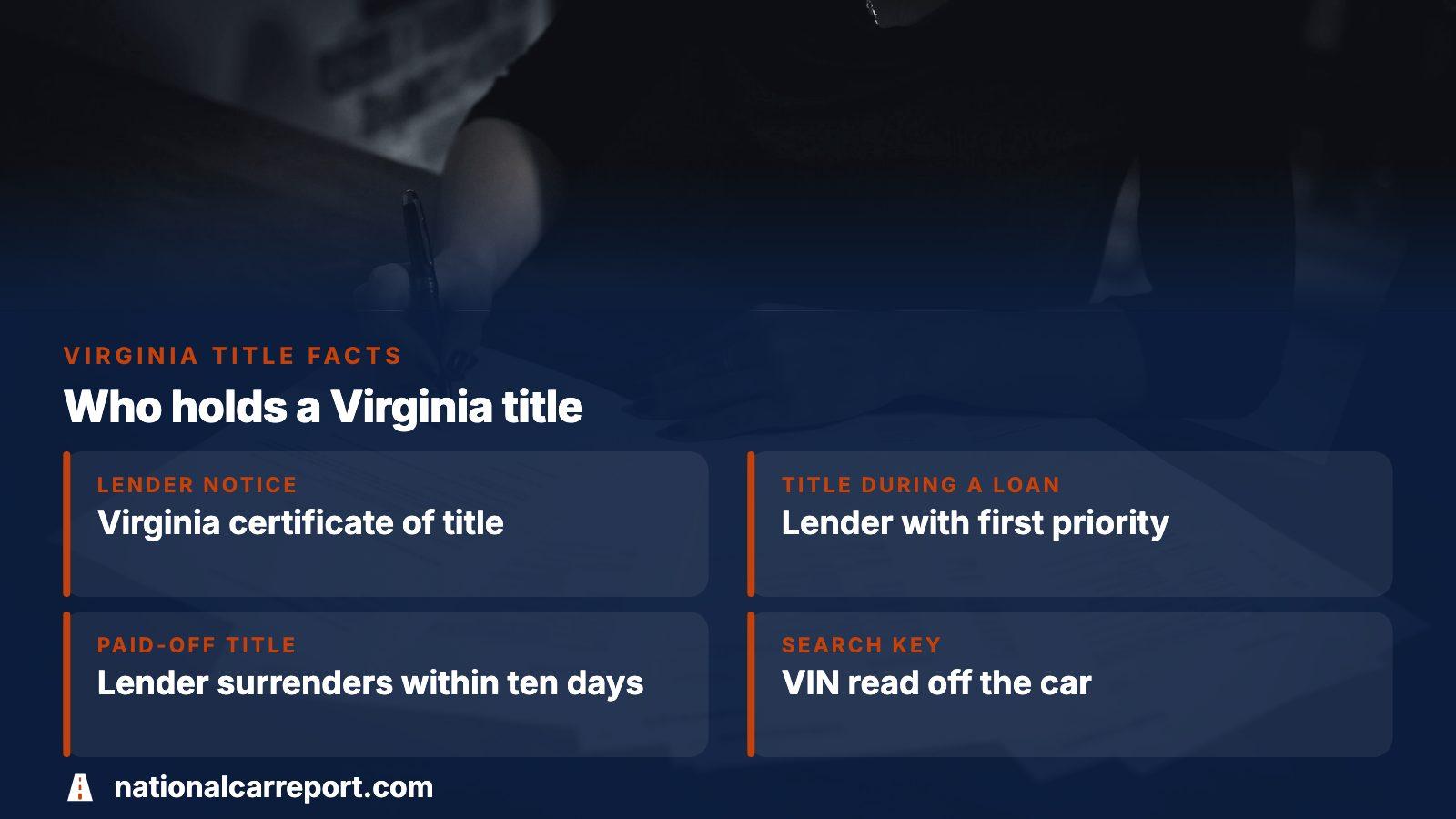
- Search key
- The VIN, read off the car itself
- Official notice of a lender's claim
- The Virginia certificate of title
- Who holds the title during a loan
- The lender with first priority
- Lender's deadline to surrender a paid-off title
- Ten days
What a VIN search can and cannot show on a Virginia car
NationalCarReport is built around the claims that can follow a vehicle from one owner to the next: money owed on it, a theft report, and a stay in a tow lot. All three attach to the VIN, so one entry searches records from Virginia and from every other state the car passed through. That matters in a state where buyers often cross the line into Maryland, North Carolina or the District to shop.
- Lien entries, where a lender's claim reached a database we read
- Theft records, including whether the car was marked recovered
- Impound history, meaning time spent in a tow or storage yard
- Title brands, which can cut a car's worth even when nobody is owed anything
The preview is the free first screen. Going further means buying the full report once, at the rate shown on our pricing page; nothing renews. Neither one replaces the paper title, which Virginia treats as the real record.
How a lender's claim ends up on a Virginia title
When an owner borrows against a car after the first title was issued, the Code of Virginia says the lender's interest must be shown on the certificate. The owner applies on the state's own form and surrenders the certificate, and a replacement comes back ranking each lender by when it filed. Where a lender files within thirty days of the purchase, its claim counts as if it had been recorded the day the loan began.
The state also says no county or city recording is needed. A title that shows a lender is adequate notice to creditors and buyers alike. For you, that is the useful part: if a Virginia title names a lender, you cannot later say you did not know. Dealer inventory is the odd one out, because liens on cars held for sale follow the commercial code instead of the title.
Five steps before the money changes hands
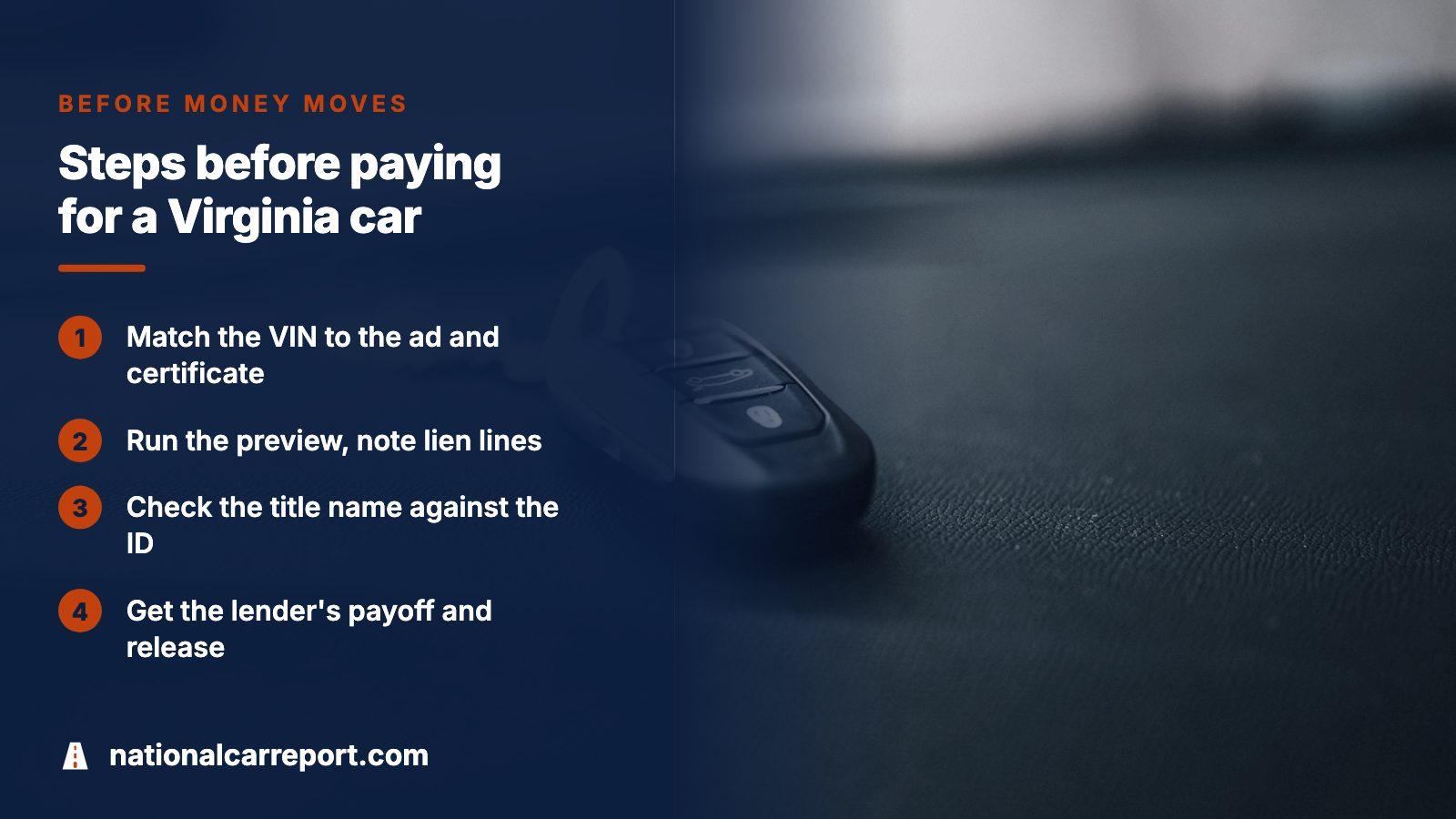
- Copy the VIN from the vehicle itself, then match it against the ad and the seller's certificate.
- Run it through the preview and write down any lien, theft or impound line.
- Ask to see the Virginia title and check that the seller's name matches the ID.
- If a lender is printed on the title, ask for its payoff figure and a signed release.
- Agree on the price only once the paper and the database agree.
Sellers with clean paperwork rarely mind being asked. A seller who gets irritated at step three has told you something.
Reading the preview as a Virginia buyer
| What shows | What it may mean | What to do |
|---|---|---|
| Lien entry | A lender may still be owed on the car | Get a payoff letter and a signed release first |
| Theft record | A stolen report was filed at some point | Ask for proof of recovery; walk if the answer is vague |
| Impound entry | The car sat in a tow or storage yard | Ask why, and who paid to get it out |
| Nothing found | No match in the data searched | Read the title anyway and ask about any loan |
Silence from a database is weaker than it sounds. The federal title database, NMVTIS, reports five things: where the car is titled and the last title date, brands, odometer, total loss and salvage history. Lien data is not among them, so a clean federal report says nothing about a loan.
Why the title sits in a lender's drawer
Under Virginia law the certificate goes to whichever lender ranks first and stays in its hands until the debt is fully cleared. After that it moves to the next lender in line, or to the owner if no one else is listed. That rule gives you a quick test. A seller who says the car has a loan but is holding the original title in hand needs to explain how, because the lender normally has it.
A mismatch worth stopping for
If the seller says the loan is paid but cannot produce a title with the lender released, treat the sale as unfinished. The release, not the seller's word, is what clears the car.
How a paid-off lien comes off the record
Once a loan is paid, the owner shows the DMV the release papers signed by the lender, together with the title. The DMV then issues a clean title or attaches an endorsement or rider recording the release. When the lender cannot be found, the owner may instead offer whatever evidence shows the debt was settled, plus a sworn statement that it was paid, and the DMV decides whether that is enough.
Lenders are on a clock too. A lender sitting on a paid-off title commits a Class 3 misdemeanor if it does not stamp it satisfied and pass it to the rightful person inside ten days. If a seller says a payoff happened last month and still has no title, ask for the lender's letter.
Tow bills, repair bills and court levies
Not every claim on a Virginia car is a loan. A towing or storage business has a lien for its charges until they are paid, and a mechanic who repaired the car at the owner's request can keep it until the bill is settled. Where the title already shows a lender, Virginia caps the storage claim at $500 and the mechanic's claim at $1,000, with a right to share in any money left after earlier liens. Both must check with the DMV about title liens within set windows, and an owner or lender gets 10 business days after the DMV's notice to reclaim a towed car.
A court-ordered levy can also attach, coming after any lender the state had already logged, once the officer files the seizure report. These show up as tow history, a gap in ownership or a seller who cannot produce the car's keys or paperwork. An impound entry in the preview is the cue to ask which of them it was.
Run the preview, then read the title
Enter the VIN to see the free preview before you drive across town. If it flags a lien, theft or impound entry, you have a specific question for the seller. If it shows nothing, you still have the title to read. The full report adds title brands, odometer readings and salvage history, paid for once.
Check the current fee and form details for title work on the Virginia DMV's own site, since we did not confirm them. Keep the lender's release and the new title together for as long as you own the car.
Where this information comes from
- Code of Virginia 46.2-637: security interests created later — How a lender's claim gets onto the title after the first issue.
- Code of Virginia 46.2-638: certificate as notice — A title showing a lender counts as notice to buyers; no county recording needed.
- Code of Virginia 46.2-642: release of security interest — What the DMV accepts as proof a lender let go.
- Code of Virginia 46.2-643: surrender of title when paid — The ten-day duty on a lender holding a paid-off title.
- Code of Virginia 46.2-644.01: lien of keeper of vehicles — Tow and storage liens, the cap and the reclaim window.
- NMVTIS: understanding a vehicle history report — The five indicators a federal title report covers.
Sources and photos: Facts checked against the sources above in November 2026. Photos by Richard R, Bence Balla-Schottner and Dimitri Karastelev on Unsplash; diagrams by NationalCarReport.
Keep reading
- Vehicle Lien Check by VIN: Nationwide Lien, Theft and Impound RecordsThe same check for a car from any state, not only Virginia.
- DMV Lien Release Search: How to Confirm a Lien Is GoneHow to tell whether a lender has really let go of its claim.
- Car Lien Holder Search: How to Find the Lender Behind a VINFinding out which lender holds a claim on a car.
- Impound Lookup: Find a Towed Car, Then Check Its VIN for Impound RecordsWhat to do when the preview shows a tow-yard entry.
Frequently asked questions
How do I do a Virginia lien search on a used car?
Read the VIN off the car, run it through our preview for lien, theft and impound entries, then ask the seller for the Virginia title. A lender, if any, is printed on that certificate. If one is named, get its signed release before paying, because the document settles what a database may miss.
Does a Virginia title show a lien?
Yes. When a lender's interest is recorded, the DMV issues a title showing it, listing lenders in order of filing. Virginia treats that certificate as adequate notice to buyers and creditors, so the title itself is the record to read, not a county filing.
What if the seller says the loan is paid but there is no release?
Ask for the lender's payoff letter or a signed release. Virginia lets an owner show the DMV release papers with the title, or in a hard case other proof of payment plus a sworn statement. Do not pay until the title is clear or the release is in your hands.
Can a tow or repair bill be a lien on a Virginia car?
It can. Towing and storage businesses and mechanics have liens for their charges until paid. Those are separate from a loan and may not appear on a lender record, so an impound entry or a long gap in the car's history is a reason to ask questions.
Does the free preview replace the DMV title?
No. The preview is a fast first screen for lien, theft and impound entries. It cannot prove no lender exists, since liens reach national databases only when passed on. Use it to decide whether the car is worth pursuing, then confirm everything on the Virginia title.
Now check the car itself
The guide explains what to look for. The report shows what this VIN has on record.