THE SHORT ANSWER
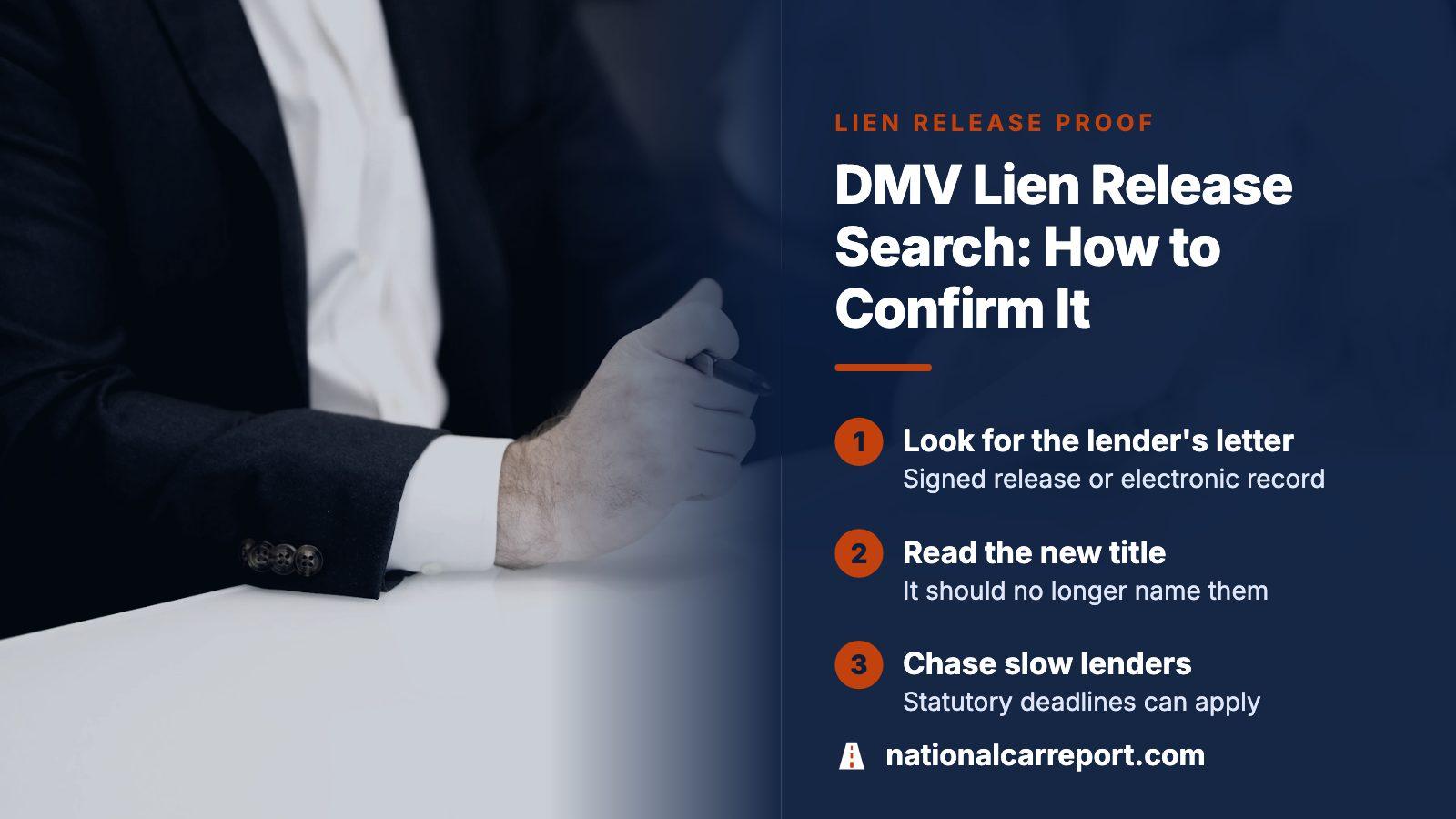
A lien ends when the lender tells the state its loan is paid, by a signed release letter or an electronic release on the state record. Usable proof is a title that no longer names the lender, the lender's written release, or a state record the owner pulls with you. A VIN check shows liens that were reported, not releases, so match it against the state record.
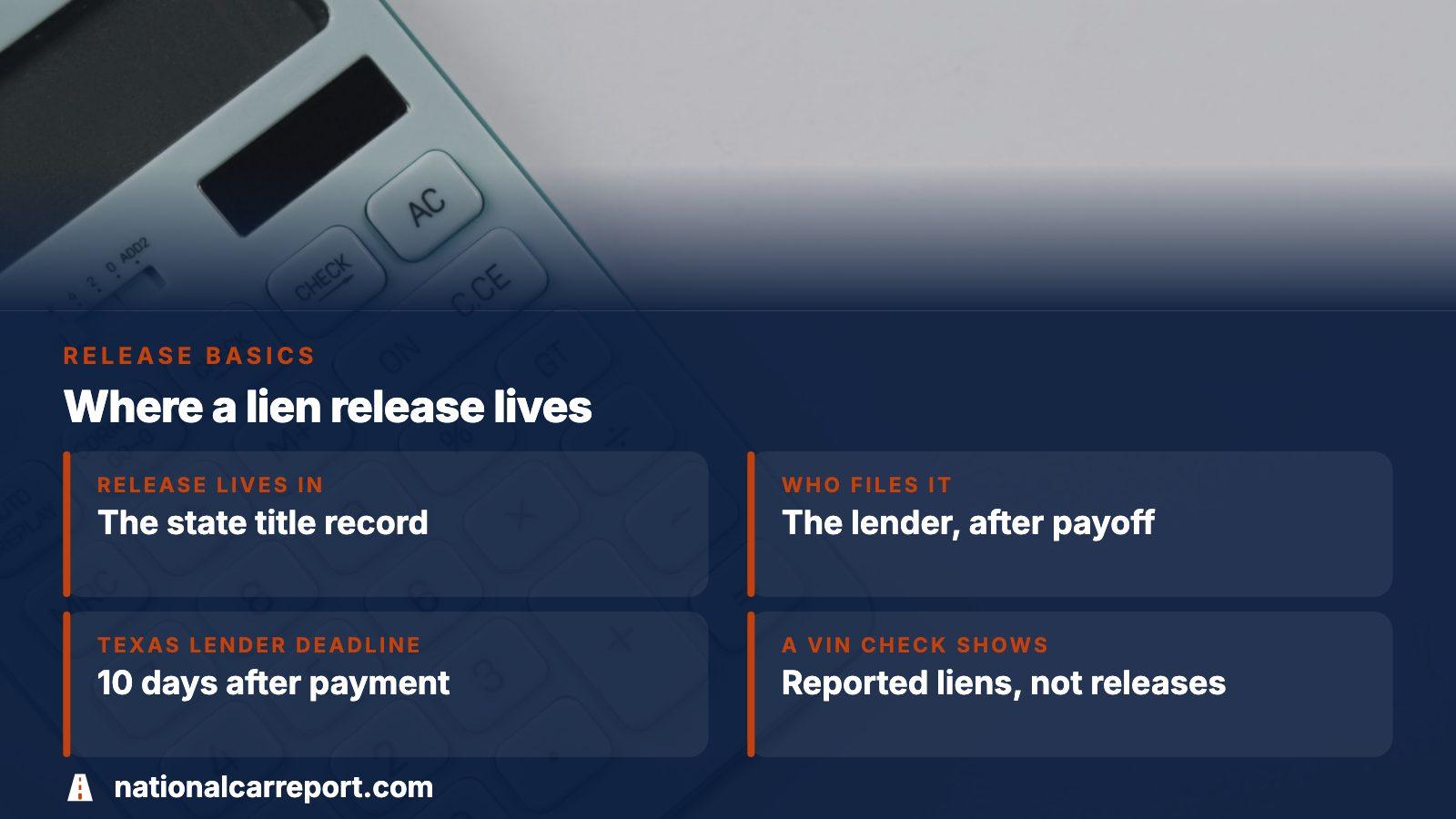
- Where a release lives
- The state title record
- Who files it
- The lender, after payoff
- Texas lender deadline
- 10 days after payment
- A VIN check shows
- Reported liens, not releases
What a lien release search can and cannot show
People often expect a lookup box that says whether a lien is gone. In practice a lien is an entry in a state's title records, and a release is the lender's later instruction to remove it. No public tool joins the two for every state, so confirming a release means gathering evidence from three directions: paperwork from the lender, the state's own record, and a national VIN screen. NationalCarReport covers the third, reading lien, theft and impound records for a VIN across state lines. The other two sit with you and the seller.
What counts as proof, and what does not
| Evidence | How much it proves | The catch |
|---|---|---|
| Lender's signed release letter | Strong, when it is an original naming the VIN | Some agencies refuse copies; Texas will not take a fax or photocopy for a certified title copy |
| Electronic release on the state record | Strongest, since it is the record itself | The owner may see nothing, so the lender or the state has to confirm it |
| Title still naming the lender | Not a release | Texas says a paid-off lien can stay printed on a title, so ask for the lender's release too |
| VIN report with no lien flag | A screen, nothing more | National data is not required to carry lender names, so a blank proves little |
| The seller's word | None | A promise is not a record |
Why the DMV will not simply run it for you
The federal Driver's Privacy Protection Act lets a state motor vehicle agency release personal details from its files only for listed purposes. They include courts and police, insurers working claims, theft and recall matters, tow and impound notices, lawsuits, and a requester who can show the individual agreed in writing. A private used-car purchase is absent from that list.
Consent is the workable door. Ask the titled owner to request the record while you watch, or to sign a consent that lets the record reach you. An owner who agrees in a minute has probably done this before. One who stalls has told you something.
Running the check in order
- Take the VIN from the car, then set it beside the title and each page the seller supplies. If one character differs, stop.
- Run the VIN preview first, to see whether a lien, theft or impound record was reported anywhere.
- Get the lender's name from the seller, along with a dated paid-in-full letter.
- Call the lender on a number you looked up yourself and ask when the release went to the state, and how.
- Have the owner pull the state record, or sign consent, and compare its lender entry with what you were told.
- Move money only after the release is confirmed, ideally with the title in your hand.

Paper release or electronic release: two paths
What proof exists depends on how the lender holds the title.
- Texas, paper title: the lender mails the title once it is paid. To clear the record the owner takes the title, the lender's release letter and Form 130-U to the county tax office.
- Texas, electronic lien: the state holds the title record, the lender reports the release, and the owner files nothing. The state then turns the record into a paper title and mails it to the recorded owner.
- Pennsylvania: a lender must release electronically right away, and the printed title follows the next business day. At a counter, an owner can obtain a clean duplicate with a release on Form MV-38O or a notarized statement on lender letterhead.
In an electronic-lien state the seller may truly have no paper to show. Ask the lender for the release date, then confirm it on the state record rather than waiting for a document.
When the lender is slow or the paper is stale
Washington's RCW 46.12.675 makes a secured party release its interest once nothing is owed, by assigning the title to the registered owner or to the buyer together with the owner's release. That subsection sets no day count. The clock starts with a proper demand: the lender then has ten days, and if it misses them and the owner or buyer loses out, it owes $100.
Texas gives a lender 10 days from payment. Pennsylvania drops its duplicate fee when an electronic release is on the record and no title has come 10 or more days later. Put your demand in writing and quote the payoff date.
Old paper causes its own trouble. Applying for a certified Texas copy of a title with a lien still recorded means the lender must complete the application or supply an original release. The form is VTR-34, every recorded owner signs, and the agency makes you wait 30 days after the last copy it issued.
Claims a lender's release will not clear
A lender's release ends the lender's claim and nothing else. California's DMV says an unpaid repair shop, parts supplier, tow operator or storage yard holds a lien on the vehicle. To sell the car, that claimant must physically have it. The process splits at a $4,000 market value, and an owner has 10 days to object to a sale. When a car is impounded, the lien begins at the moment of the tow.
A release clears the loan, not the car's record
The release letter answers one question: is this lender still owed money. Theft and impound records sit on the same VIN, and a check beside the lien search exists to catch them.
What the VIN check adds, and what it costs
Federal rules tell states to send five items to the national title system every 24 hours: the VIN, the title description with brands, the titled party's name, junk or salvage acquisitions and odometer readings. Lender details are not among them, though a state may add more with approval and uses national data to check lien-holder status when it verifies a title.
So a lien result here is a flag, not a verdict. A reported lien means stop and ask. A blank means nothing was reported, which differs from nothing existing, and neither one shows that a release was filed. Only the state record does.
The preview costs nothing and shows whether liens, theft or impound records were reported. Paid once, the full report comes singly or in sets of 3, 5 or 10, and shoppers weighing several cars tend to use the sets. No renewal exists. Prices live on the pricing page.
Where this information comes from
- TxDMV: remove a lien from a vehicle — Lender release deadline, and the paper-title and electronic-lien routes.
- TxDMV: get a copy of your title — Why a paid-off lien can still need an original release, and the waiting period.
- PennDOT: mandatory electronic lien and titling FAQs — How an electronic release becomes a printed title, and the counter options.
- Washington Legislature: RCW 46.12.675 — A secured party's duty to release, the demand period and the penalty.
- California DMV: lien sales for vehicles — Repair, tow and storage claims that a lender's release does not touch.
- 18 U.S.C. 2721: Driver's Privacy Protection Act — Why a DMV limits who may see a vehicle record, and the consent exception.
- 28 CFR 25.54: what states report to NMVTIS — The five items states must send nationally, and where lien-holder status comes in.
Sources and photos: Facts checked against the sources above in November 2026. Photos by Carrie Allen www.carrieallen.com, Jakub Żerdzicki and Sasun Bughdaryan on Unsplash; diagrams by NationalCarReport.
Keep reading
- Vehicle Lien Check by VIN: Nationwide Lien, Theft and Impound RecordsThe wider lien check, with theft and impound records read together.
- Car Lien Holder Search: How to Find the Lender Behind a VINHow to find which lender holds the claim before you ask for a release.
- Car Lien Search in Texas: Check a Used Car by VIN Before You PayTexas lien records and the e-title route in more detail.
- PricingOne report or a pack, paid once, with no subscription.
Frequently asked questions
Can I look up a lien release on the DMV website?
Rarely as an open search by a stranger. Federal privacy law limits what agencies release, so the usual path is the titled owner requesting the record or giving written consent. Ask the state agency whether it offers an online status check, and treat the answer as one input beside the lender's own written release.
How soon must a lender release the lien once the loan is paid?
It depends on the state. Texas gives the lender 10 days after it receives payment. Washington's statute sets no fixed deadline until the owner makes a proper demand, then allows ten days. Ask the lender when and how it sent the release, and write down the answer.
What is a lien release letter?
It is the lender's signed statement that the loan is paid and its claim on the car has ended. Some agencies want the original rather than a copy. The letter should name the VIN, the lender and the date, and it belongs in the same folder as the title.
Should I buy if the seller says the lien is paid but I cannot see proof?
Hold off. Without a release letter, an electronic release the lender can confirm, or a state record naming no lender, the claim may still be open, and it follows the car to you. Close the sale at the lender's office if you can, so payoff and release happen together.
Does a VIN check show that a lien was released?
Not reliably. National title data does not require lender names, and a report only shows what a state or lender sent. A reported lien is a reason to ask questions, and a blank is not proof. Confirm any release against the state record or the lender's written word.
Now check the car itself
The guide explains what to look for. The report shows what this VIN has on record.