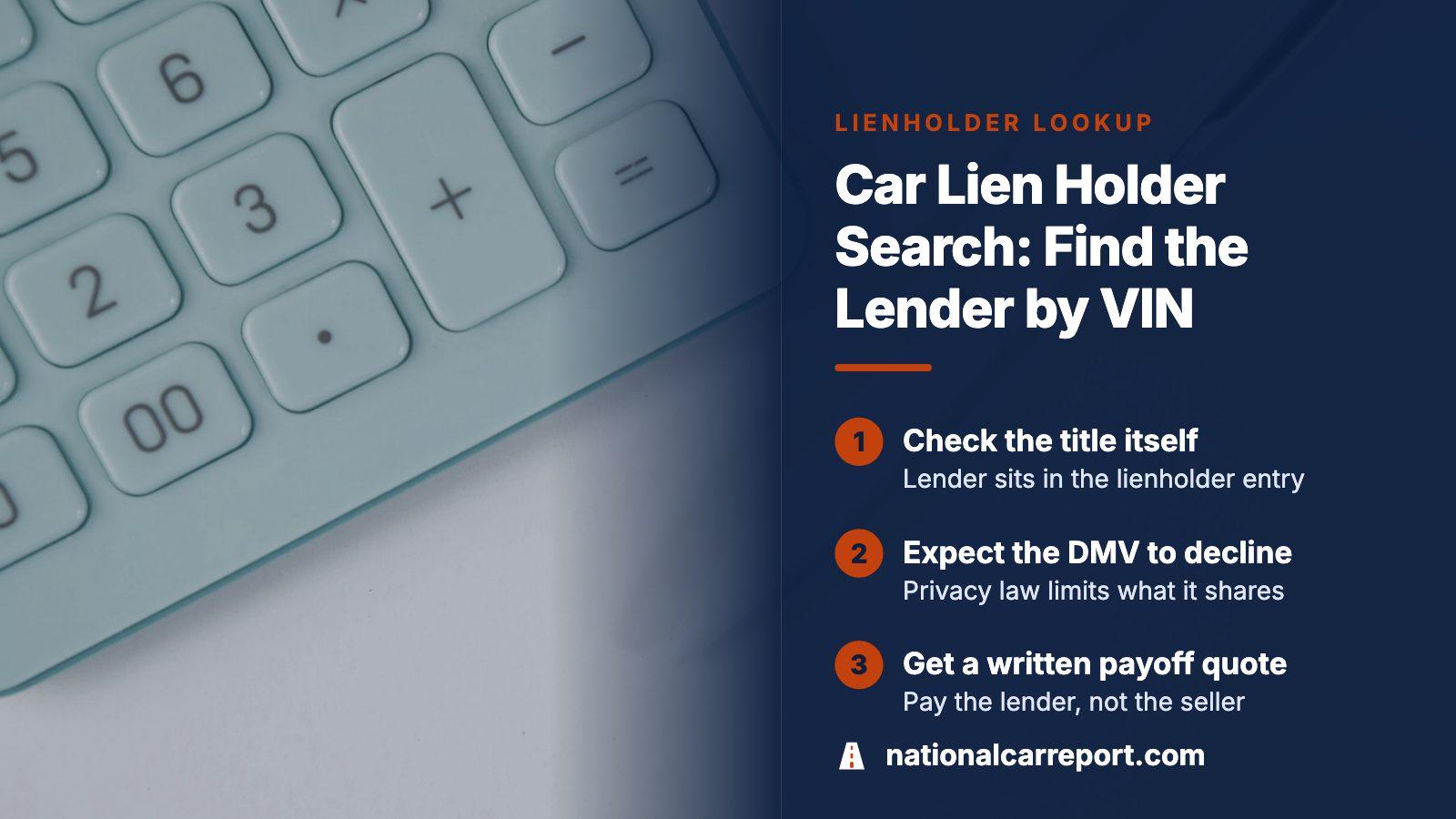
THE SHORT ANSWER
The lender's name appears in the lienholder entry on the title and in the state's title record, electronic ones included. A DMV will usually not read that record to a stranger, because federal privacy law restricts what it may release, so a buyer relies on the seller's title, the seller's written consent and a VIN-based report that flags reported liens. The national title feed does not require lender names, so the state record settles it.
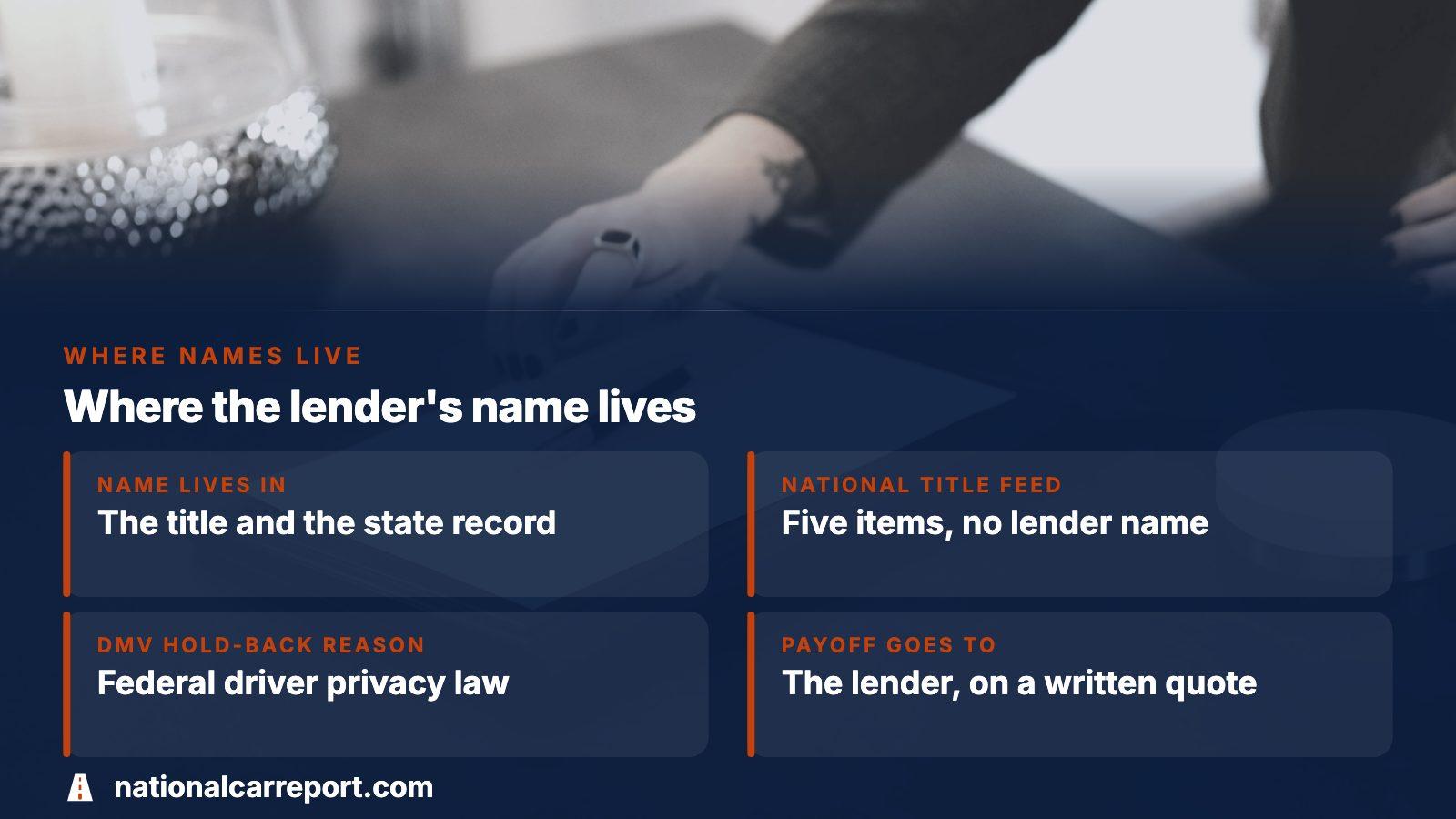
- Where the name lives
- The title and the state record
- National title feed
- Five required items, no lender name
- Why DMVs hold back
- Federal driver privacy law
- Payoff goes to
- The lender, on a written quote
The three questions behind a lien holder search
Most people typing this search want a name, yet a name is one slice of the answer. NationalCarReport reads lien, theft and impound records together by VIN, nationwide, because a buyer needs all three settled before handing over money.
- Whether a lender exists: a VIN-based report can flag a lien that was reported, whichever state it came from.
- Who the lender is: the title and the state record carry the name, while a national feed is not required to.
- Whether the claim is still open: only the lender can confirm, and a recorded release is what ends it.
Where the lender's name is actually kept
| Place | Names the lender? | What to know |
|---|---|---|
| The title itself | Yes, while money is owed | California's DMV says the lender's name and contact details print on the title, and it calls that party the legal owner. |
| State electronic record | Yes | On an electronic lien, as in Texas and for most lenders in Pennsylvania, the state holds the title while a loan is open and the owner gets paper after the release. |
| National title feed | Not required | States must send five items every 24 hours, and the lender's name is not one of them. |
| VIN history report | Only where a lien was reported | Anything beyond those five items is shared by agreement, so an empty lien field proves little. |
| DMV records request | Sometimes, for an eligible requester | Pennsylvania's Form DL-135 returns the owner's name and address, VIN, title number and plate, with extras only if asked. |
Why a DMV will not simply read the name out
The Driver's Privacy Protection Act bars state agencies from knowingly releasing personal information held in motor vehicle records, with listed exceptions. Courts, police, insurers working a claim, theft and safety matters, towing notices, lawsuits and anyone holding the person's written consent appear among them. A private car sale does not.
That leaves a buyer one plain route, the seller's written consent. Plate-only requests meet the same wall: PennDOT will not trace an owner from a plate alone and wants the VIN or the title number as well.
Consent is the shortcut
Ask the seller to request the state record with you, or to sign the consent a request needs. Agreement within a minute suggests someone who has done this before. Excuses suggest the lender's name is a subject to avoid.
Five ways to get the name before you pay
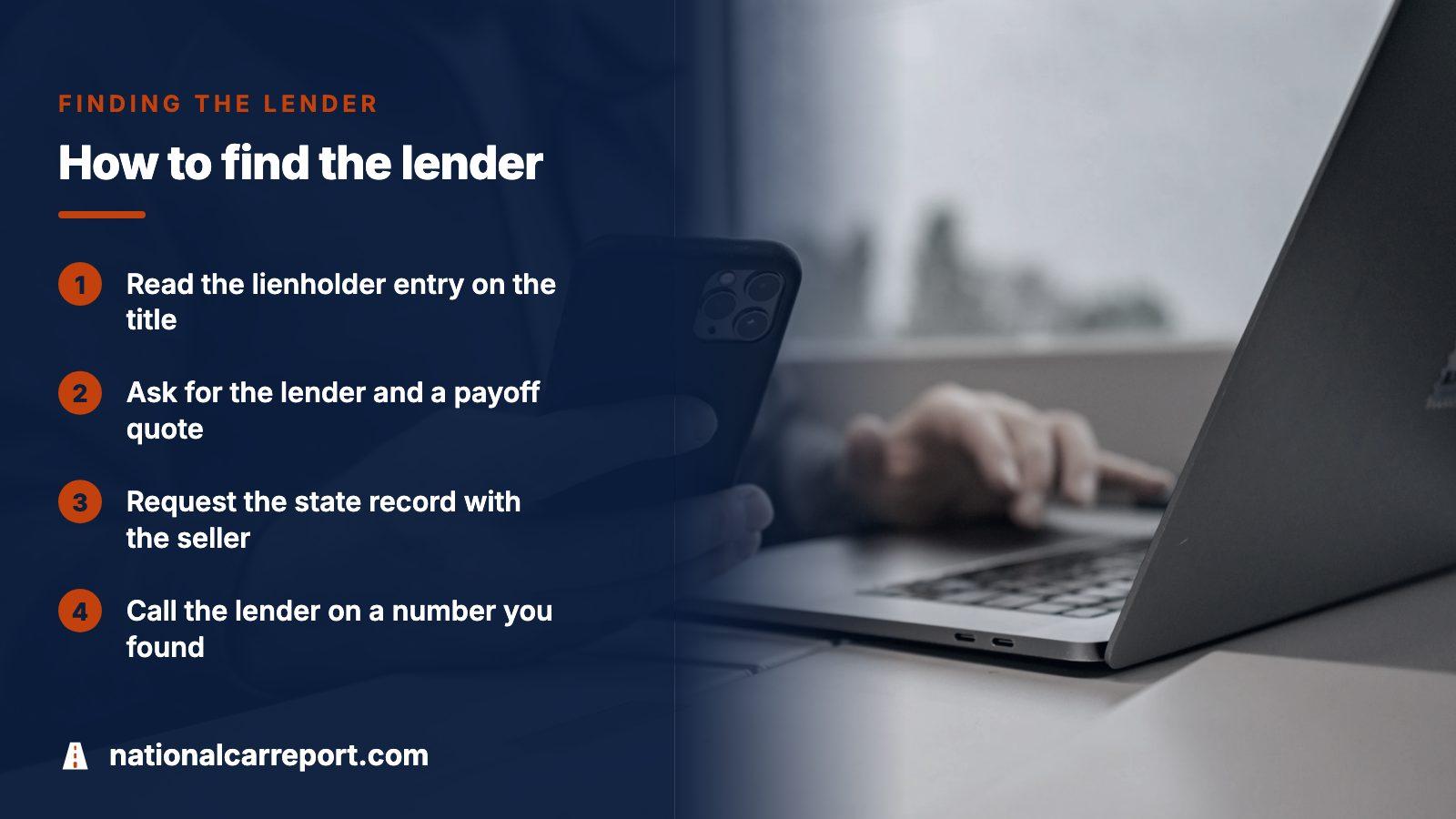
- Start with the title and read the lienholder entry. A seller with no title to show has answered for now.
- Ask for the lender's name together with a payoff quote dated this week. Only the lender can issue one, so name and figure arrive as a pair.
- Have the seller request the state record with you, or sign a consent for it.
- Run the VIN preview for liens, theft and impounds, then judge whether this car deserves the full report.
- Find the lender's phone number yourself, from its website or a statement, and call to confirm the loan, the payoff and where the release will be filed. A number the seller supplied proves little.
When the lender holds the title electronically
In Texas, a lien recorded electronically leaves the title as a state record while the loan is open. Pennsylvania requires any lender that finances vehicles as a business to enroll in its electronic program before a lien can be recorded on a title there, and an enrolled lender cannot simply opt for paper.
So the seller may have no paper title to show, and nothing is wrong with that. After payoff the lender sends an electronic release. Texas then converts the record to paper and mails it to the owner. In Pennsylvania the printed title is mailed the next business day. Ask which lender holds the record, call it, and settle the payoff there rather than on a promise that paper will turn up later.
A lender that merged, renamed or sold the loan
The name on an older title may no longer trade under that name. California's DMV maintains a roster of lenders that have closed, merged, been renamed or bought out, made for this tracing job. In a state without one, ask the agency which lender holds the record today.
Pennsylvania identifies each recording lender by an 11-digit Financial Institution Number, and a lien that moves between lenders is recorded on Form MV-950. A name that sounds defunct is not a released lien. Loans change hands, and the claim travels with them.
Claims held by a repair shop or tow yard
A lender is not the only party with a claim. California's DMV explains that anyone who repairs, supplies materials for, tows or stores a vehicle and goes unpaid has a lien on it, enforced through a court judgment or a lien sale, and the claimant must actually possess the car. The value line there is $4,000, and an owner has 10 days to oppose a lien sale.
Those claims follow where the car has physically been, not a lender's entry on a title, which is why a lienholder search belongs beside an impound check. Pause when:
- The seller's name is missing from the title, and the car sits at a shop or yard.
- An impound or tow record turns up on the VIN report.
- Nobody can say where the car spent the last few months.
Payoff and proof of release, state by state
Naming the lender is the first half. The second half is making sure the claim really ends.
- Texas: the lender has 10 days after receiving payment to release the lien. On a paper title the owner carries the lender's release letter to the county tax office, and on an electronic lien the lender and the state update the record without the owner doing anything.
- Pennsylvania: the lender files the release straight away, and the owner's printed title follows the next business day. One still missing 10 or more days after the release can be replaced without a fee.
- Any state: keep the quote, proof of payment and release confirmation together until a title in your name arrives. A lender's letter is evidence of payment, while the state record is where the release has to show up.
Cost, and where to begin
Nothing is charged for the preview, which comes before any purchase. The full report is a single payment: one report, or 3, 5 or 10 at once when several cars are on your list. Amounts sit on the pricing page, and no subscription is attached. Lien, theft and impound records arrive together for the VIN.
Treat the result as a screen. A lien that shows is worth chasing. A clean result still needs the title in your hand and the state record on your screen, because the national feed does not require lender names.
Where this information comes from
- 28 CFR 25.54: data states report to NMVTIS — Lists the five items every state must send nationally and shows that anything extra is optional.
- Driver's Privacy Protection Act, 18 U.S.C. 2721 — The federal limit on releasing motor vehicle record data, and the permitted uses.
- California DMV: vehicle titles — Shows the lender printed on the title as legal owner and the DMV roster of lenders that merged or closed.
- California DMV: lien sales for vehicles — How repair, towing and storage claims work and what the claimant must hold.
- TxDMV: add or remove a lien — Release timing after payoff, paper versus electronic titles, and the conversion to a paper title.
- PennDOT: mandatory electronic lien and titling FAQs — Which lenders must enroll, how they are identified and how a title reaches the owner after payoff.
- PennDOT: public records FAQs — What a vehicle record request returns and why a plate alone is not enough.
Sources and photos: Facts checked against the sources above in November 2026. Photos by Sasun Bughdaryan, Anastasiia Nelen and Annika Wischnewsky on Unsplash; diagrams by NationalCarReport.
Keep reading
- Vehicle Lien Check by VIN: Nationwide Lien, Theft and Impound RecordsWhether any lien is reported on a VIN, and how to read the answer.
- DMV Lien Release Search: How to Confirm a Lien Is GoneConfirming that a paid-off loan was actually released.
- Impound Lookup: Find a Towed Car, Then Check Its VIN for Impound RecordsTow and storage claims that sit outside the lender's title entry.
- PricingOne report or a pack, paid once, with no subscription.
Frequently asked questions
How do I find out who the lienholder is on my own car?
Your loan statement names the lender, and the title confirms it. An electronic title holds the same name in the state's record. If the two disagree, for example after the loan was sold, ask both the lender and the DMV which one is current.
Can I run a DMV lien holder search online?
Sometimes in part. Many agencies take record requests by form rather than a live lookup, and federal privacy law limits who qualifies. Check your own state agency's site for a title or lien status tool before paying a third party, and doubt any site promising a stranger's lender from a plate alone.
Does a lien holder search show how much is owed?
No. The balance is not among the five items states must send to the national title system, and a payoff figure is the lender's own quote, good for a stated window. Ask for it in writing with the expiry date and pay the lender.
Is the lienholder the same as the legal owner?
In California, the DMV uses legal owner for the lender named on the title while money is owed. The registered owner is the person the registration is issued to, so check that the seller's name matches that record as well as the title. Other states may word it differently.
What if the lender says the loan was paid long ago but the lien still shows?
Ask the lender to file the release with the state and confirm the date in writing. Texas gives a lender 10 days after payment, and Pennsylvania releases electronically, with the printed title following. Keep every dated document.
Now check the car itself
The guide explains what to look for. The report shows what this VIN has on record.