THE SHORT ANSWER
A vehicle lien check takes the VIN and returns lien, theft and impound records for that exact car, drawn from sources collected nationwide. A listed lien means a lender may be able to repossess the car after you buy it. A result with no lien is encouraging but not conclusive, since lien detail reaches national records only where a state chooses to send it. Verify with the state title record.
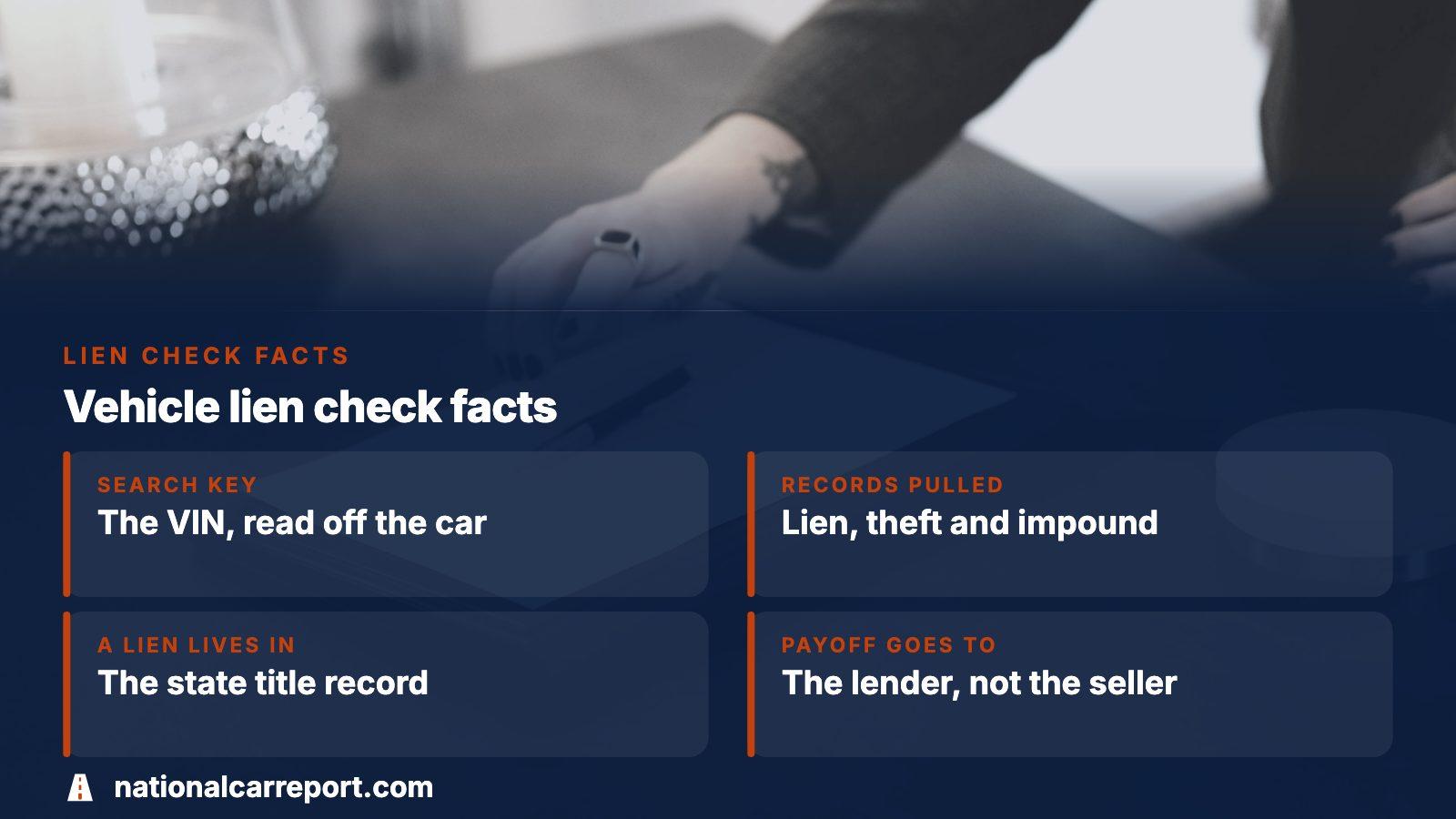
- Search key
- The VIN, read off the car
- Records pulled
- Lien, theft and impound
- Where a lien legally lives
- The state title record
- Paying off a loan
- To the lender, not the seller
One VIN, three claims on the same car
NationalCarReport treats a lien check as one of three searches that belong together. A lender can hold a lien, a police report can list the car as stolen, and a tow yard can hold it after an impound. All three attach to the VIN, so one lookup gathers them, whichever state was involved.
- Liens: a lender's recorded claim, where a state or lender has reported it
- Theft records: whether the car was reported stolen and whether it was recovered
- Impounds: a record that the car sat on a tow or storage lot
- Title brands, salvage and auction history with photos, and insurance records
- Odometer readings, recalls still open, who owned it and how it was used, plus market value and factory specs
Running the check from the VIN
- Find the 17-character VIN on the car itself: the metal plate visible from outside, low on the dashboard near the driver, or the sticker on the door pillar.
- Copy it from the car, not the advert, and compare it with the paperwork. A mismatch is a reason to stop.
- Enter it in the preview and read what comes back for liens, theft and impounds.
- If the car survives that, open the full report before you hand over a deposit.
- Match three names: the title, the seller's ID and whoever is taking your money.
Lenders, police agencies and tow lots all report against a vehicle, so the VIN opens every record.
What each result means and what to do about it
| On the report | What it suggests | Your move |
|---|---|---|
| Lien listed | A lender recorded a claim, and it may still be open | Get a written payoff quote and route the payment through the lender |
| No lien shown | Nothing was reported; that does not prove nothing exists | Check the state title record and ask to see the title |
| Theft record, no recovery | The car may still be listed as stolen | Do not pay; tell police if you know where the car is |
| Theft-recovery brand | Stolen, later found, and branded on the title | Expect a lower value and book a mechanical inspection |
| Impound record | The car was held on a tow or storage lot at some point | Ask who paid the charges and where the car has been since |
| Seller is not the titled owner | The seller may be unable to direct a payoff or a release | Stop until the names line up |
Why an empty lien field is a screen, not proof
Federal rules set the minimum a state must send to the national title system, and the list is short. Each state reports five items every 24 hours: the VIN, the brands and description on the title, the party the title went to, junk or salvage acquisitions where tracked, and the odometer reading at issue.
Missing from that mandatory list:
- The lienholder's name
- The loan balance or payoff figure
- Whether a release has been filed
- Liens a dealer holds against its own stock
A state and the system operator may agree to share more, which is how lien indicators reach a report where they do. A listed lien is a real signal. An empty field proves less, so let the state record settle it.
Where the lender's claim actually lives
For a titled vehicle, the lender's protection comes from having its name noted on the title itself. Under the Uniform Commercial Code, as Washington enacted it, a separate public financing filing is not what counts; the title notation is.
A payoff letter proves the loan was repaid, yet the lien disappears only when the title record is updated. A printed title can also be stale, so the state record outranks the paper in the seller's hand.
Electronic titles are normal
Many states keep titles electronically, Florida among them, so there may be no paper at all. A seller who says the title is electronic is describing the usual case. Ask what the state record shows, and use state tools where they exist, such as Florida's Motor Vehicle Information Check.
Claims the title will never show
A dealer finances its stock through a floor-plan lender, and that lender does not appear on each car's title. The loan is normally cleared from the sale proceeds. Trouble comes when a dealership closes, a car sits on consignment, or the title is promised for later.
The other claim belongs to whoever has had the car. Under state law, a repair shop, a tow operator or a storage yard can hold a car against unpaid work or storage fees. An impound record is the nationwide clue: the car sat on a lot, and the seller ought to account for what was owed and who paid.
- A car sold straight from a repair shop by someone who is not the owner
- A vehicle pulled out of storage and offered quickly at a low price
- A dealer who promises the title next week
Cars that changed states need a second look
A lender's claim is born in one state's title system and is recorded there. On a move to another state, the new titling agency runs the VIN through the national system and compares what returns, lien-holder status included, but only against what the old state chose to send.
Treat out-of-state history as a prompt, not a problem. If the title is recent and the plates or service stickers come from elsewhere, ask which state issued the title the seller holds, and when. Check that state's record too. The nationwide check gives the first pass; the state record has the last word.
If a lien turns up: pay the lender, not the seller
A car with an open loan can still be a good buy, provided your money reaches the lender through you.
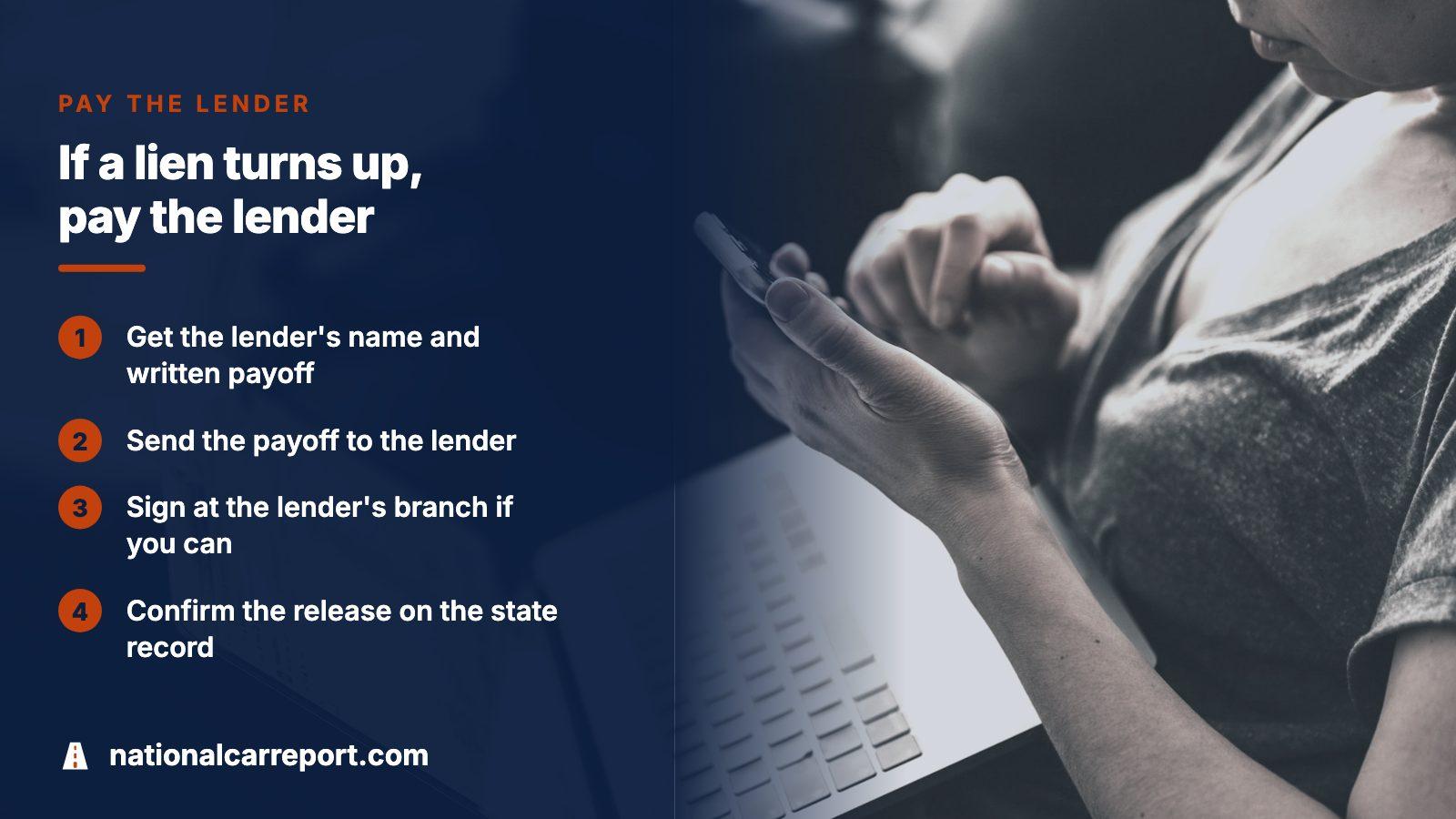
- Get the lender's name from the seller and a payoff figure in writing, with the date it expires.
- Send the payoff to the lender; the seller receives only what is left.
- Sign at the lender's branch if you can, so the release is issued while you are there.
- No branch nearby? Use a licensed escrow service instead.
- Confirm the release appears on the state record before calling the deal finished.
A sentence that should end the deal
Hand over the cash and I will clear the loan next week keeps the lender's claim attached to a car that is now yours. A sincere seller cannot fix that, so route the payoff to the lender.
What it costs and where to go next
The preview costs nothing. For a car you still like, the full report is paid once and never renews, and the pricing page shows one report and packs of 3, 5 or 10 for anyone comparing several cars. The sample report shows the layout beforehand.
NICB runs a no-charge VINCheck for theft and total-loss reports, and your state may offer its own title-status tool. Run those beside the VIN check, not instead of it. A seller who resists any of this has answered your question.
Where this information comes from
- 28 CFR 25.54: what states report to NMVTIS — Lists the data every state must send to the national title system, and leaves anything beyond that to agreement.
- Washington Legislature: RCW 62A.9A-311 — Shows that a titled vehicle's lien is perfected by notation on the title, with a carve-out for dealer inventory.
- NMVTIS: national title record — The federal source for title records and, where states report them, lien indicators.
- FLHSMV: Motor Vehicle Information Check — A state title-status tool from an electronic-title state.
- NICB: VINCheck — A no-cost theft and total-loss screen to run alongside a lien check.
Sources and photos: Facts checked against the sources above in November 2026. Photos by Ben Wicks, Michal Biernat and Annika Wischnewsky on Unsplash; diagrams by NationalCarReport.
Keep reading
- Sample reportSee how lien, theft and impound records are laid out in a finished report.
- PricingOne report or a pack, paid once, with no subscription.
- Theft Recovery Vehicle: Stolen, Lien and Impound Checks Before You BuyWhat a theft-recovery brand means for the car you are considering.
- Report a Stolen Car: Police Steps, Insurance and a VIN Theft CheckHow a police report becomes the theft record a VIN check reads.
Frequently asked questions
How do I run a vehicle lien check?
Read the VIN from the car, start the preview, and see which lien, theft and impound records come back. Then confirm any lien against the state title record, where it legally lives, and ask to see the title in the seller's own name. Do all of this before a deposit changes hands.
Is there a free lien check?
The preview is free and comes first; the full records are a one-time payment. Some states publish title-status tools at no charge, Florida's Motor Vehicle Information Check being one, and NICB's VINCheck is a free theft screen. None replaces a title carrying the seller's name.
Can I buy a car that has an open loan?
Yes. Get a written payoff quote, pay the lender directly, and keep the seller's share to the remainder. The lender's branch is the best place to sign because the release can happen on the spot. Paying the seller first and trusting a promise to settle later leaves you owning a car a bank can repossess.
What if the check shows no lien but the seller still owes money?
It can happen. Lien detail reaches national records only where a state sends it, and a dealer's stock loan never appears on the title. Treat the result as a screen, then confirm the state record and see the title, paper or electronic, in the seller's own name before any money moves.
What does an impound record on a car mean?
It means the car was held on a tow or storage lot at some point. That alone is not a defect, but a lot can hold a vehicle against fees owed, so ask what was owed, who paid it and where the car has been since. A recent impound plus a rushed sale deserves extra questions.
Now check the car itself
The guide explains what to look for. The report shows what this VIN has on record.