THE SHORT ANSWER
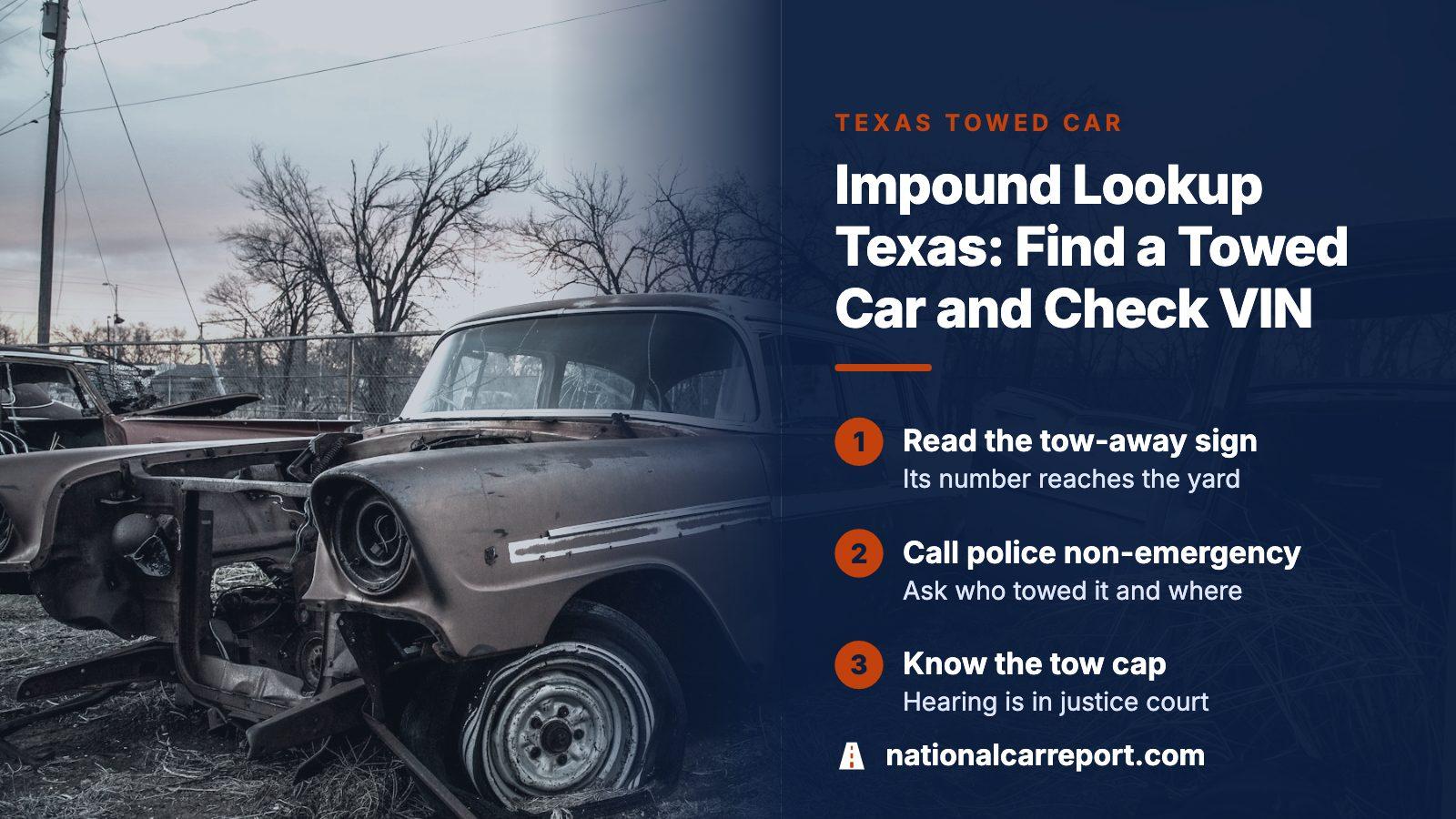
To look up a Texas impound, read the phone number on the tow-away or no-parking sign where the car stood, then call the police non-emergency line for that city and ask whether it was towed, by whom and to which yard. For a car you plan to buy, enter its VIN in the NationalCarReport preview and read the impound, lien and theft entries.
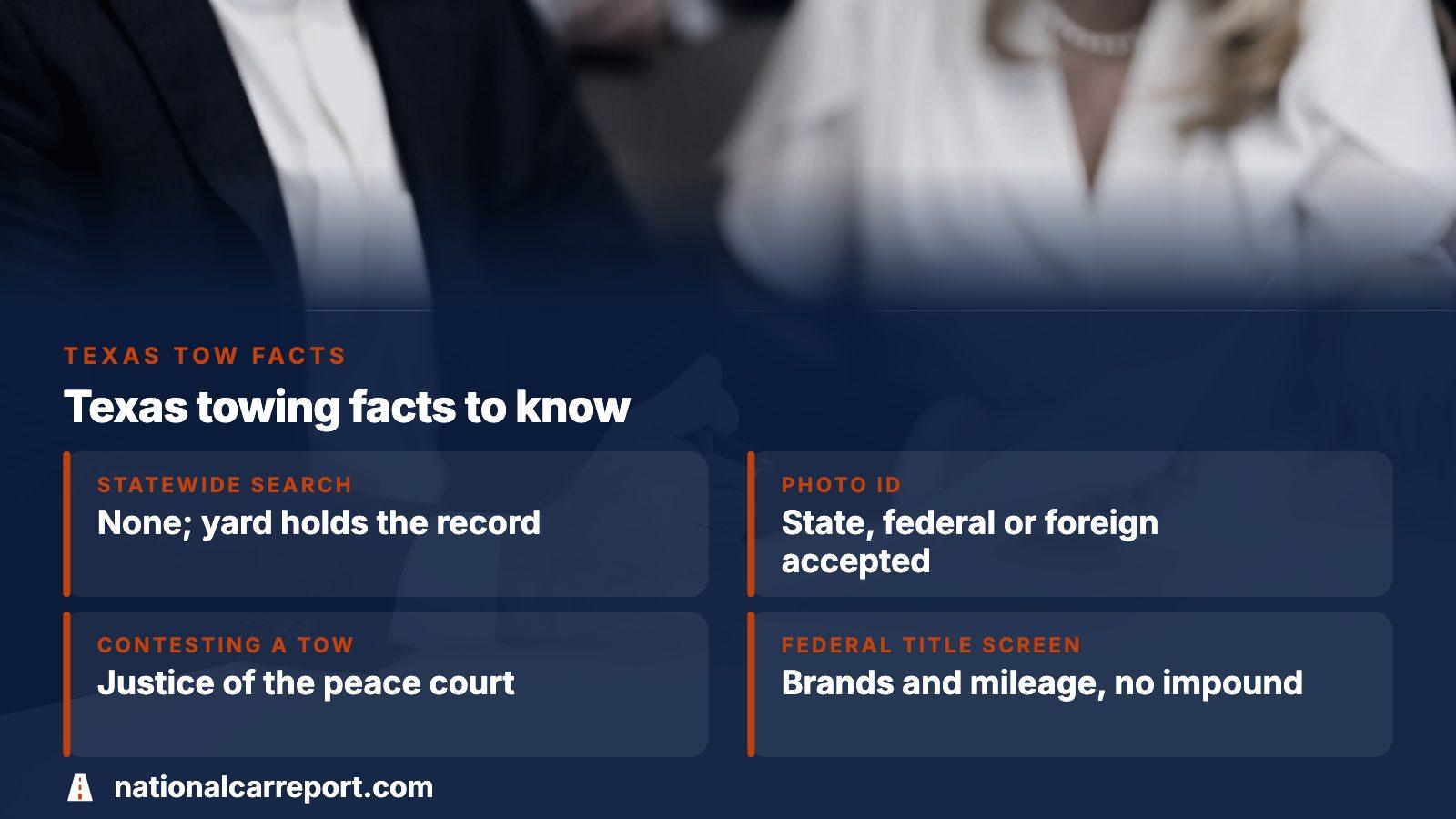
- Statewide search
- None; the yard or agency holds the tow record
- Tow cap, light vehicle
- $272 up to 10,000 lbs, unless a city sets less
- Contesting a tow
- Justice of the peace court, roughly two weeks to ask
- Federal title screen
- Lists brands and mileage, with no impound item
Why Texas has no one place to search for impounds
People search this for two reasons: the car is gone from where it was parked, or a car for sale may once have sat in a tow yard. Texas keeps no public statewide database for either, because the tow is recorded by whoever handled it. TDLR, the Department of Licensing and Regulation, licenses tow operators and the storage yards it calls vehicle storage facilities, and takes complaints online, but it offers no way to find one car.
- Private-lot tow: the yard holds the record and must tell local police within 2 hours.
- Police-ordered tow: the agency knows, and a contracted wrecker firm may hold the car.
- Boot: the boot company, whose number is on the sticker.
A car has vanished: the order to work through
- Read the signs where you parked. Lot tows and tow-away signs carry a phone number, and a boot sticker names one too. Never pull off a boot or drive on it.
- Call the police non-emergency line for that city with the plate, make, street and time last seen. Ask whether police ordered a tow, and which yard got the car. Private-lot yards must alert police too, so ask the dispatcher to check those.
- Ask whether the city runs its own search. San Antonio's police page sends owners to an Autura lookup and names its contracted wrecker firm; its impound lot never closes.
- Phone the yard before driving over: address, release hours, accepted payment and today's total.
- No record anywhere? Report the car stolen. A tow file and a theft report are separate.

What the yard has to accept when you arrive
Bring three things:
- Photo ID, whether state, federal or issued abroad.
- One proof the car is yours to collect: a license matching the registration, an insurance card with your name, the title, a notarized power of attorney, a rental or lease contract the driver signed, or a court order.
- Payment of every charge; a card method must be accepted.
A yard open around the clock must release at any hour, within one hour of your request. Yards with set hours owe the same speed from 8 a.m. to midnight Monday through Saturday and until 5 p.m. on Sundays, holidays excepted. No yard may demand proof of insurance.
Ask for the tow ticket
A non-consent tow comes with an itemized ticket naming the tow company, its certificate number and the operator's TDLR license number.
What a tow and storage bill can legally hold
Statewide ceilings apply; cities or counties may set lower ones. These use TDLR's 2023 adjustment, so confirm current amounts before disputing a bill.
| Charge | Ceiling | Detail |
|---|---|---|
| Tow, up to 10,000 lbs | $272 | Non-consent tow |
| Tow, 10,000 to 25,000 lbs | $380 | Heavier: $978 cap |
| Storage a day, 25 feet or shorter | $22.85 | Any part of a day counts |
| Storage a day, longer vehicle | $39.99 | Same counting rule |
| Notification | Up to $50 | One flat fee for all letters |
Storage stops at 5 days if the yard skips the first notice on a Texas-registered car, or does not request an out-of-state car's registration record within 5 days.
Catch it before it leaves the lot
A car hooked up but not secured can be taken back at no charge. One fully hooked up but still on the lot can be kept for a drop fee, with a cap of $135 for vehicles up to 10,000 lbs.
The notice clock before a yard can sell the car
A tow alone does not start a sale. Once the car has sat 24 hours, the yard must send a first notice by certified or registered mail to the registered owner and any lienholder: by day 5 for a Texas-registered car, day 14 for an out-of-state plate. A second notice goes out 15 to 20 days after the first. The yard may dispose of the car if nobody claims it 30 days after the second.
- The first letter lists claim hours, the daily rate, all charges, the tow date and place, the yard's license number and your right to challenge the tow.
Sale proceeds pay the tow and storage first, and any excess goes to the owner. A scrap-grade car over 10 years old gets one notice, with a sale allowed 30 days later. Lenders get letters too, though a yard can sell without a lien release.
If the tow looks wrong: the hearing and the complaint
Texas lets owners contest a tow, boot or bill by asking the justice of the peace court for the county of the tow to hold a hearing. TDLR words the deadline two ways, within 14 days or before the 14th day excluding weekends and holidays, so ask the clerk for the exact date. The court may charge a $20 fee, must hold the hearing within 21 calendar days, and rules on probable cause.
- Your contact details, and where and when the car was removed or booted.
- The person or agency that authorized it, the yard and the tow company, with addresses and phones.
- Any receipt or notice, plus photos of the posted signs or a note that none were up.
A TDLR complaint is separate and does not replace the hearing request.
Buying a car that may have sat in a Texas yard
No buyer can search every Texas yard, but a VIN carries recorded history. NationalCarReport's impound, lien and stolen-vehicle checks read one VIN and show which of those record types exist, with impound entries beside lien and theft data where recorded. Run the preview before you offer a price.
Don't rely on the title screen alone. The federal title system's consumer page covers brands, latest mileage, insurer total losses, salvage-yard transfers and some theft data, and never mentions tows. TxDMV's brand list has salvage, rebuilt, junk and water damage, but no impound brand. TxDMV also tells buyers to inspect the car and never complete a private sale without the title.
Reading the result: what each flag means for the deal
| VIN record shows | It can mean | Next step |
|---|---|---|
| Impound entry | The car was held in a yard | Ask for release paperwork and the yard's name |
| Open lien | A lender may still hold a claim | Get the lender's release in writing first |
| Theft flag | Reported stolen at some point | Stop and call the police agency named |
| Salvage or flood brand | An insurer or state branded it | Price it as branded and inspect independently |
| No entries | Nothing recorded for those types | Inspect anyway and read the title in person |
A seller who says the car sat in a lot for a week should name the yard, release date and fee.
Cost and next steps
The preview is free. A report is paid for once and nothing recurs, and bundles of three, five or ten reports are there if you are comparing vehicles. Amounts sit on the pricing page.
- Owner: bring ID, one proof of ownership and a card.
- Owner: photograph the posted signs; a hearing request asks for them.
- Buyer: run the VIN, read the entries, then inspect the car.
If your own car is missing, spend today on the phone: signs, police, then the yard.
Where this information comes from
- Texas TDLR: towing consumer information — Drop fees, hearing steps, tow ticket contents and where complaints go.
- Texas TDLR: VSF notifications — The notice timeline, letter contents and the private-property report to police.
- Texas TDLR: VSF vehicle release — Documents accepted, payment and release hours, and the insurance rule.
- Texas TDLR: VSF fees — Ceilings for towing, storage and notification, and the 5-day storage limits.
- TxDMV: title check, look before you buy — Texas title brands and the buyer's checklist.
- NMVTIS: for consumers — What the federal title system lists, and that tows are not among the items.
- City of San Antonio: SAPD impounded vehicles — One city's route to a towed car: a contracted wrecker firm and an online search.
Sources and photos: Facts checked against the sources above in November 2026. Photos by Leo_Visions, Anastasiia Nelen and Carrie Allen www.carrieallen.com on Unsplash; diagrams by NationalCarReport.
Keep reading
- Impound Lookup: Find a Towed Car, Then Check Its VIN for Impound RecordsThe national view: how impound lookups work outside Texas and what a VIN adds.
- Dallas Impound Lookup: Find a Towed Car, Then Check Its VINA city walk-through for a car towed in Dallas.
- Car Lien Search in Texas: Check a Used Car by VIN Before You PayHow a lender's claim shows up on a Texas car before you pay.
- Report a Stolen Car: Police Steps, Insurance and a VIN Theft CheckWhat to do when no yard has any record of a tow.
Frequently asked questions
How do I find a towed car in Texas?
Check the signs where you parked for a tow number, then call the police non-emergency line for that city and ask whether the car was towed and where. Some cities, San Antonio among them, offer an online search. If nothing turns up, file a stolen-car report.
Can I run an impound lookup by VIN or plate in Texas?
Not as a live statewide search, since no such database exists. City tools choose their own search fields, so read what yours accepts. A VIN report works from the other side, reading one vehicle's recorded history for impound, lien and theft entries.
How long can a Texas tow yard keep my car?
Count from the notices, not the tow. The second letter follows 15 to 20 days after the first, and the yard may sell the car if nobody has claimed it 30 days after that. Storage keeps running meanwhile, so early pickup costs less.
Does an impound show up on a Texas title?
Not as a brand. TxDMV's list covers salvage, rebuilt, junk, water damage and similar conditions, and the federal title system's consumer page never mentions tows. A VIN report can still show an impound entry where one was recorded, so buyers read it beside the title.
What does it cost to check a VIN for impound entries?
The preview costs nothing and shows what kinds of records exist for that VIN. Reading the entries themselves takes a report, paid for one time with no subscription. Bundles of several reports exist for comparing cars, and the pricing page has current amounts.
Now check the car itself
The guide explains what to look for. The report shows what this VIN has on record.