THE SHORT ANSWER
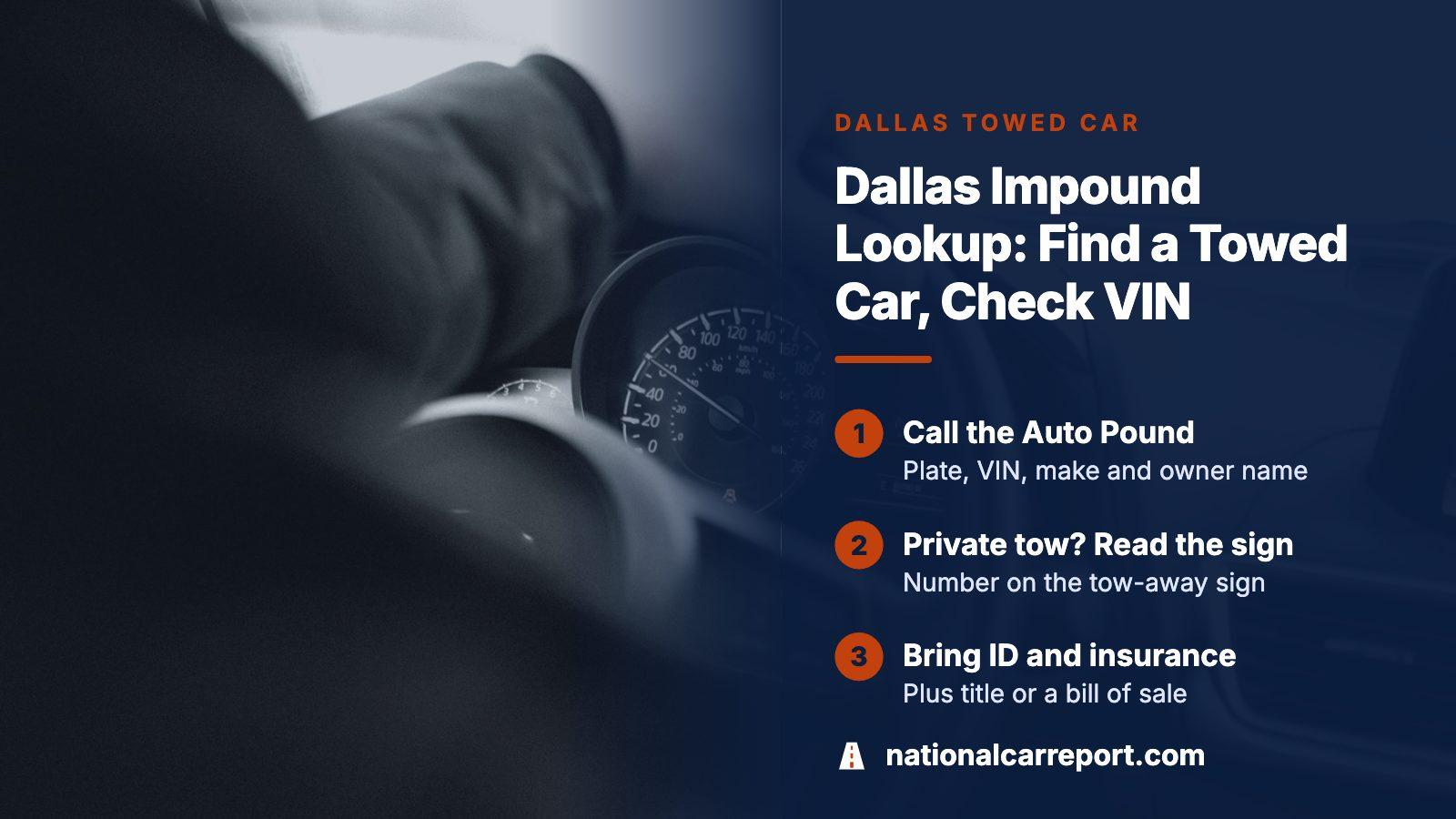
Call the Dallas Police Auto Pound at 214-670-5116 with the plate, VIN, year, make, model and registered owner's name. That finds police tows. For a private-lot tow, call the number on the tow-away sign. A VIN check is a separate job: it reads one car's recorded impound, lien and theft history, and does not show where the car sits today.
- Police tows
- Dallas Police Auto Pound, 214-670-5116
- Private-lot tows
- Number on the tow-away sign, then the licensed storage yard
- To collect a car
- Original ID, current insurance, title or bill of sale
- VIN check
- Reads recorded impound, lien and theft entries nationwide
Who towed the car decides where you call
Two tow tracks run in Dallas. Police-ordered tows end at the city's own yard. Tows ordered by a lot owner end at a private storage yard that Texas licenses. Phoning the wrong one wastes a morning.
| Tow type | Typical cause | Where to ask |
|---|---|---|
| Police tow | No insurance at a traffic stop, a wreck, an arrest, a blocked street, a parking violation | Dallas Police Auto Pound |
| Private-lot tow | Parked where the property owner forbids it | Number on the tow-away sign, then the yard it names |
| Stolen vehicle held by police | A reported theft turns up and is stored | Auto Pound, which lists stolen vehicles among the cars it stores |
| Abandoned car | Unclaimed and declared abandoned under Texas rules | Auto Pound auction, every other Monday |
Calling the Auto Pound
The unit's published pages point to a phone line and a cashier window at 1955 Vilbig Road, Dallas, TX 75208, not to an online search form. Staff ask for four details, so gather them first.
- The license plate number.
- The VIN. If the car itself is gone, your registration, insurance card or title prints it.
- Year, make and model.
- The name of the registered owner.
Two closing times
The pound's general page gives pickup hours as 9 am to 5 pm daily, while its fees page says 9 a.m. to 7 p.m. with the cashier open on holidays. Phone 214-670-5116 before you drive out, and plan to arrive early.
If staff find nothing and no sign marks a private tow, treat the car as possibly stolen and file a police report.
Papers to bring to Vilbig Road
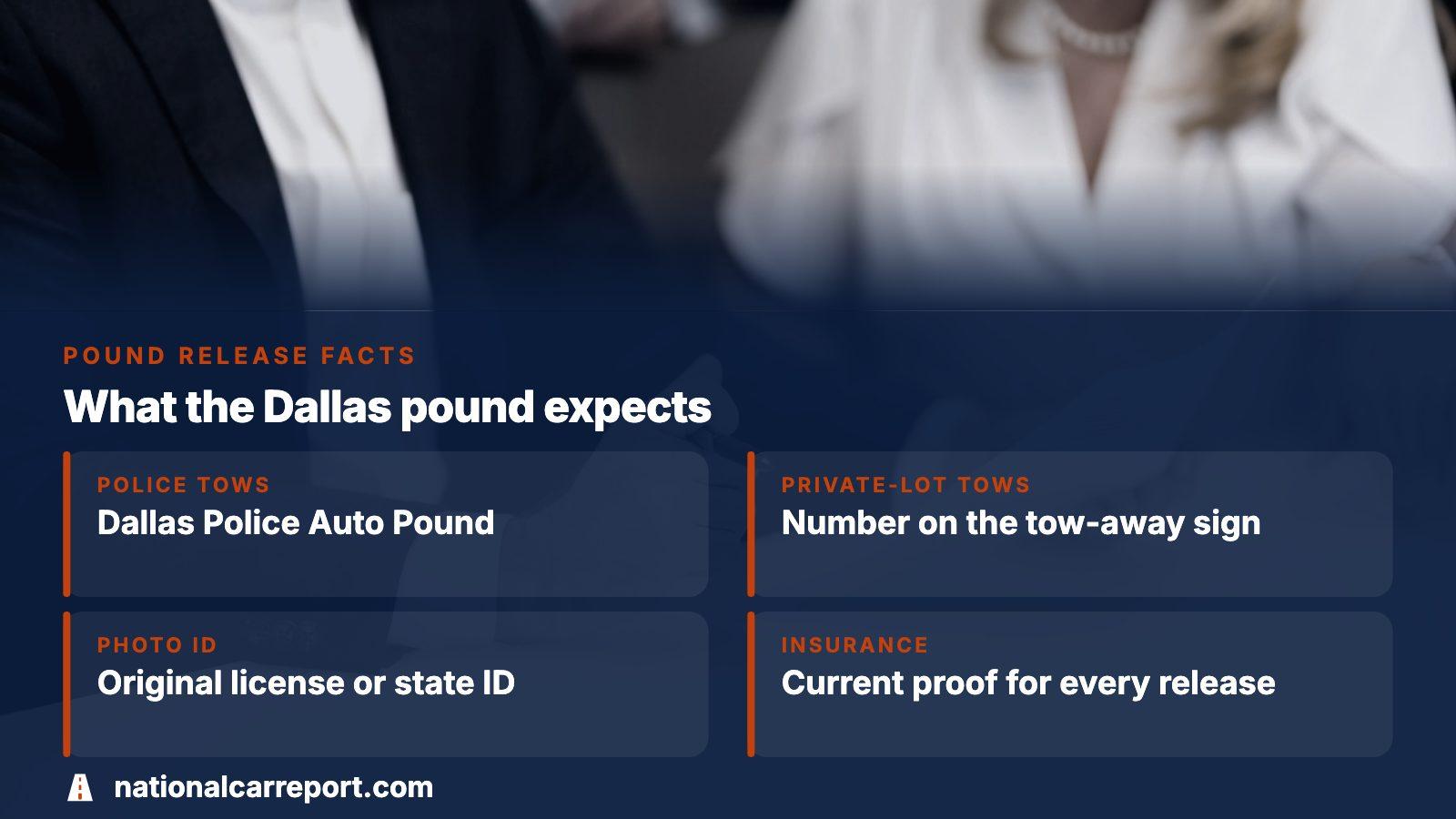
- Your original driver license or state ID. The pound turns away copies.
- Proof of current insurance. Every release needs it, except for lienholders repossessing, insurers and auction buyers.
- The certificate of title or a bill of sale.
- A DMV registration printout, if the car changed hands in the last 30 days.
- If you are not the registered owner, a notarized authorization to release (the pound keeps the form) or another listed document, such as repossession papers or a property release from Lew Sterrett Justice Center.
Photo ID and insurance matter most when you plan to drive the car out. A tow for no insurance carries one more catch: showing a policy afterward does not waive the fees, because pound staff make no waiver decisions. Dallas police have towed the car of any driver stopped for a traffic violation without proof of insurance since 2009, at the owner's expense.
What the pound charges
| Line on the bill | Posted amount |
|---|---|
| Hauling by a standard wrecker | $139.00 |
| Hauling by a mid-size wrecker | $219.00 |
| Hauling by a heavy wrecker | $509.00 |
| Storage, charged per day | $20.00 |
| Impoundment | $20.00 |
| Notice to the owner, only after 48 hours in the yard | $50.00 |
A cashier states the full total at release, and the tow line depends on the wrecker that hauled the car. Sales tax of 8.25% applies to the impound and storage lines only. Cards are accepted and checks are not. Every extra day adds a storage line, so a slow start costs money.
Private-lot tows follow Texas rules
Texas licenses tow companies, trucks and operators through TDLR, along with the storage yards that hold cars taken without the owner's consent. Start with the number on the sign.
- Caught mid-hook: if the truck has not fully hooked up your car, you can ask for it with no fee and no ownership proof. Hooked up but still in the lot, you pay a drop fee, capped statewide at $135 for cars of 10,000 lbs or less.
- At the yard: a photo ID and one document showing ownership or permission to use the car, such as a title or an insurance card naming you, then payment of the tow and storage charges.
- Release hours: a yard that takes cars around the clock must hand yours over within an hour. A yard with set hours owes that hour only from 8:00 a.m. to midnight Monday through Saturday, then from 8:00 a.m. until 5:00 p.m. on Sunday.
- Storage on a Texas-registered car can be billed for five days at most before the yard mails or publishes a notice.
- To contest a tow, ask a Justice of the Peace court covering the county where the car was towed for a hearing. The request is due within 14 days, and the court may charge a filing fee of up to $20.
Complaints about a towing company or yard go to TDLR online. Filing one does not replace a hearing.
Buying a car that sat in a pound
The pound tells you where a car is and what you owe on it. It does not tell you what the car's record says. A VIN search reads impound entries beside liens and theft records, and that matters here: the pound also holds recovered stolen cars, and its insurance requirement is waived for repossessing lenders.
Why the federal title screen is not enough
The Justice Department's NMVTIS consumer page lists title brands, the latest odometer reading and insurer salvage or total-loss reports. It never mentions impounds or tows, and warns that a flag-free result may still miss records, because not every entity reports.
- Ask the seller for the release date and who collected the car.
- Ask whether the owner or a lender paid the tow and storage bill.
- Look for a lien or a title change soon after the release.
Bidding at the Dallas Auto Pound auction
The pound holds an auction on alternate Mondays for cars the city has declared abandoned under Texas law and local code. A holiday Monday can move the sale to the Tuesday after.
- Register before the sale with a state ID, driver license or Mexican consular ID, and be 18 or older.
- Cars sell as is, every sale is final, and payment is due within an hour of the last car sold.
- No car is driven away. A licensed wrecker hauls it, and it must leave by 11:59 PM the day after.
With no warranty and no return, note the VIN stamped on the car at the viewing and run the preview before you bid. A theft or lien entry costs far less to discover on a phone than after the hammer falls.
Running the VIN check and what to do next
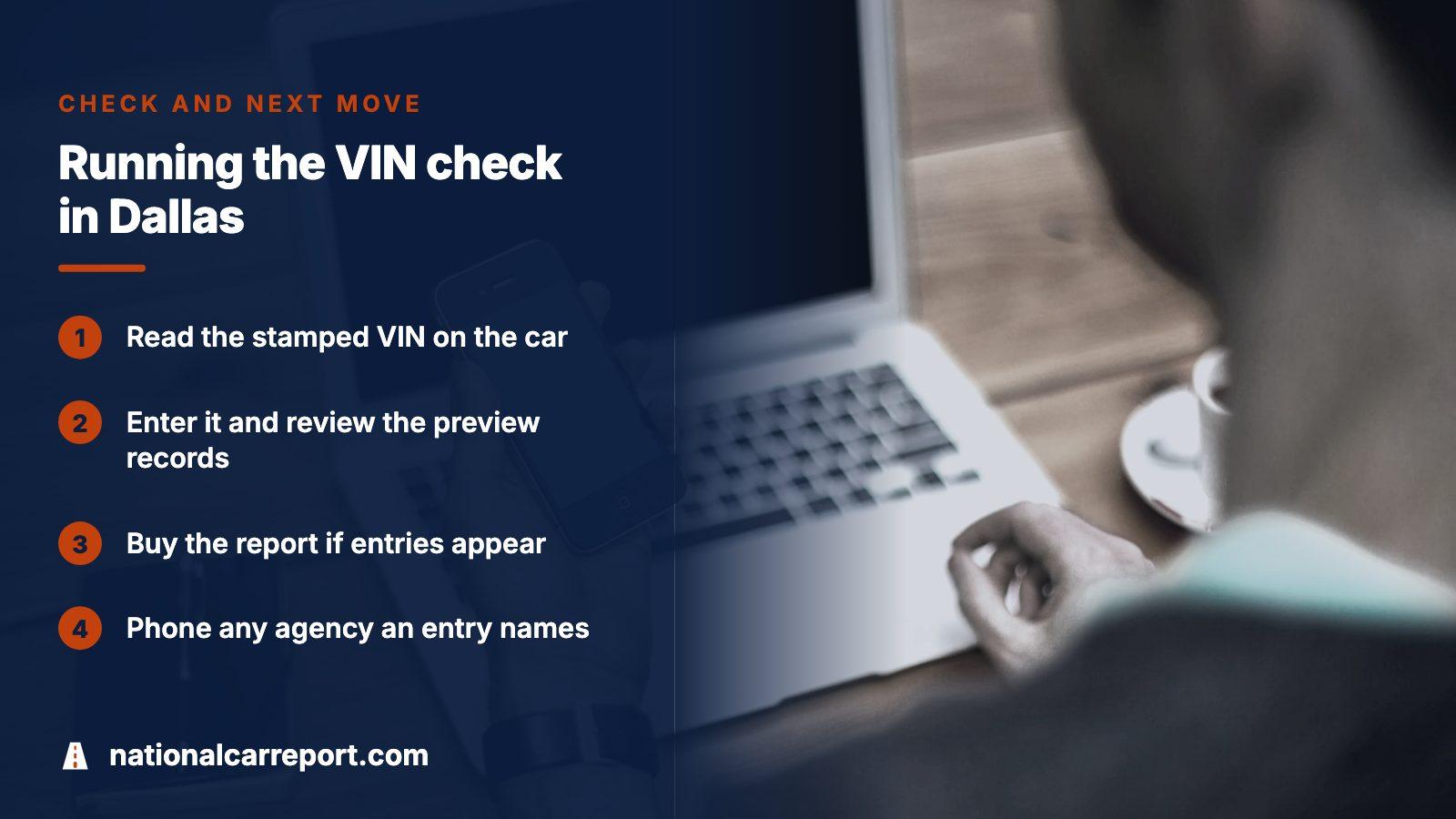
- Read the stamped VIN on the car, then check it against the title paperwork.
- Enter it at NationalCarReport and see which kinds of records the preview lists for that VIN.
- If the preview shows an impound, lien or theft entry, the full report follows as one purchase. Buyers weighing several cars can pick a pack of three, five or ten.
- Phone any agency an entry names, and ask for release papers.
The preview costs nothing. The report afterward is paid once, with nothing recurring, and the pricing page lists what it costs.
An impound with no release story, a lien right after it, or a theft record on a car you mean to buy are reasons to stop. A clean result still leaves the title and the stamped VIN to compare in person.
Where this information comes from
- Dallas Police: Auto Pound general information — Address, phone, what the pound stores, details staff need, insurance and ID rules.
- Dallas Police: claiming a vehicle — Documents an owner or another person must bring.
- Dallas Police: Auto Pound fees and payment — Posted tow, storage, impound and notification charges, tax and accepted payment.
- Dallas Police: Auto Pound auctions — Auction schedule, bidder rules and removal deadline.
- Dallas Police: towing uninsured motorists — The city rule that tows cars of drivers without proof of insurance.
- Texas TDLR: towed vehicle or storage facility consumer information — Drop fees, release hours, storage limits, notices, tow hearings and complaints.
- NMVTIS: for consumers — What the federal title system covers and why a clean result can mislead.
Sources and photos: Facts checked against the sources above in November 2026. Photos by Miles Loewen, Alejandro Escamilla and Carrie Allen www.carrieallen.com on Unsplash; diagrams by NationalCarReport.
Keep reading
- Texas Impound Lookup: Find a Towed Car, Then Check Its VINHow towed-car searches work across Texas, beyond Dallas.
- Impound Lookup: Find a Towed Car, Then Check Its VIN for Impound RecordsThe national picture: why impounds sit in local files, not one database.
- Car Lien Search in Texas: Check a Used Car by VIN Before You PayChecking a Texas car for a lender's claim before money changes hands.
- Stolen Car Check by VIN: Nationwide Theft, Lien and Impound RecordsIf neither the pound nor a tow yard has your car, test the stolen angle.
Frequently asked questions
How do I find out if my car was towed in Dallas?
Call the Dallas Police Auto Pound at 214-670-5116 with your plate, VIN, year, make, model and name as registered owner. If a property owner had it hauled, ring the number posted on the tow-away sign instead. No record from either source means you should report the car stolen.
What do I need to get a car out of the Dallas impound lot?
Bring your original driver license or state ID, current insurance, and a title or bill of sale. Someone else collecting needs notarized authorization or another listed document. Expect to pay the tow, impound and storage charges by card.
How long can the Dallas Auto Pound keep my car?
The pound's pages give no single holding period. Storage accrues daily, and cars declared abandoned are auctioned every other Monday. At a private yard, Texas generally calls for two notices and a wait of at least 30 days after the second before any sale.
Can I do a Dallas impound lookup by VIN online?
The pound's pages ask you to phone with the VIN rather than search online. NationalCarReport's VIN preview does something different: it shows whether impound, lien or theft entries exist in a car's recorded history, though it cannot say which yard holds a car today.
How much does the VIN report cost?
The preview is free. It tells you what record categories are held against the VIN you enter. The full report is bought once, not as a plan, and shoppers sizing up several cars can take a bundle. Amounts are on the pricing page.
Now check the car itself
The guide explains what to look for. The report shows what this VIN has on record.