THE SHORT ANSWER
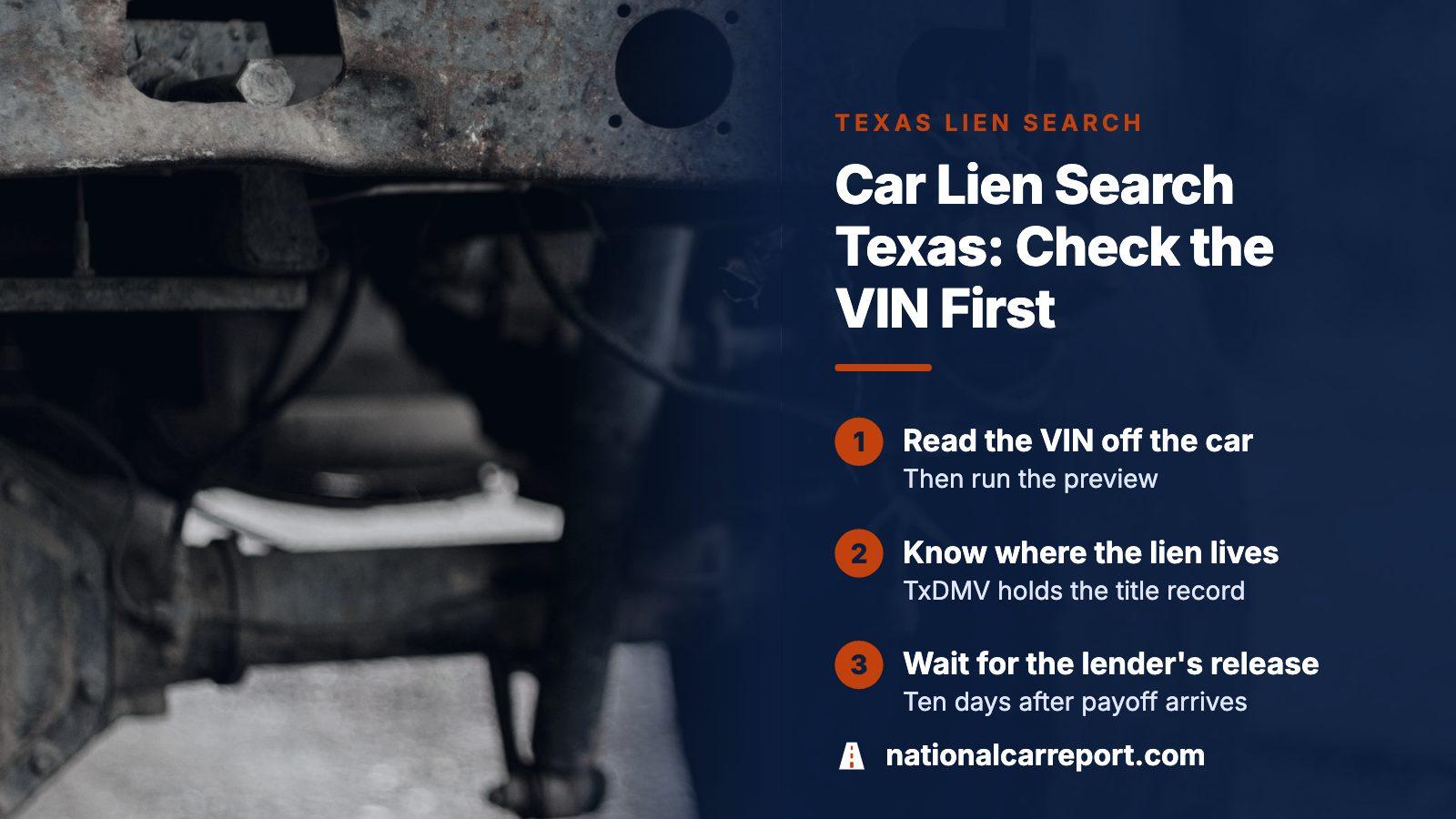
To run a car lien search in Texas, take the VIN from the car and enter it for the preview, which looks for lien, theft and impound records. A listed lien suggests a lender may still hold a claim that needs a release before you can have a clean title. A clear result is a screen rather than proof, because lien detail reaches national records only where it is shared. Settle the question on the Texas title.
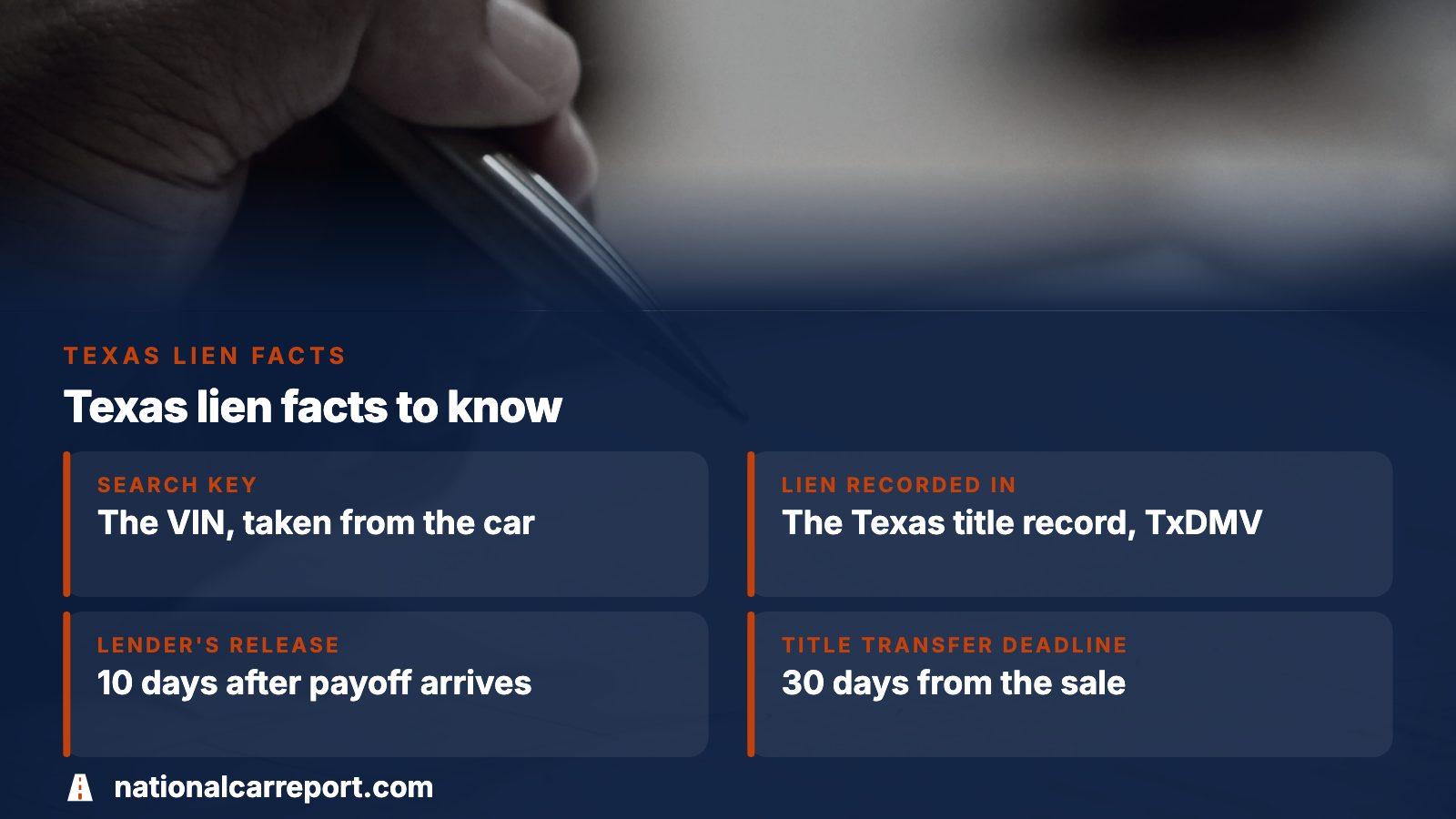
- Search key
- The VIN, taken from the car
- Where the lien is recorded
- The Texas title record, held by TxDMV
- Lender's release window
- 10 days after the payoff arrives
- Title transfer deadline
- 30 days from the sale
What a lien search by VIN brings back for a Texas car
NationalCarReport reads a car the way three parties see it. A lender may hold a lien, police may have taken a theft report, and a tow operator may have kept the car on a lot. All three attach to the VIN, so one search gathers whatever was reported, in Texas or elsewhere.
- Lien: a lender's recorded claim, shown where that detail was reported
- Theft: whether the car was reported stolen, and whether it was found
- Impound: a record that the car was held at a tow or storage yard
- Brands on the title, such as salvage or rebuilt
Where a Texas lien actually lives
A lender's claim in Texas is added to the title through the county tax office, and the Texas Department of Motor Vehicles keeps the title record. When an application names a lender, TxDMV says the lienholder receives the title. Under the state's electronic program the department holds the title instead, and the lender keeps an electronic record in place of paper.
That shapes a private sale. A seller with no paper title may be waiting on a lender, or may own a car with an electronic title. Neither is suspicious alone, but in both cases the release is not the seller's to hand you.
Running the search, then checking the paper
- Find the VIN at the dash corner by the windshield and on the door-jamb sticker, and make sure both match the title.
- Run it in the preview and note any lien, theft or impound records.
- Request the signed title and a filled-in Form 130-U from the seller, with a lien release if there was ever a loan.
- Meet at a county tax office. TxDMV says staff there can spot title problems, such as a salvage brand or a legal issue, before the application is filed.
- Put the title in your name inside 30 days of the sale, because a late transfer can draw a penalty.
What each result tells you, and your next move
| On the report | What it suggests | Your move |
|---|---|---|
| Lien listed | A lender recorded a claim that may still be open | Ask for a written payoff and pay the lender |
| No lien shown | Nothing was reported, which proves little | Ask to see the title, then check it at the tax office |
| Theft record, not recovered | The car may still count as stolen | Do not pay; tell police if you know where it is |
| Impound record | The car sat in a tow or storage yard | Ask what was owed, who paid and where it went next |
| Title not in the seller's name | The seller may be unable to sign a release | Stop until the names line up |
| Loan paid but lien still on title | The release may not have been processed | Ask for the lender's original release |
A blank lien field is a screen, not a clearance
The national title system runs on a short mandatory list: the VIN, whatever the title says including brands, who received it, salvage or junk acquisitions where a state records them, and the mileage noted at issue. The federal rule asks for that at an interval of 24 hours. Lien data is not on the list. It joins only when the system operator and the state agree.
TxDMV's own Title Check page covers title history and brands such as salvage, rebuilt and water damage, but never mentions liens.
How to read a clear result
A missing lien means only that nothing was reported nationally. Ask for the title in the seller's name and let a tax office clerk look at it before money moves.
Paying off a Texas lien, and the 10-day release
Once a loan is repaid, TxDMV gives the lender 10 days from the payoff to release its claim. What follows depends on how the title is held.
- Paper title: the lender mails the title to the owner. To clear the lien at the county office, bring that title, the lender's release letter and Form 130-U.
- Electronic title: the lender tells the owner and coordinates with TxDMV, which converts the e-title to paper and mails it.
- Dealer trade-in: the lender has 10 business days, and the paper title is mailed to the dealer.
Paid off is not the same as released
TxDMV notes that a paid-off lien can still appear on a title, and an original release is then required; a fax or photocopy is refused. If a seller says the loan is gone, ask for the original paper or an updated title.
If the search finds a live loan
An open loan does not rule out a purchase, as long as the lender is paid first. Cash handed to the seller against a promise to settle later leaves the lender's claim on a car that is now yours.
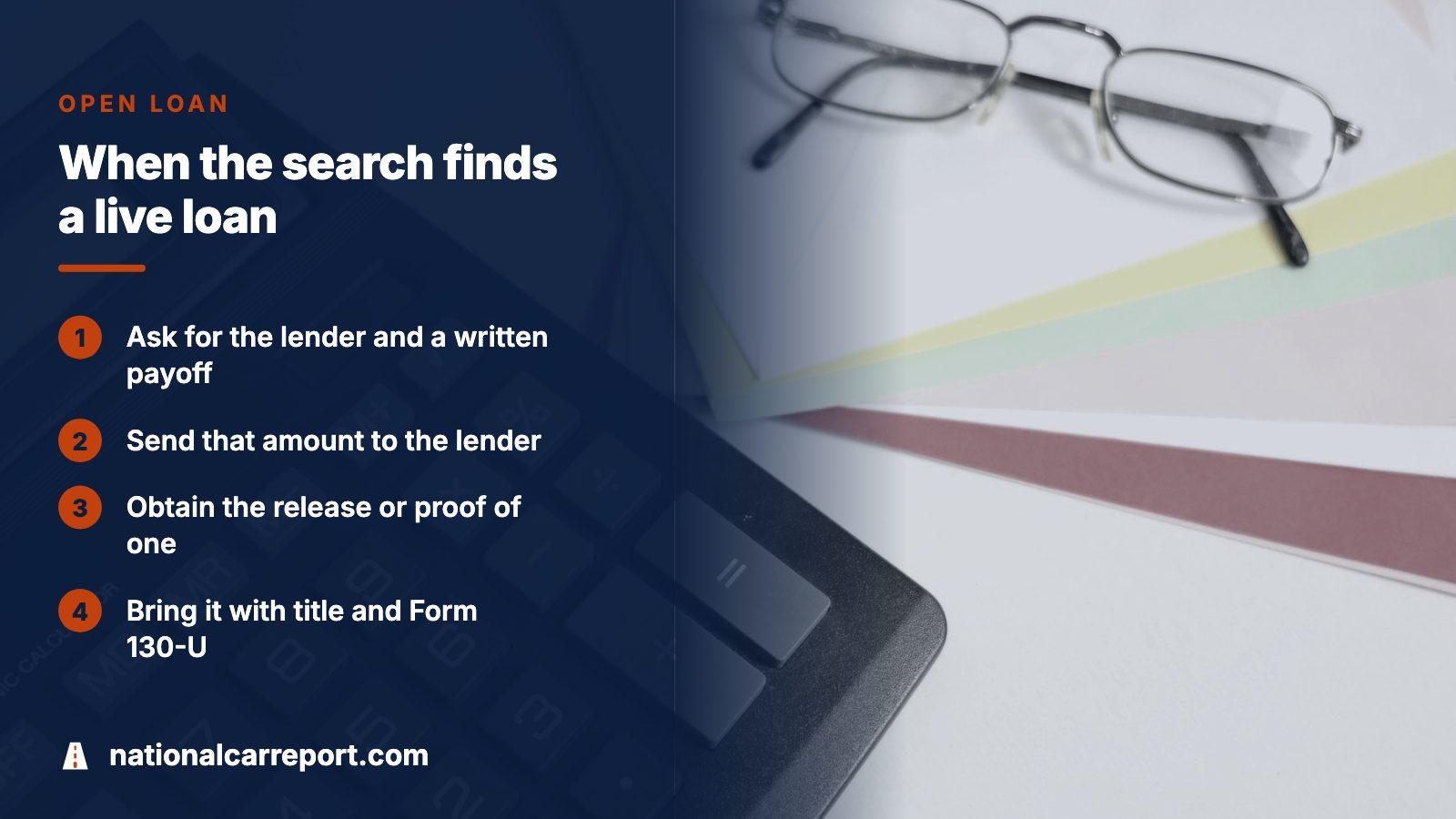
- Ask for the lender's name and a payoff quote in writing, noting when it expires.
- Send that amount to the lender. The seller keeps only the difference.
- Obtain the release, or proof that an electronic release was filed.
- Bring it with the signed title and Form 130-U to the tax office to get a title in your name.
Impound and storage claims that never reach a title
A lender is not the only party with a stake in a Texas car. The Texas Department of Licensing and Regulation licenses tow companies, trucks and operators, and it describes a storage facility as a private garage or lot that holds 10 or more vehicles a year without the owner's consent. Getting a car out takes photo ID, proof that you own it or may use it, and payment of the tow and storage bills.
Abandoned cars can be sold after at least two notices and a wait of 30 days following the second. An impound record is a prompt for questions: how long was the car held, and who settled the bill?
When the seller has no title and offers a bonded one
Some sellers pitch a bonded title as the cure for missing paperwork. TxDMV will not issue one while a recorded lien is 10 years old or less, unless the lienholder supplies a release or a letter of no interest. The bond is priced at one and a half times the car's value, and the applicant buys it.
The other route is a court order that awards the car free of liens and states the VIN. Run the VIN first, and treat a lien, theft or impound hit on a titleless car as a reason to leave.
What it costs and where to go next
Only the preview comes without a charge, and it shows what the VIN returns before anything is paid. After it, the report is a one-off purchase that never renews, and the pricing page explains buying one or a bundle for comparing cars. The sample report shows how results are laid out. Then take the car and the paperwork to a county tax office, and treat any pressure to hurry as a warning.
Where this information comes from
- TxDMV: Add or remove a lien on a vehicle — Source for the lender's release window and how paper and electronic liens are cleared.
- TxDMV: Buying or selling a vehicle — Source for the private-sale steps, the tax office check and the 30-day title deadline.
- TxDMV: Title check, look before you buy — Shows what the state's own title check lists, and that liens are not mentioned.
- TxDMV: Electronic Lien and Title program — Explains electronic titles, electronic releases and the dealer trade-in payoff window.
- TxDMV: Bought a vehicle with no title — Shows how liens limit a bonded title and how the bond is sized.
- 28 CFR 25.54: what states report to NMVTIS — Lists the items states must send nationally, and leaves lien data to agreement.
- TDLR: Towed or stored vehicle owner information — Covers reclaiming a stored car, the notices before a sale and the tow hearing option.
Sources and photos: Facts checked against the sources above in November 2026. Photos by Zoshua Colah, Cht Gsml and Masjid MABA on Unsplash; diagrams by NationalCarReport.
Keep reading
- Vehicle Lien Check by VIN: Nationwide Lien, Theft and Impound RecordsThe nationwide version of this check, for a car from any state.
- DMV Lien Release Search: How to Confirm a Lien Is GoneHow to confirm a lender has really let go of its claim.
- Texas Impound Lookup: Find a Towed Car, Then Check Its VINFinding a car that was towed or held in a Texas storage yard.
- PricingOne report or a pack, paid once, with no subscription.
Frequently asked questions
How do I do a car lien search in Texas?
Run the VIN from the car through the preview for lien, theft and impound records. Then request the signed title and visit a county tax office together, where a clerk can say whether the title is correct. The lender's claim lives on the state title record, so that step settles it.
Is there a free Texas lien search?
Only the preview carries no charge; the report itself is a one-off purchase. TxDMV's Title Check goes through approved providers, needs a VIN and a card, and lists title brands without mentioning liens. A Texas lien is confirmed at the tax office, by the lender, or on the title itself.
Can I buy a Texas car that still has a lien on it?
Yes, as long as the payoff reaches the lender. Obtain a written quote, send that amount to the lender and pay the seller the remainder. A promise to settle later is not enough, since the claim stays attached to the car.
How long does a Texas lender have to release a lien?
TxDMV's lien page gives 10 days from the moment the lender receives payment. For a dealer trade-in payoff, the lienholder page says 10 business days. If the release runs late, ask the lender for its status in writing and contact TxDMV.
What if the search finds no lien but the seller owes money?
It can happen. Lien detail reaches national records only where a state and the system operator agree to share it, so an empty field proves little. Ask to see the title in the seller's name, and leave a seller who will not let you contact the lender.
Now check the car itself
The guide explains what to look for. The report shows what this VIN has on record.