THE SHORT ANSWER
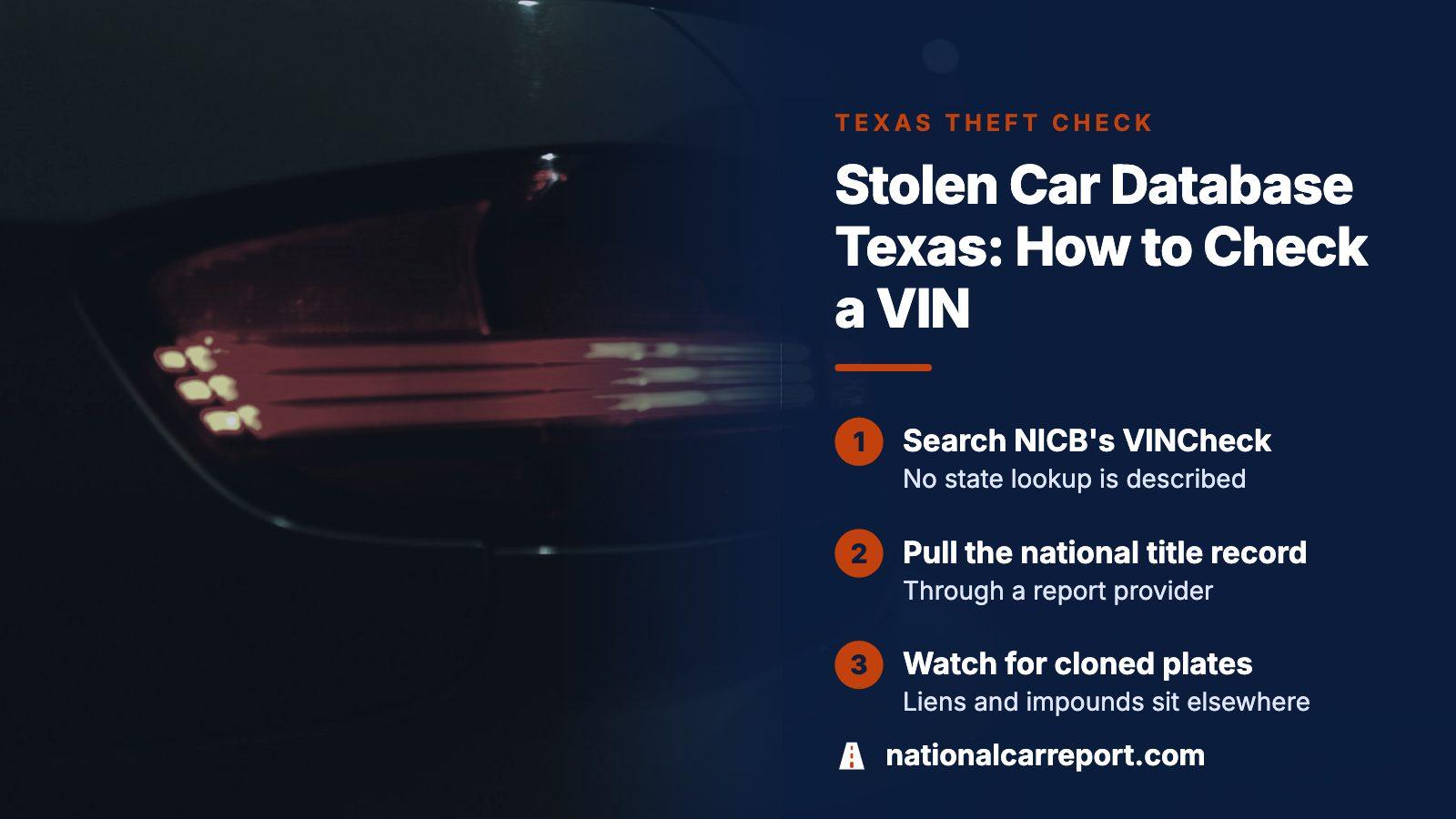
The state's buyer pages describe no public stolen-car lookup, so a Texas check is built from separate sources. Search NICB's VINCheck for insurer theft, salvage and flood records, pull the national title record through a provider on TxDMV's Title Check page, and inspect the VIN plate on the car. A clean result is a screen, not proof. The NationalCarReport preview adds theft, lien and impound entries for the same VIN.
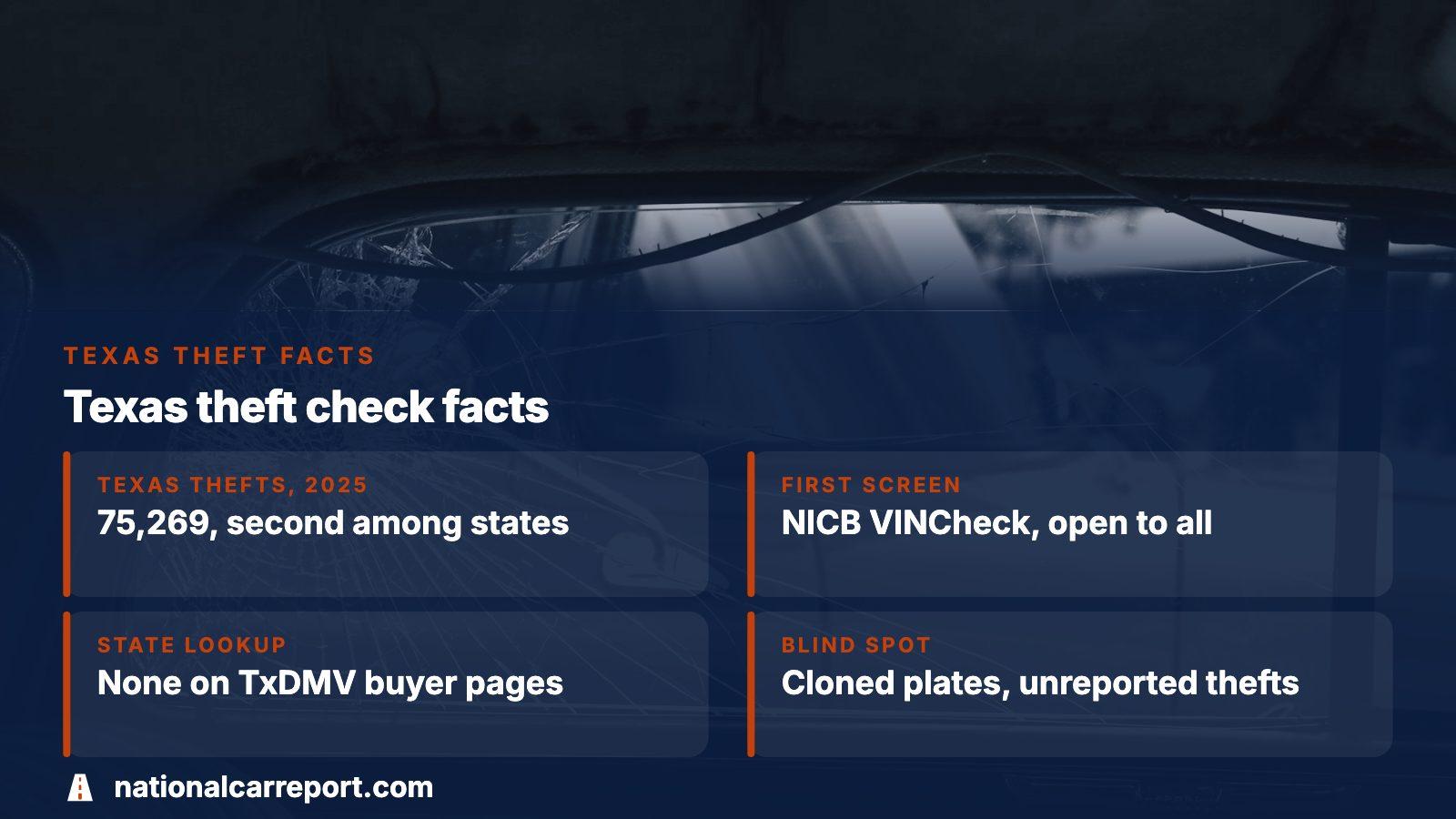
- Texas thefts, 2025
- 75,269, second among states (NICB)
- First screen
- NICB VINCheck, open to all, five searches from one IP inside 24 hours
- State lookup
- None described on TxDMV's buyer pages
- Biggest blind spot
- Cloned plates and unreported thefts
Where theft records for a Texas car actually sit
No single file holds every theft, and the pieces belong to different keepers. This table shows what a buyer in Texas can reach and what each piece leaves out.
| Keeper | Where it looks | Blind spot |
|---|---|---|
| NICB VINCheck | Member insurers' reports of cars stolen and still missing, plus salvage and flood claims. Open to anyone, with each IP address limited to five searches in 24 hours | Police files, and insurers that chose not to take part |
| National title system (NMVTIS) | Title brands, latest odometer reading, insurer total losses and, in some cases, past theft data. Reached through providers on TxDMV's Title Check page | States that do not report; theft is not a guaranteed field |
| Police agencies and auto theft task forces | The report an owner filed, with the VIN supplied at the time | TxDMV's buyer pages describe no public search of it |
| NationalCarReport | Theft, lien and impound entries together, next to title brands and auction photos | Only what its data sources have received |
Why Texas cars earn the extra look
NICB counted 75,269 vehicles reported stolen in Texas during 2025, second only to California's 136,988 among the states. The national count was 659,880, down 23% from 2024, which makes Texas about one theft in nine. It was also missing from NICB's list of the ten steepest percentage declines.
Theft clusters near big cities. NICB put the Houston metro area at 23,659 thefts and Dallas-Fort Worth at 21,638; together they pass half the state's total. Those figures say where thieves worked, not whether a particular car is clean. TxDMV's own theft page quotes yearly totals without a year attached, so NICB's 2025 count is the fresher yardstick. A popular target such as the Silverado 1500 or Accord deserves a hard look, and a quiet model can still turn out to be a clone.
Steps for checking a Texas VIN
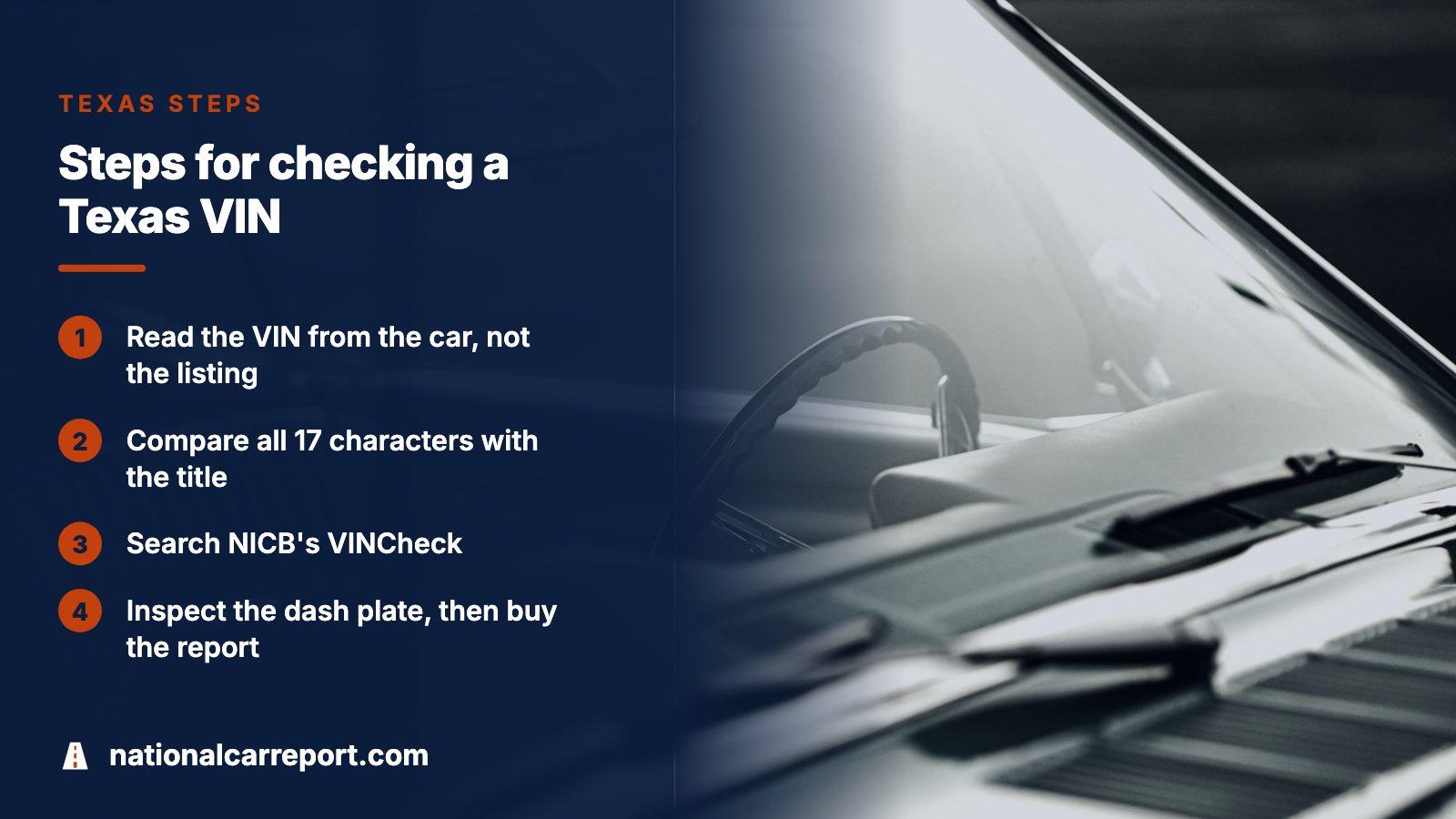
- Read the VIN from the car, not the listing. On the driver's side, look through the windshield at the dashboard corner, or find the sticker on the door or door jamb. The title and the insurance card print it as well.
- Compare all 17 characters with the title and registration. TxDMV says both documents should show the seller's own name and address.
- Search NICB's VINCheck. Anyone can use it, one IP address is held to five searches inside 24 hours, and a single wrong character can hide a match.
- Order a title record from a provider listed on TxDMV's Title Check page. Several large report brands on that page serve dealers only, so read the page before you pay.
- Enter the VIN for the free preview at NationalCarReport and see which theft, lien and impound entries exist.
- Inspect the dash plate in person, then buy the full report for any car that has cleared the first five steps.
Reading what comes back
Match each result to a next move before you talk price.
| Result | What it usually means | Your move |
|---|---|---|
| Stolen, not recovered | An insurer has the car logged as missing | Stop. Hand the VIN and listing to police |
| Theft recorded, then recovered | The car came back, in unknown condition | Ask for repair invoices and book an inspection |
| Total loss after a theft | A theft claim can end in a total-loss write-off once 30 days pass without recovery, and a car found later in good shape keeps that label | Ask what shape the car was in when found, and price the history |
| VIN Replaced brand | TxDMV defines it as a new state-assigned number, not necessarily a problem | Ask the seller to explain it with documents |
| Lien or impound entry | A lender may still hold a claim, or a storage lot once held the car | Get a written release or a release date first |
| Clean result | Nothing turned up in the files searched | Still inspect the plate and the car |
Cloned plates and swapped VINs
A search answers only for the number typed into it. TxDMV warns that thieves may lift a VIN plate off a similar wrecked car, and the federal title site describes cloning as putting a number taken from a same-make, same-model, same-year vehicle onto a stolen one. The title site cites Operation Roadrunner, which brought back roughly 250 cloned stolen cars nationwide, and a Florida ring that cloned over 250 cars worth $8 million was broken up.
- The dash plate should be present, firmly attached and unaltered, with no sign of repainting.
- Stamped numbers should look like original factory work.
- Doubts about a plate go to a new-car dealer for that make or to a police agency, per TxDMV.
An odd number is not always a thief's work. TxDMV's brand list includes VIN Replaced, a new state-assigned number that does not necessarily signal a problem, though the page advises further research to establish the correct VIN. A seller whose title carries that brand should be able to explain the replacement and show the documents.
Liens and impounds sit in separate Texas records
A car can clear every theft screen and still not be the seller's to hand over. After a Texas loan is paid, the lender has 10 days to release the lien: on a paper title it mails the title, and on an electronic record it works with TxDMV directly. If the title still names a lender, ask for the release letter or a notice from that lender before money moves.
Towed cars move on a fixed notice clock. The storage lot mails owners and lienholders a certified letter: the first no later than day five for a Texas-registered car, day 14 for one registered elsewhere, and a second somewhere from day 15 to day 20 after that. Once 30 days pass after the second letter without a claim, the lot may dispose of the car. A car with no plates and a VIN nobody can read gets an NMVTIS lookup to find its home state. Ask the seller of any recently recovered car where it was held and who released it.
Cost, and what to do after a hit
The preview at NationalCarReport carries no charge and lists the theft, lien and impound entries found for that VIN. A single report is paid for once, with nothing recurring, and a shortlist of cars can be covered by buying three, five or ten at once. Current amounts sit on the pricing page.
TxDMV's warning on stolen cars
Stolen cars are regularly resold to people who had no idea. A knowing buyer risks arrest; an innocent one risks losing both the car and the money paid.
If any search shows a theft, stop and give the VIN and listing to the police. NICB takes reports of suspected fraudulent sales online or on 800-TEL-NICB. When the checks pass, title the car in your name within 30 days of purchase to avoid financial penalties. A buyer who finds a title history problem on a car bought from a Texas dealer can complain to TxDMV's Enforcement Division.
Where this information comes from
- NICB: VINCheck lookup — What the insurer-fed theft, salvage and flood search covers, its daily limit and the records it does not query.
- NICB: U.S. vehicle thefts experience historic decline — The 2025 national total, the Texas count, the Houston and Dallas-Fort Worth metro figures and the top models.
- TxDMV: Title Check, look before you buy — How Texas routes buyers to national title records, the brand list including VIN Replaced, the dealer-only providers and the 30-day titling rule.
- TxDMV: Add or remove a lien on a vehicle — The 10-day lien release rule and how paper and electronic titles differ when a loan is paid off.
- TxDMV: Auto theft prevention — The Motor Vehicle Crime Prevention Authority's page: the stolen-car warning to buyers, VIN plate checks, theft totals without a year and task-force funding.
- NMVTIS: For consumers — What a consumer title report holds, when theft data appears, the 30-day total-loss rule and the cloning cases.
- TDLR: Vehicle storage facility notifications — The notice deadlines a Texas storage facility follows for owners and lienholders.
Sources and photos: Facts checked against the sources above in November 2026. Photos by Johnathan Kaufman, Dylan Michaud and sippakorn yamkasikorn on Unsplash; diagrams by NationalCarReport.
Keep reading
- Stolen Car Check by VIN: Nationwide Theft, Lien and Impound RecordsThe nationwide version of this check, with the same sources beyond Texas.
- Car Lien Search in Texas: Check a Used Car by VIN Before You PayHow a Texas lender's claim shows up and what a release looks like.
- Texas Impound Lookup: Find a Towed Car, Then Check Its VINFinding a towed Texas car and what the storage notices mean.
- Most stolen cars: the national list and how to check a VIN for theftWhich models thieves favor and why that matters when you shop.
Frequently asked questions
Is there a stolen car database for Texas?
TxDMV's buyer pages describe no public stolen-vehicle lookup. The files that exist are split: NICB's VINCheck holds insurer theft records, the national title system holds title data and some theft history, and police agencies hold the owner's report. None is complete alone, so a Texas check reads them together.
Can I check a Texas VIN for theft at no charge?
Partly. NICB's VINCheck is open to anyone, holds each IP address to five searches inside 24 hours, and reads only participating insurers' records. The preview at NationalCarReport also carries no charge, and the full report is bought separately. Neither replaces looking at the plate.
Who do I ask in Texas if a VIN plate looks wrong?
TxDMV says to check with a dealer that sells the same model, or contact a law enforcement agency. Do it before paying. Photograph the plate, keep the seller's name and address, and write down who you spoke with and when.
Can a car pass NICB's search and still be stolen?
Yes. NICB calls VINCheck a useful tool but not a full history report. It searches participating insurers, which it puts at 92.49% of earned premium, and skips police records. A theft nobody reported, or a clone wearing a legitimate number, would pass.
What does a stolen car check cost at NationalCarReport?
No charge for the preview, so you can see which theft, lien and impound entries exist before deciding. One report is a one-time purchase, and a shortlist can be covered with three, five or ten at once. Look on the pricing page for amounts, which this page leaves out.
Now check the car itself
The guide explains what to look for. The report shows what this VIN has on record.