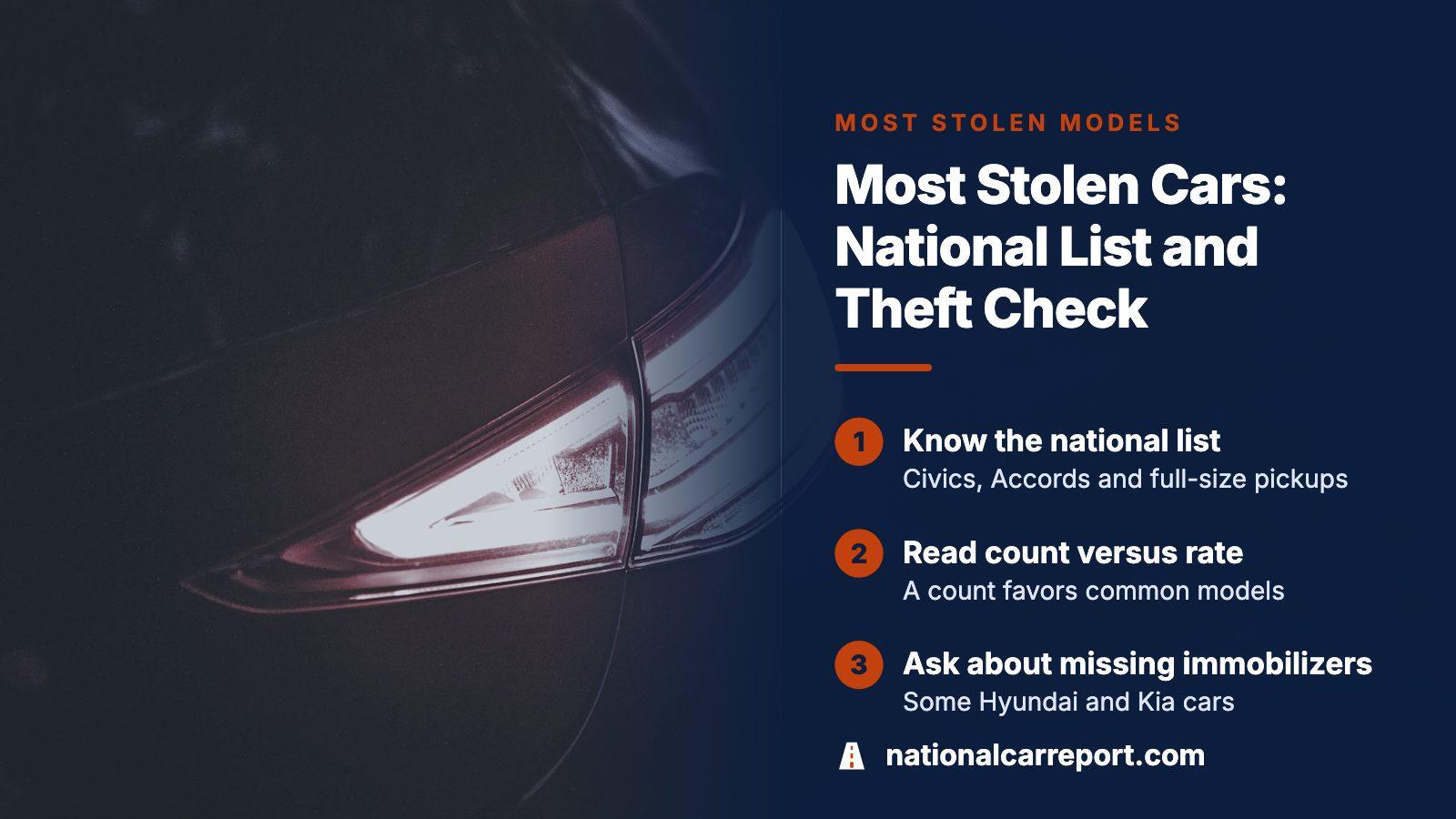
THE SHORT ANSWER
National theft rankings are topped by Honda Civics and Accords, full-size Ford and Chevrolet pickups, Hyundai and Kia cars from the 2011 to 2021 stretch that shipped without engine immobilizers, and Dodge Hellcat-family Chargers and Challengers. NICB's yearly Hot Wheels report is the scoreboard, counted from police theft reports. Before buying a used car, search its VIN in NICB's free VINCheck, then order a history report for theft, lien and impound records.
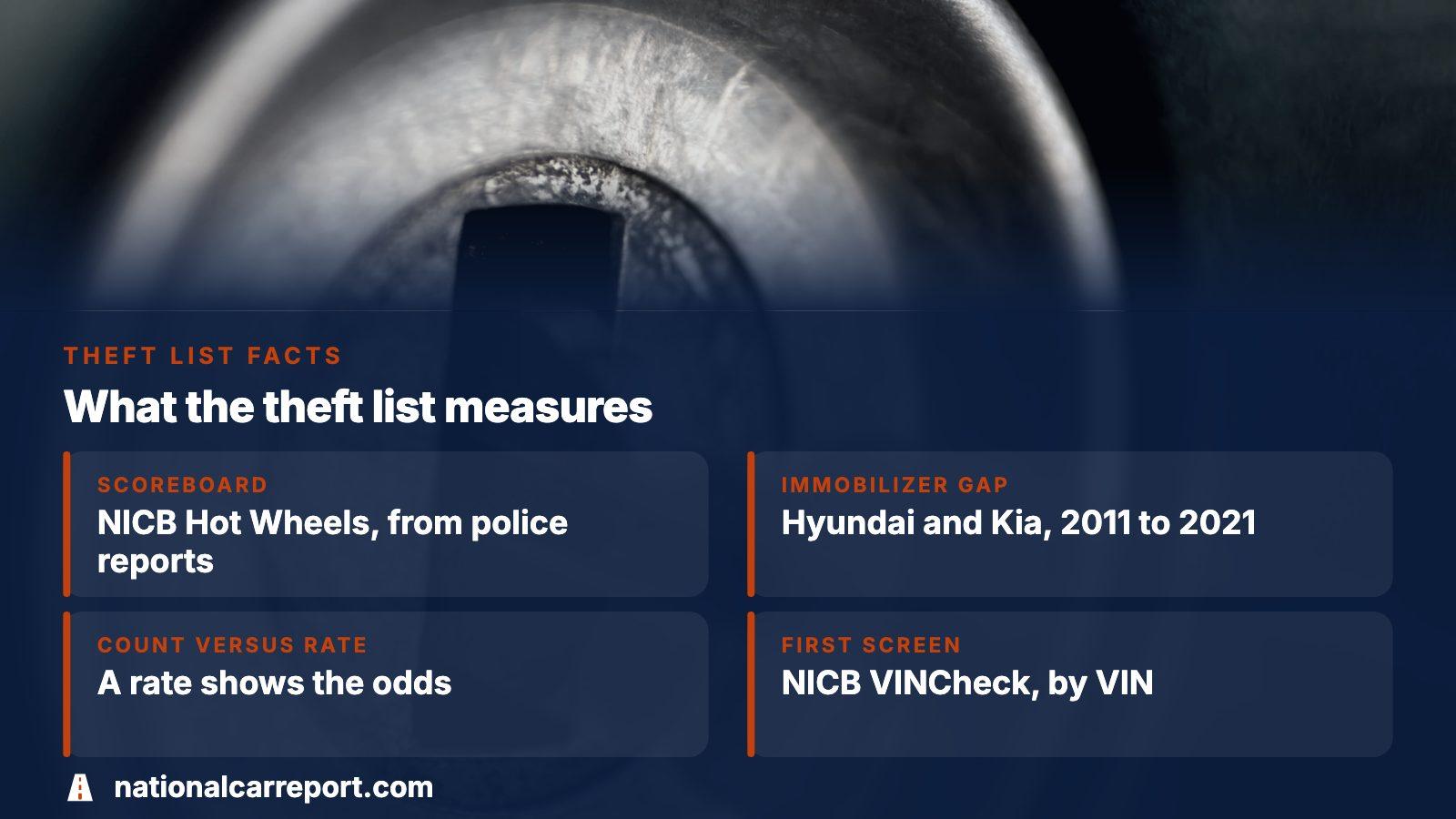
- Scoreboard
- NICB Hot Wheels, counted from police theft reports
- Immobilizer gap
- Many 2011 to 2021 Hyundai and Kia cars with turn-key ignitions
- Count versus rate
- A count favors common models; a rate shows the odds
- First screen
- NICB VINCheck, searched by VIN
The models that keep landing on the national list
Raw-count rankings fill up with whatever Americans own most: Ford and Chevrolet full-size pickups, plus Honda Civics, Accords and Toyota Camrys. Two other groups earned their place differently.
- Pickups, Civics, Accords, Camrys: sheer volume. Even a low theft rate yields a long list when this many are parked outside.
- Hyundai and Kia, built 2011 to 2021: many turn-key trims had no engine immobilizer.
- Dodge Hellcat family: horsepower with street value, and electronics that key-cloning tools have beaten.
- Any model whose parts fit many other cars: tailgates, hoods, wheels and converters resell easily.
How the national count is built, and why two lists disagree
NICB, the National Insurance Crime Bureau, counts theft reports that police agencies enter into the National Crime Information Center, the FBI's national database. One valid report on one vehicle is one theft. Nothing adjusts for how many of that model are registered, so the result is national by construction and leans toward popular cars.
| List | One entry is | Blind spot |
|---|---|---|
| NICB police-report count | A whole vehicle reported stolen | How many of that model exist |
| Insurance claim rate | A theft claim on an insured vehicle | Uninsured thefts, and part-only claims |
| Federal high-theft finding | A truck line flagged for parts marking | Current risk, since the yardstick is 1990 and 1991 |
Use the count to see what gets taken, and a rate to judge the odds for one model.
Using a national ranking when your question is about one state
Searches for most stolen cars by state turn up tables that disagree with each other and with the national list. Check which measure each one uses. A count follows what a state owns. A rate shows where a model is hit hardest against its registrations, which can put a rarer car on top.
Neither says anything about the car you are buying. A stolen vehicle entered in the national database is flagged wherever it appears, so the check is the same in every state: the VIN against national records.
Hyundai and Kia, 2011 to 2021: what a buyer should ask
The biggest theft story of recent years began with a missing part. A lot of Hyundai and Kia cars sold with a turn-key ignition had no engine immobilizer, the key-to-engine handshake rivals had made standard years earlier. A method for exploiting that spread on social media, bent national theft totals, and brought insurer surcharges, class settlements and a software update that blocks starting without the fob.
Exposure depends on the model, year and ignition, which the VIN spells out. Before buying one, get three answers.
- Was the anti-theft update installed? Ask for the dealer work order.
- Has the steering column or ignition been repaired? The attack damages both, so fresh parts suggest the car was targeted.
- What does insurance cost for this exact VIN? Get the quote first.
Converters, tailgates and hoods: when the part is the target
Not every theft takes the whole car. Catalytic converters contain platinum, palladium and rhodium, priced like precious metals. Hybrids with barely worn converters and high-clearance vehicles are the usual donors, and a saw removes one in minutes. Panels that fit many cars explain why Civics and Accords stay on lists for decades.
A new part is a question, not a verdict
A replacement converter on an eight-year-old hybrid likely means the original was cut off in a parking lot. That can be an honest repair. Ask for the shop invoice and compare its date with the seller's story.
Marked parts: what the federal parts rule means on a used car
A federal Theft Prevention Standard exists to help trace parts taken from stolen cars. Where it applies, it names eighteen parts, among them the engine, transmission, hood, fenders, doors and bumpers, that must carry the vehicle's identifying number.
Coverage has limits. Passenger cars and multipurpose passenger vehicles rated 6,000 pounds gross weight or less are included. Light-duty trucks are included only where the regulator judged the line high theft. Manufacturers building fewer than 5,000 vehicles per year for U.S. sale are out, and a line fitted with a qualifying antitheft device can be exempt. Read the rating on the certification label by the driver's door.
A missing label proves little
An unmarked panel does not mean a low-theft model, and it does not mean tampering. On a line that was marked, though, torn residue where a label belonged, with no number you can read, is what the rule was built to leave behind. Ask why that panel was replaced.
Liens and impounds: the records a theft ranking never shows
A theft screen answers one question: was this car ever reported stolen? Two other records change what you are really buying, and a history report lists them beside title brands, accident history, odometer readings and recalls.
- Theft record: find out whether the car was recovered and how it was titled afterward.
- Lien: a lender may still be owed money, whoever signs the title. Ask for proof of release before you pay.
- Impound entry: the car was held somewhere. Ask why, and who released it.
NationalCarReport starts with a free preview from the VIN. One report is then a single payment with no subscription. The pricing page has the options.
Running a theft check on a used car, in order
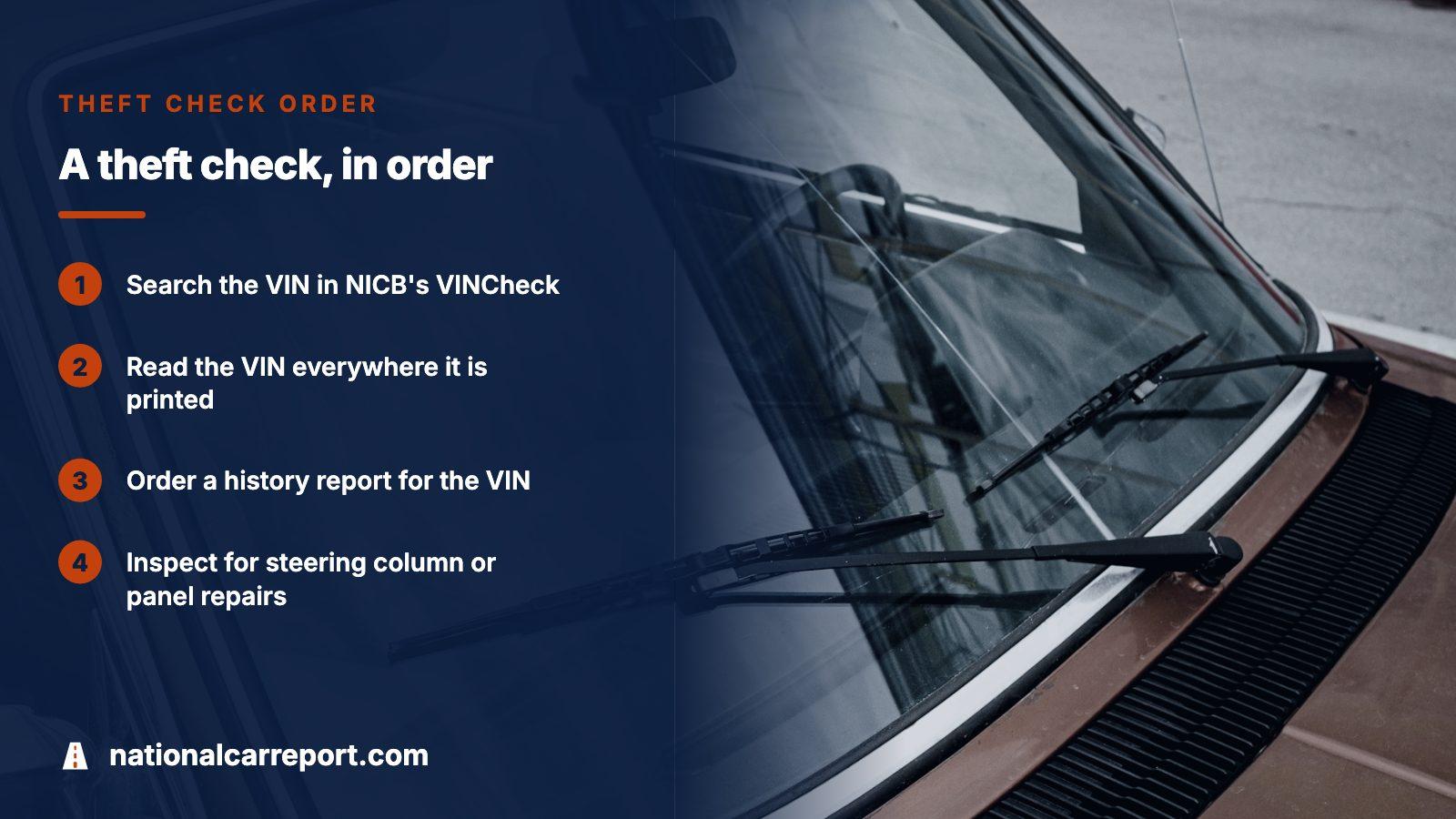
- Search the VIN in NICB's VINCheck, which costs nothing.
- Read the VIN everywhere it is printed: dashboard, door jamb, title and any etched glass. All must agree. A mismatch is how a cloned car gives itself away.
- Order a history report for the VIN covering theft, lien, impound and title records. A recovered car that insurers wrote off leaves a mark on the national title record.
- Inspect the car for a repaired steering column, a hood or tailgate newer than the body, and torn label residue.
- Get an insurance quote on the VIN before settling on a price.
A stolen-and-recovered car is not automatically a bad buy if it has been inspected, titled correctly and priced for its history. Mismatched VIN plates are different: leave the car and let the police sort it out.
If you already own a model on the list
Owning one of these cars is not a verdict, but a few steps make yours the harder target.
- Hyundai or Kia in the affected range: ask a dealer to install the manufacturer's anti-theft software update.
- Make the easy steal harder: wheel locks, a column lock, etched glass, lighting and a driveway camera.
- Hybrid or truck: a converter shield or cage slows a thief down.
- If the car is taken, call the police and the insurer at once and have the VIN entered with NICB, because recovery odds drop with every hour. Keep every receipt and report number; that paper trail supports the claim.
Where this information comes from
- NICB: Hot Wheels annual theft reports — Where each year's most-stolen ranking is released, counted from police theft reports.
- NICB: Hot Wheels versus theft claim rate reports — Explains why a police-report count and an insurance claim rate rank cars differently.
- NICB: VINCheck — The no-cost theft and salvage lookup by VIN used in the first step above.
- 49 CFR 541.5: Theft Prevention Standard parts to be marked — Backs the eighteen marked parts, the covered vehicle classes and how a label must behave when removed.
- NMVTIS: National Motor Vehicle Title Information System — The national title record, where a written-off theft recovery would surface.
Sources and photos: Facts checked against the sources above in November 2026. Photos by Maurice Sahl, Max Tokarev and Derek Nelson on Unsplash; diagrams by NationalCarReport.
Keep reading
- Theft Recovery Vehicle: Stolen, Lien and Impound Checks Before You BuyWhat to weigh if the car you are looking at was stolen and later recovered.
- Report a Stolen Car: Police Steps, Insurance and a VIN Theft CheckThe steps to take if your own car is the one that disappears.
- Vehicle Lien Check by VIN: Nationwide Lien, Theft and Impound RecordsHow lien records work, the question a theft ranking cannot answer.
- Sample reportSee how a finished report lays out theft, lien and impound records.
Frequently asked questions
Which cars get stolen the most in America?
Ford and Chevrolet full-size pickups, Honda Civics and Accords, and Toyota Camrys crowd the raw counts because so many exist. Recent years added immobilizer-less Hyundai and Kia cars and Dodge Hellcat-family models. The order shifts yearly, so read the latest NICB Hot Wheels release.
What is the most stolen car by state?
No single answer fits, since state tables mix counts and rates. A count shows which models police logged most. A rate compares thefts with registrations and can favor a rarer model. NICB's national ranking is the common reference, and for one car the VIN check outweighs the state.
Why did Kias and Hyundais become such easy targets?
Many 2011 to 2021 cars with key ignitions lacked an engine immobilizer, so the engine ran without the key's chip. A social media method spread the trick and thefts jumped. A software update now blocks starting without the fob, but the VIN tells you whether a given car was affected.
Does a stolen car show up on a vehicle history report?
A theft record can show up, and so can a recovery. NICB's VINCheck checks a VIN for theft and salvage reports filed by insurers that take part, and a recovered car that insurers wrote off shows up on the national title record. A theft nobody reported cannot appear anywhere.
How can I tell if a used car was stolen before I buy it?
Search the VIN in NICB's VINCheck, check that the dashboard, door jamb and title show the same VIN, and order a history report covering theft, lien and impound records. A repaired steering column, mismatched plates or torn label residue are warnings. So is a seller who cannot explain a new ignition.
Now check the car itself
The guide explains what to look for. The report shows what this VIN has on record.