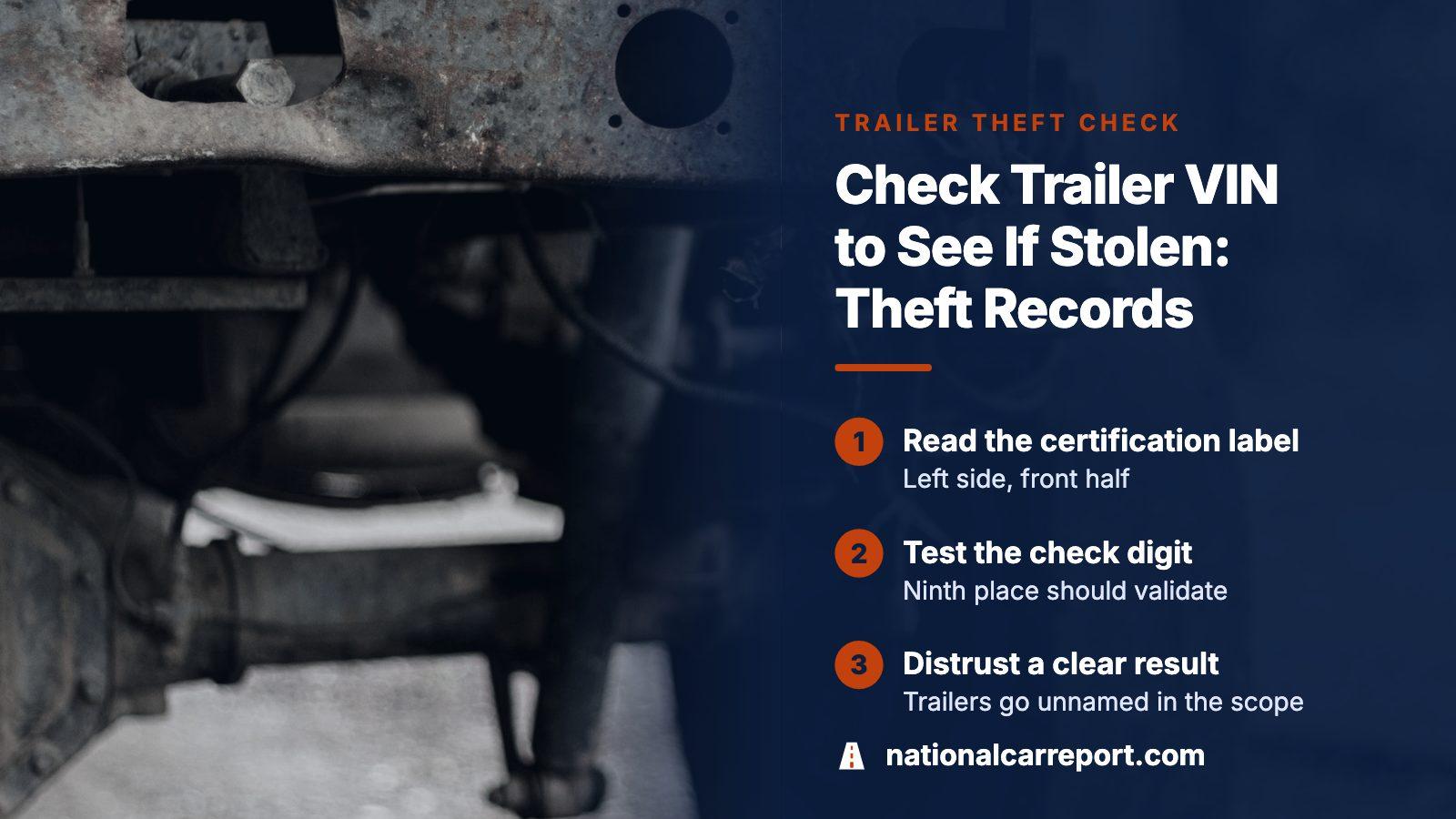
THE SHORT ANSWER
Read the VIN off the builder's certification label and confirm all 17 characters. Run it through NICB's VINCheck and any state police lookup that covers trailers. A clear result is weak evidence here: NICB's scope line never names trailers, and a swapped number returns the history of some other trailer. Compare the label with the title before any money changes hands.
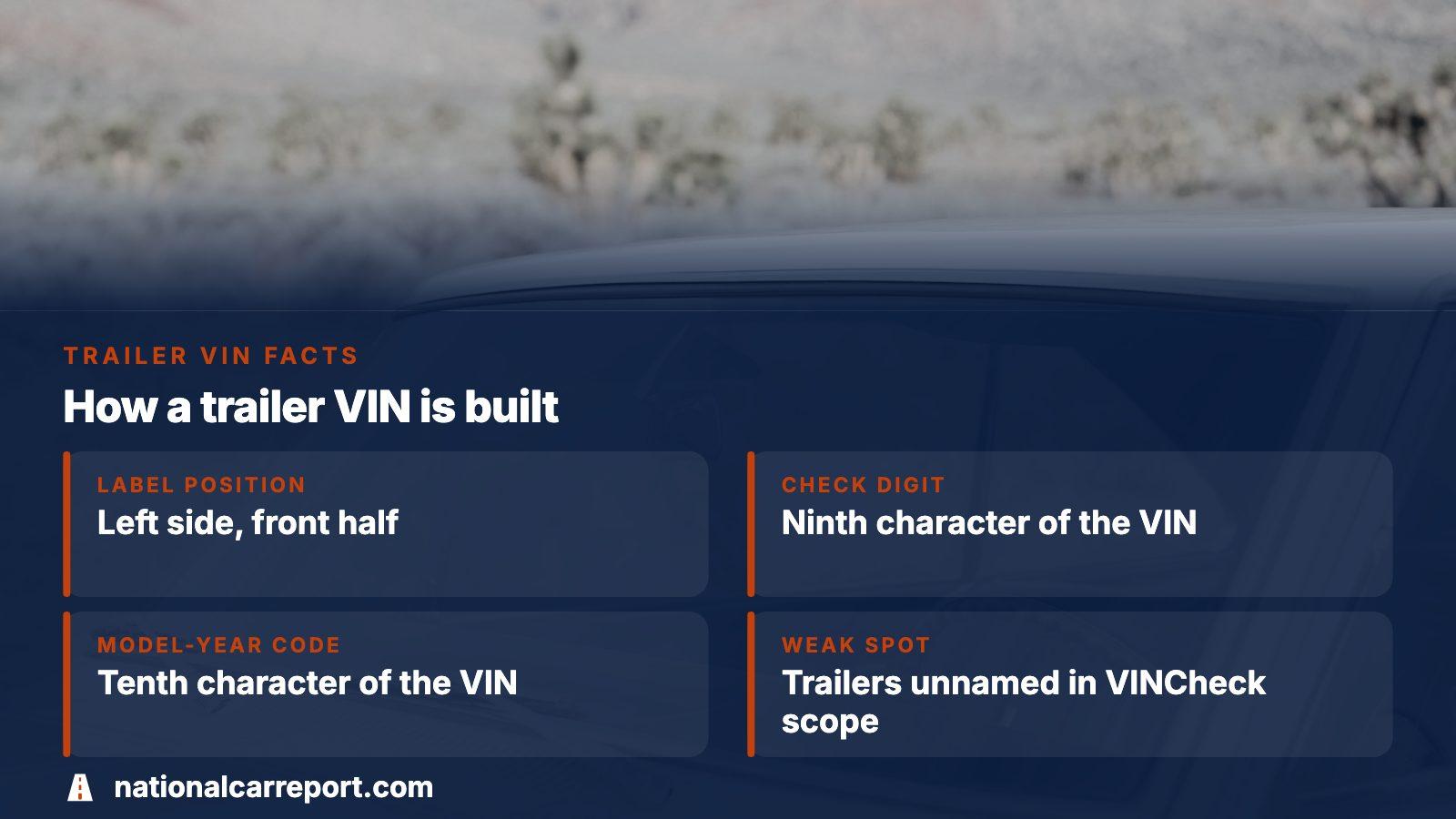
- Label position
- Left side, front half
- First screen
- NICB VINCheck, five searches per day
- Number format
- 17 characters, check digit in ninth place
- Weak spot
- Trailers go unnamed in VINCheck's scope
Which files can show a stolen trailer, and how far each reaches
No single file lists every stolen trailer, and trailer coverage varies.
| File | Run by | What it can show | Where it stops |
|---|---|---|---|
| NICB VINCheck | An insurance-industry nonprofit | Insurer theft, salvage and flood entries on insured vehicles | Scope names some motorcycles and watercraft, not trailers; no police files |
| NMVTIS | The U.S. Department of Justice | Title, brands, last odometer reading, total losses; theft only sometimes | Required reporting covers common automobiles; trailers go unmentioned |
| State police lookups | A state agency, such as Arizona's attorney general | Arizona names trailers and accepts a VIN or a plate | Thefts inside that state only, and a bare status |
| NationalCarReport report | A private reporting service | Theft, lien and impound entries beside title and salvage records | Only what its sources hold for the VIN |
Where the VIN sits on a trailer, and what else the label says
Ignore the listing and go look at the trailer. Federal rules place the certification label on the left side, in the front half, where it can be read without moving anything, and it has to be fixed so it cannot be removed without damage. Photograph it straight on.
The label carries the builder's name, the build month and year, and weight ratings for the trailer and each axle. A missing label, one painted over, or fresh scratches around its fasteners all call for a direct question. NHTSA's position is one VIN per trailer, assigned by its builder, so two different numbers on one frame need an explanation.
Six steps to check a trailer VIN for theft before you pay
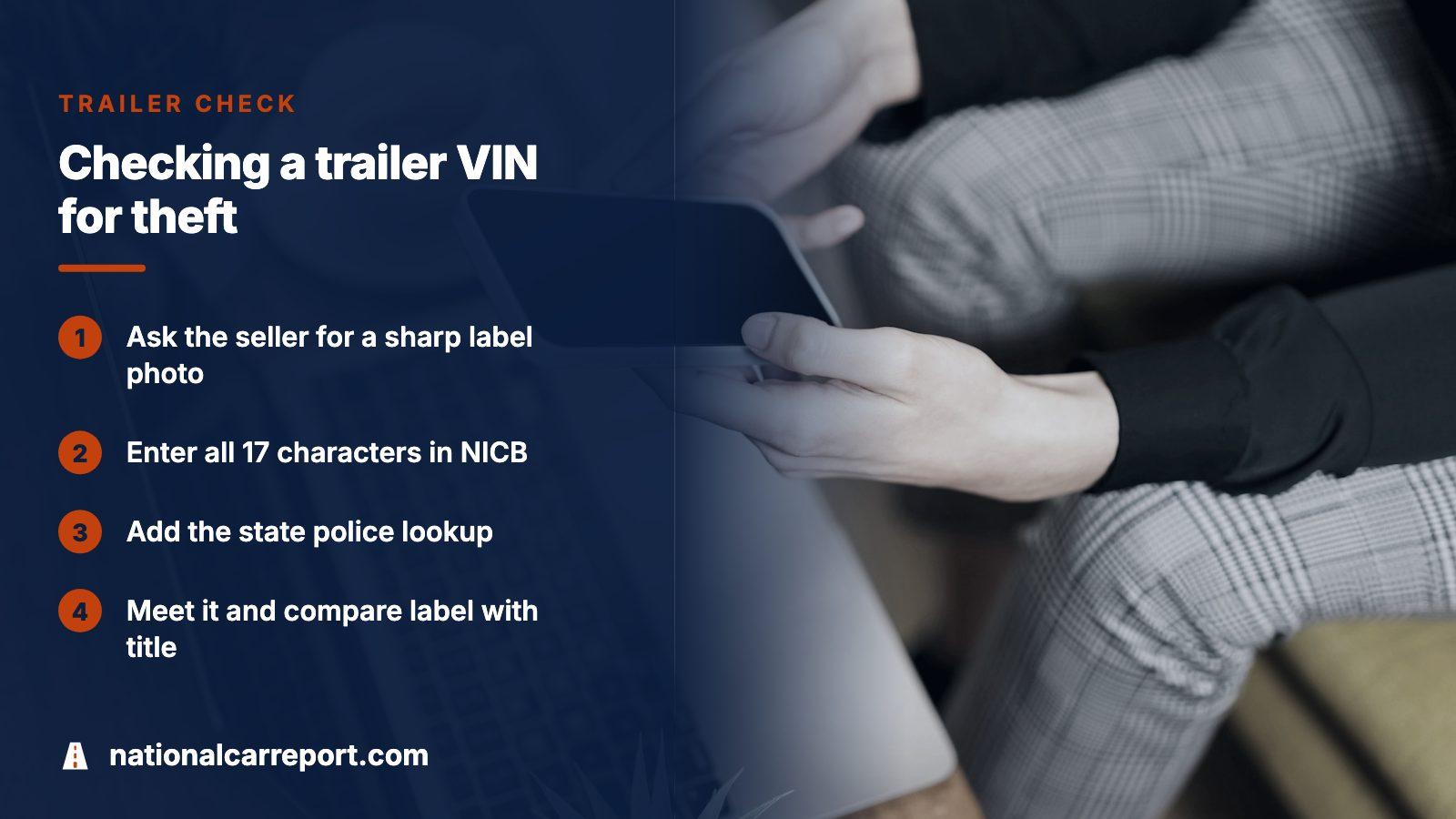
- Ask the seller for a sharp photo of the label before you drive anywhere. Dodging that request tells you plenty.
- Enter all 17 characters in NICB's VINCheck, which costs nothing. Each IP address is capped at five searches daily, and a single wrong character can hide a genuine match.
- Add the police lookup for the state where the trailer was taken or last registered, if one exists. Arizona's TheftAZ names trailers outright; Colorado's form checks a model year and VIN against its stolen file.
- Test the number itself, using the checks in the next section.
- Put the VIN into the free preview at NationalCarReport to see which theft, lien and impound records are on file before spending anything.
- Meet the trailer, compare the label with the title character by character, and pay only if they match.
Test the number before you trust a search of it
A search reports the history of whatever number you type, so test the number first. NHTSA's vPIC decoder accepts trailer VINs.
- Characters 1 to 3: the builder code. A decoder result other than a trailer maker should prompt a question.
- Characters 4 to 8: for trailers, make, trailer type, body type, length and axle layout. Match the decoded length and axles to the trailer in front of you.
- Character 9: a check digit that catches typing mistakes. The decoder errors out when it does not calculate, yet may still name the builder.
- Character 10: the model-year code. Set it against the label's build date and the ad.
A year that does not add up can expose a swap. In February 2026, agents at a Florida agricultural inspection station examined a refrigerated trailer that looked like a 2009 and found a 2022 build carrying a swapped VIN. It was worth about $65,000, and its rightful owner had yet to be established.
Why trailers pass theft searches that would stop a car
The gaps stack up. NICB says VINCheck reviews insured vehicles and some motorcycles and watercraft, with no mention of trailers. The federal title system requires reporting only for common automobiles. An insurer file exists only if an insurer ever handled the trailer.
Paperwork is thin as well. Texas, for instance, lets a used trailer of 4,000 pounds or less change hands with a bill of sale and a registration receipt, or a title only if one was issued. Then there are thefts nobody logged. NICB describes an Ohio recovery where a trailer was confirmed stolen from its public VIN, but a skid steer nearby, ID number removed and painted black, had been reported stolen without ever becoming an active entry.
Cloned and swapped trailer numbers: what the Florida cases show
NICB describes cloning as a short recipe: copy a VIN from a lawfully owned vehicle, fake a tag and ownership papers, steal a lookalike, attach the tag, sell. Most titling offices do not check for a second owner when an out-of-state title is handed in. The buyer never legally owns the vehicle; it is confiscated and returned to its owner or the insurer that paid the claim.
Documented case: 23 trailers, one buyer
In April 2026 Florida's Office of Agricultural Law Enforcement announced the arrest of a seller whose customer had bought 23 semi trailers from him and his companies. Investigators confirmed falsified VINs on all 23 and seized 18. The buyer's loss ran to six figures. The seller faces felony charges, which are allegations only.
These were commercial trailers, but the point carries over: the number on the metal and the number on the paper can both be wrong, and a search of either returns a clean history for the wrong machine. NICB's help line for agencies can rebuild a VIN from secondary locations or parts, which buyers cannot, so a scraped or replaced label belongs with the police.
Liens, impounds and what the report adds to a theft search
A theft flag is one way a trailer carries baggage. A lender's lien and a tow-yard hold are two more, and an insurer theft search shows neither. The NationalCarReport preview takes the same VIN and lists which record types exist for it, including theft, lien and impound entries, title brands and salvage history, before you pay.
One payment buys the full report for a VIN, with packs of three, five or ten for buyers weighing several trailers. No subscription is involved, and the pricing page lists current rates. A lien or impound entry appears only if someone recorded it, so treat the report as one more screen, then compare it with the trailer itself.
What to do when a trailer flags, or arrives without a number
- A theft hit: stop the sale and keep clear of the seller. TheftAZ advises calling the police agency it names rather than acting alone.
- A missing or replaced label: ask for the builder's paperwork and a written explanation, and have an insurer or police inspect before you buy.
- A VIN that fails the check digit: reread it first, since a typo is one cause. If the label itself fails, get the builder to confirm it in writing.
- A seller who will not meet, rushes you, asks for a wire or gift cards, or wants shipping money afterward. The FTC lists each as an online vehicle-sale red flag.
- A homemade trailer with a state-assigned number can be legitimate. Texas assigns one when no number was ever stamped or police cannot tell which it was, and reassigns when the original was removed or altered. Ask which applies and see the inspection paperwork.
If you suspect fraud after buying, NICB takes reports online, and a cloned trailer is not yours to keep.
Where this information comes from
- NICB: VINCheck — The insurer-fed theft, salvage and flood search, its five-per-day limit, its stated scope and its blind spots.
- NMVTIS: Information for consumers — What the Justice Department's title system reports, when theft data appears and which vehicles it requires states to report.
- eCFR: 49 CFR 567.4, certification label — Where a trailer's label goes, how it must be fixed and what it has to state.
- eCFR: 49 CFR 565.15, VIN content — What each part of a trailer VIN encodes, including the check digit in ninth place.
- NHTSA: vPIC VIN decoder — The federal decoder that handles trailer VINs, and the maker data behind it.
- Arizona Attorney General: TheftAZ FAQ — A state stolen-vehicle lookup that names trailers, and the limits it states.
- NICB: 23 semi trailers with falsified VINs — The Florida case of one buyer, 23 trailers and altered numbers.
Sources and photos: Facts checked against the sources above in November 2026. Photos by Zoshua Colah, Jakub Żerdzicki and Wesley Tingey on Unsplash; diagrams by NationalCarReport.
Keep reading
- Stolen Car Check by VIN: Nationwide Theft, Lien and Impound RecordsThe wider theft screen for cars and trucks, and what a clean result still misses.
- Vehicle Lien Check by VIN: Nationwide Lien, Theft and Impound RecordsHow a lender's claim appears on a record and how to confirm it is cleared.
- Impound Lookup: Find a Towed Car, Then Check Its VIN for Impound RecordsFinding out whether a vehicle was ever held in a tow lot.
- Report a Stolen Car: Police Steps, Insurance and a VIN Theft CheckWhat to file, and with whom, if the stolen vehicle is yours.
Frequently asked questions
Can I check if a trailer is stolen with just the VIN?
Yes, if the theft was reported. NICB's VINCheck, state police lookups and title records all search by VIN, but they return only what someone filed, and none can tell that a number was swapped in. Read the label on the trailer and compare it with the title.
Does NICB VINCheck cover trailers?
NICB's scope line mentions U.S.-insured vehicles plus some motorcycles and watercraft, and trailers are absent from it. A clean result therefore counts for less than on a car. Participating insurers hold 92.49% of earned premium, and each IP address gets five searches a day.
How do I know a trailer's VIN is real?
Decode it with NHTSA's vPIC tool, which returns the builder and vehicle type and flags a failing ninth character. Then compare the decoded length, axle layout and model year with the trailer itself. A disagreement is a reason to pause, even with no theft record.
What if the trailer has no VIN, or only a state-assigned one?
Some legitimately do. Texas, for one, requires a law enforcement inspection before it will assign or reassign a number. Ask for that inspection paperwork and the title. A trailer with no number and no paperwork is a bad purchase at any price.
What does a trailer check at NationalCarReport cost?
No charge applies to the preview itself. The full report is billed once, and packs exist for buyers comparing several trailers. Current options are on the pricing page.
Now check the car itself
The guide explains what to look for. The report shows what this VIN has on record.