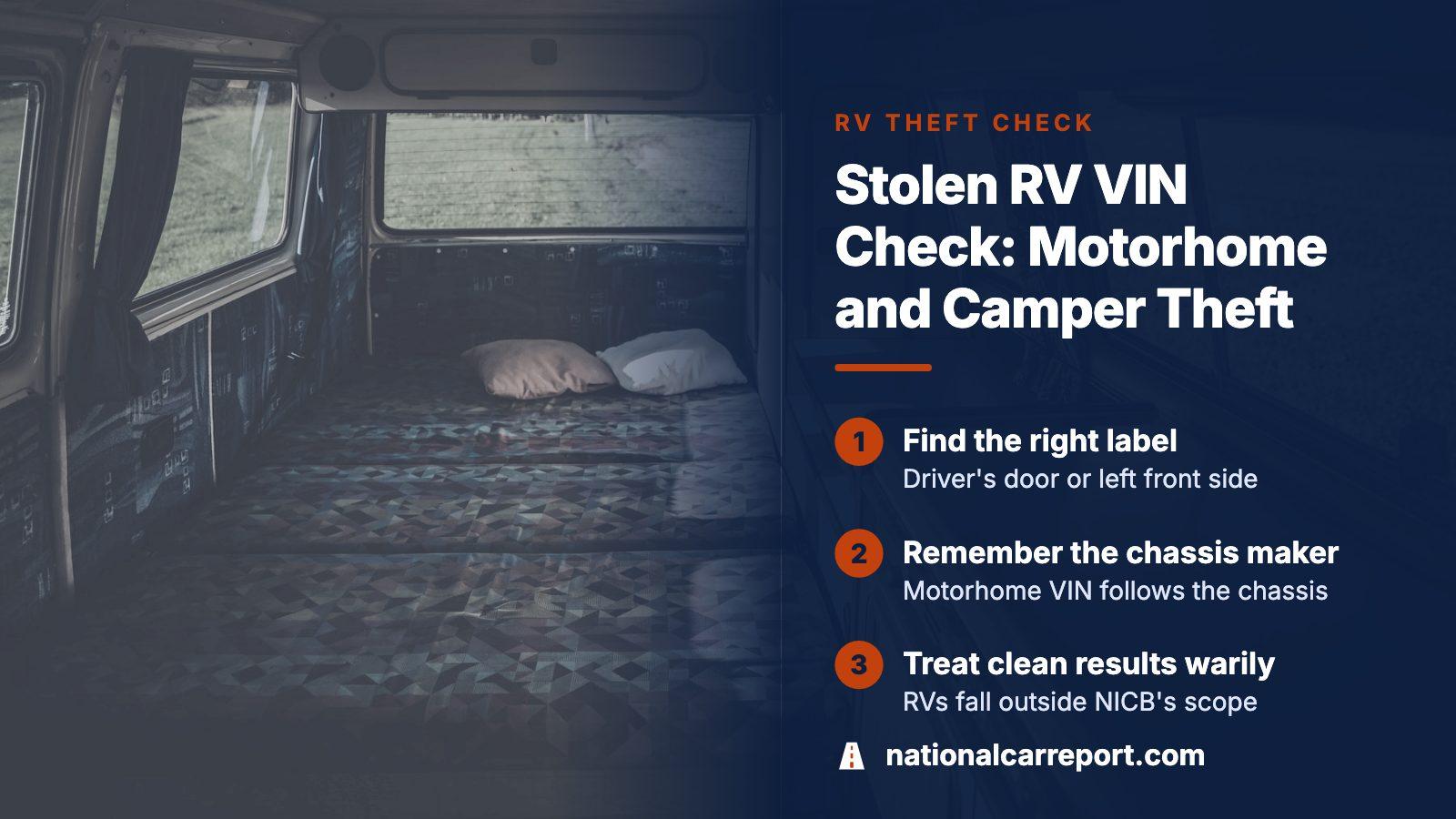
THE SHORT ANSWER
Read the VIN yourself: from the label beside the driver's door on a motorhome, or the label on the front half of a towable's left side. Decode it, search NICB's VINCheck, add any state lookup, then run the preview. Trailers go unnamed in NICB's scope and NMVTIS requires reporting only for common automobiles, so a clean result proves less here than on a car.
- Motorhome VIN
- The chassis maker's number
- Towable label
- Left side, front half
- First screen
- NICB VINCheck, five searches a day
- Blind spot
- Trailers go unnamed in NICB's scope
What each kind of RV gives you to search
Which number you hold decides what a search can reach, and each kind of RV hands you a different one.
| Rig | Number to search | Where it comes from | What the files reach |
|---|---|---|---|
| Motorhome (Class A, B or C) | The chassis maker's VIN | Set by the truck or van builder, then carried onto the finished coach | NICB covers insured U.S. vehicles; NMVTIS requires reporting only for common automobiles |
| Travel trailer or fifth wheel | The towable's own VIN | Assigned by its builder, shown on the certification label | NICB's scope names some motorcycles and watercraft, not trailers |
| Slide-in truck camper | The pickup's VIN | Texas titles the truck alone when the camper lifts off easily | The search tests the truck; the camper may leave no record of its own |
Motorhomes: the number belongs to the chassis
A coach builder rarely makes the whole vehicle. A truck or van maker supplies the chassis; another company builds the living space. For a motorhome on a cutaway van, Texas titles it under the chassis maker's VIN and takes the year, make and body style from the coach builder's paperwork. So the number you search names the chassis, not the badge on the coach.
NHTSA's vPIC shows the same split. A Ford F-53 VIN prefix decodes as a motorhome chassis, listed as an incomplete vehicle, and the first three characters used by Freightliner Custom Chassis and Workhorse return that vehicle type as well. Set the decoded maker against what the seller says the rig sits on.
At the rig, look near the driver's door. Outside trailers, the federal label sits around that door opening, on the hinge side, the latch side or the door's edge. It repeats the VIN. Photograph it and compare every character with the title.
Towables: a label on the left side that should not budge
A travel trailer or fifth wheel has its own VIN on a certification label. Federal rules locate that label on the trailer's left side, forward half, readable from outside. It must be riveted or otherwise fastened so that taking it off damages it. It states the builder, when the trailer was built, the weight rating of the rig and of each axle, the VIN, and the type, trailer.
Count the axles under the rig and set them against the axle ratings on the label. A label gone missing, painted over or sitting on fresh rivets points to a removal.
A quick decoder test
Run the first three characters through NHTSA's vPIC. Jayco, Keystone, Grand Design and Forest River prefixes decode as trailers. A towable sold under one of those names that decodes as an incomplete vehicle or another maker needs an explanation.
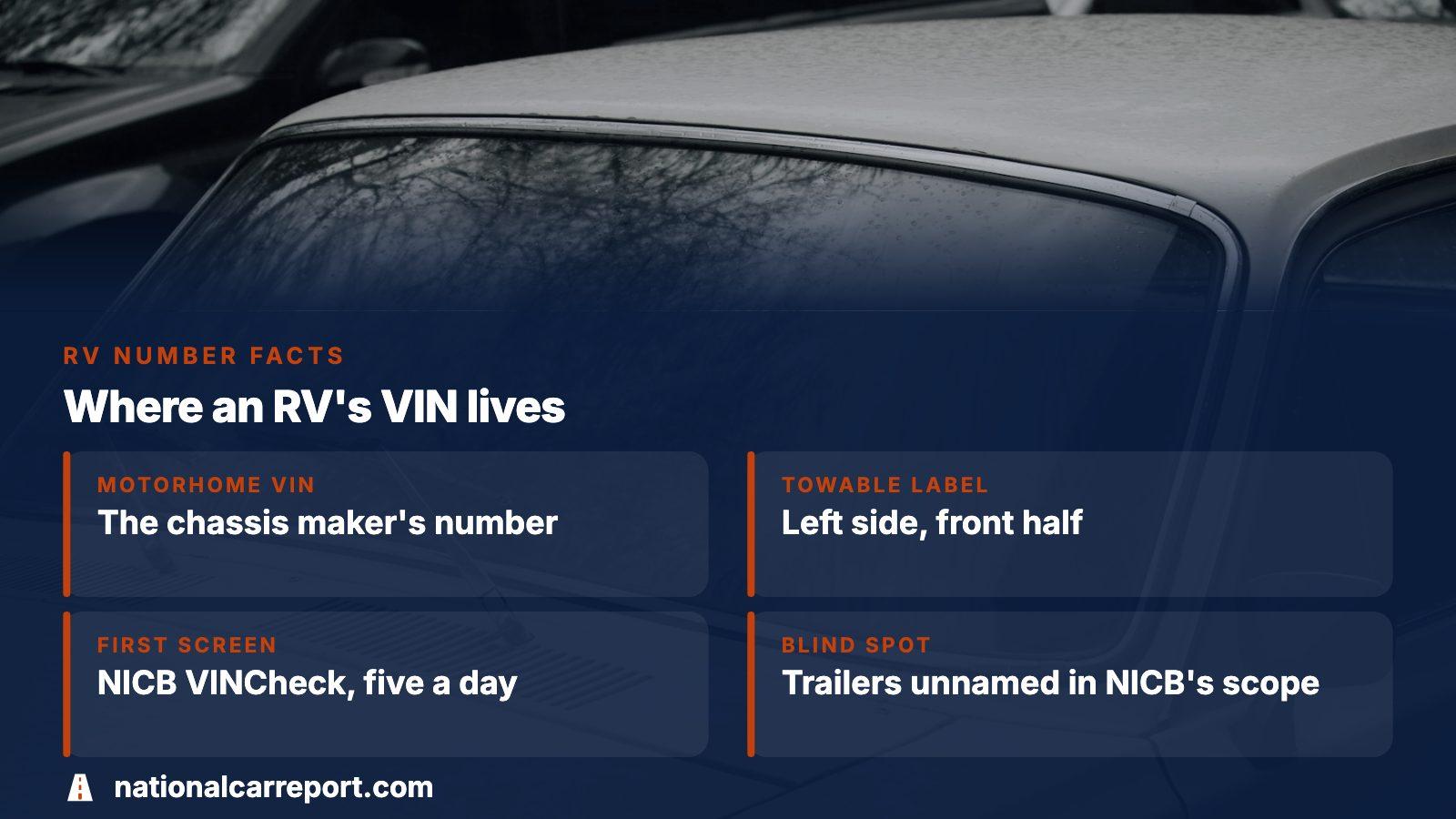
Six steps to check a rig before you pay
- Photograph the number at the rig yourself; take the title's number from the paperwork, not the advertisement.
- Decode it in NHTSA's vPIC and confirm the type and maker fit the seller's story.
- Search NICB's VINCheck. It costs nothing, but it limits a single IP address to five searches per 24-hour window and needs all 17 characters right, or a real record can slip past.
- Add a state police or DMV stolen-vehicle lookup if your state, or the state of last registration, has one; the agency can tell you by phone.
- Put the VIN into the NationalCarReport preview to see which theft, lien and impound records exist, alongside title brands and salvage history.
- Meet the rig, hold the label beside the title and pay only if every character agrees.
Why a clean result counts for less on an RV
NICB calls VINCheck a useful free tool but not a full history. It searches only participating insurers, whose records represent 92.49% of earned premium, and it never queries police files. Its links for recreational and commercial vehicles name motorcycle, boat and commercial-vehicle reports, and none for motorhomes or towables.
NMVTIS adds title and brand records, but its consumer page requires reporting only for common automobiles, never mentions RVs and shows theft in some cases. It adds that an insurer can declare a stolen vehicle a total loss once 30 days pass without recovery, and the label stays if the vehicle returns in good condition.
Read a clean result as nothing found in those files, and a hit as a reason to stop.
Liens, credit fraud and the title that disagrees
A rig can be taken without anyone breaking into a storage lot. An unpaid loan or a sale on borrowed credit may leave no theft entry. NICB advises a title search and a close look at the owner history of any late-model rig that lists no lienholder, so ask why a near-new coach is owned outright.
Documented case: a motorhome bought on stolen credit
In February 2017 a U.S. Attorney in Texas announced a five-year prison term for a woman who bought a Coachman motorhome valued at more than $82,000 from a Corpus Christi RV dealer, on credit taken out in a stolen name. She was later found in Atlanta with the coach still in her possession. The court's restitution counted, besides other losses, what the recovered motorhome had lost in value.
The lesson is about paperwork. Ask for the title, and the lender's release if there was a loan, and set the owner named on it beside the person selling. The preview shows which lien and impound records exist for the VIN.
Cloned numbers, and what to do when a VIN flags
NICB lists five steps in cloning: take a VIN from a vehicle someone lawfully owns, forge a tag and matching ownership papers, steal a lookalike, fit the forged tag and sell it. Titling offices rarely test whether someone else already owns the vehicle when an out-of-state title comes in. Whoever buys a clone never legally owns it. The rig is seized and returned to its owner, or to the insurer that covered the loss.
- A theft hit: stop, keep the seller at a distance and phone the police agency that took the report. Do not confront anyone.
- A label that has gone missing, been painted over or sits on fresh rivets: ask the builder to confirm the rig's identity in writing, and have an insurer inspect before you commit.
- A title VIN that differs from the label by a single character: hold off until the titling office explains it.
- Already paid: tell NICB about the sale through its online form or on 800-835-6422, and expect a seized clone to return to its owner.
What the NationalCarReport report adds, and what it costs
Neither VINCheck nor NMVTIS lists liens or impounds among its records. The NationalCarReport preview runs the same VIN and shows which record types exist: theft, lien and impound entries, title brands, and salvage and auction history. The preview can be opened without paying anything. The report is a single payment, sold singly or in packs of three, five or ten, with no recurring charge.
Rates sit on the pricing page. A record exists only if someone filed it, so treat the report as another screen, not a verdict.
Where this information comes from
- NICB: VINCheck — The insurer-fed theft, salvage and flood search: its scope line, five-per-day limit, missing police files and the partner reports it names.
- NICB: Buying a Used Vehicle — How cloning works, what happens to a buyer of a clone, and the title and lienholder checks NICB advises.
- NMVTIS: Information for consumers — Which vehicles states must report, when theft data appears and the 30-day total-loss quirk.
- TxDMV: Assembled and Reconstructed Vehicle Manual — How Texas titles a motorhome on a chassis and a pickup carrying a slide-in camper.
- eCFR: 49 CFR 567.4, certification label — Where the label goes on a trailer and on other vehicles, how it is fixed and what it must state.
- NHTSA: vPIC VIN decoder — The federal decoder, and the vehicle types it returns for RV chassis makers and towable builders.
- U.S. Attorney, Southern District of Texas: RV identity-theft sentence — The 2017 case of a motorhome bought on credit with a stolen identity.
Sources and photos: Facts checked against the sources above in November 2026. Photos by Balkan Campers, Alejandro Escamilla and Tigran Shishmanyan on Unsplash; diagrams by NationalCarReport.
Keep reading
- Check a Trailer VIN to See If It's Stolen: Theft, Lien and Impound RecordsA closer look at towable VINs, swapped labels and why trailers slip past theft searches.
- Vehicle Lien Check by VIN: Nationwide Lien, Theft and Impound RecordsHow a lender's claim shows on a record and how to confirm it has been cleared.
- Impound Lookup: Find a Towed Car, Then Check Its VIN for Impound RecordsFinding out whether a vehicle has ever sat in a tow lot.
- Report a Stolen Car: Police Steps, Insurance and a VIN Theft CheckWhat to file, and with whom, if the missing rig is yours.
Frequently asked questions
Can I check if an RV is stolen with just the VIN?
Yes, when the theft was reported to a file you can search. NICB's VINCheck covers participating insurers' records, and some states run police lookups. None can show that a number was swapped in, so read the VIN off the rig and compare it with the title.
Does NICB VINCheck cover motorhomes and travel trailers?
NICB limits its scope to vehicles insured in the U.S. along with some motorcycles and watercraft; motorhomes and trailers go unnamed. Participating insurers represent 92.49% of earned premium, and one IP address gets five searches daily. Treat a clean result as incomplete.
Do truck campers have their own VIN?
Not necessarily. Texas titles a pickup carrying a camper that lifts off easily as an ordinary pickup, so the truck's VIN is the record. A camper mounted permanently on a chassis is titled there as a motorhome.
What should I do if the title shows a different VIN than the RV?
Hold off and get a written explanation from the titling office or the builder. A mismatch can be a typing error, a replaced label or a cloned number. NICB says whoever buys a clone never legally owns it; the vehicle is seized and returned.
What does a stolen RV check at NationalCarReport cost?
The preview does not cost anything. A full report is one payment per VIN, sold singly or in packs of three, five or ten for buyers weighing several rigs, with no recurring charge. Check the pricing page for current options.
Now check the car itself
The guide explains what to look for. The report shows what this VIN has on record.