THE SHORT ANSWER
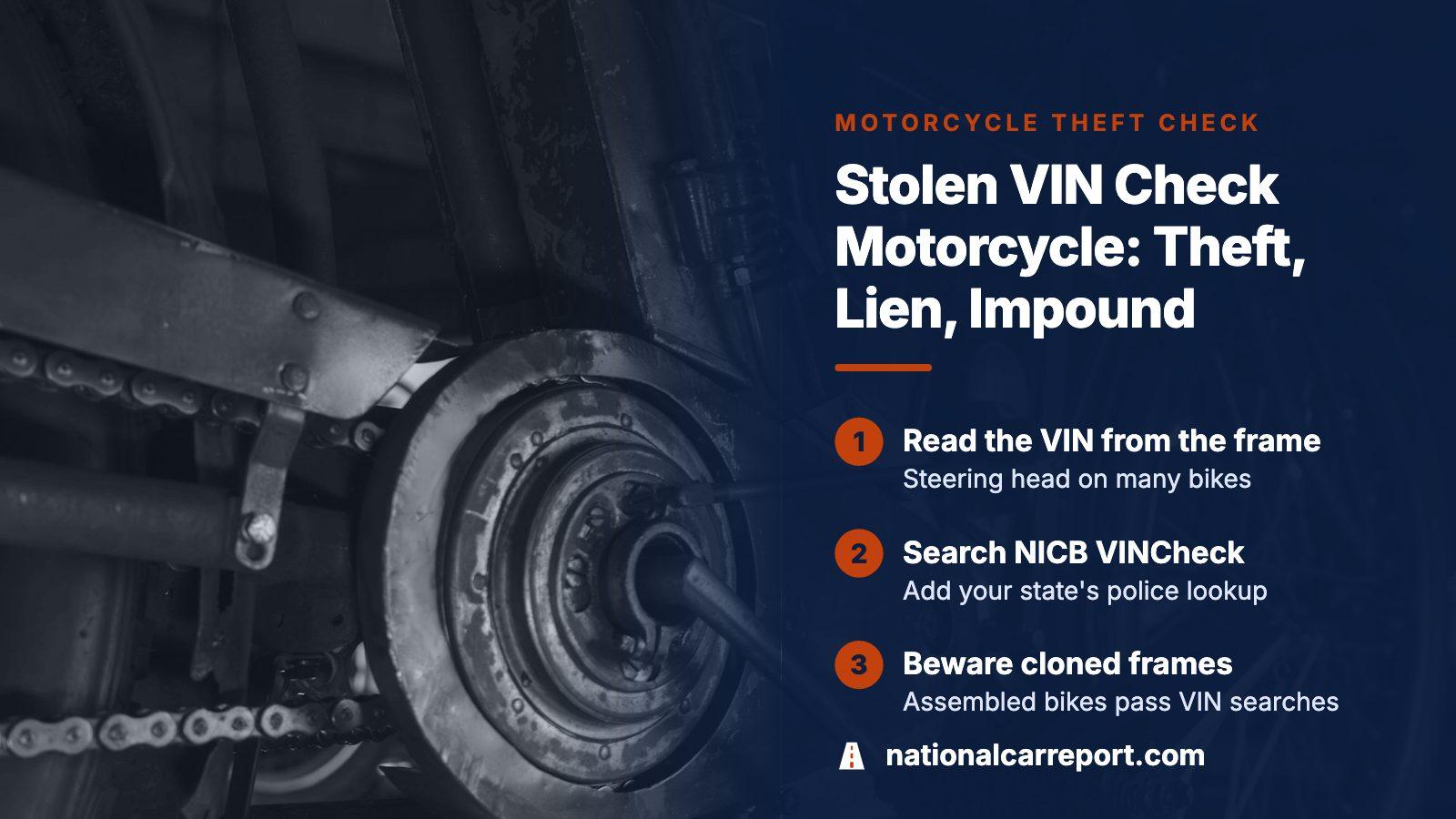
To see whether a motorcycle is stolen, read the 17-character VIN from the frame and search it in NICB's VINCheck, which draws on theft, salvage and flood reports from participating insurers. Add your state's police lookup if one exists, plus the federal title record. A clean result proves little: it misses unreported thefts, police-only reports and bikes wearing a copied number. Compare the stamping with the title before any money moves.
- Bikes stolen in 2025
- 44,564 reported, 41% eventually recovered
- First screen
- NICB VINCheck, five searches per day
- Where the VIN sits
- Steering head on many bikes, varies by maker
- Biggest gap
- Cloned frames and unreported thefts
Where a bike's theft record can sit, and what each file misses
A theft can be logged in several places, and a motorcycle search reaches only some of them.
| File | Kept by | What it can show for a bike | What it misses |
|---|---|---|---|
| NICB VINCheck | An insurance-industry nonprofit | Insurer theft entries not yet recovered, plus salvage and flood entries | Police files, nonparticipating insurers, bikes no insurer handled |
| NMVTIS | The U.S. Department of Justice | Title, brands, last odometer reading, insurer total losses, theft in some cases | States differ on reporting motorcycles |
| State police lookup | A state agency, such as Arizona's attorney general | Whether a bike is in that state's stolen file | Other states' thefts; Arizona gives status only |
| Report from NationalCarReport | A private reporting service | Theft, lien and impound entries beside title brands and salvage photos | Whatever the sources were never told |
Why motorcycles slip through theft checks more easily than cars
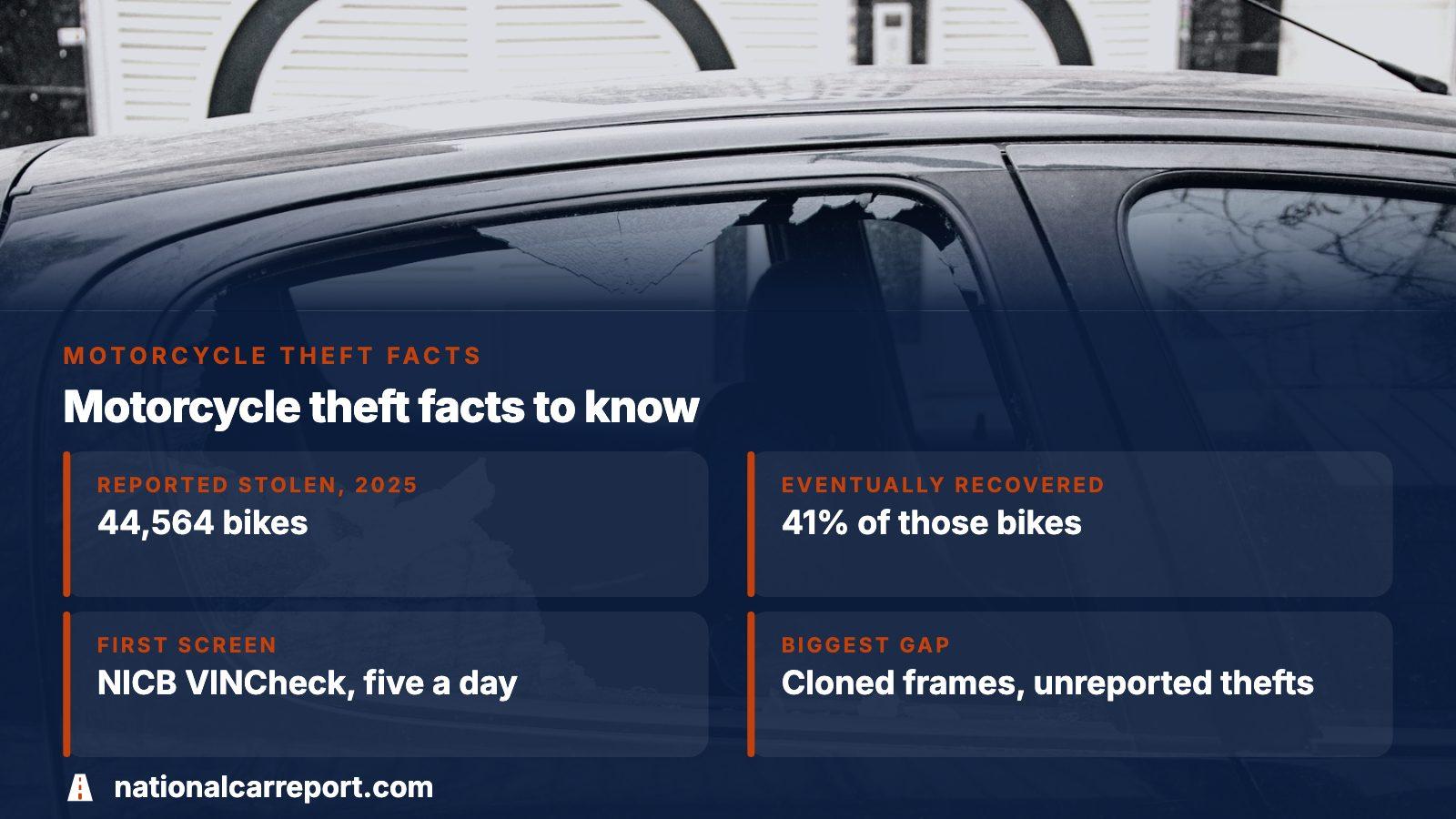
NICB counted 44,564 motorcycles reported stolen in 2025, and 41% were eventually recovered. Its motorcycle theft page explains the gap with cars: a frame or engine can be altered and reused with little effort, thieves sell bikes whole or by the part, and the priciest models find buyers overseas. Many bikes now cost $20,000 or more, and the parts trade runs hottest in cold states, where the riding season is short.
For a buyer, that means a stripped bike can resurface as a frame wearing parts from elsewhere, and a theft from last week may not sit in any file yet.
Finding the VIN on a bike, and the second number to read
A motorcycle has no windshield corner to peer into, and each maker picks the spot. Look first at the steering head, the tube the forks pivot in. Indian's help pages put the number on the left side of it for many Scout models, and on the right for the FTR, with a printed sticker opposite. Wipe off the road film and take a photo instead of writing it down.
The engine has its own serial, and it is not the VIN. Indian stamps it into a crankcase and will use it to identify a bike when the VIN is unreadable, but says this stops working once the engine has been replaced. Treat the frame as the bike's identity and ask about any engine swap. On a dirt bike, read the same two numbers.
Running the check, from the first message to the preview
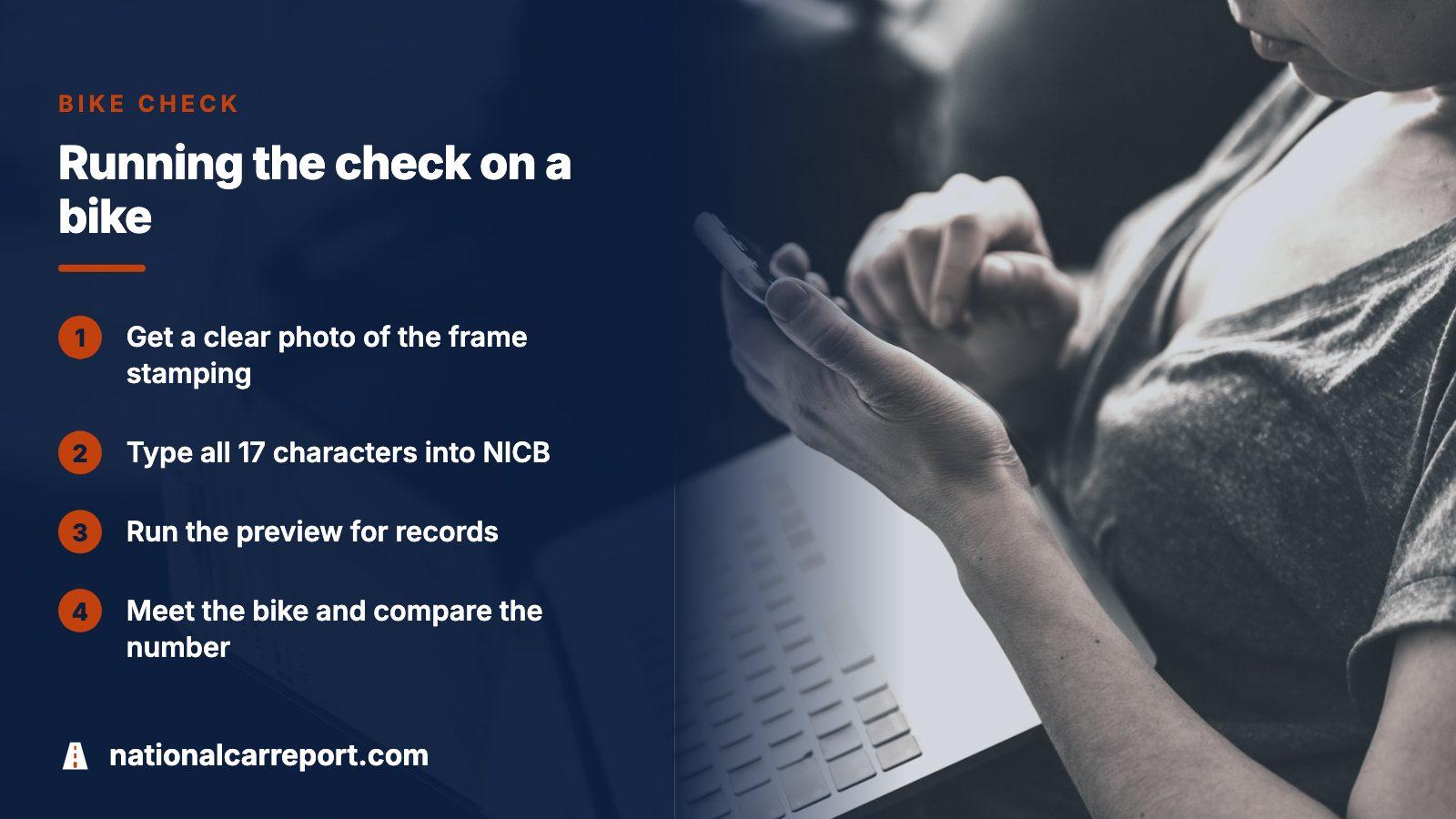
- Have the seller text a clear picture of the frame stamping before you drive anywhere. A seller who stalls has told you something.
- Type all 17 characters into NICB's VINCheck. It costs nothing, and any one IP address gets five searches a day. One wrong character can hide a real match.
- Try the police lookup for the state where the bike was last titled. Arizona's TheftAZ lists motorcycles, takes a plate or VIN, and names the agency to call.
- Enter the VIN into the free preview at NationalCarReport, which lists the record types on file before you spend anything.
- Meet the bike. Compare the stamped number with the title character by character, and read the engine number too.
- If it still looks right, buy the full report so theft, lien and impound entries sit beside title brands and salvage history.
Why cloned and assembled bikes pass a VIN search
NICB warns about sellers who build a bike from replica aftermarket parts and pass it off as a genuine Harley-Davidson, Honda, Kawasaki or Yamaha. False VINs, it says, are easy to obtain and fit, so a search returns the history of a number, not of the machine in front of you. Three warning signs from NICB's buyer advice:
- A title or registration that reads assembled vehicle, or a seller who calls the bike all custom.
- A title history showing several manufacturer's statements of origin for major components.
- A frame or large component said to have come from a swap meet.
NICB's remedy: an insurer's inspection, or an expert appraiser, before you pay.
A Kawasaki stolen in 1992 and found with its identifiers gone
A recovery documented by NICB
Hartford police in Connecticut called in NICB over a 1990 Kawasaki KX-125, a motocross bike taken from an owner in Waterbury in October 1992. An NICB agent found it no longer carried a legible VIN or its other identifying marks. Investigators traced it through NICB's shipping history data, and a dealership helped name the last legal owner. The owner got the bike back after 27 years.
Two lessons for a buyer. An old theft can outlive its police entry: NICB says the national police file drops unrecovered vehicle records once four full years have passed beyond the year they were entered, while NICB keeps them for good. A bike stolen long ago may match nothing current and still belong to someone else. And a bike with no readable number cannot be searched at all, so read the metal before trusting a screen.
Reading what comes back, and what to do about it
| What you see | What it can mean on a bike | Your move |
|---|---|---|
| Stolen, not recovered | An insurer has an open theft file on this VIN | Do not buy or confront the seller; give the VIN and listing to the police agency named |
| Salvage or total loss, no crash story | A theft payout can cause the label, and it stays if the bike is found intact | Ask what caused the write-off; request repair records |
| Lien listed | A lender may still hold a claim | Ask for the lender's written release before any payment |
| Impound entry | The bike sat in a tow lot at some point | Ask who released it, when, and for the release paper |
| Frame number differs from the title | A clerical slip, an altered number or a clone | Hold off until the seller accounts for it on paper |
| Title says assembled or all custom | Parts may come from several different bikes | Arrange an insurer inspection or an appraisal first |
| Nothing found | Nothing turned up in the files searched | Still read the metal against the paperwork |
Cost, the preview and the next step
The free preview at NationalCarReport takes the VIN and lists the record types on file for the bike before any payment. A report is paid for once and nothing renews, and packs exist for riders weighing several bikes. Current amounts sit on the pricing page.
Read theft, liens and impounds first, then branded titles and salvage or auction photos. What comes back depends on what each source was told, so take the preview before the report.
If a search shows a theft, walk away and hand the VIN and the listing to the police agency named in the result. Owners should keep photos of the VIN and any distinguishing marks, and tell both police and their insurer straight away after a theft, since over half of recreational-vehicle recoveries come within two weeks.
Where this information comes from
- NICB: VINCheck — The insurer-fed theft, salvage and flood search, its daily limit, its motorcycle scope and its stated blind spots.
- NICB: Motorcycle and boat theft — Why stolen bikes are recovered less often, how cloned bikes are built and the buyer warning signs NICB lists.
- NICB: Recreational vehicle thefts in 2025 — The 2025 motorcycle theft count, the share recovered and the two-week recovery window.
- NICB: Agents help recover a stolen motocross bike — The Kawasaki recovery, and how old unrecovered theft records are purged from the police file but kept by NICB.
- NMVTIS: For consumers — What the Justice Department's title system shows, when theft data appears, why motorcycle coverage depends on the state and how a theft can become a total-loss label.
- Arizona Attorney General: TheftAZ FAQ — A state stolen-vehicle lookup that includes motorcycles, and the limits it states.
- Indian Motorcycle: VIN and label locations — A maker's own account of where the VIN and the separate engine number are stamped.
Sources and photos: Facts checked against the sources above in November 2026. Photos by Haberdoedas, Michal Biernat and Ali Aliakbari on Unsplash; diagrams by NationalCarReport.
Keep reading
- Stolen Car Check by VIN: Nationwide Theft, Lien and Impound RecordsThe wider theft screen for cars and trucks, and what a clean result still misses.
- Theft Recovery Vehicle: Stolen, Lien and Impound Checks Before You BuyWhat a recovered stolen vehicle leaves behind and how to price one.
- Vehicle Lien Check by VIN: Nationwide Lien, Theft and Impound RecordsHow a lender's claim shows up on a record and how to clear it.
- Impound Lookup: Find a Towed Car, Then Check Its VIN for Impound RecordsFinding out whether a vehicle was ever held in a tow lot.
Frequently asked questions
Can I check if a motorcycle is stolen with just the VIN?
Yes, for thefts that were reported. A VIN search of insurer files, state police lookups and title records can flag a bike reported stolen and not recovered. It cannot flag a theft nobody reported, a report held only by police, or a copied number, so read the frame against the title too.
Does NICB VINCheck cover motorcycles and dirt bikes?
Only partly. NICB describes its scope as U.S.-insured vehicles with some motorcycles added, built on participating insurers' records. A bike no insurer ever handled leaves nothing to find. The VIN must be typed exactly, or a real match can be missed.
Is there a government site to check for a stolen motorcycle?
Some states run one. Arizona's attorney general operates TheftAZ, which includes motorcycles and returns only a status. Federally, the Justice Department's title system lists approved providers, though theft data appears only in some cases and motorcycle reporting depends on the state.
What if the frame number does not match the title?
Stop and ask the seller for a written explanation. A mismatch can be a clerical slip or a sign of tampering, and you cannot tell which from the driveway. Never pay against a promise to fix the paperwork later. NICB suggests an insurer inspection and a VIN check with your state's motor vehicle agency.
What does a stolen motorcycle check cost at NationalCarReport?
Typing a VIN into the preview costs nothing. The full report is billed once, without renewal, and packs exist for riders weighing several bikes. The pricing page has the current options.
Now check the car itself
The guide explains what to look for. The report shows what this VIN has on record.