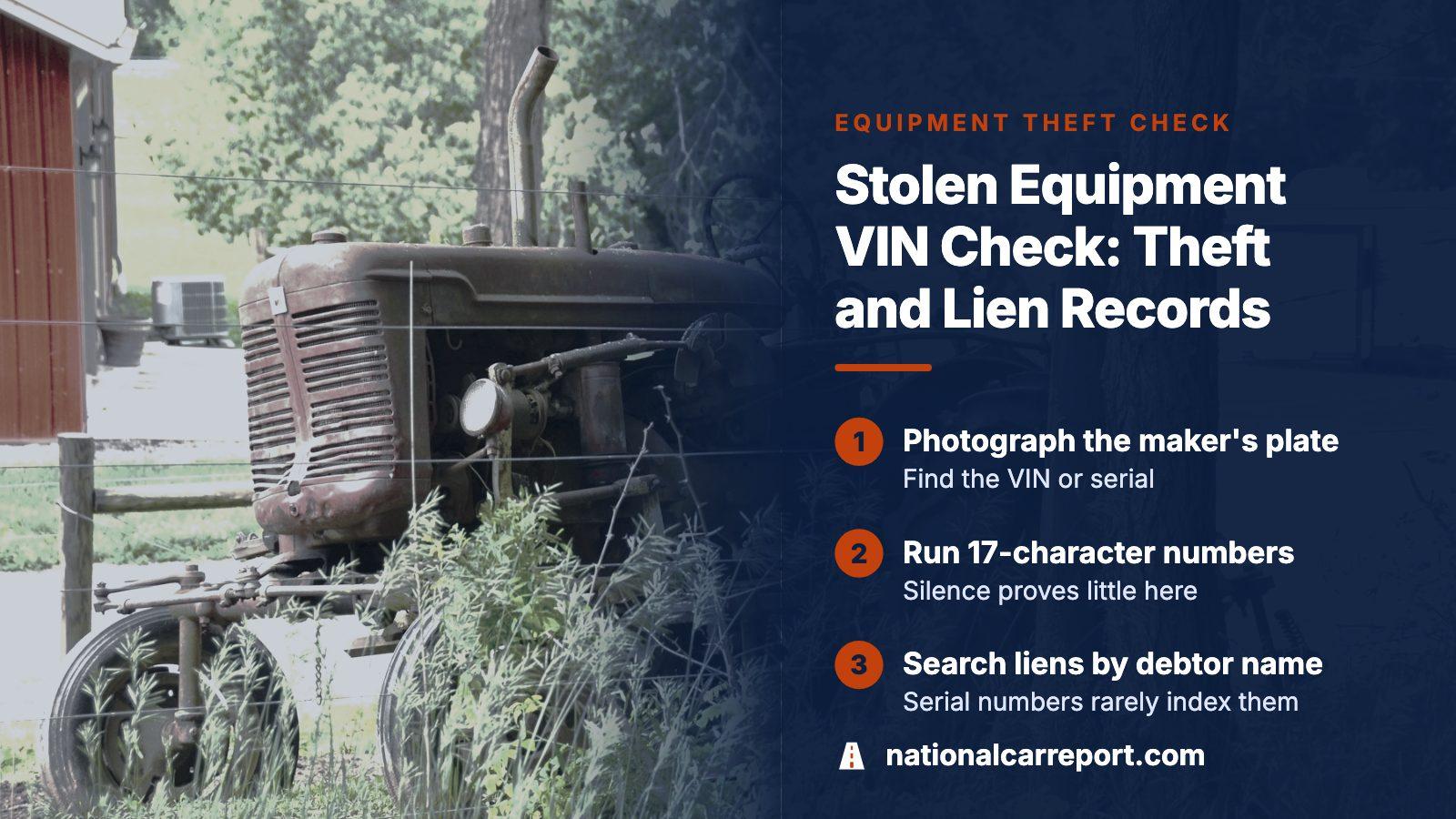
THE SHORT ANSWER
Photograph the maker's plate, then run any 17-character number through NICB's VINCheck and the NationalCarReport preview. A hit is useful, but silence proves little, because VINCheck's stated scope is insured vehicles and some motorcycles and watercraft, with machinery unnamed. For a lien check on equipment, search the owner's exact name in the state where that person lives or the company was formed. Alaska's system, for one, cannot be searched by serial number.
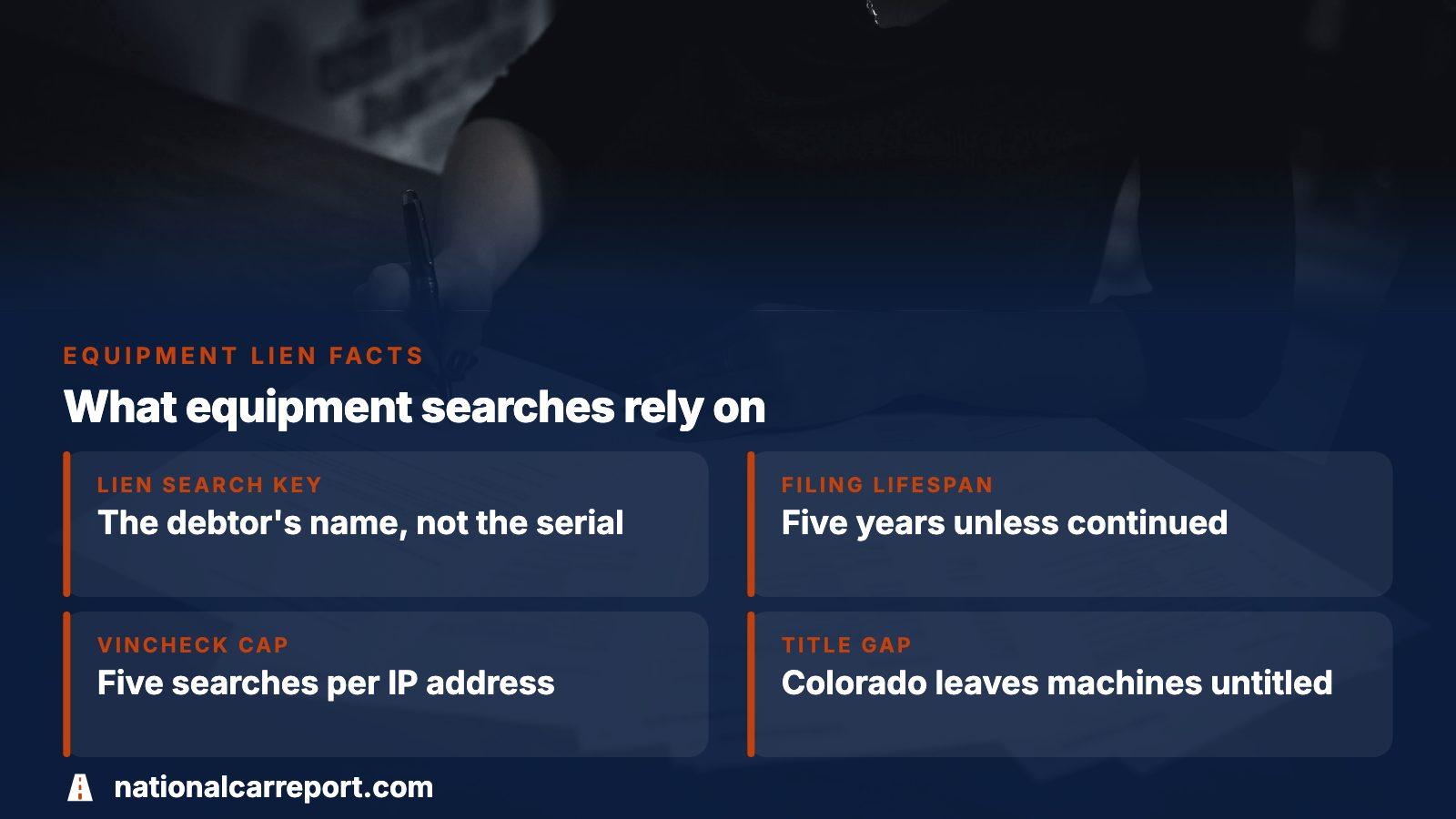
- Lien search key
- The debtor's name, not the serial
- Filing lifespan
- Five years unless the lender continues it
- VINCheck daily cap
- Five searches per IP address
- Title gap
- Colorado leaves self-propelled machines untitled
What a VIN check reaches on a machine and what it misses
Equipment crosses state lines more easily than its paperwork does. A VIN report is built from records tied to a road-vehicle number: insurer theft and salvage entries, title branding, lender liens and tow-yard holds. How much of that exists depends on what is parked in the yard.
| What you are buying | Where its records tend to sit | What a VIN search can do |
|---|---|---|
| Dump truck, flatbed or other road truck | Title file, insurer claims, theft entries | A correctly typed VIN reaches whatever was recorded |
| Equipment trailer | A title, where the state issues one, plus theft and impound entries | Reaches the trailer's record, not the machine riding on it |
| Crane, drill or lift built on a truck or trailer chassis | A title in states such as Colorado | Reaches whatever that title file carries |
| Self-propelled backhoe, loader or skid steer | The lender's UCC filing; theft reports under the maker's serial | Often little, so lean on the lien search and the police |
Reading the ID plate: VIN, PIN or maker serial
Road vehicles wear a 17-character VIN. A skid steer or excavator more often carries a product identification number, called a PIN, on a maker's plate whose position changes by model. Compare every character on it with the paperwork.
A decoder miss proves little. In a check of NHTSA's vPIC make list on November 5, 2026, Caterpillar, JLG, John Deere, Doosan and Kubota had entries, though Kubota had no vehicle types attached. Komatsu, JCB, Case, Hitachi, Kobelco, Takeuchi and Gehl had none, and Bobcat appeared only as a trailer company. A blank result for a machine built by one of them is no sign the number is forged.
Five steps to check equipment for theft before you pay
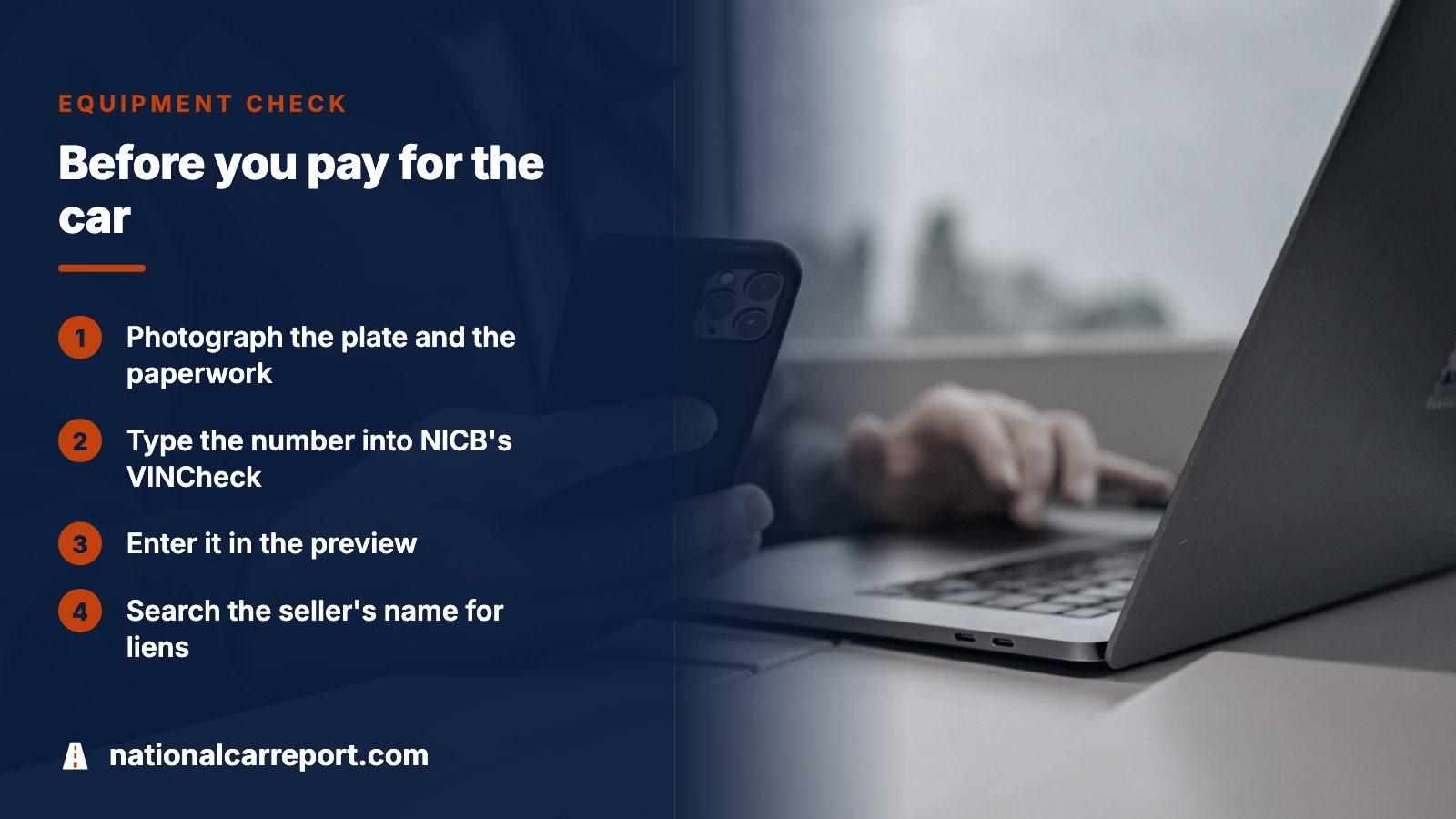
- Get a sharp picture of the plate and the paperwork from the seller before you make the trip. Write down every number on them: machine, engine and any attachment.
- Type any 17-character number into NICB's VINCheck. It costs nothing, caps each IP address at five lookups in 24 hours, and draws on insurers holding 92.49% of earned premium. The scope it states is U.S.-insured vehicles, with some motorcycles and watercraft added, so a quiet result on a machine counts for less than on a pickup.
- Enter the same number in the free preview at NationalCarReport and see which theft, lien and impound records it holds.
- Search the seller's name for liens, following the rules in the next two sections.
- Ask the local police or sheriff's office whether it will check the number against its stolen-property records. Then inspect the machine and compare its plate with the paperwork.
Lien check on equipment: where to search and what to type
Lenders on machinery commonly record a UCC financing statement, a public notice that they claim an interest in the borrower's property. Alaska's filing office says outright that a serial number cannot surface one; its online system accepts a name, a date, a document number or a document type.
The state to search follows the debtor, not the machine. For a person, that is the state of legal residence. For an LLC or corporation, it is the state where the company was formed, wherever its yard sits. A Texas contractor operating through a Delaware LLC gets searched in Delaware. Type the owner's exact legal name, and when someone sells on an owner's behalf, search both names.
Reading a lien hit before any money moves
- Match the collateral description to your machine. Georgia's clerk notes that descriptions often list serial numbers, so a filing against some other unit means little.
- Check whether a UCC-3 ending the loan was filed against that particular machine. One loan paid off does not prove every loan on it is paid.
- Read the dates. A statement normally lapses after five years unless the lender continues it, and Alaska's results keep lapsed filings visible for up to a year.
- If a lender is named, get a written release that describes the machine before payment.
A quiet search is not a clearance
Georgia's clerk points out that no law requires a lender to file. Finding nothing means only that nothing was recorded under that name.
Titles and state rules: why the answer changes at the border
Titling varies by state and by type of machine. Colorado's title manual requires one for machinery mounted on a truck or trailer frame made for highway use. It says self-propelled backhoes, graders, forklifts and loaders are not titled, so those machines have no title record to check. Where no title exists, the UCC file may hold the only public trace of a loan.
Federal title data stops short as well. NMVTIS's reporting requirement covers common automobiles and no more, though several states send in heavy-equipment records regardless, and its consumer list of items includes no liens. Filing offices differ too: Georgia sends most statements to the county clerk where the debtor lives and scans them into a statewide database, while Alaska runs one central file.
Red flags on a used machine, and one documented case
- A plate that is missing, ground down, painted over or newer than the machine wearing it.
- Numbers that disagree between plate and paperwork, even by one character.
- A price far below what similar machines sell for.
- A seller who will not meet, will not allow an inspection, rushes you or asks for gift cards or a wire.
- A seller whose name appears nowhere in the paperwork or the lien search.
Documented case: $185,000 of Ohio machines
Police in Ohio asked NICB to identify farm and construction machines that had lost their product numbers. An agent put names to the machines and the trailers with them, together worth about $185,000. The lead defendant was charged with six counts of receiving stolen property, pleaded guilty on August 5, 2020 and received a 48-month prison term on September 14, 2020.
What the NationalCarReport check costs
Starting costs nothing: the preview tells you which kinds of record exist for a VIN. Going further is a single payment covering that one VIN, and packs of 3, 5 or 10 are offered for comparing several units. Nothing renews, so there is no subscription to cancel, and the pricing page carries the current rates.
Spend it on numbers that came off a road truck, a trailer or a titled machine. For an off-road unit with only a maker's serial, treat any result as one screen among several.
What to do with each result
- A theft hit: stop the sale, keep the seller out of your next step and contact the police agency that took the report.
- A lien hit: ask the lender for a written release naming the machine, then confirm the termination in the filing office.
- A clean result on a machine with only a maker serial: ask a dealer for that brand whether the serial fits the model and year.
- A tampered or missing plate: do not buy. Police can ask NICB for identification help on a stripped machine, as Ohio's did.
Where this information comes from
- NICB: VINCheck — The insurer-fed theft, salvage and flood search, its daily limit, its stated scope and its stated blind spots.
- NMVTIS: Information for consumers — Which vehicles the Justice Department's title system must cover, what its consumer search lists and why a clean result can mislead.
- NHTSA: vPIC API — The federal decoder's make and vehicle-type lists, used for the equipment-maker check dated November 5, 2026.
- Colorado DMV title manual: special mobile machinery — Which machines Colorado titles and which it leaves untitled.
- Alaska UCC Central File: FAQ — Why a serial number cannot find a lien, where a filing goes and how long it lasts.
- Stephens County, Georgia: UCC financing statements — A clerk's checklist for buyers: search by owner name, read the description, look for a termination.
- NICB: Valuable ID of farm and construction equipment — The Ohio case of machines with removed numbers, the value recovered and the court outcome.
Sources and photos: Facts checked against the sources above in November 2026. Photos by Roger Starnes Sr, Anastasiia Nelen and Dimitri Karastelev on Unsplash; diagrams by NationalCarReport.
Keep reading
- Vehicle Lien Check by VIN: Nationwide Lien, Theft and Impound RecordsHow a lender's claim appears on a record and how to read it.
- DMV Lien Release Search: How to Confirm a Lien Is GoneConfirming that a lien was released, not just promised.
- Check a Trailer VIN to See If It's Stolen: Theft, Lien and Impound RecordsThe hauling trailer needs its own theft screen and label check.
- Car Lien Holder Search: How to Find the Lender Behind a VINFinding the lender when a filing names one.
Frequently asked questions
Can I run a stolen equipment VIN check with just a serial number?
Only if the serial is a 17-character VIN that insurers, title offices or police files hold. NICB's VINCheck wants a correct 17-digit VIN, and a number in a maker's own format may match nothing. Try it anyway, then ask a police agency about it and search the seller's name for liens.
Does NICB VINCheck cover construction and farm equipment?
Its scope line says vehicles insured in the United States plus some motorcycles and watercraft, and machinery is not named. The insurers behind it hold 92.49% of earned premium. A clean result on a machine is weaker evidence than one on a pickup.
How do I find out whether equipment has a lien on it?
Search the UCC filing office in the state where the seller lives, or where the selling company was formed, using the owner's exact name. Then confirm the collateral description names your machine and look for a UCC-3 termination filed against it.
Do heavy machines have titles?
It depends on the state and the machine. Colorado titles machinery on truck or trailer frames but not self-propelled backhoes, graders, forklifts or loaders. Where no title exists, a lender's claim lives in the UCC file, and a VIN report has no title record to draw on.
What does an equipment check at NationalCarReport cost?
Looking at the preview costs nothing. Past that, a report is paid for once per VIN, and 3-, 5- and 10-report packs exist for comparing several units. There is no subscription, and the pricing page shows today's rates for each option.
Now check the car itself
The guide explains what to look for. The report shows what this VIN has on record.