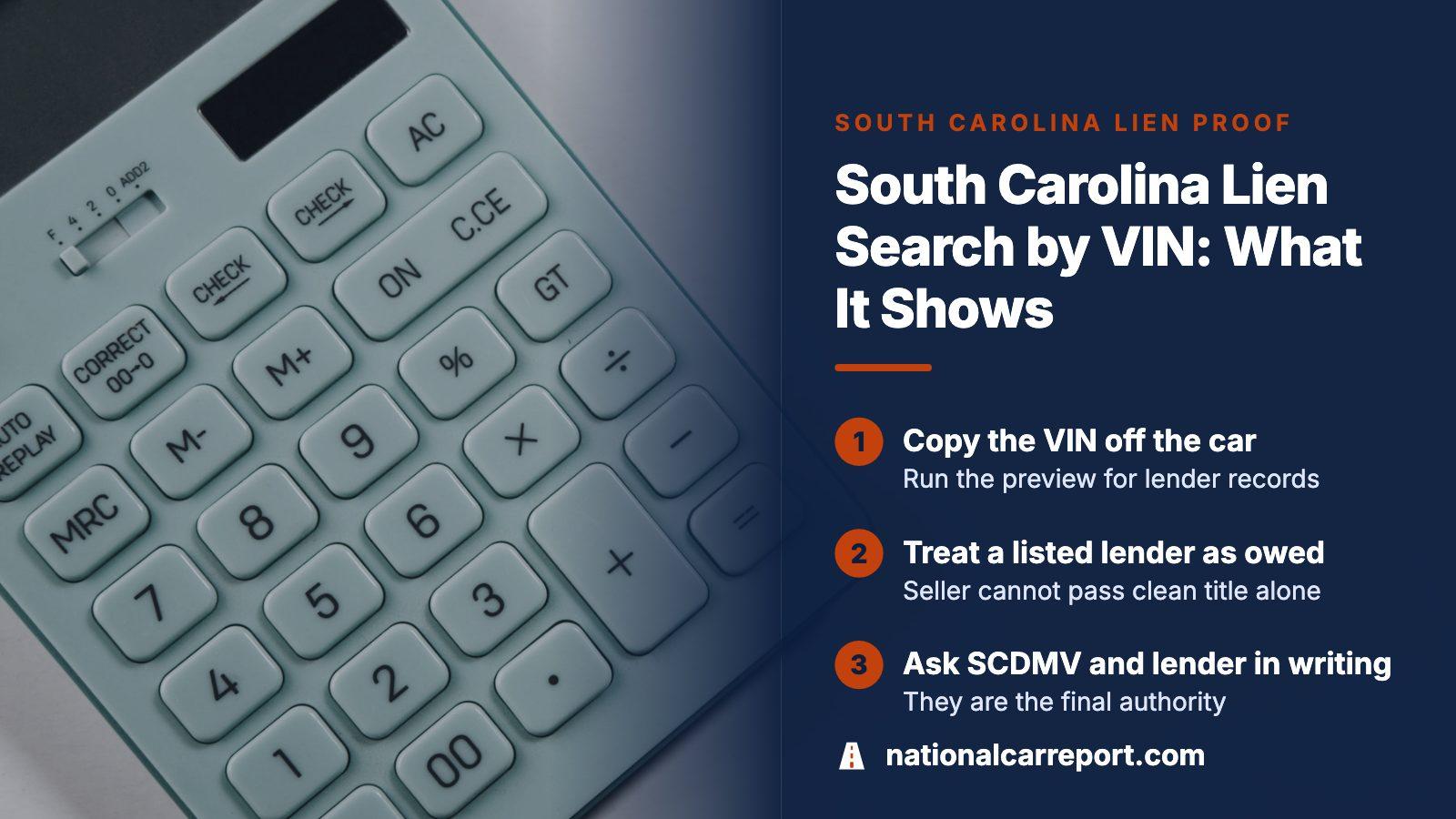
THE SHORT ANSWER
To search for a lien on a South Carolina car, copy the VIN from the vehicle and run the preview, which looks for lender, theft and impound records on that number. A listed lender means money may be owed and the seller cannot pass a clean title alone. An empty result is not proof, since the national title system has no required lender field. Ask the SCDMV and the lender in writing.
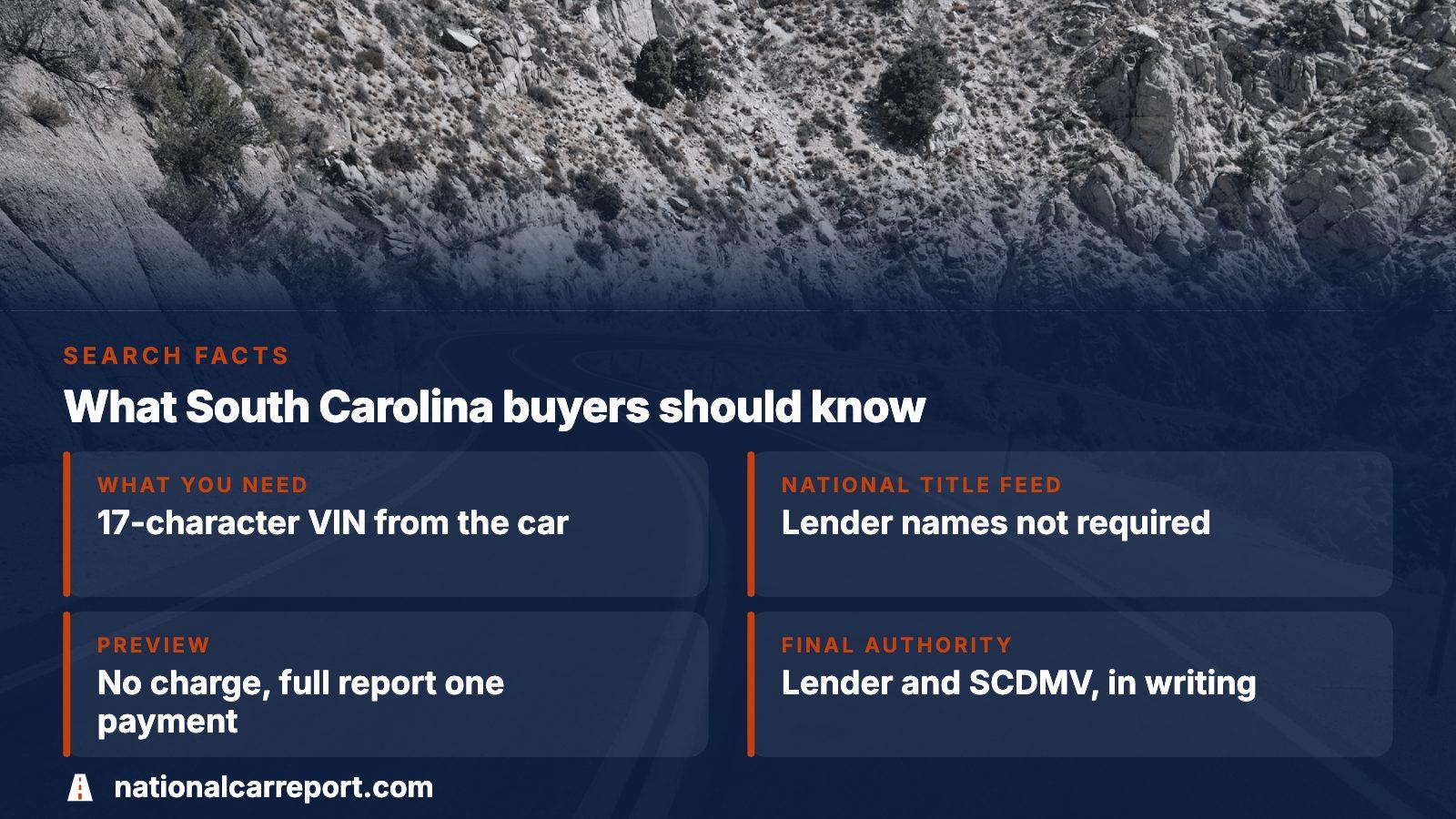
- What you need
- The 17-character VIN, read off the car itself
- National title feed
- Updated every 24 hours, but lender names are not required in it
- Preview
- No charge; the full report is one payment
- Final authority
- The lender and the SCDMV, in writing
Why a hidden lien lands on the buyer
Money borrowed against a car gives the lender a legal hold on it until the balance is cleared. Sell the car in the meantime and that hold does not disappear; it can follow the vehicle to its next owner. That is the whole reason a South Carolina buyer wants the lien question answered before cash changes hands, and why a seller's cheerful assurance is not an answer.
NationalCarReport works nationwide on stolen-vehicle, lien and impound records, so the same search covers a car that has crossed a state line. That matters in a state where many used cars arrive from somewhere else.
What the VIN preview looks for
The preview matches the VIN against several kinds of claim that never show on a glance at the paperwork. Think of it as three separate questions asked at once.
- Does a lender appear to hold a claim on this car?
- Was it held by a tow or storage yard, and was it sold from there?
- Was it reported stolen, and did it come back?
Brand records such as salvage or flood come along too, because a brand and a lien can sit on the same car. Each answer is attached to the VIN, never to a person, so nothing here is a look-up of the seller.
Why an empty result is a prompt to confirm
The federal title database that states feed once every 24 hours has a fixed list of required fields. By the rule that sets them, those include the VIN, the brands on the title, who the title was issued to, salvage details where a state collects them and the odometer disclosure. A lender's name is not on that list.
The federal consumer pages for that system do not describe lien data in a buyer's report either. They describe title status, brand history, odometer, total loss and salvage. So a search that finds nothing may simply mean no source it reads has the lender on file.
How to read a blank
A blank means no claim was found in the records searched. It does not mean the loan is paid. Treat it as one good sign and still get the lender's own statement.
Running the search in four steps
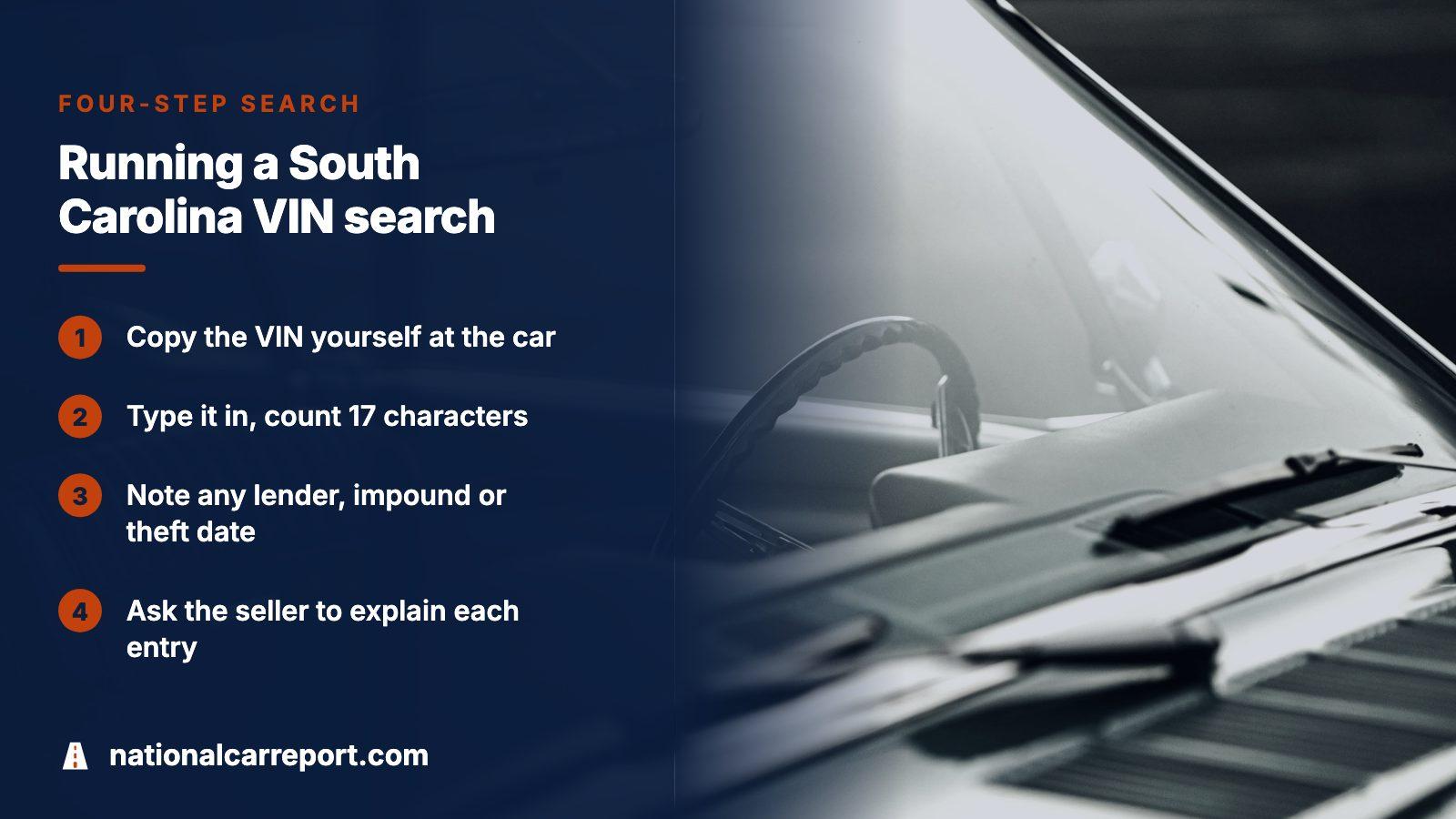
- Copy the VIN yourself while standing at the car, not from a text or an ad, and check it character by character against the title.
- Type it into the preview. Count the characters: a real VIN has 17, and a mistyped one returns nothing useful.
- Read what the preview lists. Note any lender, impound or theft entry and its date.
- Take every entry back to the seller and ask for the paperwork that explains it.
Should the car and the title disagree on even one character, pause the deal. A database cannot repair that.
What the South Carolina side has to confirm
Lien rules belong to the state, and the state's motor vehicle agency is the body that records titles. We could not open the SCDMV's own pages or the state code while writing this, because both refused our requests, so we are not going to describe South Carolina's lien forms, deadlines or fees here. Guessing at a fee or a form number would do a buyer more harm than saying nothing.
What you can do is ask the SCDMV how a lien is shown on the title for the exact car, and how a lender's release is recorded once the loan is cleared. Ask the same question of the lender. Get both answers in writing and keep them with the bill of sale.
Reading a hit and what to do about it
| Result | Possible meaning | Your response |
|---|---|---|
| A lender listed | A loan may still be open | Ask for a written payoff and a release plan |
| An impound or tow entry | A yard held the car, maybe sold it | Ask how the seller got it back or bought it |
| A theft entry | The car was reported stolen | Do not pay; ask for proof it was recovered |
| A salvage or flood brand | Damage history sits on the title | Get an independent inspection |
| Nothing at all | No source searched has a claim | Still confirm with the lender and SCDMV |
A lender entry is not an accusation against the seller. Plenty of people sell cars they are still paying for. The only trouble comes when the sale pretends the loan is not there.
When the seller is still paying off the car
If the seller owes money, the cleanest sale runs through the lender. Meet at the lender's branch if there is one, pay the payoff directly to the lender, and leave with the release in your hand rather than a promise to mail it later. If the lender is an online one, ask it to confirm the payoff amount and release method by writing before any money moves.
Never hand over the full price and trust the seller to settle the loan afterwards. Sellers who mean well still forget, and sellers who do not mean well rely on that.
One rule for lien cars
The lender gets paid first, from the money you hand over, with proof of release in return. Nothing else is safe.
Pair the lien search with an inspection
A history search tells you about paper, not about metal. The Federal Trade Commission points out that these reports tend to cover crashes and water damage, not worn brakes or a tired transmission, so they cannot stand in for a mechanic's inspection. The national title system's own consumer page strongly encourages an independent inspection as well.
Get the shop to write up what it finds, VIN included, with a cost estimate for any repair. If something turns up, those figures give you something concrete to bargain with.
Price of the check and your next call
Looking at the preview costs nothing. If the car earns a deeper look, you pay one time for the full report, never monthly, and the choices are listed on the pricing page. Start with the preview, read what comes back, then decide.
Then phone the SCDMV and the lender with the VIN in hand. Those two calls close the gap that no database can.
Where this information comes from
- NMVTIS: For consumers — what the national title system collects, and how state rules differ
- NMVTIS: Understanding a vehicle history report — the short list of items in a consumer report and the advice to inspect
- Federal rule 28 CFR 25.54: Responsibilities of the States — the fields states must send and how often; no lender field is required
- FTC: Buying a used car from a dealer — limits of history reports and the case for an independent inspection
Sources and photos: Facts checked against the sources above in November 2026. Photos by Sasun Bughdaryan, Dylan Michaud and Will Truettner on Unsplash; diagrams by NationalCarReport.
Keep reading
- Vehicle Lien Check by VIN: Nationwide Lien, Theft and Impound RecordsThe same search without the state angle, for any car.
- DMV Lien Release Search: How to Confirm a Lien Is GoneHow to confirm a paid-off lien was actually released.
- Buying a Private-Party Car That Has a Lien: Safe StepsA walk through buying when the seller still owes money.
- North Carolina Lien Search: Check a Car's VIN for Lender ClaimsA neighboring state's lien check, for cars that crossed the border.
Frequently asked questions
How do I do a South Carolina lien search on a car?
Take the VIN off the car, put it through the preview, and read any lender, impound or theft entry it lists. Then contact the SCDMV and the lender named on the paperwork, and ask for written confirmation of the loan status. The search points you to questions; the lender's letter settles them.
Can the seller sell a car that has a lien?
People do, usually by paying the loan off from the sale. The safe version sends the payoff straight to the lender and gets a release in return. The unsafe version relies on the seller to settle later. Ask which one is on offer, and put the answer in writing.
Does a clean search mean the car has no lien?
No. It means none of the records searched showed a claim. The federal title feed does not require lender names, so a loan can sit outside what any buyer's search reads. Confirm with the lender and the state before you pay, especially on a private sale.
Does the preview show who owns the car?
No. It searches by VIN and returns records about the car, not personal details about people. If you need to know who the current owner is on paper, the title and the seller's identification are the documents to examine, alongside the SCDMV.
What if the VIN on the car does not match the title?
Walk away until it is explained. A mismatch can come from a typo on paper, though it may also signal a swapped plate or a cloned car. A search on either number will not repair that. Ask the SCDMV how it would verify the vehicle.
Now check the car itself
The guide explains what to look for. The report shows what this VIN has on record.