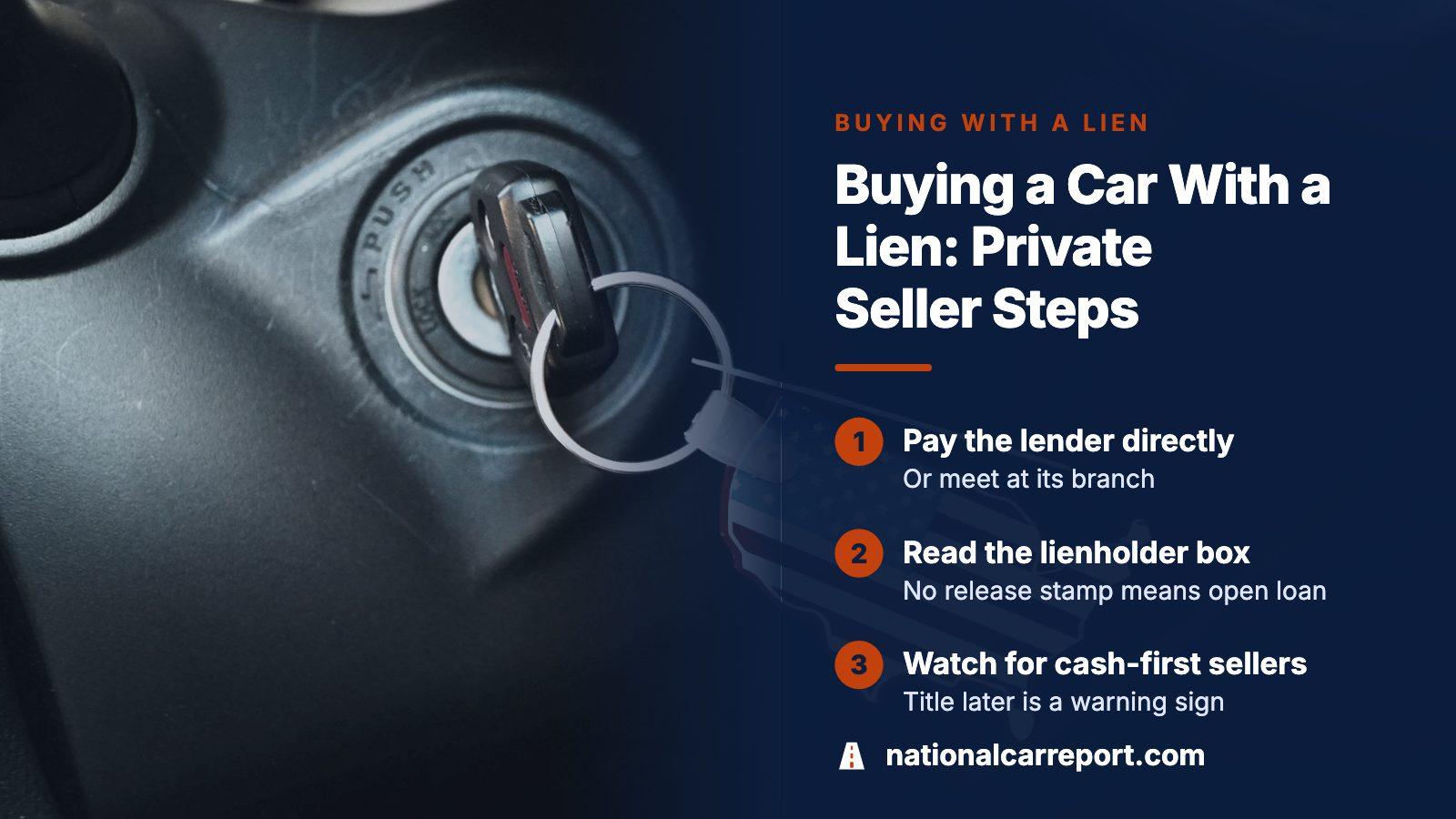
THE SHORT ANSWER
Ask the seller to show the title, then confirm with the lender how much is owed. Pay the lender directly, or meet at the lender's branch, so the payoff and the release happen together. Do not take a car whose title still names a bank unless the lender's release comes with it. Run a VIN check first so you know whether a lien, a theft report or an impound record is already on file.
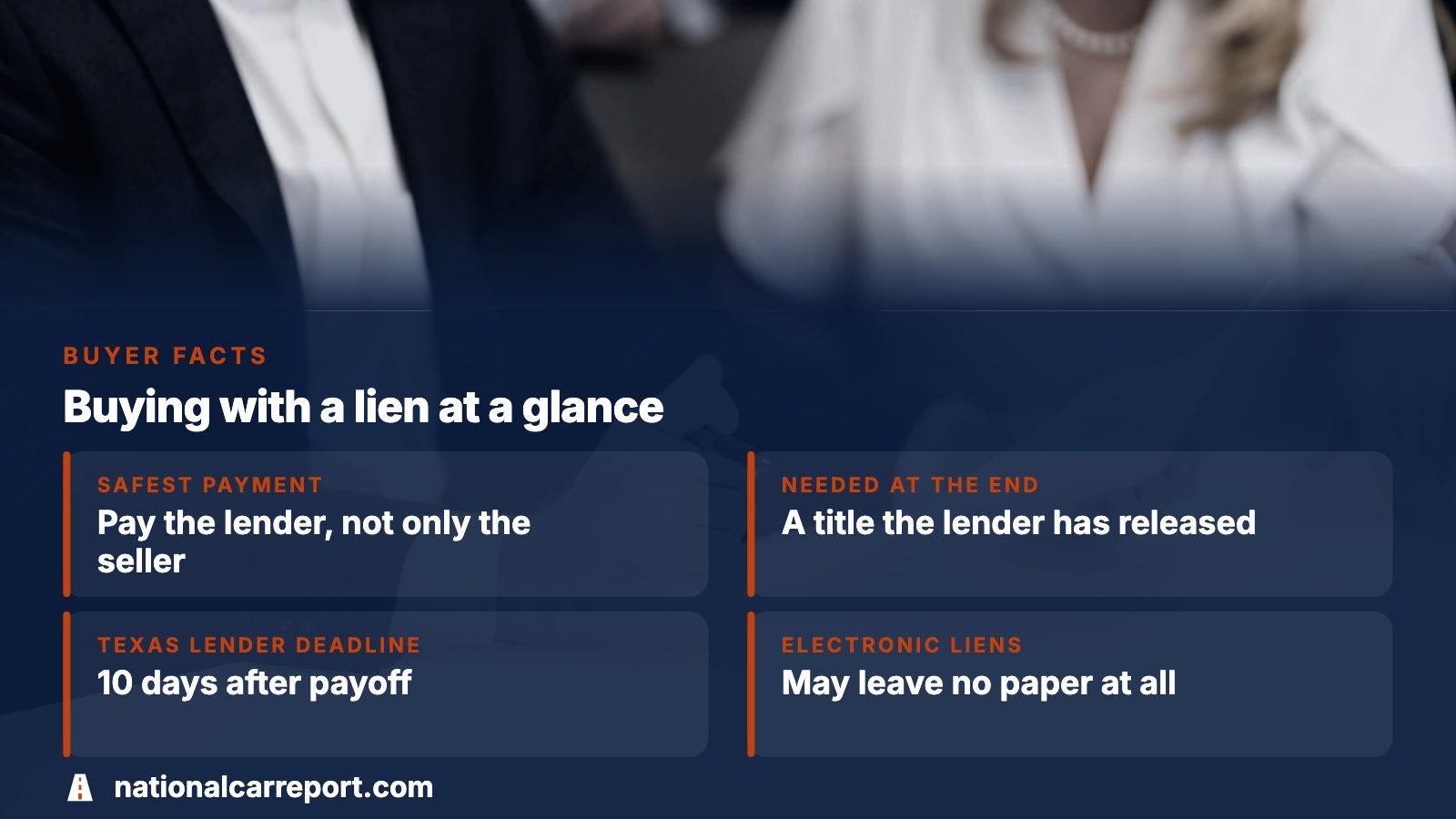
- Safest payment route
- Pay the lender, not only the seller
- What you need at the end
- A title the lender has released
- Texas lender deadline
- 10 days after payoff
- Electronic liens
- May leave no paper at all
Why a seller's loan becomes your problem
Financing a car puts the lender's name on the state title until the loan is repaid, and that entry is called a lien. States treat it as notice to anyone who deals with the vehicle. In Virginia's wording, a title that shows a security interest tells purchasers one exists.
Private buyers often miss the next part. A seller who hands over paperwork and takes your cash has not removed the lender's entry, and the lender agreed to nothing. In the lien, theft and impound records we read from many states, trouble tends to begin when the car changes hands before the lender is dealt with.
Start with the paper in the seller's hand
Ask to see the title before you discuss price. Compare the seller's photo ID to the owner name, and check the number printed on the paper against the one on the car itself. A bank or credit union in the lienholder area means the loan is open or was never released.
- A lender is listed with no release stamp attached: assume the loan is open.
- No title in hand because the bank holds it: common with paper titles under a loan, and it means the lender has to join the sale.
- Electronic title: the state keeps the record, so nothing on paper exists to inspect.
- Vague answers about the lender or the balance: slow down and verify on your own.
Texas describes the electronic case clearly. The state keeps the title record and the lender arranges the release with it, so the owner files nothing. For you as the buyer, that leaves only the seller's word unless you look at a record.
Pay the lender so the release happens with the sale
The cleanest private deal puts the lender in the middle. Have the seller ask the lender for a payoff figure good through your closing day, and get the name of the department that handles title releases. Then pick one of two routes.
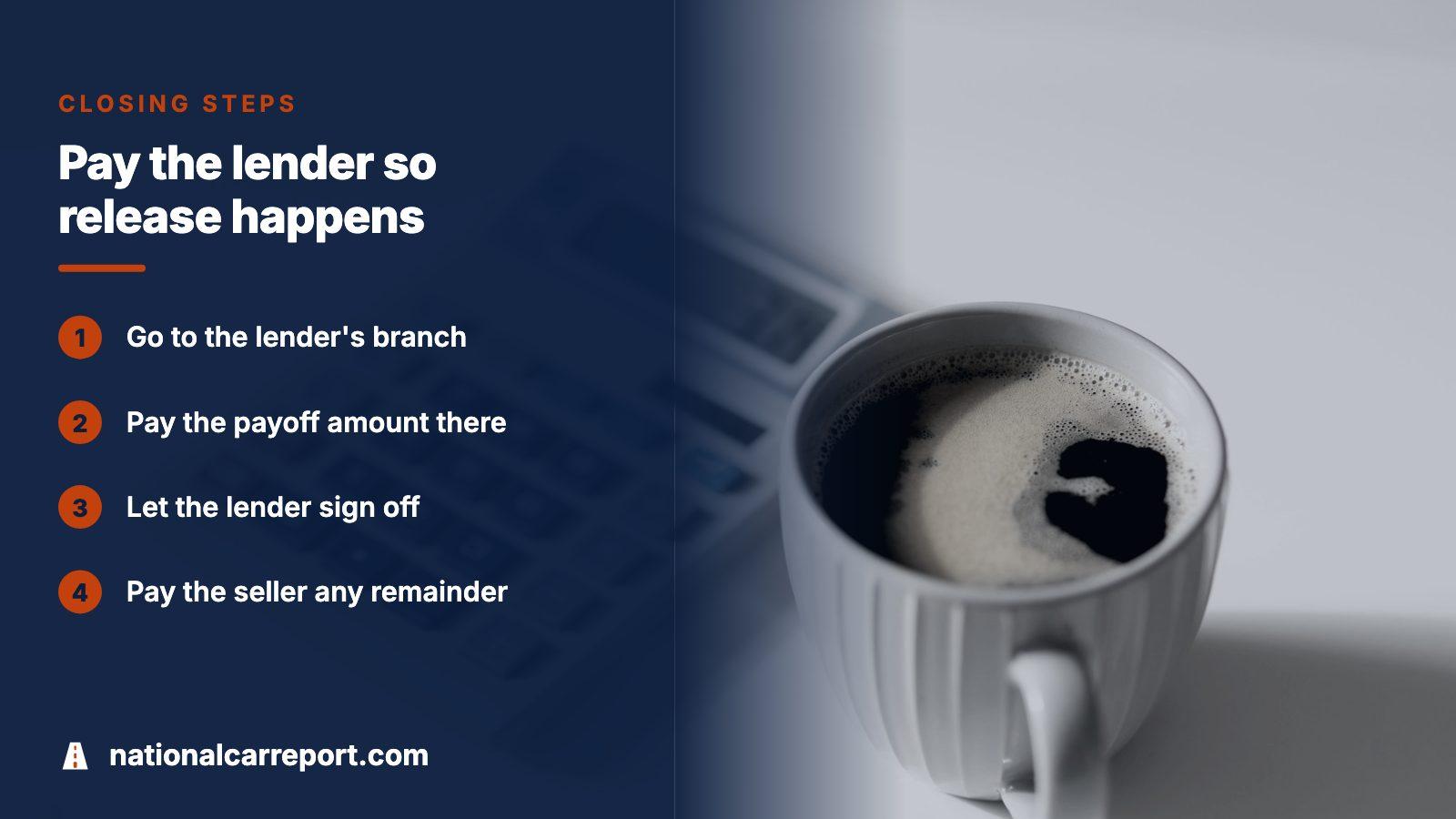
- Go to the lender's branch if one is close. Pay the payoff amount there, let the lender sign off, and give the seller any remainder during the same visit.
- Pay the lender by wire or its official payoff channel, with the seller present, and have the lender confirm in writing that the loan is closed and when the title or electronic release will go out.
Keep every receipt and every name. If the sale price is higher than the payoff, you pay the lender what it is owed and the seller the difference. If it is lower, the seller must cover the shortfall before the lender will release anything, and you should not hand over the car's purchase money until that is arranged.
What the release has to look like
A release is the lender giving up its claim in a form the state office will accept. Washington's statute describes both routes. After the debt is satisfied, the lender either signs the title over to the owner and sends it to the state, or signs it to the person acquiring the car along with the owner's release of interest. Either way the buyer is covered only once the lender has acted.
| State | What the official page says | What it means for you |
|---|---|---|
| Texas | Lender gets 10 days from payoff; paper title mailed or electronic record converted | Ask for the release date and watch for the title |
| Pennsylvania | Electronic release runs right away; paper title mailed next business day | Ask the lender to run it the day you pay |
| California | Seller or lienholder signs the title; buyer submits it to DMV | Both signatures matter at the counter |
| Washington | Ten days after a proper demand, or a $100 penalty if a loss follows | Put the demand in writing and keep a copy |
Those are the states whose pages we opened. Other states set their own timelines and forms, so ask your own DMV what it accepts as proof of release.
Check the VIN before any money moves
Paperwork tells you what the seller chose to show. A VIN check tells you what records say. Run it at the start, before you travel or negotiate, so a surprise costs you a few minutes and not a deposit.
NationalCarReport lets you preview a VIN before you pay anything. Going further means one payment for one report, with no recurring charge, and the pricing page shows the amount. On a financed car, read the lien entries first, then theft and impound records, since one car can carry several problems. Title brands and odometer readings finish the picture.
What a report cannot do
National title data does not promise a lender's name. The federal reporting rule lists the VIN, brands, whom the title was issued to, salvage acquisitions and odometer disclosures; no lender appears. A clean result is useful evidence, not a release letter.
Closing the deal at the state office
Once the lender has released, take the signed title, a bill of sale and your ID to the state office. California wants a change of owner or lienholder reported to DMV inside 10 days, and its form for a lost title needs a notarized section when a legal owner is listed. In Texas the county tax office asks for the title, a notice from the named lender, and Form 130-U, plus a title fee of $28 or $33 depending on county.
If the lender has not released when you want to close, wait. A good seller will understand, and the delay costs far less than owning a car whose title still names a lender you cannot reach. Lenders that merge or close can be hard to find later.
Signs the seller is working around the lender
- The seller asks you to pay in cash and promises to send the title later.
- The seller wants to meet in a parking lot, never at the lender or a DMV office.
- The title is a duplicate or copy and the seller cannot say why.
- The seller refuses to share the lender's name or a payoff statement.
- The price is far below what similar cars ask, with a story attached.
No single item proves fraud, but together they describe deals that end with the car taken back from the new owner. Walk away, or move the sale to the lender's office where steps cannot be skipped.
If you already bought one with the lien still on it
Contact the lender right away with the VIN, the seller's name and your bill of sale. Ask what is owed and whether it will accept payment from you in exchange for a release. Many lenders will, because a paid loan is better for them than a repossession.
Keep messages with the seller, and think about a police report if money was taken without a release. Our lien release letter guide covers what to ask for, and the lienholder lookup guide helps when you do not know the lender.
Where this information comes from
- Virginia Code 46.2-638 on titles as notice of liens — Supports the point that a title showing a lender is notice to buyers.
- Washington RCW 46.12.675 on security interests — How a lender must release and the penalty after a proper demand.
- TxDMV page on adding or removing a lien — Texas payoff deadline, electronic records and paperwork.
- PennDOT electronic lien and titling FAQs — How electronic releases and paper titles work in Pennsylvania.
- California DMV title transfer page — Who signs the title and the reporting window.
- Federal rule 28 CFR 25.54 on state reporting to NMVTIS — The titling data states report to the national system.
Sources and photos: Facts checked against the sources above in November 2026. Photos by Jake Kling, Ben Wicks and Carrie Allen www.carrieallen.com on Unsplash; diagrams by NationalCarReport.
Keep reading
- Vehicle Lien Check by VIN: Nationwide Lien, Theft and Impound RecordsRun a lien check on the VIN before you meet the seller.
- Car Lien Release Letter: What It Is and How to Get OneWhat a lender's release letter should show.
- Selling a Car You Still Owe On: How a Lien Sale WorksThe same deal seen from the seller's side.
- Car Lien Holder Search: How to Find the Lender Behind a VINFind out which lender holds the loan.
Frequently asked questions
Is it legal to buy a car that is still financed?
Nothing in the state pages we opened bars it, but the lender's claim does not vanish on its own. The lien stays on the title until the lender releases it. Pay off the loan as part of the sale and get the release before you take the car.
Who should I pay, the seller or the lender?
Pay the lender the payoff amount, then pay the seller any difference. Doing it at the lender's office, or with written confirmation from the lender, gives you proof the loan was closed. Handing the seller all the money and trusting them to pay the bank leaves you exposed.
How long does a lender take to release the lien?
It depends on the state. Texas gives the lender 10 days after payoff, and Pennsylvania has lenders release electronic liens right away. Washington sets ten days after a proper demand. Ask the lender for a date in writing and check your own state's rule.
What happens when the seller's title is electronic?
Then the state holds the record and the lender releases it electronically, so a paper title may not exist until after the release. Confirm the release with the lender and the state before you pay. A VIN check can also show whether a lien is reported.
Does a clean VIN check mean the lien is gone?
Not by itself. National title data does not reliably carry the lender, so a clean result is evidence and not proof. Treat the lender's written release and the state's updated title as the real confirmation, and use the report to catch theft, impound and title problems.
Now check the car itself
The guide explains what to look for. The report shows what this VIN has on record.