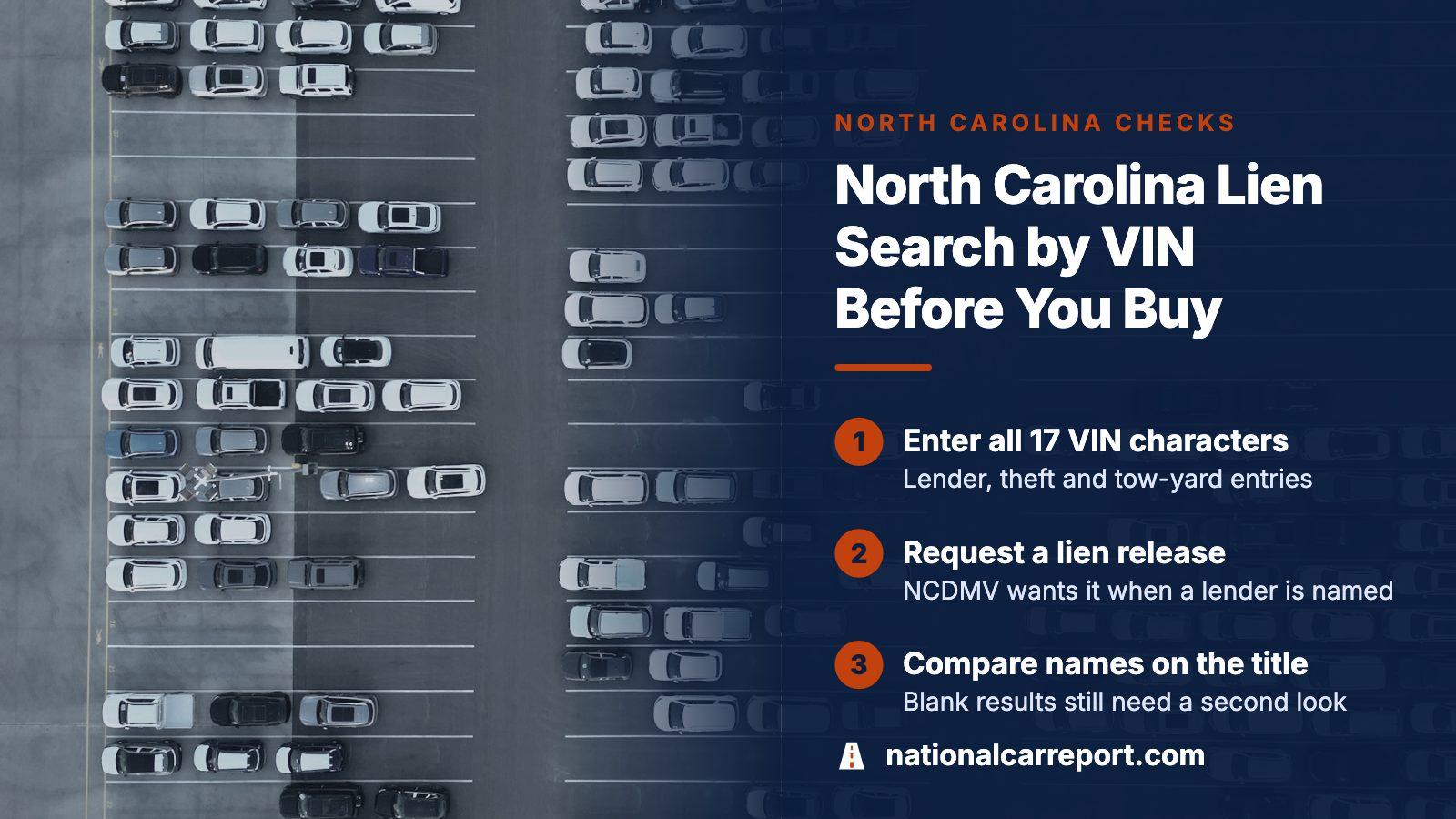
THE SHORT ANSWER
To run a North Carolina car lien check, take the VIN off the car, all 17 characters, and enter it in the preview. The search hunts for lender, theft and tow-yard entries filed against that number. Seeing a lender's name suggests the loan could be unpaid. A blank result proves little, because no public NCDMV tool turned up for searching liens by VIN. Ask for a lien release and compare names on the title.
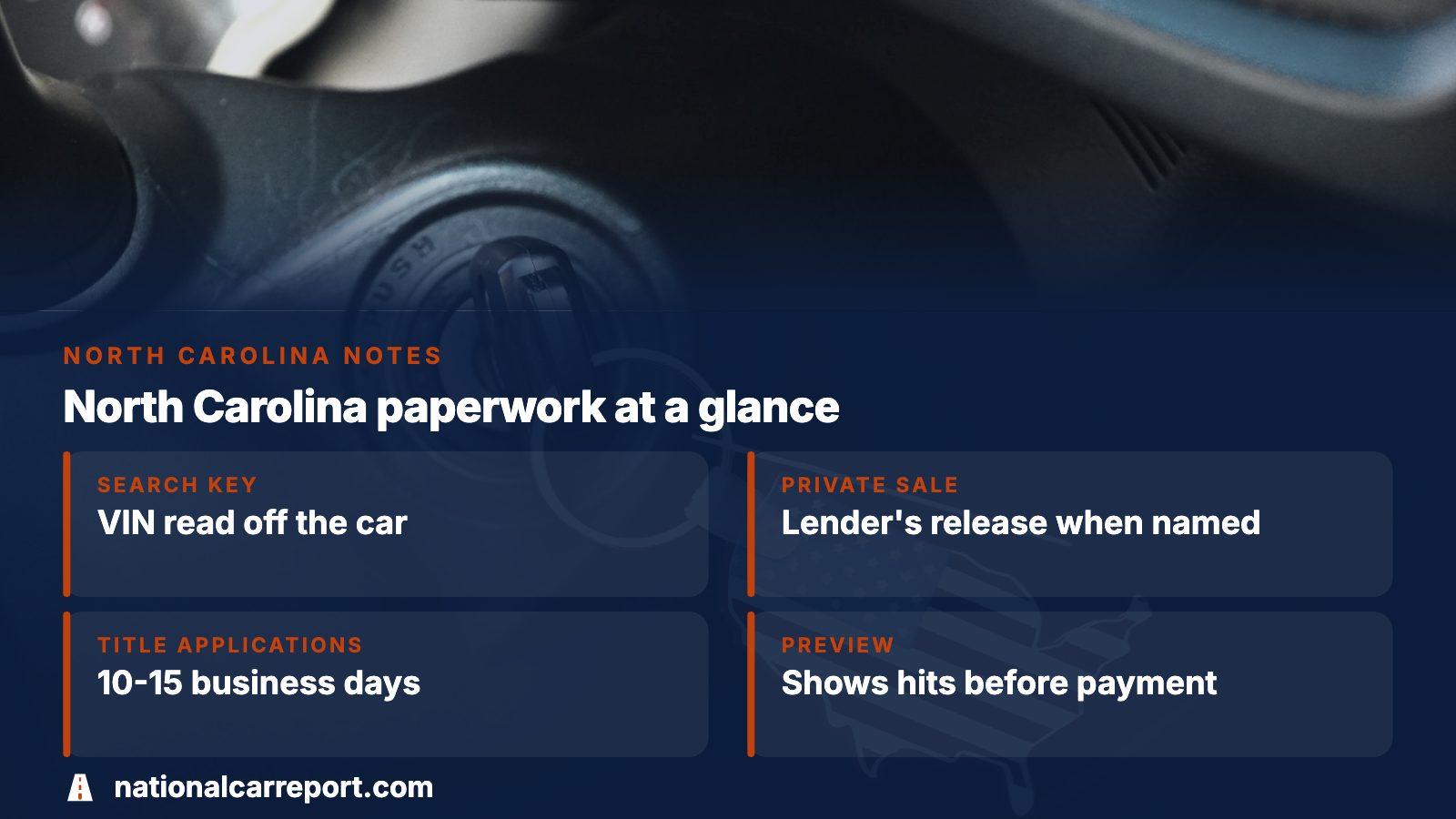
- Search key
- The VIN, read off the car
- On a private sale
- NCDMV wants the lender's release when the title names one
- Paperwork clock
- Title applications take 10-15 business days
- Free preview
- Shows what turned up before any payment
What the VIN search looks for on a North Carolina car
Money owed on a car can leave a lender with a legal claim on it until the debt is cleared. In a private sale the seller may not volunteer it, so the claim has to be found from the car itself. NationalCarReport is built around the records a buyer rarely sees, so the preview leans toward lenders, tow yards and theft reports rather than a long maintenance story.
- Lender claims, where one reached a record the search reads
- Impounds: evidence that a yard held the car and may have sold it
- Theft: any stolen report on file, plus a recovery if there was one
- Salvage and flood brands that sharply change what the car is worth
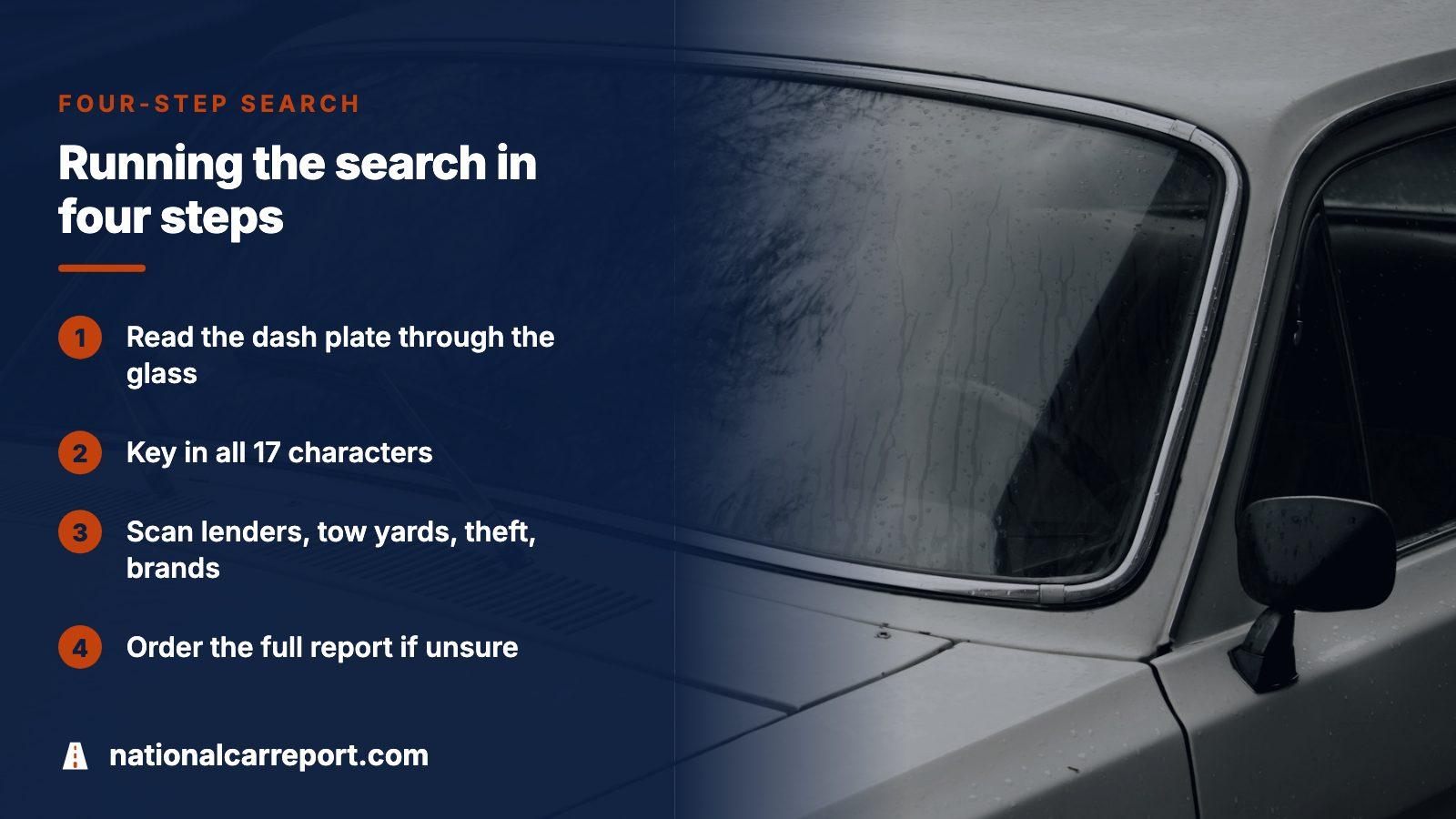
Running the search in four steps
- Read the metal plate on the dash by the driver's side, visible from outside, then confirm the door jamb sticker carries the identical number.
- Key all 17 characters into the preview box. One wrong character can return another car's record or nothing at all.
- Go through the preview lines for lenders, tow yards, theft and brands before deciding anything.
- If something turns up or the picture looks thin, the full report is the next step.
Do this before you visit a bank, a notary or a license plate agency. Finding a problem on a phone in the seller's driveway is cheaper than finding it at the counter.
What NCDMV asks for when a lien is on the title
The state's own forms tell you how a lien is supposed to be handled. For a car bought from a private individual, NCDMV lists the vehicle title, the title application (MVR-1), an odometer statement (MVR-180) and a damage statement (MVR-181). Add one more document to that stack whenever the title names a lender: that lender's signed release.
Every title application must also declare liens and be notarized. The consequence is plain. If the seller still owes a lender, the lender's release is part of the paperwork you will need, and you cannot finish the transfer without it.
Out-of-state cars with a loan
If the car comes from another state and a lender on record holds its title, the state's checklist adds the current registration card from that state, an odometer reading and the MVR-1. In that situation the lender, not the seller, controls the title.
Reading each outcome and your response
| Result | What it points to | Your next move |
|---|---|---|
| Lien listed | A lender filed a claim that may still be open | Identify the lender, request a written payoff figure, and send the money to the lender |
| No lien shown | Nothing reached the records searched | Ask for the lien release or a letter from the lender anyway |
| Theft, not recovered | Possibly still listed as stolen | Stop the sale and contact police |
| Impound entry | A yard once held the car | Ask who paid the fees and whether a sale followed |
| Title in another name | The seller may be unable to sign | Pause until the names on the title and ID match |
Why a blank result still needs a second look
No search sees every lender. On the NCDMV pages we opened, we found no public screen for looking up a lien by VIN or plate, so the lender's release or the title itself remains the strongest proof. The federal title system does not fill the gap either. Its report is built on five indicators (title status, brands, odometer, total loss, salvage), and a lender field is not among them.
The insurer-backed NICB VINCheck is also free and worth a run, but it only draws on member insurers' theft, salvage and flood files, and the bureau itself warns that encumbered titles may not show. Treat each source as one piece, not the verdict.
Salvage and lien can arrive together
Under NCDMV's definition, a car is salvaged when parts and labor to make it roadworthy would pass 75 percent of fair market value. If the car is six model years old or newer, the title applicant needs a State Highway Patrol anti-theft inspection. Ask whether either applies before you agree on a price.
When the seller says the title was lost
A lost title is where lien problems tend to hide. A registered owner can order a duplicate, and requests must wait 15 days before processing. Should the title name any lender, that lender's release must accompany the application, and the application itself needs a notary.
NCDMV also offers an indemnity bond route for a missing title, but it refuses the bond when a lien is outstanding and no cancellation can be issued. It also refuses it for mechanics and storage liens. A seller who is pushing a bond while the loan is unpaid is describing something the state does not accept.
Getting the lien cleared after the payoff
NCDMV publishes a form for removing a lien from a certificate of title (MVR-8), and a separate affidavit that North Carolina lienholders use (MVR-46D). You do not need to memorize either. What matters is that the paperwork comes from the lender, and that you hold it before the seller keeps the cash.
- Pay the lender, or hand over funds in the lender's presence, never the seller alone
- Get the release on paper, with the VIN written on it
- Complete the back of the title, which both parties fill in and a North Carolina title also needs notarized
- Allow 10-15 business days for a standard title application, or ask whether instant titling suits your agency
Cost, and where to go from here
Seeing the preview costs nothing. For the full record you buy the report one time, and the pricing page carries the figures for a single report or a larger pack. Run it before money moves, since a refund from a private seller is hard to win.
NCDMV customer service is 919-715-7000 for questions about your own paperwork. If the check turns up a lender, the guides below explain how to buy around a loan, how to confirm a release and how the same search works in a neighboring state.
Where this information comes from
- NCDMV: Vehicle titles — Duplicate title rules, the lien release requirement and processing times.
- NCDMV: Title documents and forms — Which documents a private sale needs and the lien form list.
- NCDMV: Title special cases — Lien declaration, indemnity bond limits and salvage rules.
- NMVTIS: Understanding a vehicle history report — The five indicators the federal title system reports.
- NICB: VINCheck — What the free insurer lookup covers and what it leaves out.
Sources and photos: Facts checked against the sources above in November 2026. Photos by Iain, Tigran Shishmanyan and Jake Kling on Unsplash; diagrams by NationalCarReport.
Keep reading
- Vehicle Lien Check by VIN: Nationwide Lien, Theft and Impound RecordsThe same check for a car from any state.
- DMV Lien Release Search: How to Confirm a Lien Is GoneHow to tell whether a lender has really released its claim.
- Buying a Private-Party Car That Has a Lien: Safe StepsHow a purchase can work when the seller still owes money.
- South Carolina Lien Search: Check a Car's VIN for Lender ClaimsBuying across the border? See how the search reads there.
Frequently asked questions
How do I do a North Carolina lien search?
Take the VIN from the car and run it through the preview for any lender, theft or tow-yard entry. Then ask the seller for a lien release or a letter from the lender. In a private sale NCDMV wants the lender's release whenever the title names one, so that paper is the real proof.
Can I look up a lien on a North Carolina car by plate?
We found no public NCDMV page for searching a lien by plate or VIN. Plates are not how this search works anyway. Get the VIN from the car, the insurance card or the registration, then search by VIN and verify any result with the lender or the title itself.
If a federal title report comes back clean, is the car free of liens?
No. The federal system reports five items only, covering title status, brands, mileage, total loss and salvage. Lenders are not on that list. A clean report is good news about brands and damage, but it cannot tell you whether a lender still has a claim.
What if the seller lost the title?
The owner can order a duplicate, which must wait 15 days before processing and needs a notarized application. If the title names a lender, its release goes in too. Do not accept a bond as a shortcut, since NCDMV refuses one when a lien is outstanding.
Is the lien search free?
The preview costs nothing and shows what turned up for that VIN. You pay for the full report once and nothing recurs; each option's figure is on the pricing page. NICB VINCheck is a separate free tool, limited to insurer theft, salvage and flood records.
Now check the car itself
The guide explains what to look for. The report shows what this VIN has on record.