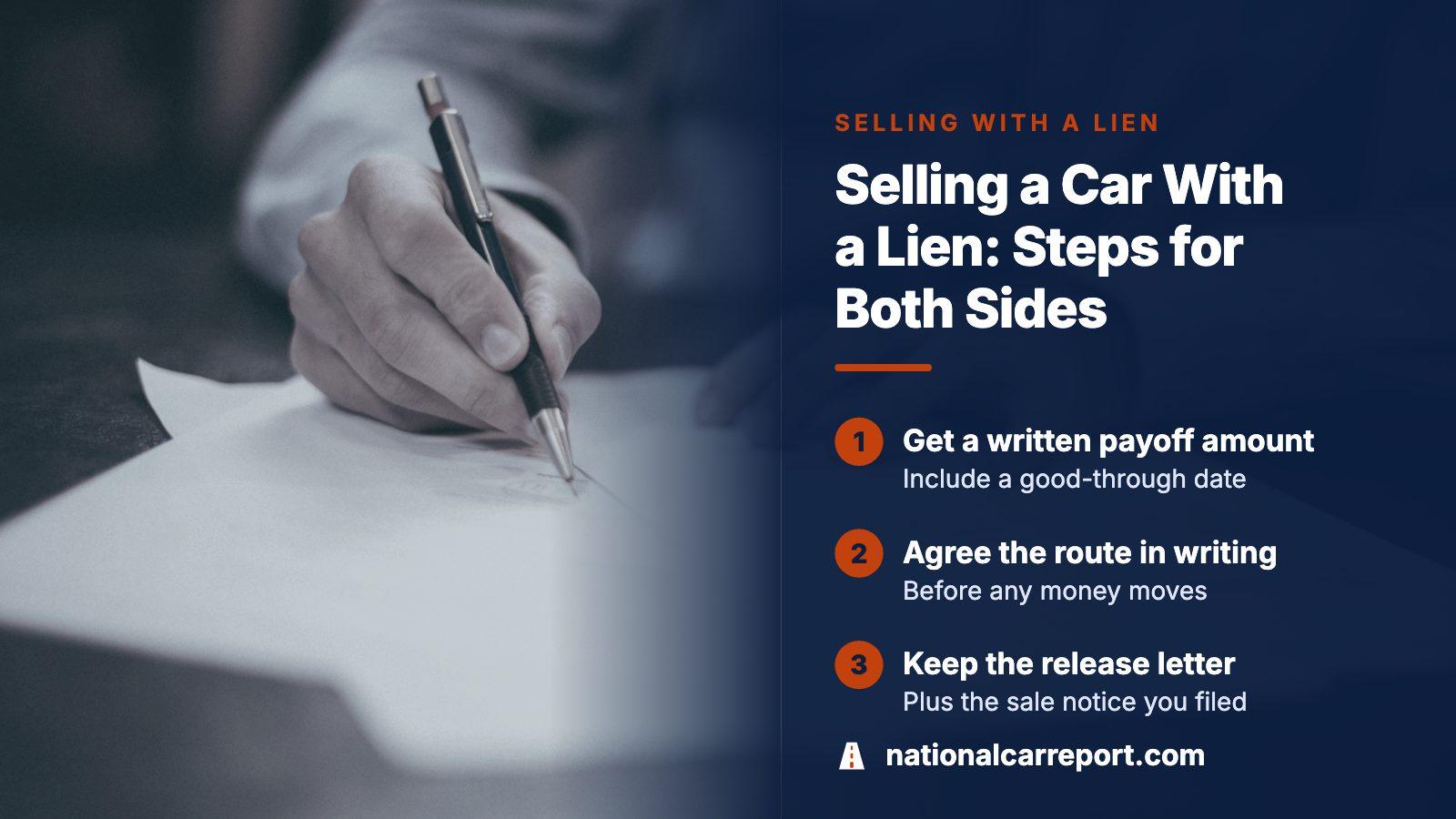
THE SHORT ANSWER
You can sell a car you still owe money on. The lender holds a claim on the title, so the buyer cannot get a clean title until that claim is paid and released. Most sales either close at the lender's branch, or the seller pays the loan off first. Buyers should confirm the lien status from the title and a VIN check before paying.
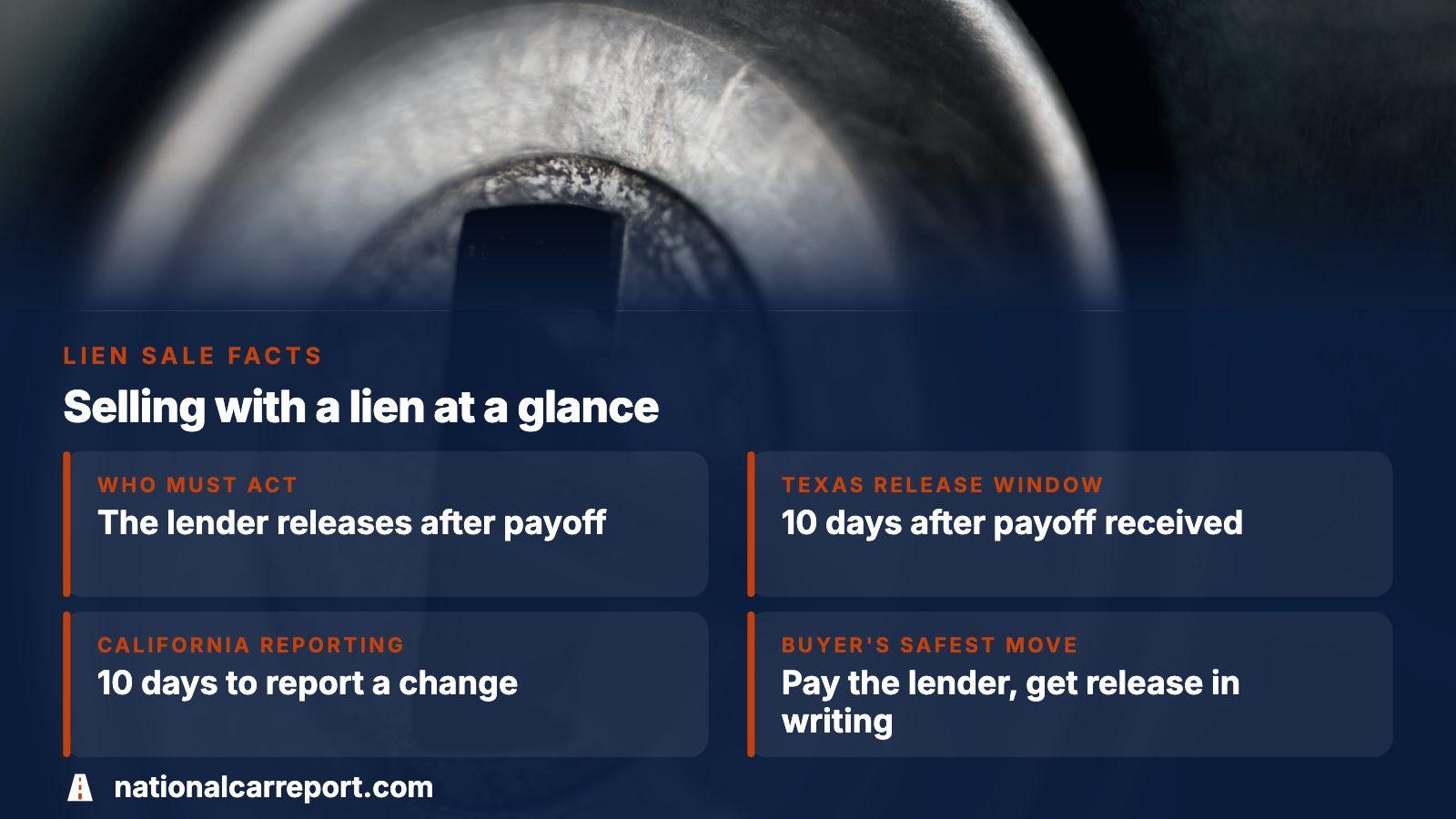
- Who must act
- The lender releases the lien after payoff
- Texas release window
- 10 days after the lender gets the payoff
- California reporting window
- 10 days to report a change of lienholder or owner
- Buyer's safest move
- Pay the lender directly, then get the release in writing
Why a lien complicates a sale
A lien is the lender's recorded claim on a car that secures the loan. While it stands, the title shows the lender, and the lender's claim follows the car, not the person who owes the money. That is why a seller cannot simply hand over the title and pocket a buyer's cash. Virginia's motor vehicle code spells out the buyer's side of this: a title that shows a security interest counts as adequate notice to purchasers that the interest exists. In plain terms, a buyer who skips the title is taking on the lender's claim, with the car as the collateral.
NationalCarReport looks at this from the buyer's chair, reading lien, theft and impound records for a VIN across states. The seller's job is simpler to state than to carry out: turn the lien into a release before, or at the moment of, the sale.
Three ways to close the sale
| Route | How it works | Main risk |
|---|---|---|
| Pay off, then sell | The seller clears the loan first, waits for the release and title, then sells a clean car. | Needs cash up front, plus waiting time for the release. |
| Close at the lender | Buyer and seller meet at the lender, the buyer's payment retires the loan, and the lender signs or releases on the spot. | Branch hours, and lenders that only work through a central office. |
| Buyer pays the lender directly | The buyer sends the payoff to the lender and the balance to the seller, then waits for the release. | Payoff amounts drift daily, and the buyer relies on the lender to follow through. |
A dealer trade-in is the same thing done by a professional. The dealer pays the lender and the lender releases the title to the dealer. Pennsylvania's own FAQ describes this: when a dealer pays off a loan on a trade, the lender must run the release immediately, and the state prints a paper title naming the dealer the next business day.
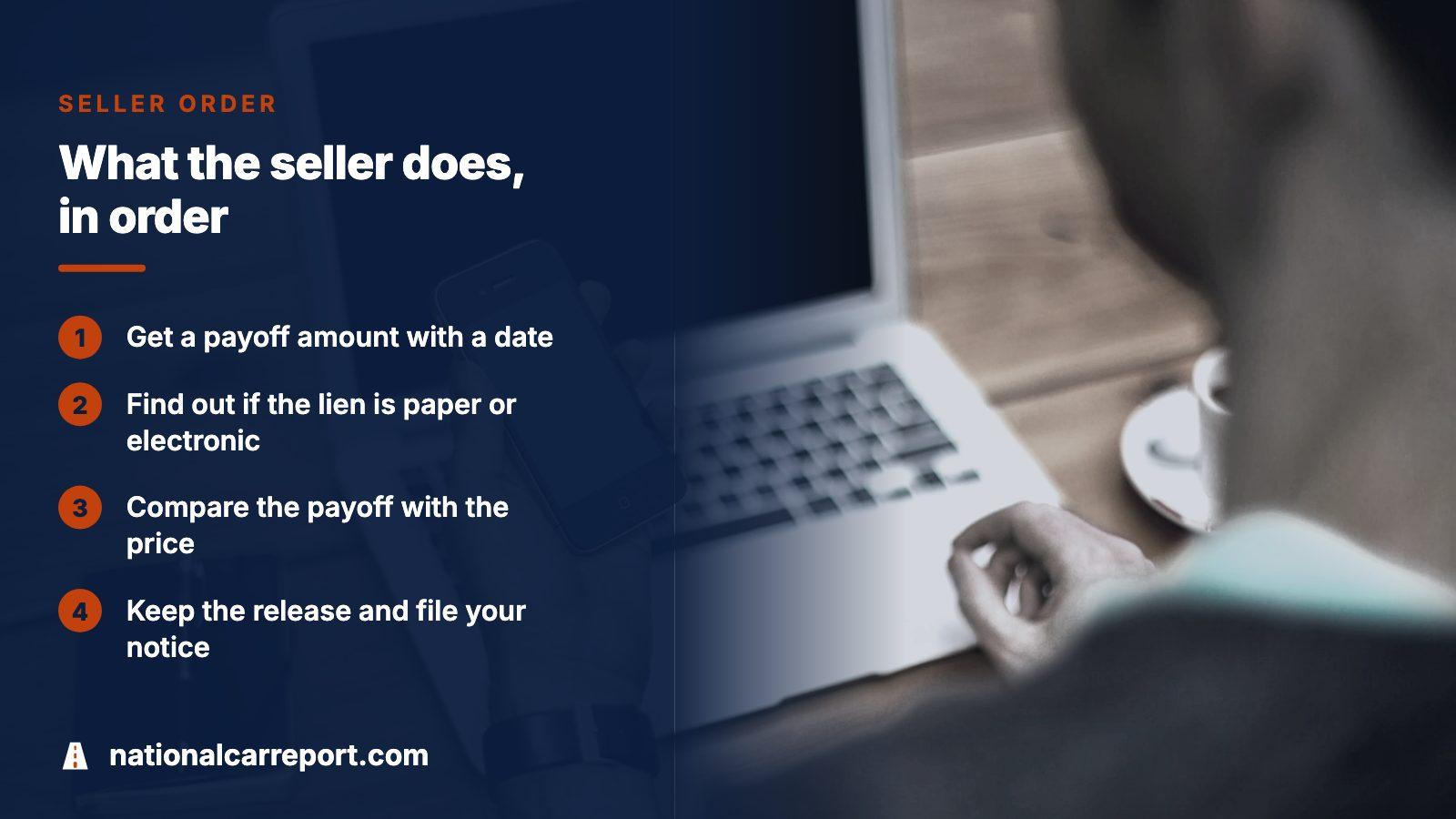
What the seller does, in order
- Ask the lender for a written payoff amount with a good-through date, and for its instructions for a sale to a third party.
- Find out whether the lien is recorded on a paper title or electronically; this decides who holds the title and how quickly it can reach a buyer.
- Compare the payoff with the price you expect. If the payoff is higher than the sale price, you must cover the gap yourself.
- Agree the route with the buyer in writing before any money moves, including who pays the lender and when the title will arrive.
- After payoff, keep the lender's release letter or a copy of the electronic release, and file your state's notice that you no longer own the car.
Some sellers owe more than the car will fetch. The sale can still happen, but the shortfall is the seller's debt, and the lender will not release the title until the whole payoff clears.
How the title reaches the buyer
Rules differ by state, so here are three official examples. In California, a private sale or loan payoff works by having the seller or lienholder sign the title, which the buyer then submits to DMV; the state expects any change of owner or lienholder to be reported within 10 days, and the seller separately files a release-of-liability notice. In Louisiana, the buyer's title application must include the old title signed over in front of a notary, showing any lien as released; a bank officer can stand in for the notary in certain cases.
Texas puts a clock on the lender: it has 10 days from the day the payoff arrives to let go of the lien. If the title is on paper, the lender posts it back. If the lien lives in the state's electronic system, the lender clears it there and the state then prints a paper title and sends it to the owner on record or to a named third party.
What this means in practice
The buyer's title is only as clean as the lender's release. Until the lender's paperwork or the state's electronic record shows the lien gone, the car is not free of the claim, whatever the seller says.
What a buyer should demand before paying
- The lender's name and a payoff letter, so you know exactly what retires the loan.
- A plan in which your money goes to the lender first, not to the seller.
- A written release of lien or a title with no lienholder, delivered before or at the moment of sale.
- A VIN check that agrees with the story, covering theft and impound records, not just the lien.
- A signed bill of sale that names the lender payoff and states who delivers the title.
Washington's statute shows why the paperwork matters. When the loan is satisfied, the secured party must either assign the title to the owner or to the buyer with the owner's release. If it fails to act within ten days after proper demand, it owes $100 to whoever suffered a loss. That is small money next to the price of a car, so do not treat the penalty as protection.
What a VIN check adds, and what it cannot do
A VIN check tells a buyer whether a lien has been reported against the car, and in the same pass whether it has been flagged as stolen or has landed in an impound. That cross-check catches a seller who says the loan is paid when a lien still shows, and a car whose paperwork looks fine but whose theft record does not. Looking at the preview carries no charge, and the full report is one payment you can hold back until this car looks worth pursuing.
The limits matter too. The federal rule behind the national title system lists the fields states must transmit: VIN, title brands, the titled owner, salvage data where states collect it and odometer disclosures. Nothing in that list names the lender. So a VIN check is a screen, and the state's own title record, plus the lender's release, remain the proof.
Treat a mismatch as a stop sign
When the seller claims the loan is settled yet a lien shows, or when the title names a lender the seller never mentioned, pause the sale until the lender confirms the status in writing.
Snags that stall a lien sale
- A lender that has closed, merged or changed its name; California DMV keeps a list to help owners track one down.
- A lost title, which means applying for a replacement first, and in California a notarized section when a lienholder exists.
- A payoff figure that goes stale because interest keeps accruing between the quote and the payment.
- A seller who wants cash now and promises the title later, which leaves the buyer holding a car nobody can register.
Most of these are solved with a phone call to the lender and a written timeline. Buyers who cannot get that timeline are usually better off walking away than paying and waiting.
Where this information comes from
- Texas DMV page on lien changes — supports the lender's release deadline and how paper and electronic liens differ
- PennDOT: Mandatory electronic lien and titling FAQs — supports the dealer payoff and release flow
- California DMV: Title transfers and changes — supports who signs the title on a private sale and the reporting windows
- Louisiana OMV page on used titles — supports the notarized assignment with a released lien
- Washington Legislature: RCW 46.12.675 — supports the lender's duty to release and the penalty for delay
- Code of Virginia 46.2-638 — supports the title as notice of a security interest to buyers
- GovInfo: 28 CFR 25.54 — supports what states report to the national title system
Sources and photos: Facts checked against the sources above in November 2026. Photos by Scott Graham, Alejandro Escamilla and Derek Nelson on Unsplash; diagrams by NationalCarReport.
Keep reading
- Buying a Private-Party Car That Has a Lien: Safe StepsThe same situation from the buyer's side, with the risks spelled out.
- Car Lien Release Letter: What It Is and How to Get OneWhat the lender's release paperwork is and how to get it.
- How to Remove a Lien From a Car Title After PayoffHow a lien comes off the title record once the loan is paid.
- Vehicle Lien Check by VIN: Nationwide Lien, Theft and Impound RecordsRun the lien screen on a VIN before you commit.
Frequently asked questions
Can I sell my car if I still owe money on it?
Yes. The lender must be paid and the lien released as part of the sale, so the buyer receives a title without the lender on it. Ask for a written payoff amount first, and pick one of the usual routes: pay off before selling, or close the deal at the lender.
Can I sell a car with a lien to a private buyer?
You can, but the buyer has the most to lose. The best structure sends the buyer's money to the lender first, with the remainder going to you, and the release arriving in writing. A buyer who pays the seller alone is relying on the seller to pay the lender.
What if I owe more than the car is worth?
The lender will not release the title until the whole payoff is cleared, so you must cover the difference out of pocket or refinance it. The buyer pays the car's price; the shortfall remains your debt to the lender.
How long does the lender take to release the title?
It varies by state and lender. Texas, for example, gives the lender 10 days after it receives the payoff, and Washington has a ten-day demand window with a $100 penalty. Ask for the release in writing and confirm the timeline before you sign.
How do I check whether a car I want to buy has a lien?
Read the title for a named lender, ask for a payoff letter, and run the VIN preview for reported liens, theft and impounds. If anything disagrees with the seller's account, get the lender to confirm in writing before paying.
Now check the car itself
The guide explains what to look for. The report shows what this VIN has on record.