THE SHORT ANSWER
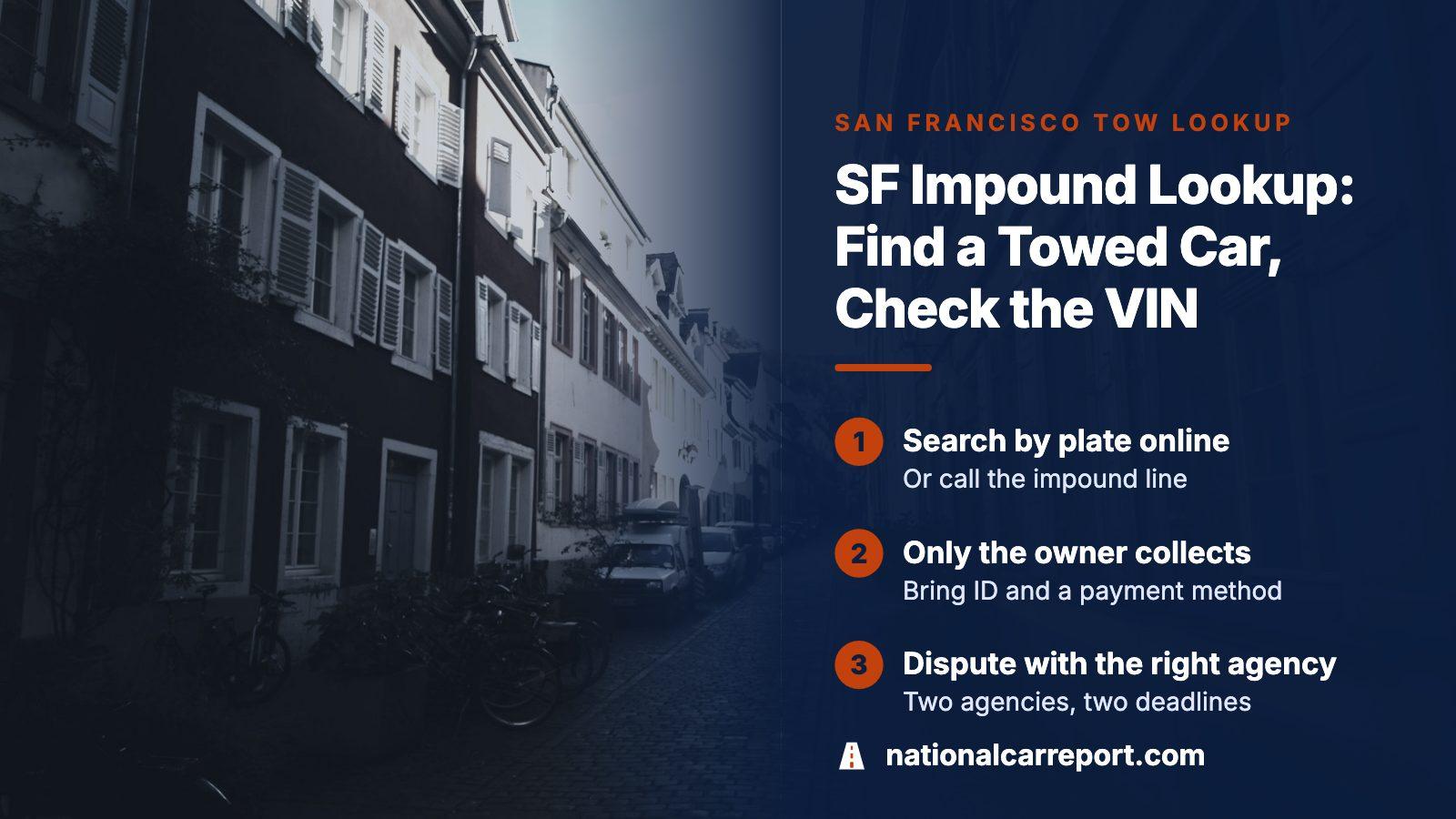
Search by plate on the city's online tow search or call 415-865-8200. The lot at 450 7th Street stays open around the clock, but only the registered owner can collect, and payment is in person by cash, ATM card or major credit card. The standard administrative fee is $385 and the tow fee $317, before storage. Police-ordered tows go through 415-678-3625. A VIN check shows a car's record, not where it sits today.
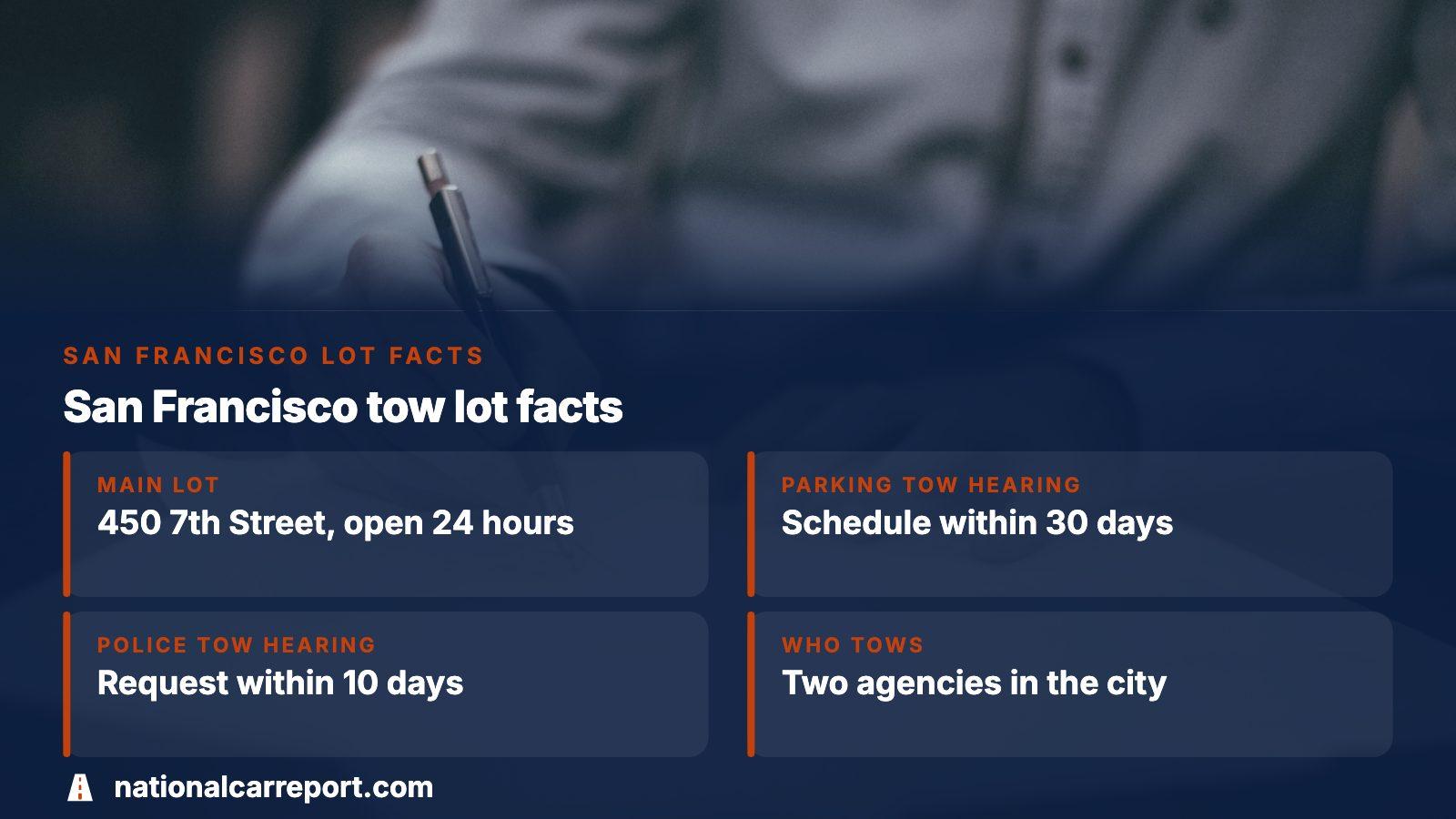
- Main lot
- 450 7th Street, open 24 hours
- Impound line
- 415-865-8200
- City parking tow hearing
- Schedule within 30 days
- Police-ordered tow hearing
- Request within 10 days
Two agencies tow in San Francisco, so start with the reason
The transportation agency tows for parking and abandoned vehicles. Police order tows for hazards, crimes, arrests and expired licenses. If an officer was on the scene, read whatever paper you were handed before you call anyone, since it may say where to go.
| What happened | Who ordered it | First call or click |
|---|---|---|
| Parking violation or abandoned vehicle | City transportation agency (SFMTA) | Impound line, 415-865-8200, or the online plate search |
| Arrest, crime, hazard or expired license | San Francisco Police | The officer's instructions, then 415-678-3625 or the impound line |
| No record anywhere | Possibly stolen, or towed by another jurisdiction | Police non-emergency, 415-553-0123 |
Bring the plate number, a description of the car, your guess at the tow date and the spot where it was parked.
The 450 7th Street lot and the Daly City yard
- The main lot sits at 450 7th Street, 94103, between Harrison and Bryant Streets.
- Its doors are open 24 hours a day, holidays included, and release happens in person.
- Cash, ATM cards and most major credit cards are accepted. Phone payments, online payments and checks are not.
- Whoever pays by card has to be standing at the counter with valid ID in the same name.
Oversized vehicles, and cars nobody has claimed, may be moved to a second yard at 2650 Bayshore Blvd in Daly City. It opens weekdays from 8am to 8pm and Saturday from 8am to 12pm, and it is closed Sunday. It takes no release payments, so settle up at 7th Street first. Phone before you drive anywhere.
Who may collect the car, and the police paperwork that can come first
Only the registered owner, or the legal owner, can claim a car. Sending a representative may call for a Hold Harmless form, which the city page mentions but does not link, so ask the impound line what the counter expects first.
- Recovered after a theft: pick up a release form at a police station first, with a driver license and proof of ownership.
- Held after a stop for a suspended or unlicensed driver: call 415-678-3625 for the release.
- Held for a criminal investigation: the investigating sergeant must lift the hold. Then you email a photo of your license, registration and insurance proof, and name the STOP window where a callback suits you.
Leave the registration alone
Police warn against moving the registration into someone else's name while a release is pending, since that may cause delays.
What the lot charges, and who pays less
| Charge | Standard | First tow | Low income | Waiver for homelessness |
|---|---|---|---|---|
| Administrative | $385 | $335 | $0 | $0 |
| Tow | $317 | $317 | $111 | $0 |
Storage costs nothing for four hours, then $69 for the first day and $82 for every day after. A dolly adds $56 when the car needs one. Weight can shift the tow and storage figures, so ask for an estimate. After an arrest tow, police add their own $194 administrative fee.
The first-tow rate needs a car that neither SFMTA nor SFPD has towed before, and it trims only the administrative fee. Low-income owners also get the dolly waived and up to 15 days of storage; the one-time homelessness waiver stretches to 30 days. Show a Medi-Cal, EBT, Lifeline or WIC card at payment, or pay in full and file for reimbursement within 30 days. Businesses do not qualify.
Disputing the tow: two agencies, two clocks
A hearing officer rules on one thing: whether the tow was legal. A money problem is not a ground. If you win, the tow and storage charges are dropped. If you lose, you owe tow, storage and administrative fees.
Count the days from the tow
City parking tow: schedule the hearing within 30 days, though the hearing itself can fall later. Police-ordered tow: ask by mail or phone within 10 days. Find out which agency ordered yours before you start counting.
If you cannot pay to free the car, you may ask for a hearing inside 2 business days, but storage keeps building until the car leaves. Police hearings run by phone from 9:00 AM to 3:00 PM on weekdays, no appointment needed. The transportation agency takes protests by phone, video or in writing, and in limited cases in person at 11 South Van Ness Avenue. The ticket behind the tow is judged in the same hearing, so do not protest it separately.
When the city has no record of your car
If the impound line and the police cannot confirm a tow, the car may have been stolen or hauled off by another jurisdiction. Report a theft to the police non-emergency line, 415-553-0123, or online.
Report it with the plate, the VIN from your insurance papers or title, the make, the color and the last place you saw the car. A theft entry and an impound entry are separate records, and a recovered car can end up carrying both.
What the title database leaves out, and what a VIN check adds
A tow lot tells you where a car is and what you owe, not what it has been through. The federal title database, NMVTIS, carries brand history (junk, salvage, flood), the newest odometer figure, total-loss rulings from insurers and moves into salvage or junk yards. Whether tow records belong among its entries is not stated, and it holds 87 percent of the nation's vehicles.
A quiet search is not a clean car
Reporting gaps remain and brand rules differ from state to state, so a search that finds nothing can still be wrong.
NationalCarReport adds impound, lien and theft entries to that picture, so a car that sat in a tow yard, or carries a lender's claim, shows up before you pay for it.
Red flags when the car you want has been in the yard
- A seller who cannot say which agency towed the car or who paid to release it.
- A tow followed soon after by a lien entry or a change of title.
- No lot receipt or release paperwork from someone who admits the car was towed once.
- A theft entry on a car described as an ordinary private sale, or a recovery story with no police release to show.
None of these proves the car is bad. Each one tells you what to ask the seller and which agency to phone.
Running the check and what the preview shows
- Copy the VIN off the car, then check it against the title or registration paperwork.
- Enter it on NationalCarReport and read the preview, which names the record types attached to that VIN.
- Decide about the full report. It is a single purchase, and bundles of 3, 5 or 10 are sold to anyone weighing several cars. Amounts are on the pricing page.
- Phone the agency behind any entry, whether SFMTA, SFPD or a lender, and ask for release papers.
Seeing the preview costs you nothing, and the report carries no subscription. Walk away from an unexplained impound, a lender's claim behind it or a theft entry. Even a clean result leaves one job to you: compare the stamped VIN with the paper title in person.

Where this information comes from
- SFMTA: Towed vehicles — The impound line, the 450 7th Street lot, payment methods and the standard fee table.
- SFMTA: Contest a tow — The 30-day window, the 2-business-day exception and what a hearing officer can decide.
- SFMTA: Tow hearings — Phone, video, written and in-person hearing options.
- SFMTA: Waivers and first-time tow reduction — Who qualifies for lower fees, the proof accepted and the reimbursement route.
- SFPD: Towed vehicle information — Police-ordered tows, release steps, the 10-day hearing request and the arrest-tow fee.
- Autura: San Francisco impound — The operator's note on the Daly City storage yard and its payment rule.
- NMVTIS: for consumers — What the federal title database reports and where its coverage thins out.
Sources and photos: Facts checked against the sources above in November 2026. Photos by Karwin Luo, Alejandro Escamilla and Scott Graham on Unsplash; diagrams by NationalCarReport.
Keep reading
- Impound Lookup: Find a Towed Car, Then Check Its VIN for Impound RecordsHow tow records are kept city by city, and where a national search fits.
- Stolen Car Database in Los Angeles: How to Check a VINChecking a California car for theft entries when no yard has it.
- Report a Stolen Car: Police Steps, Insurance and a VIN Theft CheckWhat to gather and whom to call if the car was taken, not towed.
- Vehicle Lien Check by VIN: Nationwide Lien, Theft and Impound RecordsFinding a lender's claim that can surface around a tow.
Frequently asked questions
How do I find out if my car was towed in San Francisco?
Search by plate on the city's online tow search, or call 415-865-8200 with your plate, a description of the car, the likely tow date and the location. If the city has no record, ask police about a theft report or a tow by another jurisdiction at 415-553-0123.
How long do I have to dispute a San Francisco tow?
For a tow by the transportation agency, schedule the hearing within 30 days of the tow. For a police-ordered tow, ask within 10 days, by mail or by calling 415-678-3625. The deadlines differ, so confirm which agency ordered yours. Financial hardship is not accepted as a reason.
Can someone else pick up my car from the San Francisco impound?
Only the registered owner can claim it, unless that owner designates someone. The city may then ask for a Hold Harmless form. Call 415-865-8200 first to learn exactly what the counter will want.
Can I pay the San Francisco impound by phone or check?
No. The lot takes cash, ATM cards and most major credit cards, in person only, and refuses phone payments, online payments and checks. It is open 24 hours a day. Nobody can pay for a release at the Daly City yard, so go to 450 7th Street first.
Does the VIN preview show where my car is towed?
No, it does not locate cars. It shows which impound, lien and theft entries exist for a VIN, which helps a buyer judge a car's record. You can see the preview at no charge; the full report costs one payment, and the pricing page has the figure.
Now check the car itself
The guide explains what to look for. The report shows what this VIN has on record.