THE SHORT ANSWER
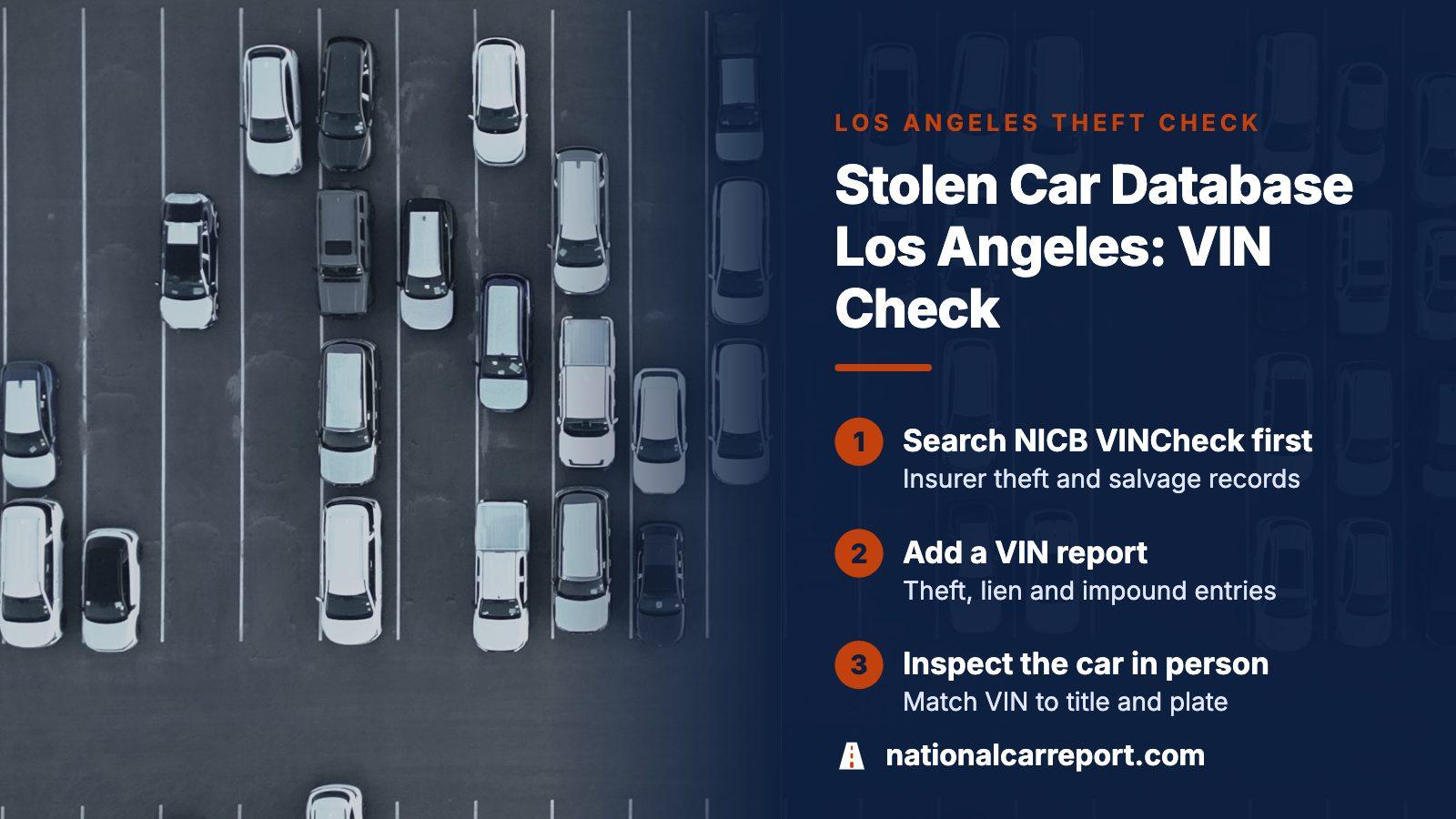
No single public database covers every stolen car in Los Angeles. Copy the VIN from the car, search it on NICB's VINCheck for insurer theft and salvage records, then run a VIN report for theft, lien and impound entries that other sources hold. Make sure the seller's name matches the California title. A clean answer shrinks the risk without ending it, so look over the car too.
- LA County thefts, 2025
- 47,191, down from 57,987 in 2024
- Recovered cars, state total
- 55.2% came back intact and drivable
- NICB VINCheck
- Five lookups per IP address per 24-hour period
- NationalCarReport
- Free preview; full report paid once
Who keeps stolen-car records in Los Angeles
A theft report begins with police. The Highway Patrol's 2025 fact sheet ranks the agencies that report the most recoveries, and the Los Angeles police, the county sheriff and the Highway Patrol itself hold the top three places. It lists the state Department of Justice's Stolen Vehicle System among its data sources. The table shows what a buyer can reach.
| Source | What it shows | What it leaves out |
|---|---|---|
| NICB VINCheck | Insurer claims for vehicles taken and never found, plus salvage and flood write-offs | Police files, and any insurer that opts out |
| NMVTIS, the federal title system | Brands on the title, the most recent odometer reading, total losses reported by insurers, transfers through salvage yards | Theft appears only in some cases |
| The California title in the seller's hand | Owner of record, brands and mileage at the last sale | Only as good as the document; compare it with the car |
| NationalCarReport preview and report | Theft, lien and impound entries for the VIN, nationwide, next to title brands | Only what each source has reported to it |
What 2025 theft figures mean for a Los Angeles buyer
The same sheet counts 47,191 vehicle thefts in Los Angeles County for 2025, down from 57,987 the year before, a drop of 18.6%. Alameda County was next at 12,277. Statewide the total was 133,372 thefts and 84.0% of the vehicles were recovered, with 38,549 recoveries in Los Angeles County alone.
Volume matters to a buyer because tens of thousands of cars are found each year, and each one has a theft entry somewhere in its past. Statewide, the agencies with the most recoveries were:
- Highway Patrol: 17,516 recoveries
- Los Angeles Police Department: 15,619
- County Sheriff's Office: 11,308
Running the check on a Los Angeles listing
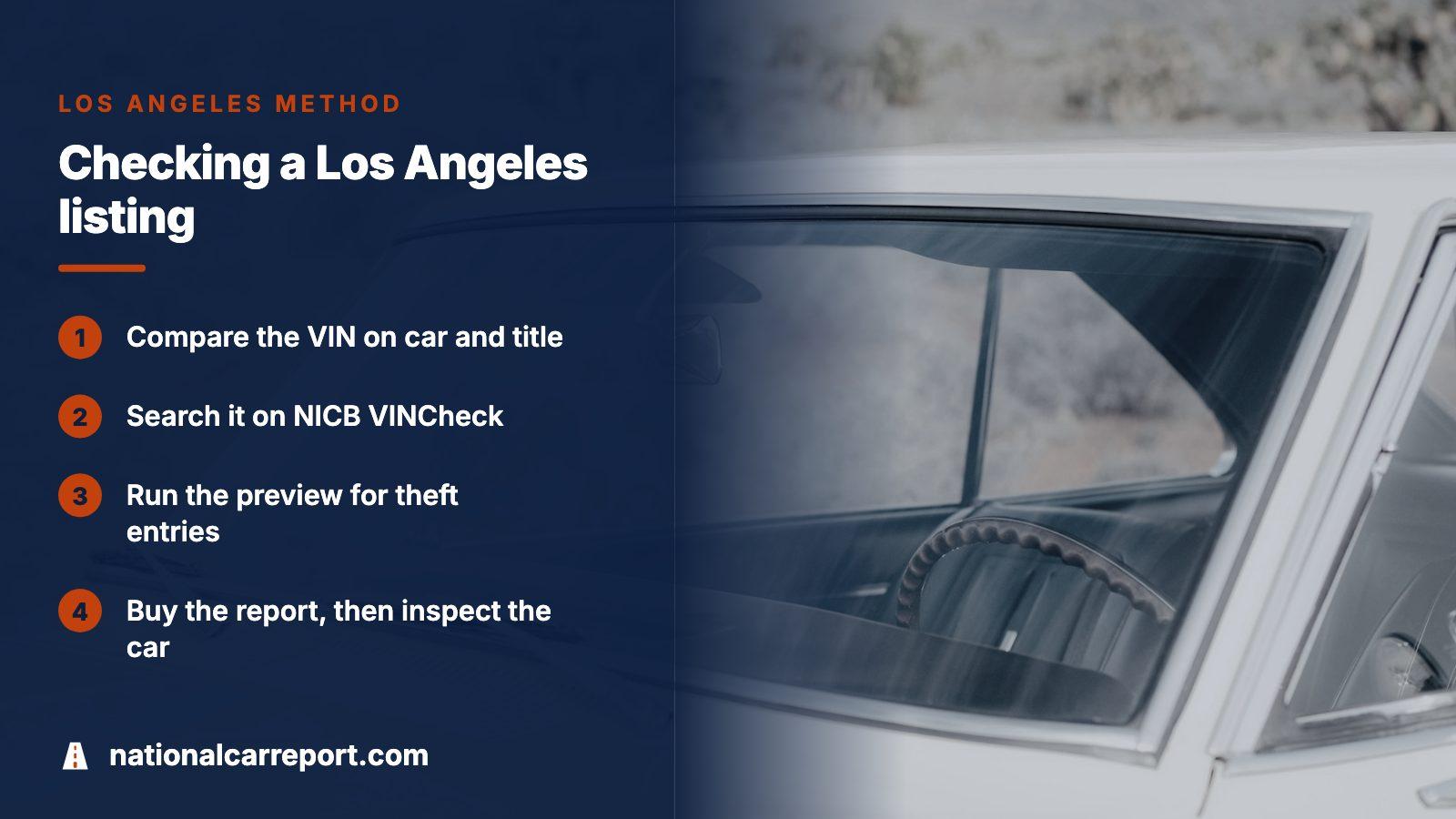
- Hold the number stamped into the car up to the one on the seller's title and read both out slowly. Any difference ends the talk.
- Search it on NICB VINCheck. The service is free, caps each IP address at five lookups in a 24-hour period, and needs an exact 17-digit VIN to match anything.
- Run it at NationalCarReport. A free preview lists the theft, lien and impound entries that exist, so you know what a full report holds.
- Read the California title for the owner's name, the history box and any lender. The seller should be that owner, or hold a signed bill of sale that explains the gap.
- Ask a police agency near the seller whether an officer will run the VIN against stolen-vehicle records. That is the agency's decision, so treat a yes as a bonus.
- If the results hold up, buy the full report and inspect the car with it in hand.
Reading what comes back, and what to do about it
| Result | What it suggests | Your move |
|---|---|---|
| Stolen, not recovered | An active theft claim sits on the VIN | Stop. Do not confront the seller; give the VIN and the listing to police |
| Theft entry with a recovery | The car came back in unknown shape | Ask for repair invoices and have a shop check the ignition and steering column |
| Impound entry | The car spent time in a tow yard | Ask who released it, on what date, and for the release paperwork |
| Lien listed | A lender may still hold a claim | Ask for the lender's signed release before paying |
| Salvage, junk or water brand | A serious loss in the car's past | Price it as branded and look for the repair work |
| VIN plate that looks wrong | Possible tampering | Walk away; the DMV lists a plate not held by rivets as a sign of hidden salvage |
| Seller not on the title | An agent, or a car that is not theirs | Ask for a power of attorney or a signed bill of sale; with neither, stop |
| Nothing found | No entry in the sources searched | Inspect the car anyway; a clean search is no guarantee |
What a recovered car looks like
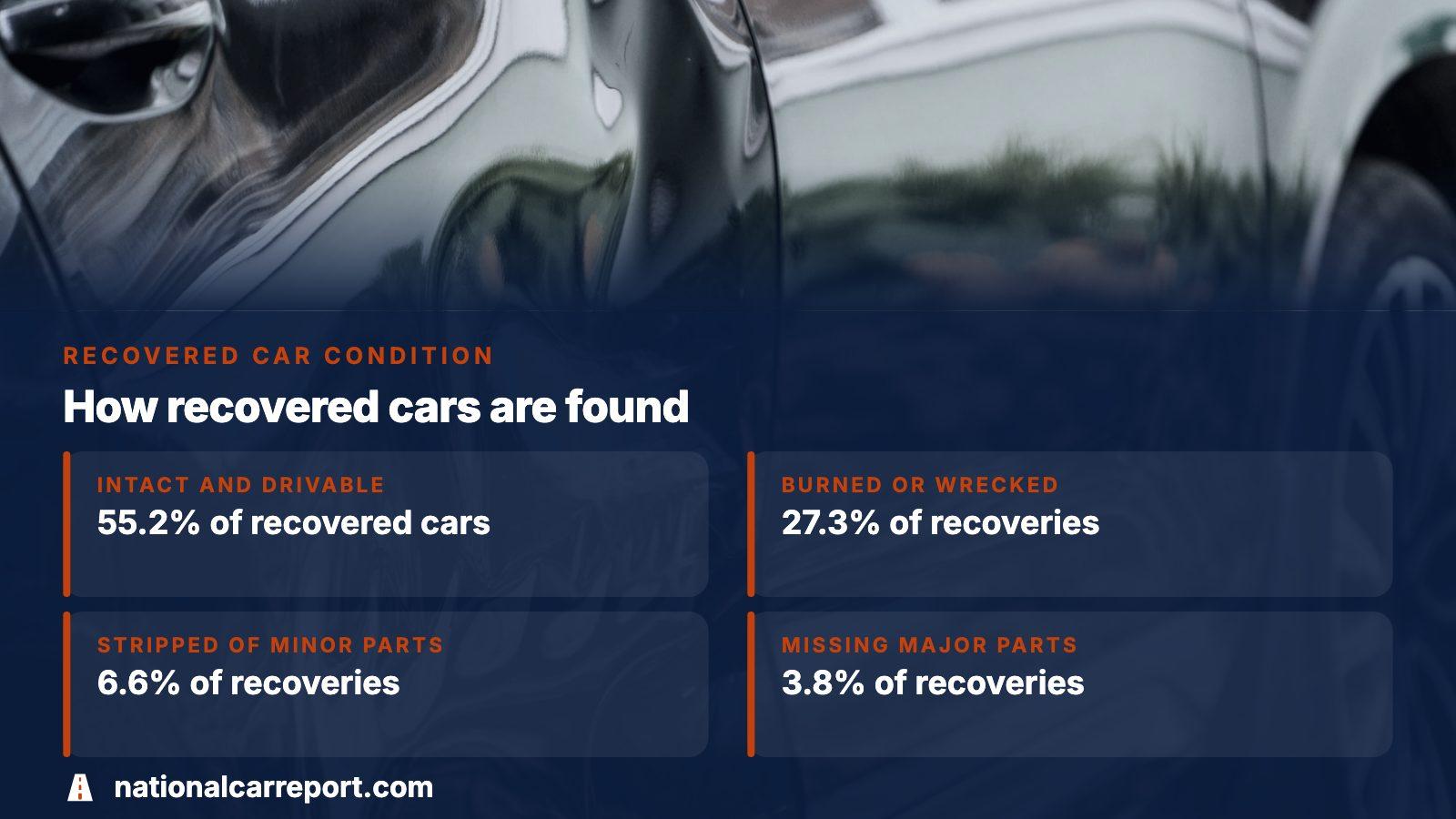
Of the 111,661 vehicles recovered in California in 2025, the Highway Patrol sorted the condition this way:
- 55.2% intact and drivable
- 27.3% intentionally burned or wrecked
- 6.6% stripped of minor parts
- 3.8% missing major components
From an NHTSA owner complaint
The owner of a 2013 Hyundai Sonata reported to NHTSA that thieves took the car in mid-May and that it was located on June 1. A dealer replaced the ignition, then said the engine had seized, though the owner says it "worked perfectly fine prior to the theft."
A recovery date tells you where the car was found, not what shape it was in. Ask what failed, who repaired it and which parts were replaced.
When a theft ends in a write-off
From an NHTSA owner complaint
An owner of a 2015 Kia Optima told NHTSA that the windows were broken, the steering column was forced open and the car was stolen. By the owner's account the seats were spray painted, the front end was smashed and the car was totaled.
That outcome matters to the next buyer. The DMV counts vandalism among the damage that earns a salvage brand, and it describes revived salvage as a car repaired and registered again. It warns that some were rebuilt using stolen parts, and that the car or the parts can be seized. Search for a brand, then read the red history box on the newest California title.
Models on the 2025 California theft list
| Type | Model and year | Thefts |
|---|---|---|
| Automobile | 2013 Hyundai Elantra | 766 |
| Automobile | 2015 Kia Optima | 643 |
| Automobile | 2013 Hyundai Sonata | 609 |
| Truck or SUV | 2001 Chevrolet Silverado | 689 |
| Truck or SUV | 2002 Chevrolet Silverado | 641 |
| Truck or SUV | 2004 Chevrolet Silverado | 608 |
The leading model years in both groups are more than a decade old, and the Silverado has topped the truck and SUV ranking four years running. Personal trucks and SUVs made up 43.2% of 2025 thefts and automobiles 37.3%. A listing for one of these is not suspect by itself, but the VIN search stops being optional.
California paperwork to compare with the records
In a private sale the buyer has 10 days to transfer ownership, and the seller has 5 days to file a release-of-liability notice. The DMV expects a title signed by the seller, plus:
- a bill of sale signed by both the seller and the person named on the title, when those are different people
- an odometer disclosure for cars under 10 years old
- a smog certification, needed to finish registration
Missing papers do not prove theft. They are where a bad sale tends to show, so hold each one up against the VIN results.
Cost, and the sensible next step
A stolen-car preview for a California VIN is free of charge. Each car's full report is a single purchase, while packs sized 3, 5 and 10 reports fit a shortlist of several vehicles. Nothing recurs. For rates, open the pricing page.
If a theft entry appears
Do not argue with the seller. Step away and hand police the VIN, the listing and any messages. A lien or an impound entry is a different story: the car may still be sellable once the lender's or the tow yard's paperwork is in your hands.
Where this information comes from
- CHP: 2025 California Vehicle Theft Facts — Theft, recovery and model figures for Los Angeles County and the state, and the data sources behind them.
- California DMV: Branded titles — Salvage and revived salvage definitions, the history box on the title and the signs of hidden salvage.
- California DMV: Registering a vehicle bought from a private party — Transfer deadlines, the signed title, the bill of sale and the odometer disclosure.
- NICB: VINCheck — What the free insurer-record search covers, its daily limit and what it does not query.
- NMVTIS: For Consumers — What the federal title system reports and its limited theft coverage.
- NHTSA owner complaint 11337434 — owner experience, paraphrased
- NHTSA owner complaint 11548548 — owner experience, paraphrased
Sources and photos: Facts checked against the sources above in November 2026. Photos by Iain, Wesley Tingey and Maxim Tolchinskiy on Unsplash; diagrams by NationalCarReport.
Keep reading
- Stolen Car Check by VIN: Nationwide Theft, Lien and Impound RecordsThe nationwide version of this check, covering theft records from every state.
- Most stolen cars: the national list and how to check a VIN for theftWhich models thieves target across the country, beyond California's list.
- Theft Recovery Vehicle: Stolen, Lien and Impound Checks Before You BuyWhat a recovered stolen car leaves behind in its title and repair history.
- Impound Lookup: Find a Towed Car, Then Check Its VIN for Impound RecordsFinding a towed car and reading what a tow record means for a buyer.
Frequently asked questions
Is there a public stolen car database for Los Angeles?
None covers everything. Police agencies hold theft reports, and the state's theft figures draw on the Department of Justice's Stolen Vehicle System. Buyers can reach insurer records through NICB VINCheck and federal title data through NMVTIS, then add a VIN report.
Does NICB VINCheck cover cars sold in Los Angeles?
It reviews vehicles insured in the United States, so a Los Angeles car qualifies, but only participating insurers supply the data. It skips police records, caps lookups per IP address, and NICB itself says a clean answer does not guarantee a clean history.
What if the VIN on the car does not match the title?
Stop the purchase. A mismatch might be a typo on paperwork or a tampered car, and you cannot tell which from the driveway. Look at the plate itself too: the DMV lists a VIN plate that is not held on with rivets among the signs of hidden salvage history.
Can a stolen car be recovered and then sold to a buyer?
Recovery only means the car was found. Statewide in 2025, 55.2% of recovered cars were intact and drivable, while others had been burned, wrecked or stripped of parts. If an insurer wrote one off, a salvage brand should follow, so search the title records before paying.
Will the check show liens and impounds as well as theft?
The NationalCarReport preview lists which theft, lien and impound entries exist for a VIN, and the full report shows them beside title brands. They are separate records, so a car can carry a lender's claim or a tow entry with no theft flag.
Now check the car itself
The guide explains what to look for. The report shows what this VIN has on record.