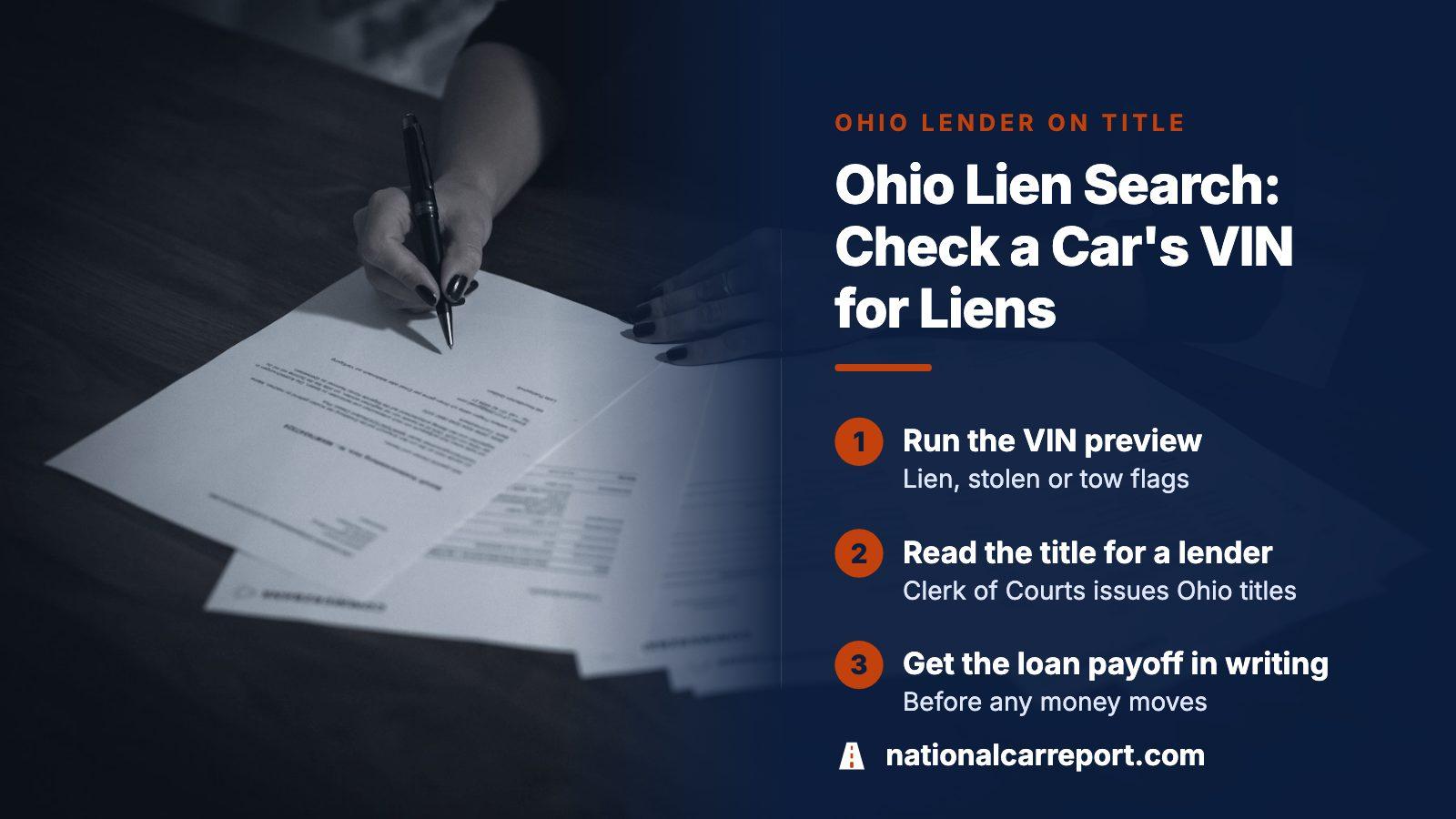
THE SHORT ANSWER
Enter the VIN in our free preview to see whether a lien, stolen report or tow record is tied to the car. Next, get the Ohio title in your hands and look for a lender's name on it. If one appears, get the lender's written confirmation that the loan is paid before you hand over any money. The state's own title search carries a limited-information warning, so treat it as one input, not the verdict.
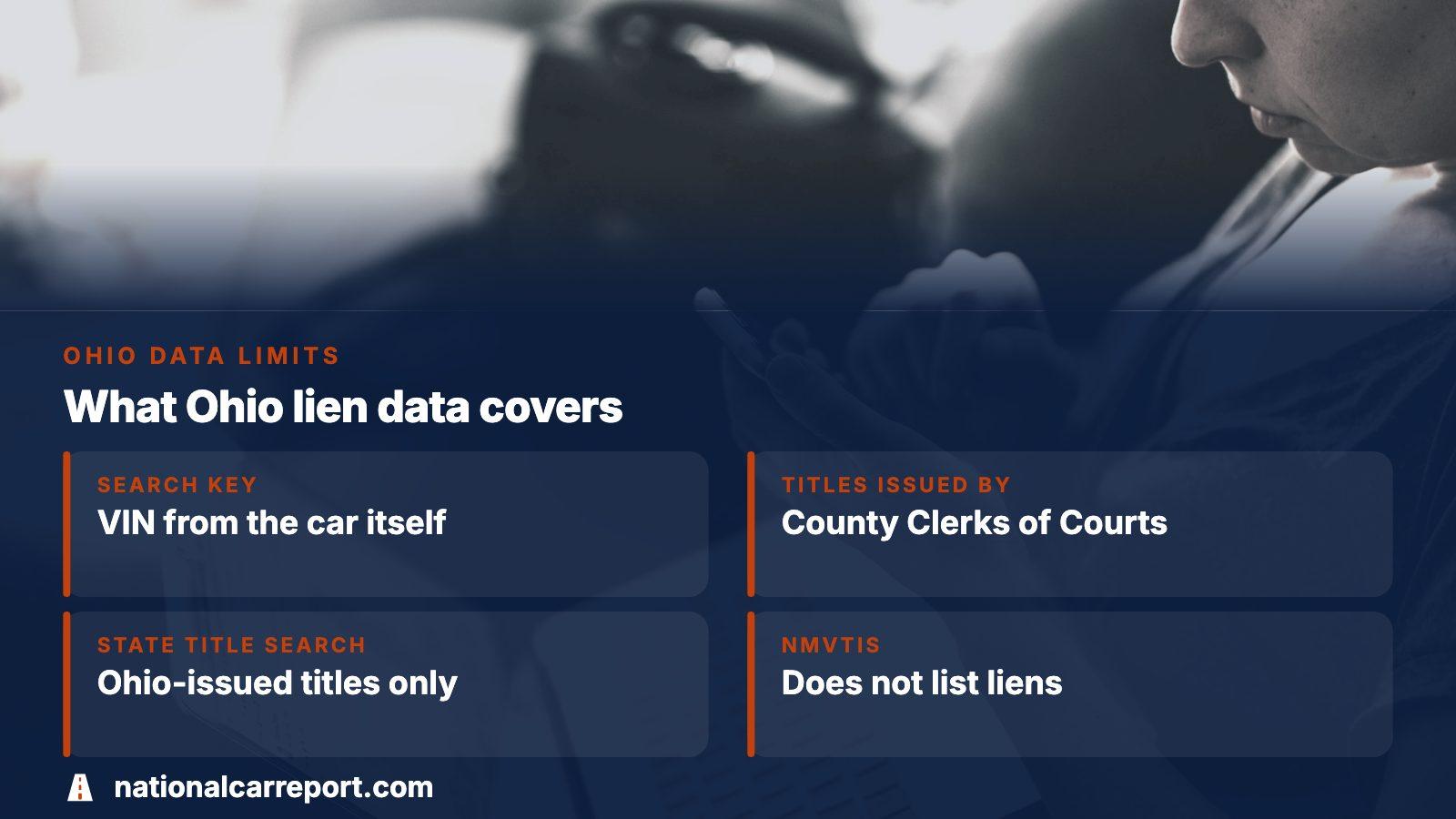
- Search key
- The VIN from the car itself
- Who issues Ohio titles
- County Clerks of Courts
- State title search
- Covers Ohio-issued titles only
- NMVTIS
- Does not list liens
What an Ohio VIN search looks for
NationalCarReport reads a car through the claims that can follow it: money still owed to a lender, a theft report, a stay in a tow yard. All of them hang on the VIN, so the search works the same for a car that never left Cleveland and one that arrived from Kentucky last spring.
- Liens, where a lender's claim reached a record we read
- Theft entries and whether the car came back
- Impound and storage records
- Salvage and similar brands that cut resale value
The preview costs nothing and gives a first look at those records. A quiet preview lowers the odds of a surprise. It does not replace the title, which is the document that settles who owns the car.
How Ohio handles titles, and why it matters for liens
Ohio does not hand titling to a single state counter. According to the BMV's online title search page, each county's Clerk of Courts is the issuer, working in a state system the page calls ATPS. So the office that holds the record for your car is a county title office, and the right one depends on where the title was filed.
That is also why a seller's story needs the paper to back it up. If the title shows a lender, the lender is the party who can say whether the loan is paid. I could not open the Ohio statutes or the BMV's own title pages for this guide, so I am not quoting a lien-release deadline or fee. Ask the clerk's title office or the lender for the current process.
What the state's free title search can and cannot tell you
The BMV runs an online title search that accepts a title number or a VIN. It is free, and it is worth a minute. Its page, though, opens with a plain warning: the results cover titles issued in Ohio and do not show whether the car was titled somewhere else first.
Read the limit before trusting a clean result
A car branded or financed under another state's title can look ordinary in a search that only covers Ohio. The BMV page itself points consumers to an approved NMVTIS provider for the wider history, and the page does not describe lien details in its results.
Use it as a cross-check on the title number and the car's basic record, not as proof that nobody holds a claim.
Where national title data stops short on liens
The federal NMVTIS system is built for title fraud and damage history. Its report is limited to five items: the title's home state and the date of its latest change, brands from any state, odometer data, insurer write-offs and salvage-yard records. Liens are not among them.
That surprises buyers who assume a clean national title report means the car is paid off. A clean NMVTIS result is good news about brands and salvage, and silent on the loan. The federal site also calls the report intentionally concise and still urges an independent inspection.
So a lien question needs a source that looks at lender records, and finally the lender itself.
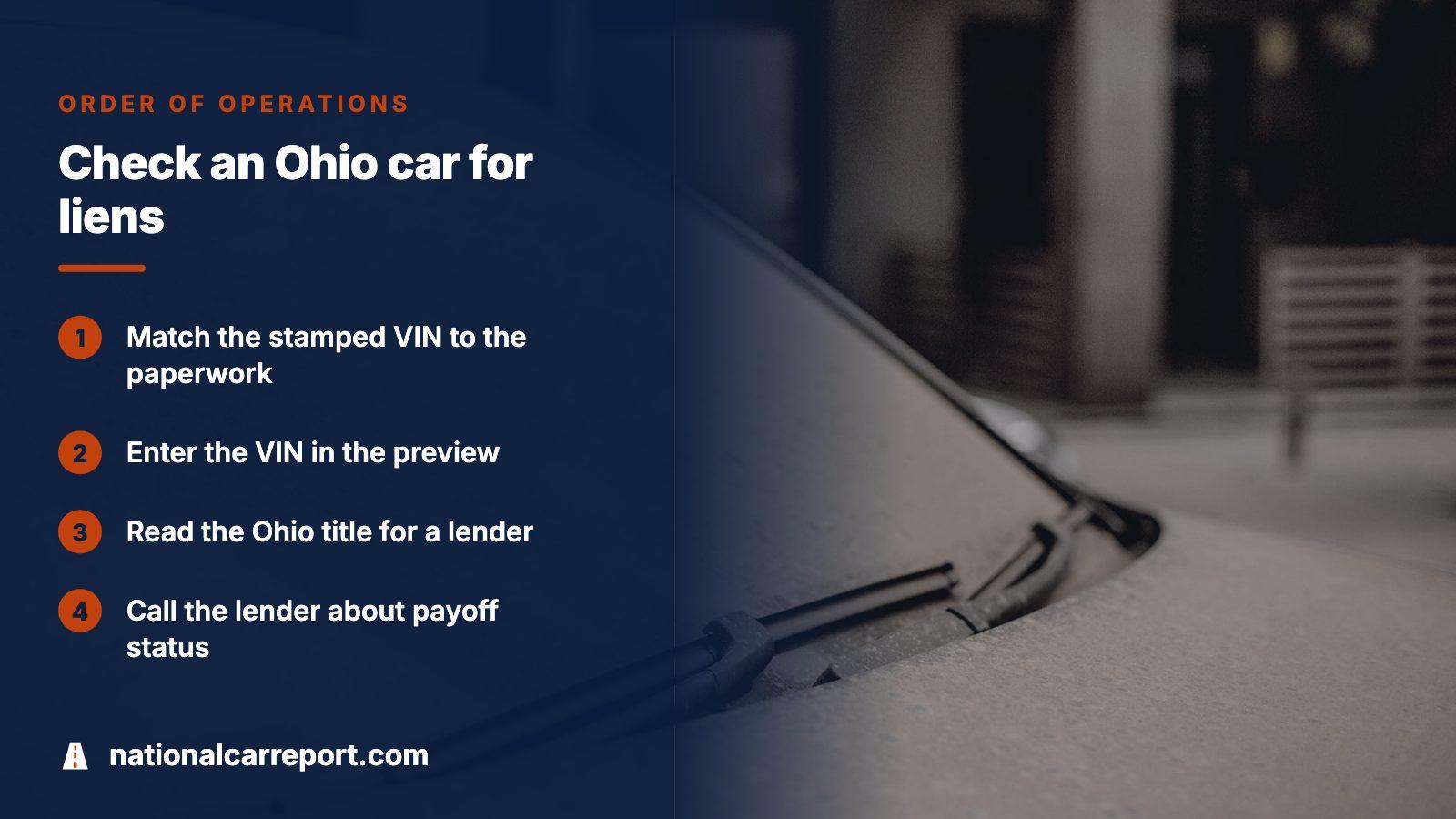
A five-step order of operations
- Write down the 17 characters stamped on the vehicle and hold them against the paperwork and the listing; any difference means you stop.
- Enter the VIN in the preview and note any lien, theft or impound flag.
- Ask the seller to show the Ohio title, and read it for a lender's name.
- If a lender is named, call that lender, using a number you looked up yourself, and ask for payoff status.
- Decide whether to order the full report and book an inspection before you pay.
Do the call before the money moves. A lender who confirms in writing is far better evidence than a seller's promise to settle the loan after the sale.
Red flags that point to a lien problem
- The seller says the title is at the bank, in the mail or being replaced
- A lender's name on the title and no sign the loan was released
- A title number that the state search will not match to the VIN
- A price well under what similar cars ask
- The seller wants cash at a parking lot, not at an office or the lender's branch
One of these means slow down; a pair means leave. A seller who cannot account for the car's past is a reason to track down whoever owned it before.
If a lien turns up
A lien is not always a dead end. Plenty of sellers still owe something and can settle it, ideally at the sale with the lender present, so the payoff and the release happen together. Ask the lender how it releases its interest and how long that takes, then get the answer in writing.
If the seller cannot or will not involve the lender, step away. A car you cannot title in your own name is a costly lawn ornament, and chasing a lender after the fact is slow.
Ohio full report contents and price
You pay nothing for the preview. Going deeper takes one purchase and no subscription, and our pricing page shows what is on offer now. For a lien question, the sections that matter are the lien and impound records, theft history and any title brands.
Order it after the preview looks promising and before you pay the seller, not after. Pair it with a mechanic's inspection, since no database sees a worn transmission.
Where this information comes from
- Ohio BMV Online Services: Title Search — clerks issue titles, Ohio-only scope, limited-information warning
- NMVTIS: Understanding a vehicle history report — the five indicators a national title report covers
- NMVTIS: Used car buying tips — inspection and previous-owner advice
- NMVTIS: Approved data providers — where consumers are sent for reports
Sources and photos: Facts checked against the sources above in November 2026. Photos by Dimitri Karastelev, JavyGo and Michal Biernat on Unsplash; diagrams by NationalCarReport.
Keep reading
- Vehicle Lien Check by VIN: Nationwide Lien, Theft and Impound RecordsThis check explained without a state focus.
- DMV Lien Release Search: How to Confirm a Lien Is GoneMaking sure a lender has truly let go.
- Car Lien Holder Search: How to Find the Lender Behind a VINFinding who the lender on a title is.
- Stolen Car Check by VIN: Nationwide Theft, Lien and Impound RecordsThe theft side of the same VIN.
Frequently asked questions
Can I do an Ohio lien search online by VIN?
The Ohio BMV title search accepts a VIN, but the page I read does not describe lien details in its results. Our preview searches the VIN for lien, theft and impound records, and the title plus the lender's confirmation remain the real proof.
Who issues a car title in Ohio?
Titles come from the county Clerk of Courts, per the BMV's own title search page, and not from a BMV branch. For a question about a specific title, the clerk's title office is the place to ask.
Does a national title report show a lien?
No. The federal NMVTIS report sticks to title state, brands, odometer, write-offs and salvage records. Debt is outside its scope, so a clean report says nothing about financing.
What should I do if the seller owes money on the car?
Bring the lender into the sale. Settle the payoff directly, get the lender's written confirmation, and ask how it releases its interest. Do not pay a seller who promises to clear the loan afterward.
Is the report free?
The preview is the only free piece. For the report proper you pay a single time, nothing repeats, and the options are set out on the pricing page.
Now check the car itself
The guide explains what to look for. The report shows what this VIN has on record.