THE SHORT ANSWER
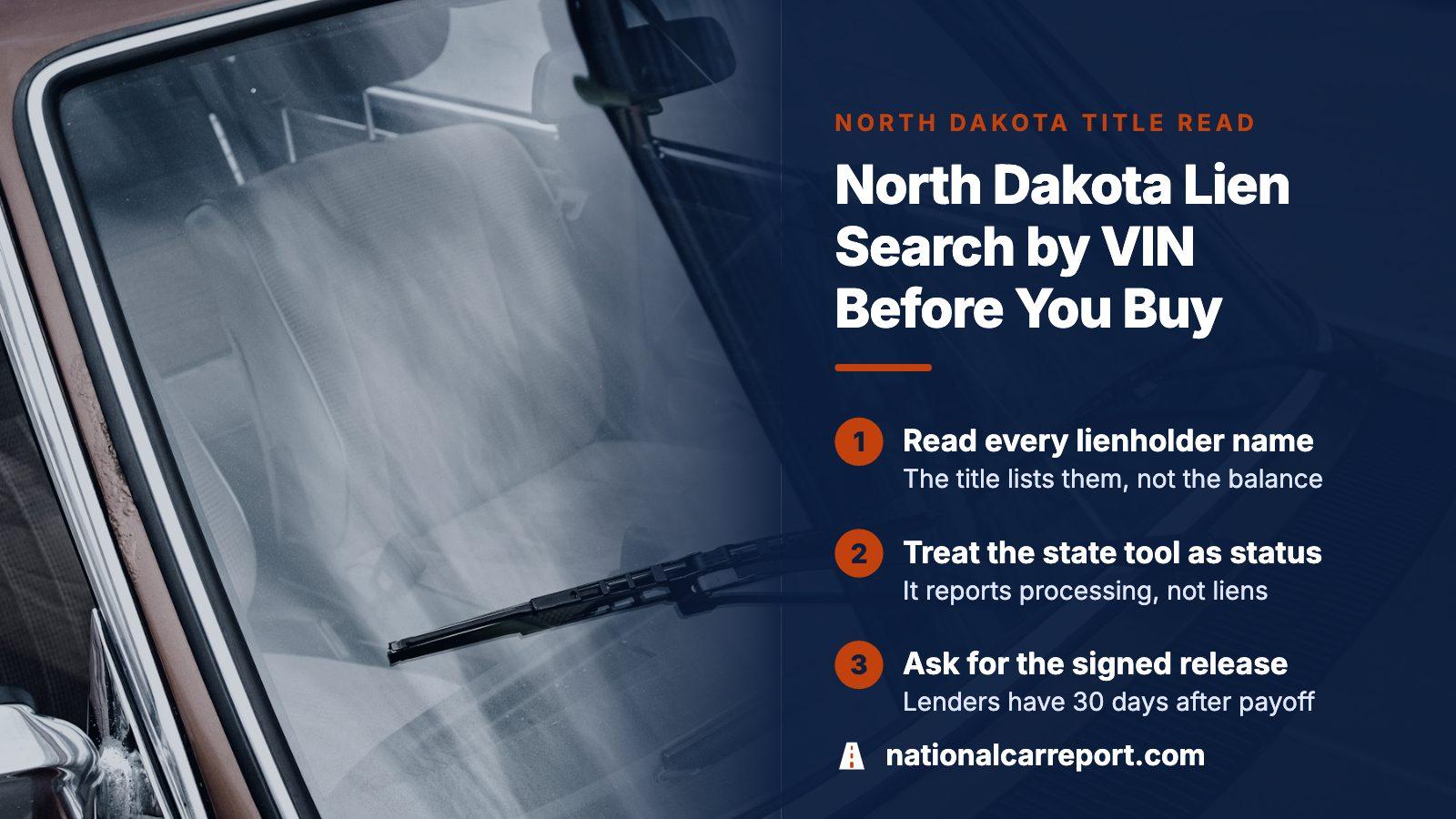
To check a North Dakota car for a lien, enter its VIN in the preview and read any lender, theft or impound entry it returns. North Dakota titles list every lien and the lienholder's name, but not the amount owed. The state's online title tool reports processing status only, so ask the seller for a payoff letter or a signed release.
- Search key
- The VIN, copied from the car
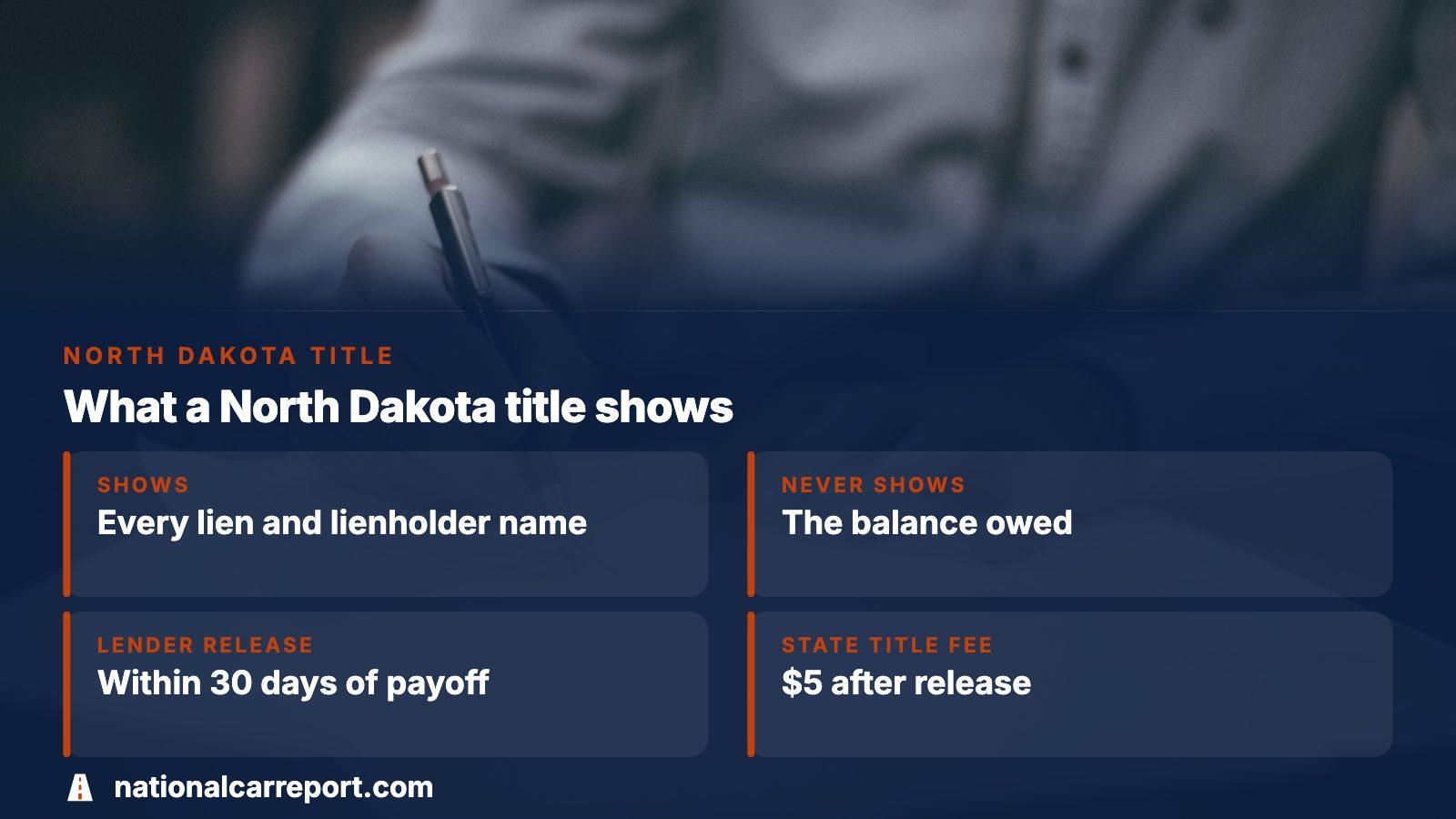
- What a title shows
- The lienholder's name, never the balance
- Lender release deadline
- Within 30 days of payoff
- State title fee after release
- $5
What a lien search on a North Dakota car turns up
A lender that financed a car files its claim against the VIN, and the same number links the car to theft reports and tow-yard holds. Looking up one VIN therefore answers three questions a buyer cares about: does somebody besides the seller have a stake, was the car ever reported taken, and did a yard ever keep it.
- Lien entries: a bank, credit union or finance company with a claim, where a source the search reads has recorded one
- Theft entries: a stolen report, and whether the car was later found
- Impound entries: a sign that a yard held the car, and how it left
- Title brands, which can matter more to the price than the loan
Looking costs nothing. Order the full report only once the car survives that first pass.
How North Dakota writes a lender into the title
Chapter 39-05 of the Century Code sets what a North Dakota title, on paper or electronic, must carry: the owner, the vehicle number, each lien or encumbrance, and whether the owner or a lender has possession.
Money is another matter. The statute says the balance does not have to be printed, only the lien itself and the lender's name. A buyer can learn that a loan exists and whom to call, but not how much is left.
What this means at the sale
A named lienholder on the title is a phone number, not an answer. Only that lender can tell you the payoff figure and confirm in writing when the loan is cleared.
What the state's online title tool does and does not do
The Department of Transportation runs a Title Status Search that takes a VIN typed without dashes or spaces. By its own description it reports where a title stands in processing. That is a progress check on paperwork, not a way to see lenders.
For a lender's name from the state's records, the manual points to the Request for Vehicle Information, form SFN 51269, which carries a $3 processing fee. It names the form as the route for verifying the registered owner, address and any lienholder. Release depends on an access exception the applicant must explain, so a casual shopper is unlikely to qualify.
A private buyer usually pieces it together from the title in the seller's hand, a VIN search and a call to the lender.
Running the check the way a careful buyer would
Start at the car itself. Match the number on the windshield-corner plate with the one on the driver's door label and with the title. If any pair differs, stop.
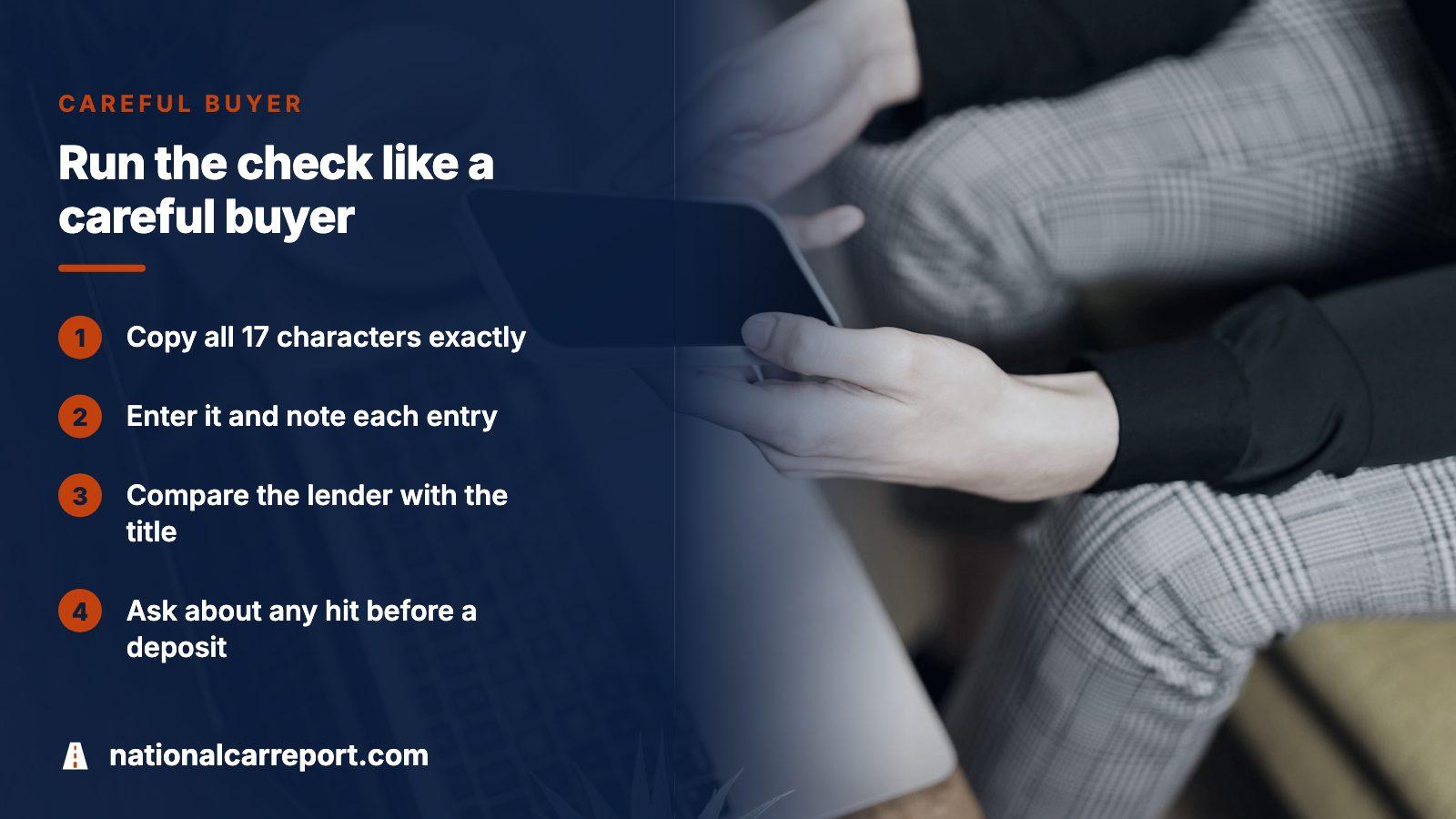
- Copy all 17 characters exactly as stamped, with no guessing at smudged ones.
- Enter it in the preview and note every lender, theft or yard entry.
- Compare the lender on the screen with the lienholder printed on the title.
- Ask the seller about any hit before you leave a deposit.
- If the price looks too good, order the full report.
Because we check lien, stolen-car and impound records nationwide, the steps hold for a car first titled in Minnesota or Montana too.
Reading a hit, and reading a blank
A lien in the results is a lead. The loan may be almost repaid, repaid but not yet released, or fully open. A blank is weaker, since a search reports only what reached its sources.
| What you see | What it often means | What to do |
|---|---|---|
| A lender named | A loan may still be open | Get a payoff letter dated this week |
| A lender on the title but not in the search | The record may not have reached the sources | Trust the title, and call the lender |
| A theft entry | The car was reported stolen at some point | Pause until its status is explained in writing |
| An impound entry | A yard once held the car | Ask how it was released and what was paid |
| Nothing at all | No record reached the sources | Check the title and ask for proof of ownership |
The federal NMVTIS consumer page admits as much about its own reports: they are short, can miss things, and hold less than a state's full title record.
Paying off a lien and getting the release
When a loan is repaid and the lender holds the title, the lender owes a signed release 10 days after you ask for it, and no later than 30 days after payoff. Any further lender on the title gets the papers next; otherwise they go to the owner or the owner's designee.
Whoever receives them forwards the title, release and a $5 fee, and the department issues a fresh title. Lenders on an electronic lien system follow the department's procedure for it, so some sellers have no paper title to show.
If you pay the lender directly at the sale, get the release in writing, VIN included, before the car leaves. The state's release form is numbered SFN 2876 and titled for the legal owner.
What the state requires before a title can move
The registration manual is blunt: any lien printed on the face of the title has to be cleared before it can move, and the title fee is $5. The seller has 15 days to hand over the title, and the buyer has 30 days from receipt to submit it.
- Out-of-state title with a lien: the lien must be cleared if the car changes hands at the time of the North Dakota application
- If the owner stays the same, an unreleased lien is carried onto the new North Dakota title
- A secure power of attorney can complete a transfer when a lender holds the title
A seller with no released title and no lender letter is asking you to carry a risk the rules say to clear first.
Other claims that behave like liens
Not every claim comes from a bank. The manual describes a repairman's lien, where a shop can pursue title and must write to lienholders of record once repairs pass $6,000 or 30 percent of what the property is worth. A repossession leaves its own paper too: an affidavit, form SFN 2880, that the lender signs.
A car that came out of a shop sale or a repossession has often had its title reissued along the way, so tow, theft or lender entries near those events give you better questions to ask.
What the check costs and where to go next
Previewing costs nothing. A full report is a single purchase, nothing recurring, and the pricing page shows the current options.
Whatever the preview says, finish offline: phone the lender on the title, get the payoff in writing, and hold off paying until you hold the release. The search says where to look, and the lender's letter closes the question.
Where this information comes from
- North Dakota Century Code chapter 39-05 — what a title must list about liens and the lender's release duty
- NDDOT Motor Vehicle Registration Manual — transfer rules, forms SFN 2876 and SFN 51269, repair and repossession steps
- NDDOT Title Status Search — what the state's online VIN tool is described as doing
- NDDOT Vehicle Recalls and History Reports — the state's pointer to NMVTIS reports and the NHTSA recall lookup
- Department of Justice: NMVTIS for consumers — limits of the federal title database
Sources and photos: Facts checked against the sources above in November 2026. Photos by Max Tokarev, Jakub Żerdzicki and Scott Graham on Unsplash; diagrams by NationalCarReport.
Keep reading
- Vehicle Lien Check by VIN: Nationwide Lien, Theft and Impound RecordsThe general method for checking any car for a lender's claim.
- DMV Lien Release Search: How to Confirm a Lien Is GoneHow to confirm a lender really signed off.
- Car Lien Holder Search: How to Find the Lender Behind a VINFinding who holds the loan when the title is unclear.
- Minnesota Lien Search by VIN: Who Else Has a Claim on the CarThe neighboring state's rules, useful for cars crossing the border.
Frequently asked questions
Can I run a North Dakota lien search with only the VIN?
Yes. The VIN identifies the car, so you do not need the owner's name. Enter it in the preview to look for lender, theft and impound entries. A blank result does not prove the car is clear, so ask the seller for the title and a payoff letter.
Does a North Dakota title show how much is owed?
No. State law has the title name the lienholder, but the balance is not required to appear. Call the named lender for the payoff figure, and ask for it in writing with a date, since interest changes the balance.
Does the state's Title Status Search show liens?
The page describes it as a search for the processing status of a title, using the VIN with no dashes. It does not say it lists lenders. Use it to see whether title paperwork is moving, not to clear a car of liens.
What is the deadline for a North Dakota lender to sign off after payoff?
Where the lender is holding the title, state law sets a 10-day window after a demand and an outer limit of 30 days from payoff. Keep the date of your final payment, because it starts that clock.
What if the seller has no title because a lender holds it?
That is common with financed cars. Arrange the payoff with the lender directly, pay it from the sale funds, and get the release and title routed to you. Do not hand over the full price on a promise that the paperwork will follow.
Now check the car itself
The guide explains what to look for. The report shows what this VIN has on record.