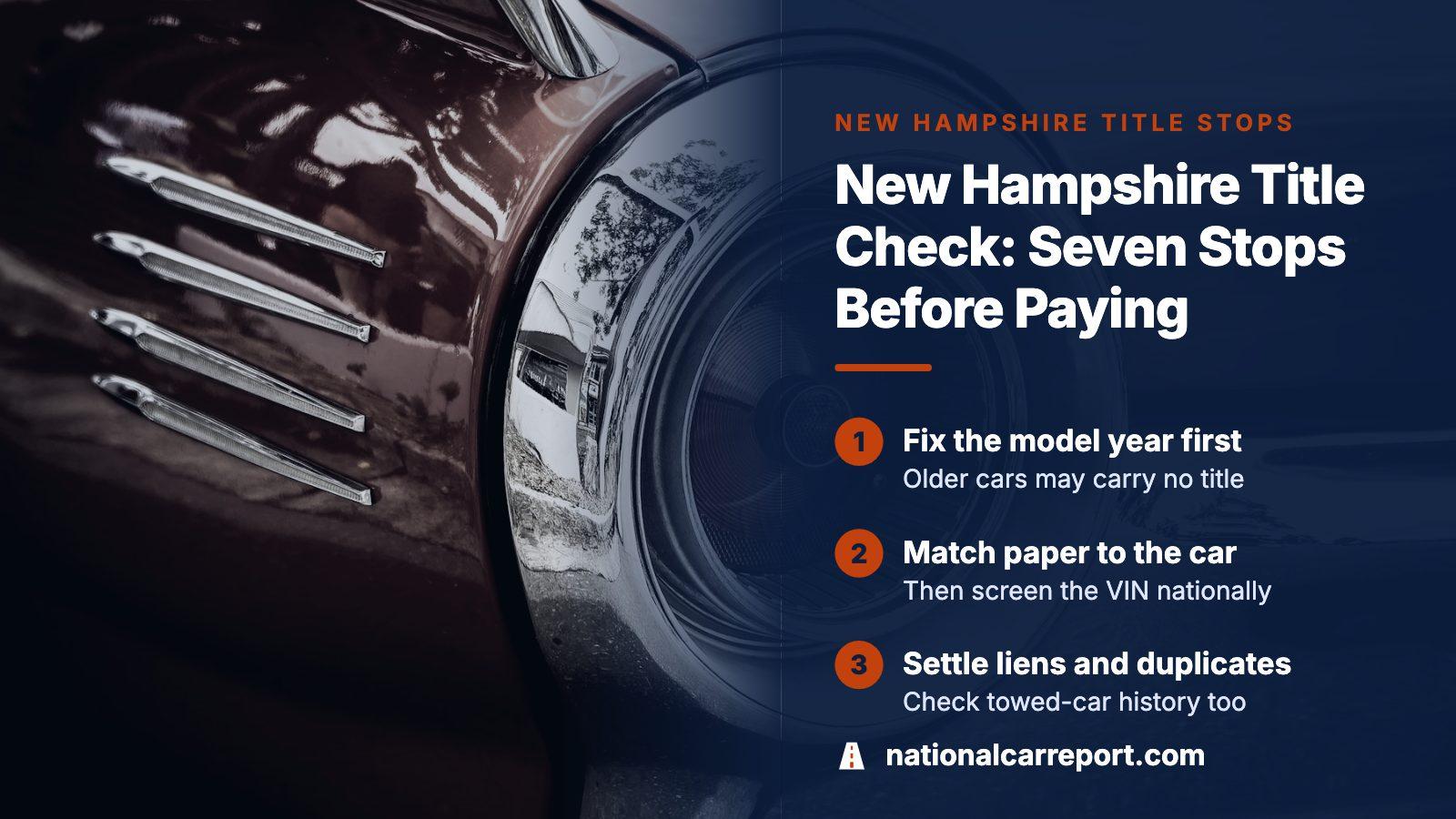
THE SHORT ANSWER
Decide first whether the car should carry a title at all, since New Hampshire issues none for model year 1999 and older. Then test the car's VIN against the paperwork, run it in the preview and through NICB and NHTSA, and look for a lender or a salvage brand. The DMV's title search names lawyers, investigators, tow companies and garages as requesters, not private buyers.
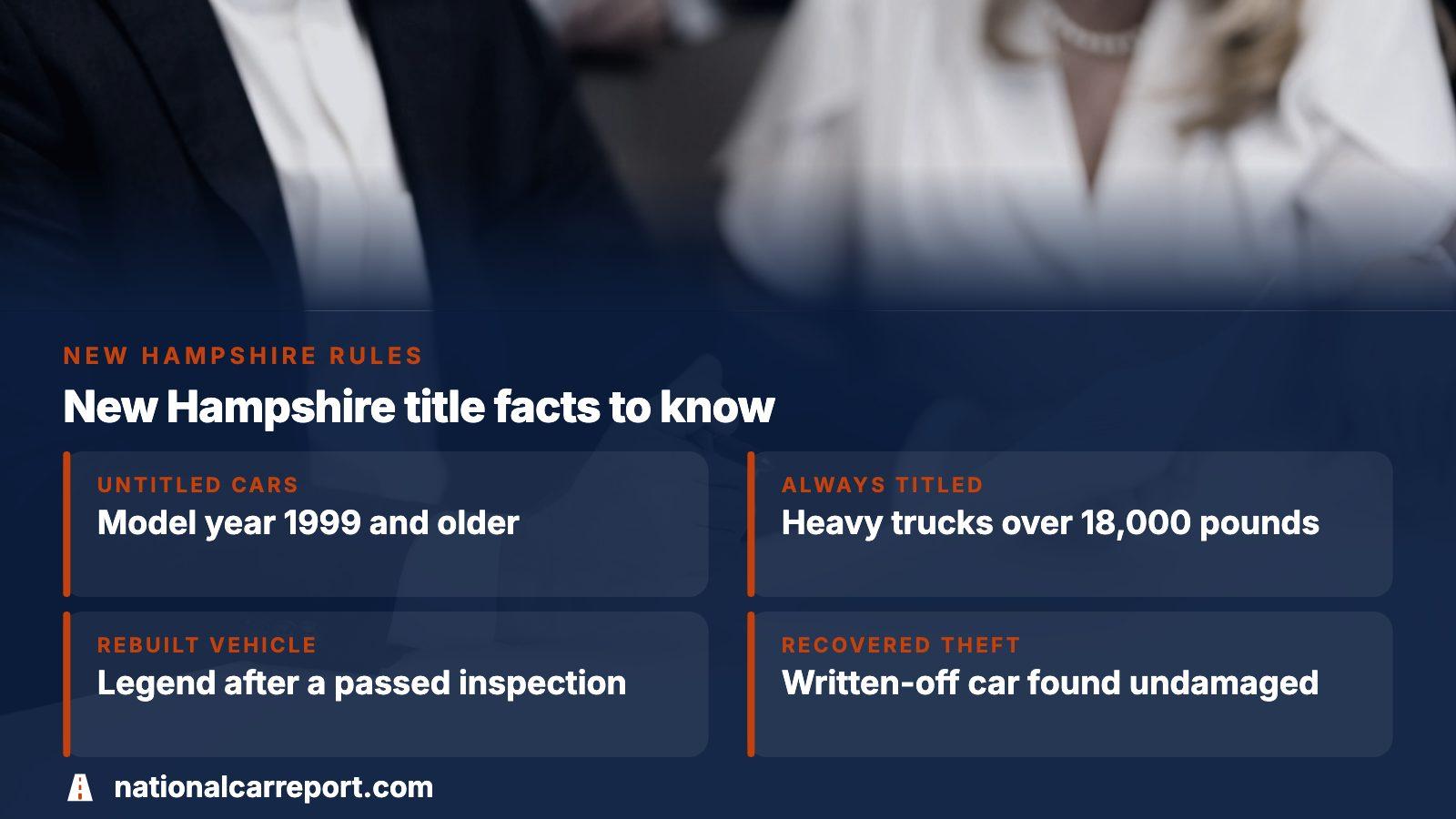
- Untitled cars
- Model year 1999 and older, unless the owner asks for a title
- DMV title search
- $20.00 per request, for the trades the DMV lists
- New title fee at the clerk
- $35.00, plus registration fees
- Always titled
- Heavy trucks and truck-tractors over 18,000 pounds
Stop 1: Fix the model year before judging the paperwork
A missing title on a New Hampshire car can be perfectly ordinary. For model year 1999 and older the DMV issues no certificate, and one is created only if the owner asks. Sort the vehicle into its group first.
| Vehicle | What to expect |
|---|---|
| Car or pickup, model year 1999 or older | No certificate unless the owner requests one |
| Car or pickup, model year after 1999 | Titled at sale unless another exemption fits |
| Truck with three or more axles over 18,000 pounds | Always titled, whatever its age |
| Truck-tractor above 18,000 pounds | Always titled, whatever its age |
| Small trailer (under 3,001 pounds), moped, snowmobile, mobile home, boat | Not required to be titled |
Stop 2: Match the paper to the car
Read a New Hampshire title as a checklist. It carries the VIN and title number, the make, body type and model year, the owner's name and address, and any lienholder. Every line must agree with the car and with the person handing it over. Take the VIN from the vehicle itself, since a listing can be wrong.
An untitled car has no certificate, so the bill of sale carries the load. The state expects these details on it:
- The date of the sale
- A description detailed enough to identify the car: make, model, color, model year and VIN, plus body type and cylinder count
- Printed name, signature and street address for buyer and seller; a PO Box does not count
A VIN that disagrees
If the number on the car differs from the DMV's record or the paper, a VIN verification may be demanded, and only a state inspection station, dealer or police officer can sign one. Without a good explanation for the mismatch, walk away.
Stop 3: Ask what the state's own record can add
The DMV's title search covers owner count, lienholder, exact mileage, the date a title was issued and any brand. The DMV page names attorneys, private investigators, tow companies and repair garages as requesters and does not list private buyers.
Requests use form DSMV 505, a $20.00 fee and a yearly Certificate of Authority, a typed letter on company letterhead naming who may receive records. Mail it or bring it to the title office in Concord. Anyone outside those trades should ask the DMV whether it will answer, and lean on the national screens meanwhile.
Stop 4: Screen the VIN nationally for theft, salvage and flood
Theft, lender claims and tow history cross state lines, which is where NationalCarReport does its work. Run the 17-character VIN in the preview first, then add lookups that cost nothing:
- NICB's VINCheck flags cars that member insurers reported stolen and unrecovered, or salvage or flood damaged. Five searches per IP address are allowed in 24 hours.
- NHTSA's recall lookup shows unrepaired recalls on the VIN, but skips repaired ones and recalls older than 15 years.
- A report from an approved NMVTIS provider shows brands, the last odometer reading and any sale to a salvage yard.
A gap is not a clean bill
The Justice Department puts NMVTIS coverage at 87 percent of vehicles, so a search can miss history, and states differ on whether they brand flood cars at all. NICB skips police records. Each screen is one witness, not the verdict.
Stop 5: Read a New Hampshire brand the way the DMV defines it
The state's salvage law hangs on an insurer's total-loss decision, whether damage or theft caused it. The DMV issues a salvage title, and the car cannot be registered or retitled until it is rebuilt and inspected.
- Salvage: written off by an insurer. Ask who repaired it.
- Rebuilt Vehicle: the legend on every title after a passed inspection, which checks the VIN and the repairs. A permanent decal goes on the car.
- Recovered Theft: marked when a written-off stolen car turns up undamaged and passes inspection.
Total loss is not always wreckage
Insurers can declare a car a total loss when a theft goes unsolved for 30 days, and the label survives a clean recovery. Here the salvage title stays with the insurer until the car is found, so Recovered Theft tells you how the story ended.
Stop 6: Settle liens, duplicates and towed-car history
A title records the liens known when it was issued, so read the lienholder line and ask for the lender's signed release if one shows. A duplicate title also calls for a question: it replaces a lost, stolen or destroyed original, voids the older certificate, and needs the release attached when a lien was recorded.
Impounds live in a different record. Anyone dealing with an abandoned or unclaimed car files DSMV 505, a Certificate of Authority and a Notice of Removal, and such a car needs a VIN verification before it is titled. Ask the seller whether the car was ever towed or claimed from a lot.
No title, no lien line
A model year 1999 or older car has no certificate to hold a lienholder entry, and the DMV pages describe no substitute. Get the seller's written statement that nothing is owed.
Which record answers which question
Each lookup answers one question well and stays silent on the rest.
| Source | Answers | Leaves out |
|---|---|---|
| DMV title search | Owners, lienholder, mileage, title date, brand | Open to the listed trades only; $20.00 a request |
| NMVTIS report | Brands, odometer, salvage and total-loss flags, salvage-yard transfers | Gaps in state reporting; not the full state title record |
| NICB VINCheck | Unrecovered theft, salvage and flood from member insurers | Police records, non-member insurers, liens |
| NHTSA recall lookup | Unrepaired safety recalls | Title, theft and lender data |
| NationalCarReport report | Theft, lien and impound records beside brands, odometer and salvage history | Current ownership, which the DMV record still decides |
Stop 7: Sign, register and wait for the new title
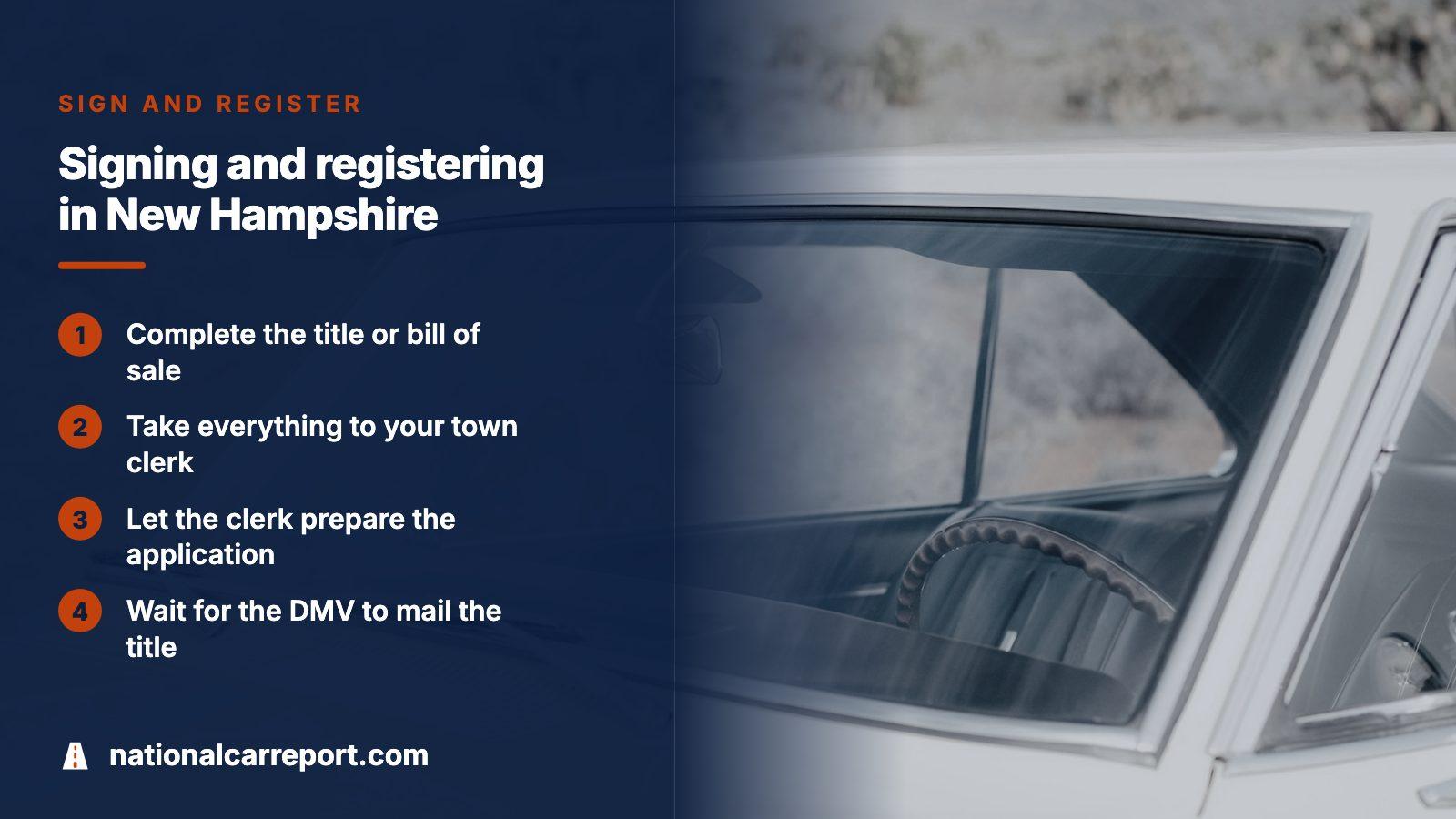
- Titled car: fill in the buyer's name, address and the current odometer reading on the back of the title, and both of you sign.
- Untitled car: collect the bill of sale, plus a current or expired New Hampshire registration or a valid title from any state as proof of the VIN.
- Take it all to your home town or city clerk, who prepares the application. A $35.00 title fee comes on top of registration fees.
- A New Hampshire dealer files for you. An out-of-state dealer cannot, so you hand its title or certificate of origin to the clerk.
- The DMV mails the title to the owner or the lender, taking up to 50 calendar days from receipt.
Cost: a preview first, then one payment
Seeing what a VIN returns costs nothing, because the preview lists the kinds of record that exist for that car. A report is bought once, for one car or in a bundle of three, five or ten, and no subscription follows. The pricing page holds the amounts, and a sample report is there to study first.
Run the VIN before any deposit changes hands, and treat a theft, lien or impound hit you cannot explain as grounds to walk away.
Where this information comes from
- NH DMV: Exempt Vehicles — Source for the 1999 cutoff, the always-titled heavy vehicles and the other exempt groups.
- NH DMV: Apply for a Title — Covers what a title lists, how liens are recorded, duplicates and the mailing time.
- NH DMV: Title Search — Lists what a title search returns, who can request one, the fee and the abandoned-car paperwork.
- NH DMV: Salvage and Rebuilt Vehicles — Explains the salvage title, the inspection, the decal and the Rebuilt Vehicle and Recovered Theft legends.
- NH DMV: Purchasing or Selling a Titled Vehicle — Shows the private, dealer and out-of-state paths, the title fee and the exempt-car paperwork.
- Department of Justice: NMVTIS for consumers — Source for what the national title system shows, its coverage gaps and the total-loss label.
- NICB: VINCheck lookup — Describes the theft, salvage and flood screen, its daily search limit and what it does not query.
Sources and photos: Facts checked against the sources above in November 2026. Photos by Warren Griffiths, Wesley Tingey and Carrie Allen www.carrieallen.com on Unsplash; diagrams by NationalCarReport.
Keep reading
- Vehicle Lien Check by VIN: Nationwide Lien, Theft and Impound RecordsThe lender step in detail, for a car from any state.
- Stolen Car Check by VIN: Nationwide Theft, Lien and Impound RecordsHow theft records are found by VIN and what a recovery looks like.
- Impound Lookup: Find a Towed Car, Then Check Its VIN for Impound RecordsTracing a car that was towed or held, and what to ask afterward.
- Maine Title Check: Which Records to Pull, by Type of SellerA neighboring state's title rules, if the car crossed the border.
Frequently asked questions
How do I do a New Hampshire title search?
Start from the VIN on the car, run it in the preview and through the NICB and NHTSA lookups, and ask the seller to show the title. The DMV's own search takes form DSMV 505 and is open to the trades it lists, so ask the DMV before counting on it.
Does New Hampshire title an older car?
Not if the model year is 1999 or earlier, unless the owner asks, so the sale rests on a bill of sale and proof of the VIN. Heavy trucks and truck-tractors over 18,000 pounds are always titled. Ask for the previous registration or any out-of-state title as backup.
What does a Rebuilt Vehicle title mean?
The car was once declared a total loss and given a salvage title, then repaired and passed an inspection that checks the VIN and the damage listed in the adjuster's report. A decal stays on the car and every later title carries the legend. Ask for repair proof.
Can I buy a New Hampshire car that still has a lien?
Only with the lender's signed release or a payoff made straight to the lender. A promise to settle later leaves the claim on a car you now own. On a 1999 or older car there is no title line to read, so get a written no-loan statement.
What if the seller lost the title?
Only the current owner, a lienholder or a New Hampshire licensed dealer may request a duplicate. The fee is $35.00 and the DMV says to expect it by mail in 5 to 10 calendar days. If two owners are named, both sign. The old certificate goes void, so settle this before paying.
Now check the car itself
The guide explains what to look for. The report shows what this VIN has on record.