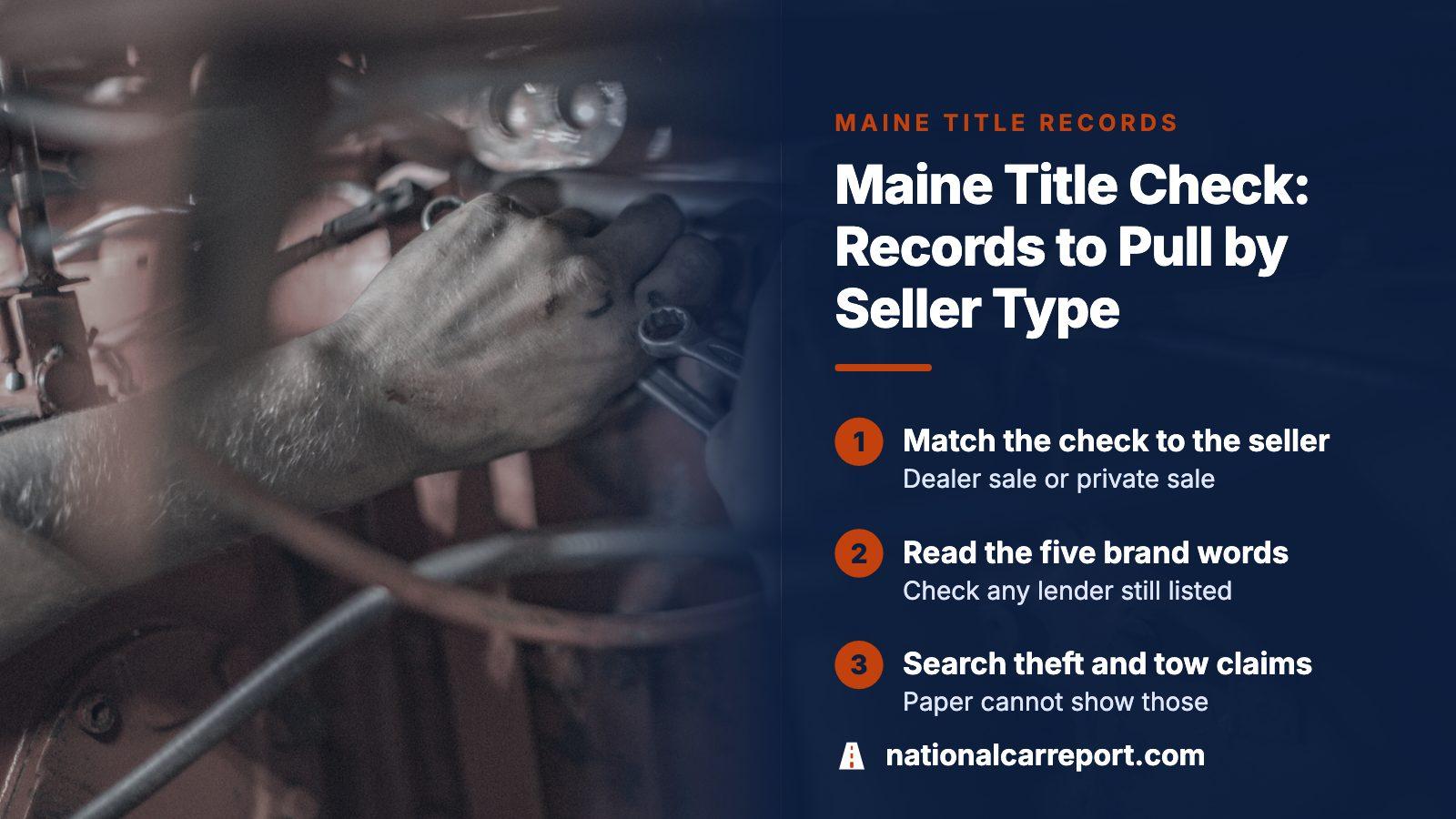
THE SHORT ANSWER
To check a Maine title, read the certificate against the VIN on the car, look for brand words and any lender still listed, then search that VIN for theft reports and tow claims the paper cannot show. The Secretary of State checks stolen-vehicle records when you apply for the new title, which comes after the sale, so search before you pay and ask any listed lender for a release.
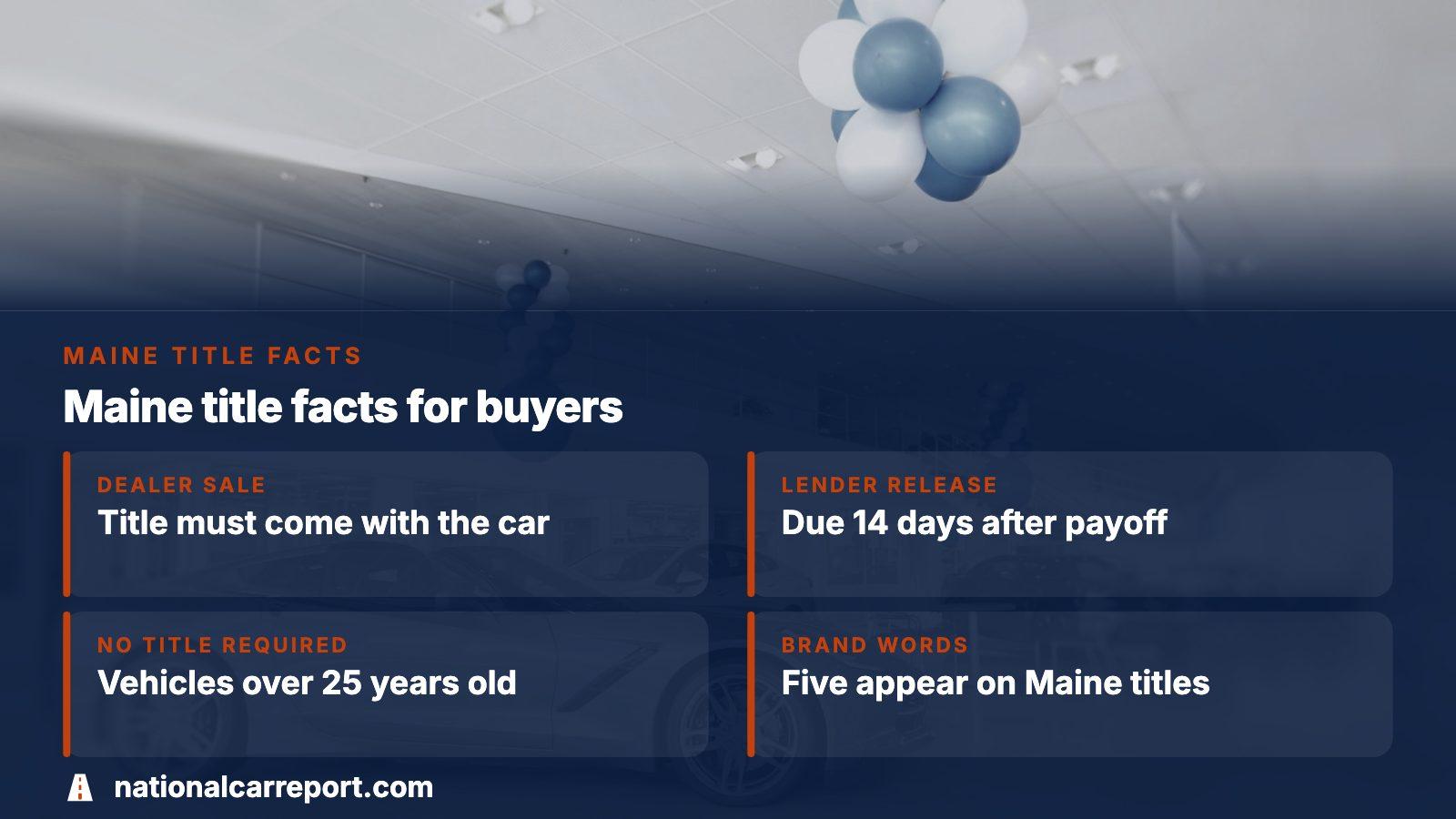
- Dealer sale
- A valid title, correctly assigned, must come with the car
- Lender release
- Due 14 days after the payoff is received
- Title fee in the statute
- $33, plus $10 to expedite
- No title required
- Vehicles more than 25 years old
Match the check to who is selling
NationalCarReport looks for claims a title does not advertise: a lender holding a lien, a theft report, a tow lot waiting to be paid. Maine's handover rules shift with the seller, so find your row.
| Seller | What Maine expects | Walk away if |
|---|---|---|
| Licensed dealer | A valid title or salvage certificate, correctly assigned, delivered with the car | The title is coming later, or still lists a lender with no release |
| Private owner with a title | A signed assignment and warranty of title at delivery, plus a released lien certificate if a lender existed | The seller's name differs from the title, or signature lines are empty |
| Private owner without a title | No signed paper exists; the state's missing-title process applies | There is no explanation, or no one can find the lender |
| Car last titled in another state | That state's title or salvage certificate, plus a VIN inspection certificate | A brand word the repair history does not explain |
Dealer sales: the title has to arrive with the car
Maine requires every car a dealer sells to arrive with a valid title or salvage certificate, correctly assigned, on the day of sale. When that title still names a lender, the dealer cannot let the car go until it holds a released lien certificate or a replacement title the Secretary of State has issued without the lender. A promise to mail the paper later does not satisfy the rule.
The dealer files your title application within 30 days. Delay past that brings a traffic infraction, and a delay of 90 days or longer becomes a Class E crime. Any document charge beyond the statutory title fees must be disclosed before the sale closes and posted on the car.
Private sale: a checklist for the certificate in the seller's hand
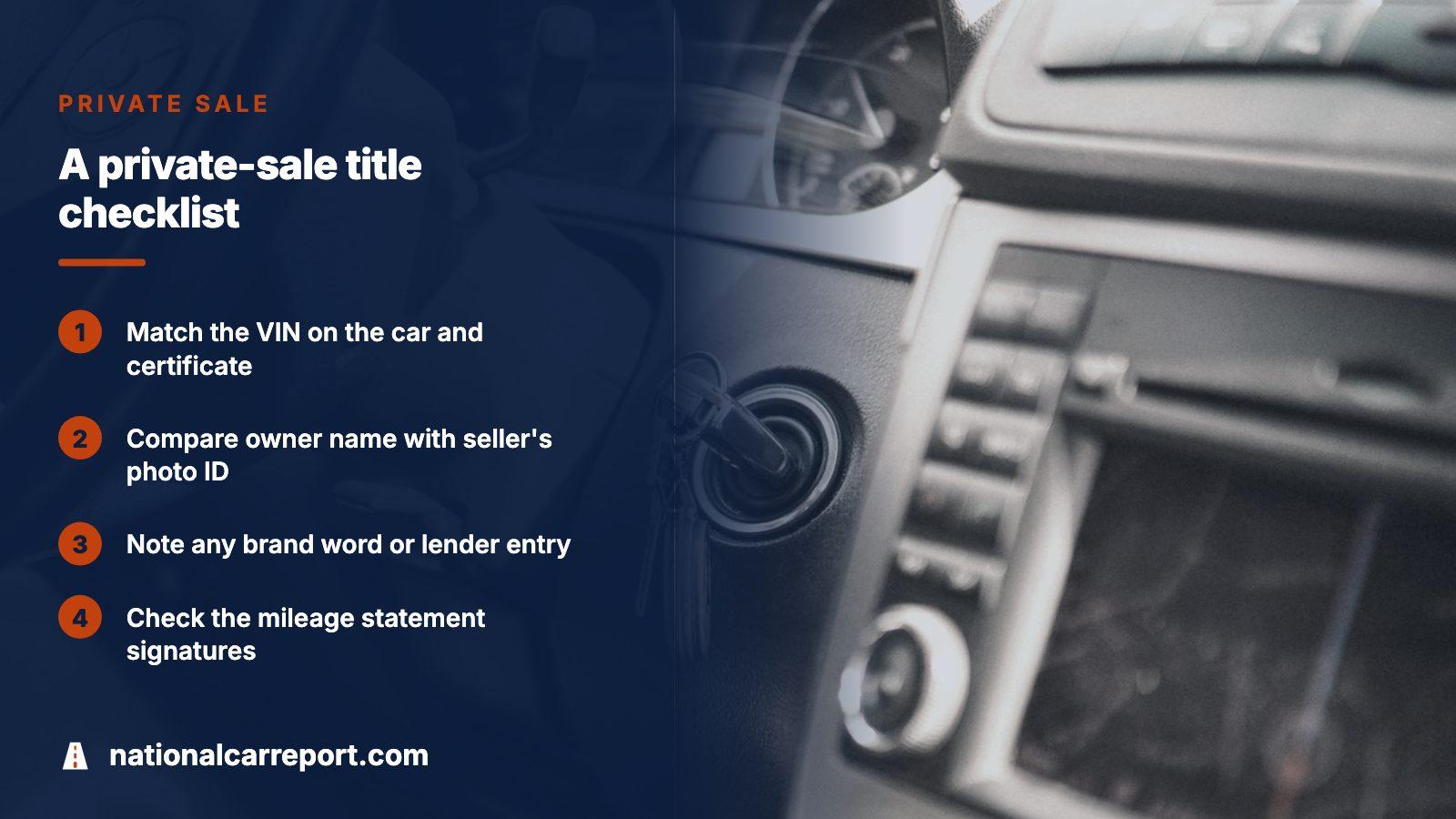
A private seller signs an assignment and warranty of title at delivery, and the mileage statement sits in the same signature block. Go down this list before paying.
- Read the VIN on the car, then on the certificate; every character must agree.
- Compare the printed owner name with the seller's photo ID.
- Note any brand word and any lender entry, and ask for the release if a lender appears.
- Check the mileage statement: the seller signs first, the buyer signs once it is complete, and no one signs both roles.
- Fill in the purchase date and the seller's name and address exactly; the state's application asks for both.
Liens: how a Maine lender gets released
After a loan is repaid, the lender has 14 days from receiving the money to sign a release. If the payoff came out of the sale itself, the paper goes to the owner or to someone the owner authorized in writing. A lender that misses the deadline can owe the owner $1,000, unless it disputed the payoff in time.
If a lender ignores a demand, the Secretary of State can cancel the certificate and print a replacement that leaves the lien off. That is the owner's remedy, not a buyer's shortcut. Get the lender's confirmation first.
Electronic liens
Lenders may join an electronic lien program and report releases to the state through it, so a paper title is not the only place a lien can sit. Ask the lender as well as the seller.
Five brand words on a Maine title
| Legend | When Maine uses it | What to ask |
|---|---|---|
| Salvage | Worth only its parts, sold for parts only, or carried over from an earlier salvage title | Why it was branded |
| Rebuilt salvage | Frames from two or more vehicles joined, five or more component parts replaced, a front or rear clip used on a total loss, or a rebuilt salvage title from any state | Purchase receipts, and donor VINs for used parts |
| Rebuilt | One to four component parts replaced, airbags excluded, or a rebuilt title from another state | Which parts, and who fitted them |
| Repaired | A salvage vehicle repaired without replacing component parts | What was done, in writing |
| Lemon Law Buyback | The maker took the car back under the state lemon law | Why it came back |
A rebuilder must tell the buyer in writing that the car was salvage and list the repairs. A Maine legend also survives a stay in another state.
Theft and tow claims a title will not show
A clean certificate says nothing about a theft report. When a title application arrives, the Secretary of State compares the VIN against stolen and converted records, and may suspend the registration of a car reported stolen.
Tow claims run on a clock. A car is deemed abandoned once its owner or lender has failed, for 14 days after the state's notices, to retrieve it and pay the towing, storage and repair bills. Storage charges cannot exceed $1,500 across 30 days. State Police may also impound a car whose VIN looks altered.
Cloned VINs
The Justice Department describes stolen cars wearing a VIN copied from a matching make, model and year; one operation recovered about 250. Insurers sometimes write off a vehicle that stays missing for 30 days, and that label survives a clean recovery.
When there is no title, or none is required
Maine requires no title for a vehicle more than 25 years old, a trailer of 3,000 pounds or less, or a motorcycle or moped under 300 cubic centimeters. A dealer must still supply papers showing the owner and any lender; ask a private seller for the same.
- An owner who cannot get the title from a prior owner can apply to the Secretary of State with proof of ownership, no lien and failed attempts.
- If the prior owner stays silent for 15 days after notice, the title issues with a warning that a prior owner's rights may remain. A standard title can follow after 6 months without a claim.
- Where ownership or a lien is in doubt, the state may hold the title back or require a surety bond.
After the paper holds up: the national screen and the filing
Maine's paper cannot see other states. The Justice Department puts NMVTIS coverage near 87 percent of vehicles nationwide, and not every state reports, so a salvage history can go missing. A brand can also vanish if the car is titled again in a state that skips its earlier records. The FTC points to NICB's lookup for flood damage, theft never recovered and salvage declarations, and to NHTSA for open recalls.
The statute sets $33 for a first title or a title after a transfer, an extra $10 to expedite, and a $50 penalty for papers not delivered within 30 days. It lists $33 as well for a search of BMV records by name or identification number, so ask the BMV what it will release for a VIN. Confirm current fees first.
Preview, report and the next step
The preview costs nothing and shows what a VIN returns. After that, one payment buys a report, with no renewal, and sets of 3, 5 or 10 exist for weighing several cars. The pricing page lists amounts. Run the VIN before the deposit. A lien with no release, a brand the seller cannot explain or a tow record is a reason to pause the sale, not to haggle, and the lender's release should be in writing.
Where this information comes from
- Maine Revised Statutes, Title 29-A, chapter 7: title to vehicles — Dealer and private transfer rules, fees, missing-title process, theft reports, impounds and the lemon law brand.
- Maine Revised Statutes, Title 29-A, section 652: exempted vehicles — Which vehicles need no title, including those more than 25 years old.
- Maine Revised Statutes, Title 29-A, section 667: salvage — Source for the salvage, rebuilt salvage, rebuilt and repaired legends and the rebuilder's disclosure duty.
- Maine Revised Statutes, Title 29-A, section 705: release of security interest — The lender's release deadline, the owner's remedy and the state's replacement-title route.
- Maine Revised Statutes, Title 29-A, chapter 15: abandoned vehicles — How a tow claim ripens, the notice period and the cap on storage charges.
- Department of Justice: NMVTIS for consumers — Coverage gaps, brand washing, cloning and the total-loss label on unrecovered thefts.
- FTC: Used cars — What NICB's lookup and NHTSA's recall list cover, and why a history report is not an inspection.
Sources and photos: Facts checked against the sources above in November 2026. Photos by Nina Mercado, tim and Richard R on Unsplash; diagrams by NationalCarReport.
Keep reading
- Vehicle Lien Check by VIN: Nationwide Lien, Theft and Impound RecordsThe nationwide version of the lender step, for a car titled anywhere.
- Stolen Car Check by VIN: Nationwide Theft, Lien and Impound RecordsHow a theft report turns up, and what a recovery leaves behind.
- Impound Lookup: Find a Towed Car, Then Check Its VIN for Impound RecordsLocating a car that was towed or held, and what to ask afterward.
- PricingOne report or a pack, paid once, with no subscription.
Frequently asked questions
How do I do a Maine title search?
Begin at the car: copy its VIN and compare it with the certificate. Run the VIN for brands, liens, theft and tow records, then ask the Maine BMV what its own record shows. The statute lists $33 for a records search.
Is there a free Maine title check?
Only pieces of one. The preview costs nothing, and NHTSA's open-recall list is free. NICB's lookup covers flood, unrecovered theft and salvage. None replaces the BMV's record of the owner and lender. A full report beyond the preview is a one-time purchase.
Does a Maine car older than 25 years need a title?
No. Vehicles more than 25 years old are exempt, though the Secretary of State may issue a warranty title to a Maine owner of an antique or classic vehicle with notarized proof and a $40 fee. Ask for ownership and lender papers.
What if the title lists a lender?
Insist on a released lien certificate before the seller is paid, or pay the lender directly and collect the release. A Maine lender has 14 days from receiving a payoff to sign one, so ask for the signed release, not a promise.
What does a rebuilt title mean in Maine?
Rebuilt means a salvage vehicle had one to four component parts replaced, airbags excluded. Rebuilt salvage covers five or more, joined frames, a front or rear clip on a total loss, or a rebuilt salvage title from any state. Request the written disclosure.
Now check the car itself
The guide explains what to look for. The report shows what this VIN has on record.