THE SHORT ANSWER
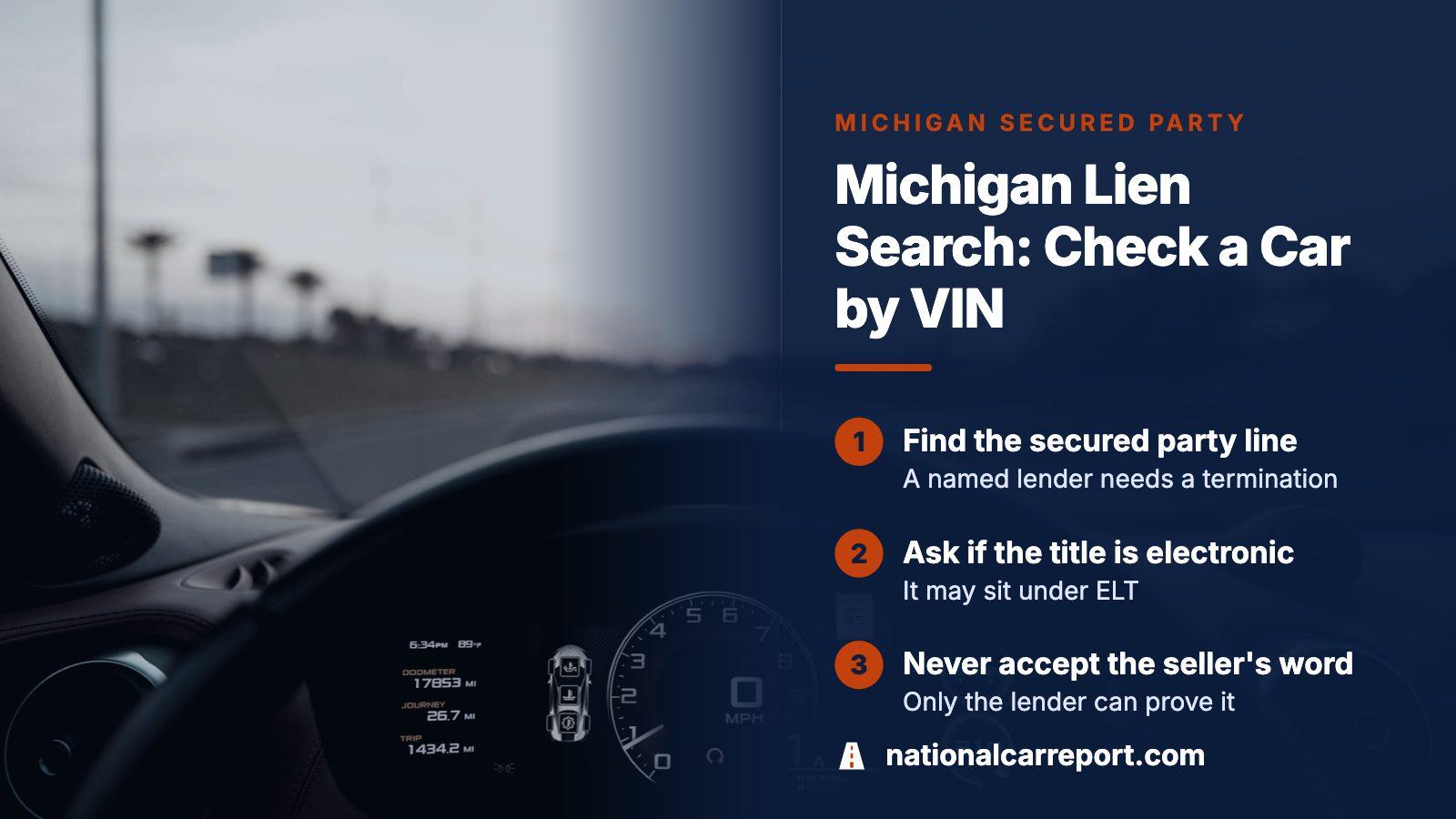
Put the VIN into our free preview and see whether a lien, stolen report or tow record is attached. Next ask the seller for the Michigan title and read its secured party line. If a lender is named, you need a termination from that lender, in one of the forms the state accepts, before any money changes hands.
- Search key
- The VIN, taken from the car itself
- Where the lien is recorded
- On the title, or electronically under ELT
- Proof the lien is gone
- A lender termination, never the seller's word
- Late transfer fee
- $15 after 15 days from the sale
What a VIN search shows on a Michigan car
NationalCarReport looks at a vehicle through the claims that can trail it: money owed to a lender, a theft report, a stay in a tow lot. Each of those hangs on the VIN, so the same search covers a car that spent its life in Detroit or one that came north from another state.
- Liens, where a lender's claim reached a database we read
- Theft records and whether the car was recovered
- Impound and storage entries
- Salvage and similar brands that cut a car's resale value
The preview carries no charge and gives a first look at those records. A clean preview lowers the odds of a surprise but does not replace the title, which is the document Michigan treats as the record of ownership.
How a Michigan lender gets recorded
When someone finances a car, the lender is written on the title as the secured party. For a brand-new vehicle the line can appear on the maker's origin certificate. A lender may also send its details in a loose paper, either the TR-11L application or a short letter.
Michigan has also moved much of this off paper. Under its Electronic Lien and Title program, created by Public Acts 290 to 292 of 2014, banks and finance companies must enroll and keep the title and lien record electronically with the state. Paper titles a lender already held before enrolling were not converted.
For a buyer, that means a seller may truthfully say there is no paper title to show. In that case the car is financed, and the lender holds the record.
Steps to take before any money moves
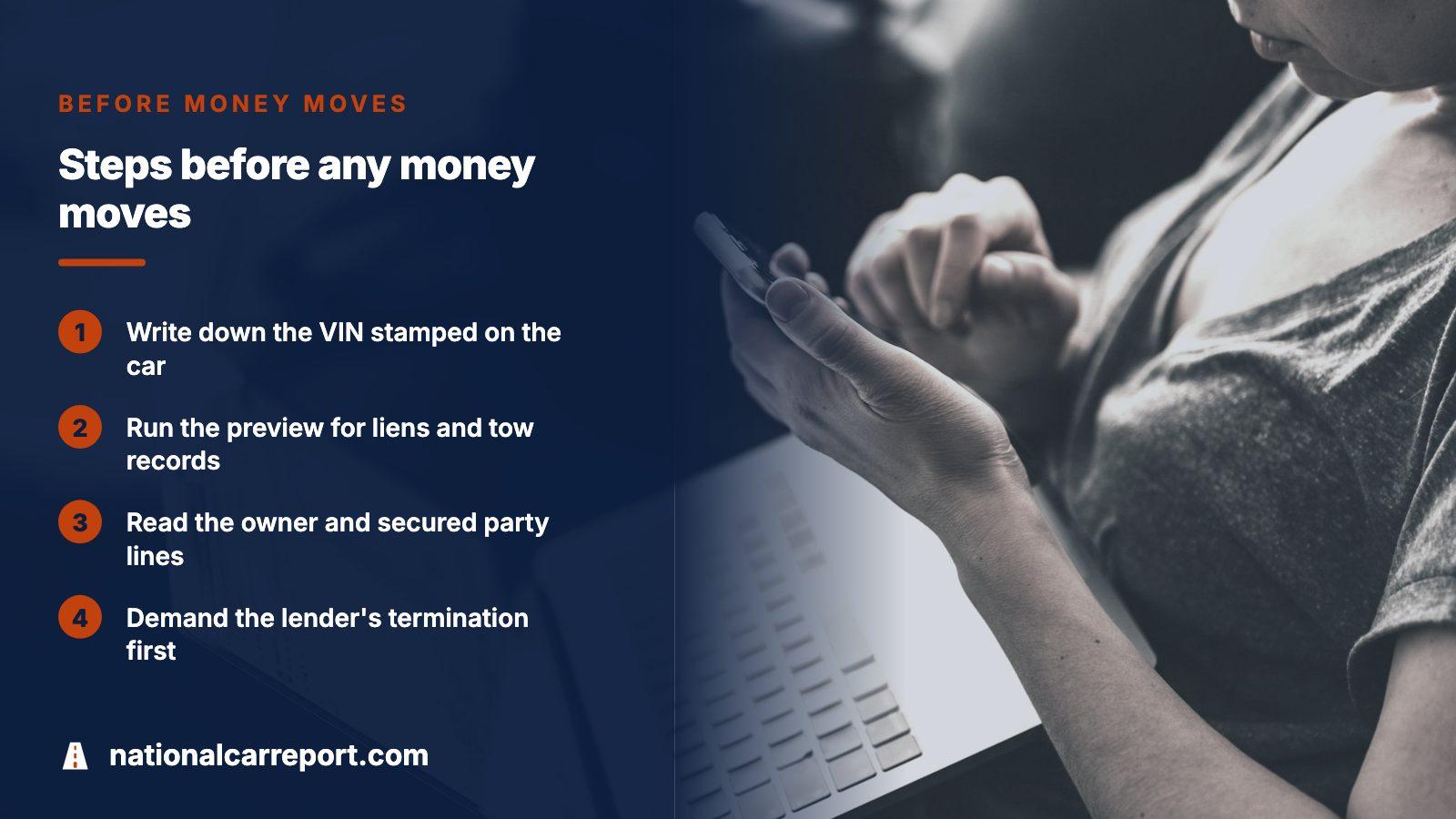
- Write down the 17-character VIN as stamped on the car, then match it to the number in the seller's paperwork. If they differ, stop.
- Type it into our preview and go through what it says on liens, theft and tow records.
- Ask for the Michigan title, and read the owner's name and the secured party line.
- If a lender shows up, demand the termination first.
- Open the full report when the preview flags something, or when the car costs enough to justify one more record.
You pay once for a report and nothing recurs. See the pricing page for the options.
What counts as proof the lien is cleared
At a title transfer the Secretary of State takes several kinds of termination. One is enough for the clerk, and each must originate with the lender, never the seller.
| Form of proof | What to look for |
|---|---|
| Termination box on the title | Filled in and signed by the lender |
| Paid stamp on the title | Dated, with the lender's signature |
| Stand-alone termination statement | Lender signature plus the VIN |
| Company letterhead letter | Gives the VIN and says the lien has ended |
| Original loan contract | Paid mark from the lender, signed |
A photographed receipt, a text message or a promise that the loan is almost done is not on that list. If the paper falls outside it, the risk sits with the buyer.
When the title is electronic
An electronic title changes who can fix problems. After the last payment, the lender lets go of the electronic lien and has the department mail the owner a paper title. Secretary of State offices cannot release an electronic lien themselves, and they cannot issue a duplicate or an instant title for one.
Seller says the loan is paid off?
Ask the seller to show you the paper title that arrived after the release. If the seller is still waiting on it, the lender has not finished, and you should not complete the purchase yet.
Paper titles are issued for an electronic record in a few other cases, for example when an owner is moving and will register in another state.
Michigan's title rules a buyer should know
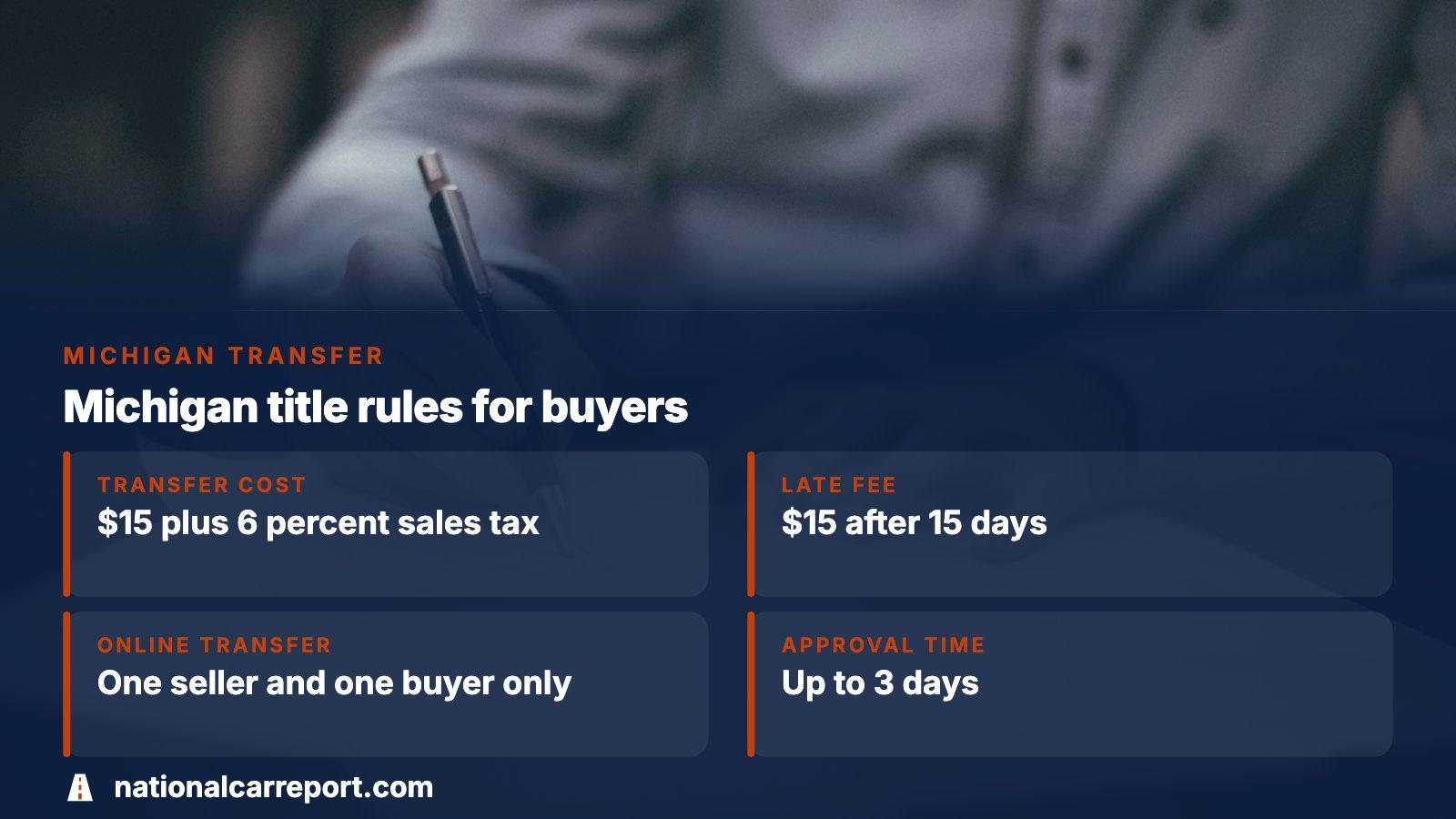
- A title transfer costs $15, with 6 percent sales tax on top.
- Waiting longer than 15 days after the sale adds a $15 late fee.
- Online transfer is only for one individual seller and one individual buyer, with a paper Michigan title, and the buyer cannot be financing the car.
- After an online submission, approval can take up to 3 days.
If the buyer's own loan will put a lender on the new title, the lienholder information goes on the secured party line or on a separate document. Adding a lienholder to an existing title costs $16, and removing one costs $15, with a corrected title arriving by mail in 14 days.
Red flags that point to a hidden lien
- The seller has no title and offers only a registration
- The person selling is not the name printed on the title
- The VIN preview shows a lender, but the seller denies any loan
- A duplicate title request is pending, which can be a way to dodge the lender
- The price is well below what similar cars list for
Duplicate titles are a useful tell. When a car carries a lien, the state sends the duplicate to the lienholder, so a seller who says the title was lost on a financed car cannot simply replace it and hand it to you.
If a lien turns up
Do not pay the seller and hope the seller pays the lender. Contact the lienholder named on the title, confirm the payoff, and either have the loan settled in your presence or walk away. A lender with a valid claim can pursue the car, not just the person who borrowed against it.
Once a termination is in hand, the office will remove the lien when only that change is being made, and only one owner needs to appear. Bring the title, photo ID for the owners, and the lender's termination. Keep copies of every document you received.
Where the full report helps, and where it stops
Michigan's own transfer page urges buyers to get an NMVTIS report from an approved provider, which it says covers title data, the newest mileage entry, past brands and occasionally theft. That is useful context, but the state's pages do not describe a public lien lookup by VIN.
Our report adds lien, impound and theft detail to those title facts in one place, which is the part a lien question depends on. It does not replace asking the lender directly, and no database does. Use it to decide whether the seller's story deserves a phone call to the lender.
Where this information comes from
- Michigan Department of State: Title transfer and vehicle registration — accepted lien terminations, fees, late fee and online transfer limits
- Michigan Department of State: Electronic Lien and Title program — how electronic liens are held and released
- Michigan Department of State: Title correction — adding and removing a lienholder, fees and timing
- Michigan Department of State: Title replacement and duplicate — where a duplicate goes when a lien exists
- NMVTIS consumer access (U.S. Department of Justice) — where buyers find approved history providers
Sources and photos: Facts checked against the sources above in November 2026. Photos by Dennis Eusebio, Michal Biernat and Scott Graham on Unsplash; diagrams by NationalCarReport.
Keep reading
- Vehicle Lien Check by VIN: Nationwide Lien, Theft and Impound RecordsThis check explained without a state focus.
- DMV Lien Release Search: How to Confirm a Lien Is GoneMaking sure a lender has truly let go.
- Car Lien Holder Search: How to Find the Lender Behind a VINFinding who the lender on a title is.
- Stolen Car Check by VIN: Nationwide Theft, Lien and Impound RecordsThe theft side of the same VIN.
Frequently asked questions
Can I do a Michigan lien search online by VIN?
The Michigan pages I read describe no public lien lookup by VIN. A VIN search through us shows liens, theft and impounds where records reached a database, and the title with a lender termination remains the proof the Secretary of State accepts.
Does the Secretary of State release an electronic lien?
No. The department says its offices lack the authority. The lienholder releases the electronic lien, then the state mails a paper title to the owner. A seller waiting on that title has not been fully cleared yet.
What should I do when the seller claims the title is lost?
On a financed car the duplicate goes to the lienholder, so a lost title is a warning. Any owner can request a duplicate, but with a lien it will not simply land in the seller's hands. Ask the lender directly.
How much does it cost to remove a lien from a Michigan title?
The state lists $15 for removing a lien and $16 for adding a lienholder. Same-day instant title service costs $5 extra, and a corrected title otherwise comes by mail in 14 days. Card payments carry additional fees.
Does the preview cost anything?
No. The first screen is free, and a full report is bought once, with no recurring charge. Our pricing page lists the choices.
Now check the car itself
The guide explains what to look for. The report shows what this VIN has on record.