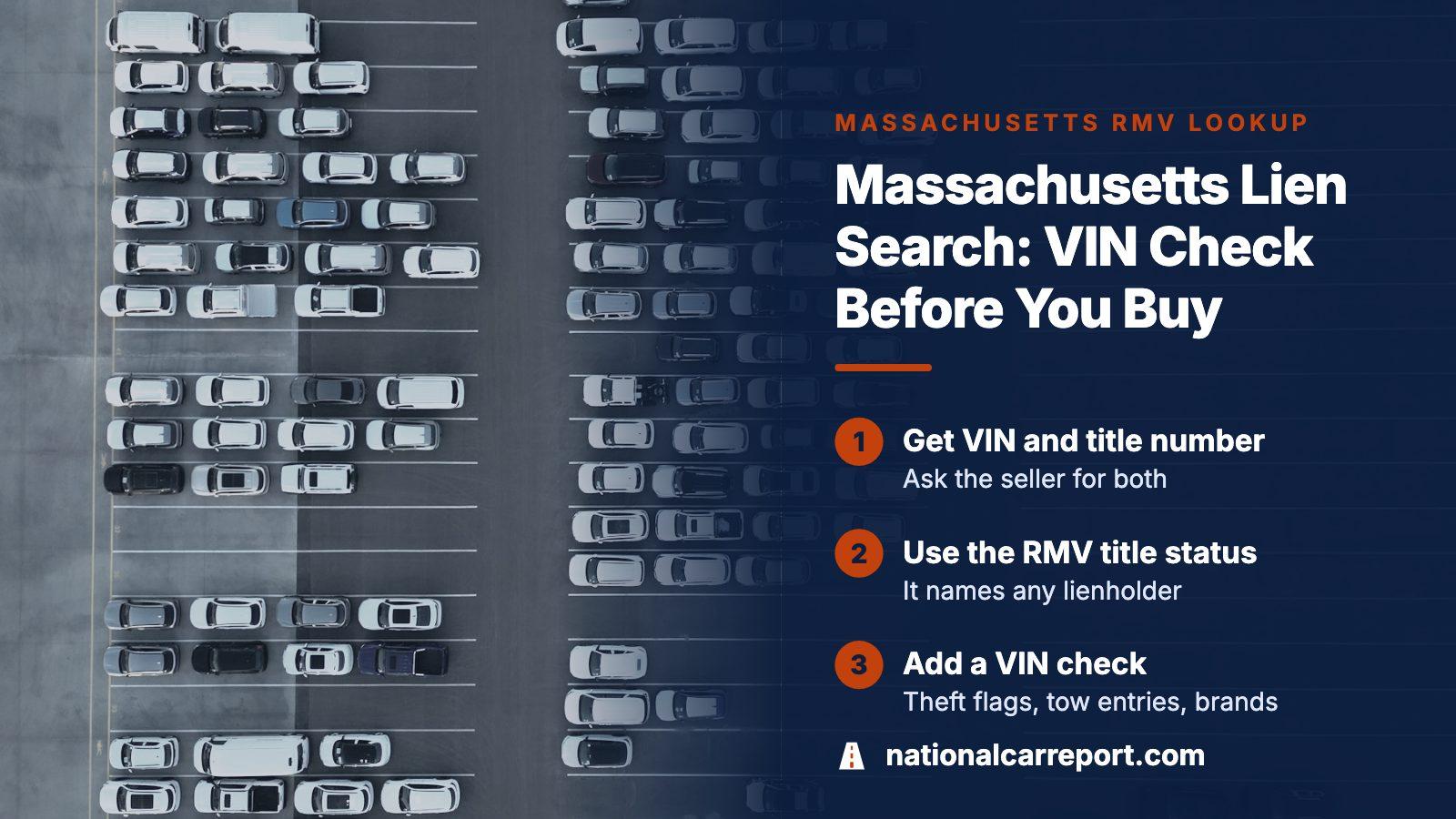
THE SHORT ANSWER
Get the VIN and title number from the seller, then enter both in the RMV's online title-status lookup, which names any lienholder at no charge. Next, run the VIN through our preview to catch theft flags, tow entries and title brands. If a lender appears, get a payoff letter and settle with that lender directly.
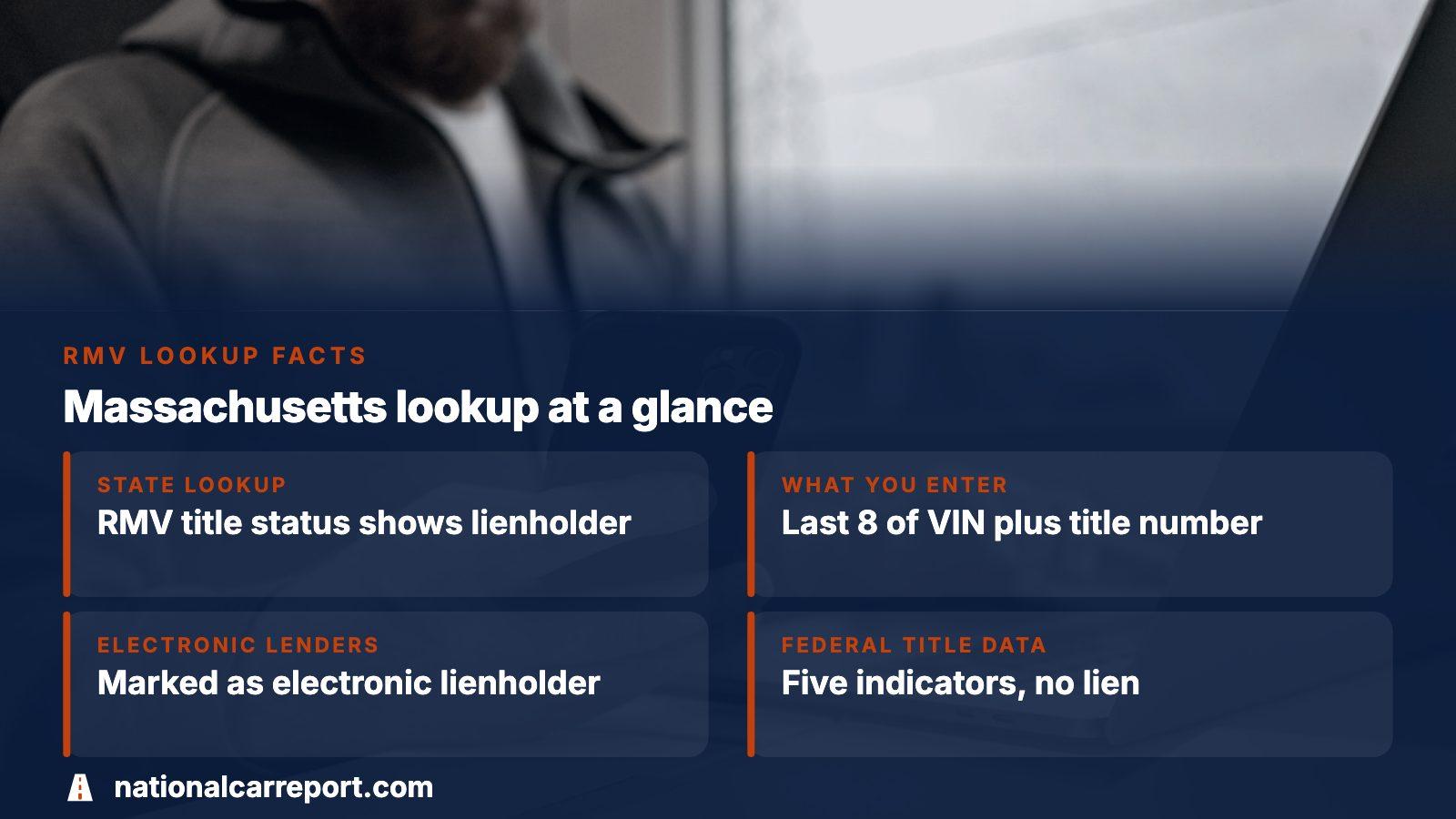
- State lien lookup
- RMV title status shows the lienholder, no fee
- What you enter
- Last 8 of the VIN plus title number
- Electronic lenders
- Marked as an electronic lienholder in the record
- Federal title data
- Five indicators, and a lien is not among them
Two lookups cover a Massachusetts car
Debt on a car is recorded on its title, and in Massachusetts the Registry of Motor Vehicles runs a public tool that reads that record. It is the closest thing to a direct answer about a lender. What it does not do is look at the rest of a car's past, which is where a nationwide VIN search earns its place.
NationalCarReport searches by VIN across theft entries, impound and tow records, and the lien and title data that flow into national databases. A car sold in Worcester may have spent two winters in another state, so a search that follows the number instead of the plate catches what a single state's page cannot.
Reading the RMV title-status result
The RMV's title-status page returns a short record. It lists the issue date of the title, the name of the person receiving the mailed copy, the paper or electronic format, and a lienholder's name when there is one. Checking costs nothing.
The form asks for the final 8 characters of the VIN and the title number, which is printed on the registration. A seller who cannot find that number can supply the whole VIN instead.
A shortcut for electronic lenders
When the lender takes part in the state's electronic lien program, its entry shows a Yes beside the electronic lienholder line. Treat that Yes as a confirmed debt, and expect no paper title in the seller's hands.
Why there may be no paper title to inspect
Massachusetts lenders often hold a title as a data record rather than a printed sheet. Under the electronic lien program, the RMV sends the lender an electronic record in place of mailing paper. The record remains digital once the debt is cleared or until the lender requests a printout, for instance following a repossession or an owner's move to another state.
- A seller with no title in hand is not automatically hiding something; the lender may hold the record.
- Someone claiming the title went missing still owes you an answer on the lien, and the lookup supplies it.
- A car with no lender may carry an E-Title, which the lookup lists as electronic with no lienholder.
The two ideas are separate under state law. An electronic lien can exist without an E-Title, and an E-Title can exist with no lien at all.
What a VIN check adds that the RMV page lacks
The RMV tool answers a narrow question about one Massachusetts title. Our preview, run on the VIN, widens the view to the problems that quietly sink a purchase.
| Question | RMV lookup | VIN check |
|---|---|---|
| Is a lender named on the title? | Yes, for Massachusetts titles | Yes, where the data reaches national records |
| Was the car ever reported stolen? | No | Yes, theft records |
| Has it sat in an impound lot? | No | Yes, impound entries |
| Does it carry a salvage or flood brand? | Only the title type | Yes, brands from any state |
Our preview is no-cost. Going further means a single purchase of the full report, never a subscription, and the options are laid out on the pricing page.
A federal gap worth knowing about
The Justice Department says the national title system's consumer report is built around five indicators. They cover the titling state with its latest date, brands, mileage, total loss and salvage. Lenders are absent from that set. A clean federal report therefore says nothing regarding a lender in Massachusetts.
The same page calls a clean report a good result and urges buyers to pair it with an independent inspection. Read that as advice to stack checks. No single database covers every risk, and the RMV lookup is the one that speaks to the lien itself.
Memorandum titles and cars from out of state
A vehicle imported into Massachusetts while financed gets a memorandum title here, and its lender holds the original title from the other state. This document cannot be negotiated, and the state says it is not transferable unless the out-of-state title travels with it.
If a seller hands you a memorandum title, you are buying a car with an active loan behind it. Ask who the lender is and request the payoff in writing. Run the VIN as well, because a car that crossed a state line may have records in the origin state that a Massachusetts search will never see.
When a lender turns up
A lien does not end the deal. It changes who you pay. Pay the seller alone and the lender can still claim the car, so the payoff has to reach the lender before the title moves to you.
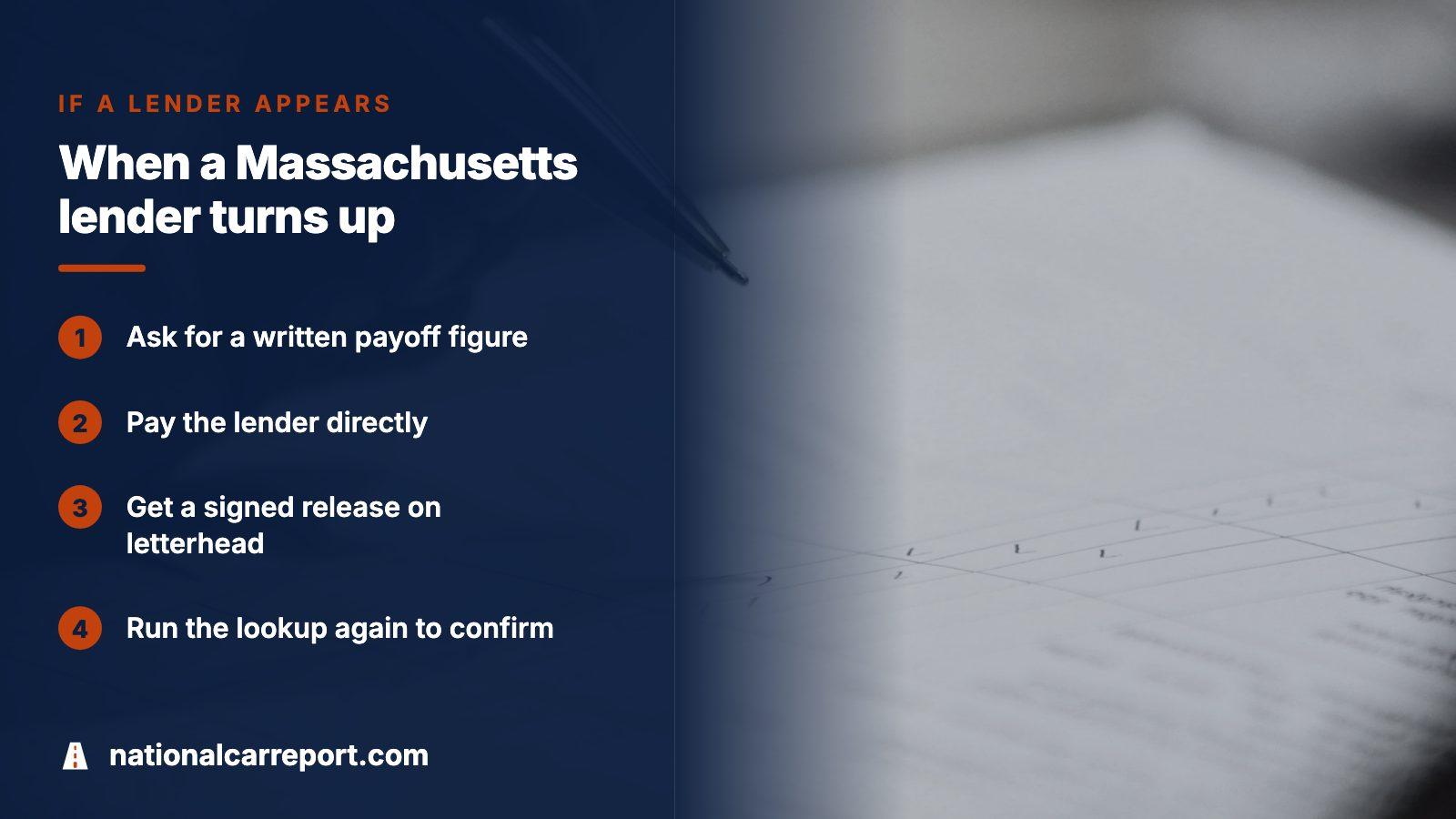
- Ask the seller to request a written payoff figure from the lender.
- Arrange payment so the lender is paid directly, ideally with the seller present.
- Get a signed release on the lender's letterhead naming the year, make, VIN and every titled owner.
- Do not accept a fax or a photocopy of the release; the RMV refuses them.
- Confirm the title record afterward by running the lookup again.
A signature is not a release
The RMV states that a lienholder's signature on a title application does not count as a lien release. Insist on the letter.
Seller says the loan is paid, yet the title is missing
Sellers who finished a loan years ago sometimes cannot find the paper. The owner can order a duplicate, priced at $25, with delivery by mail taking as long as 10 days. The owner supplies the VIN or title number and a Massachusetts driver's license number.
Where a loan existed, the lender's release letter must go in with that application, no matter how old the loan is. The state adds that an original found later has to be handed back to the Registrar. For a buyer, the practical point is timing: do not pay before the replacement is in the seller's hands, or you will be funding a promise.
Putting it together before you pay
Begin with the number stamped on the car, then compare it against what the registration and the title show. Run the RMV lookup for the lender. Run our preview for theft, impound and brand records. If a lien shows, get the release letter before the sale closes.
That sequence takes a short while and costs far less than losing a car to a lender who was never paid.
Where this information comes from
- Mass.gov: Check the status of your vehicle's title — what the RMV lookup returns, what you enter, and that it carries no fee
- Mass.gov: Electronic Lien and Title (ELT) Program — why a lender may hold an electronic record and when a paper title is printed
- Mass.gov: Understanding Electronic Vehicle Certificate of Title (E-Title) — how E-Title differs from the electronic lien process
- Mass.gov: Replace your vehicle's paper certificate of title — replacement fee, timing and the lien release rules
- Mass.gov: Title types and definitions — what a memorandum title means
- US Department of Justice: Understanding an NMVTIS vehicle history report — the five indicators in the federal consumer report
Sources and photos: Facts checked against the sources above in November 2026. Photos by Iain, Masjid MABA and Anastasiia Nelen on Unsplash; diagrams by NationalCarReport.
Keep reading
- Vehicle Lien Check by VIN: Nationwide Lien, Theft and Impound RecordsThe general version of this check for any state
- DMV Lien Release Search: How to Confirm a Lien Is GoneHow to confirm a lender has actually let go of the car
- Car Lien Holder Search: How to Find the Lender Behind a VINFinding out who the lender is when the paperwork is thin
- Stolen Car Check by VIN: Nationwide Theft, Lien and Impound RecordsThe theft side of a pre-purchase search
Frequently asked questions
How do I do a Massachusetts lien search on a car?
Open the RMV's online title-status lookup. It wants the VIN's final 8 characters alongside the title number, and the entire VIN stands in if that number is missing. It names any lienholder and costs nothing. Then run the VIN through a history check for theft and impound records the state page does not carry.
Does the RMV title lookup cost anything?
No. The RMV states there is no fee to check a vehicle's title status. You pay only if you later ask the RMV for something else, such as a replacement paper title, which has its own fee. A VIN check from a private service is a separate product.
Why would a Massachusetts seller have no paper title?
Several reasons are ordinary. The lender may hold an electronic record, the owner may have converted to an E-Title, or the paper may be lost. None proves a problem alone, so use the lookup to see the format and lender instead of relying on the seller's account.
Can I buy a car that still has a lien?
Yes, if the payoff goes to the lender before the title is transferred. Get a written payoff, pay the lender directly, and collect a signed release letter on letterhead. Handing the full price to the seller and trusting them to settle the loan leaves you exposed.
Will a federal NMVTIS report show a lien?
Not as a standard item. The Justice Department builds that report on five indicators covering title, brands, mileage, total loss and salvage, and lenders are not among them. Treat a clean federal report as useful on damage history only, and use the RMV lookup for the lender.
Now check the car itself
The guide explains what to look for. The report shows what this VIN has on record.