THE SHORT ANSWER
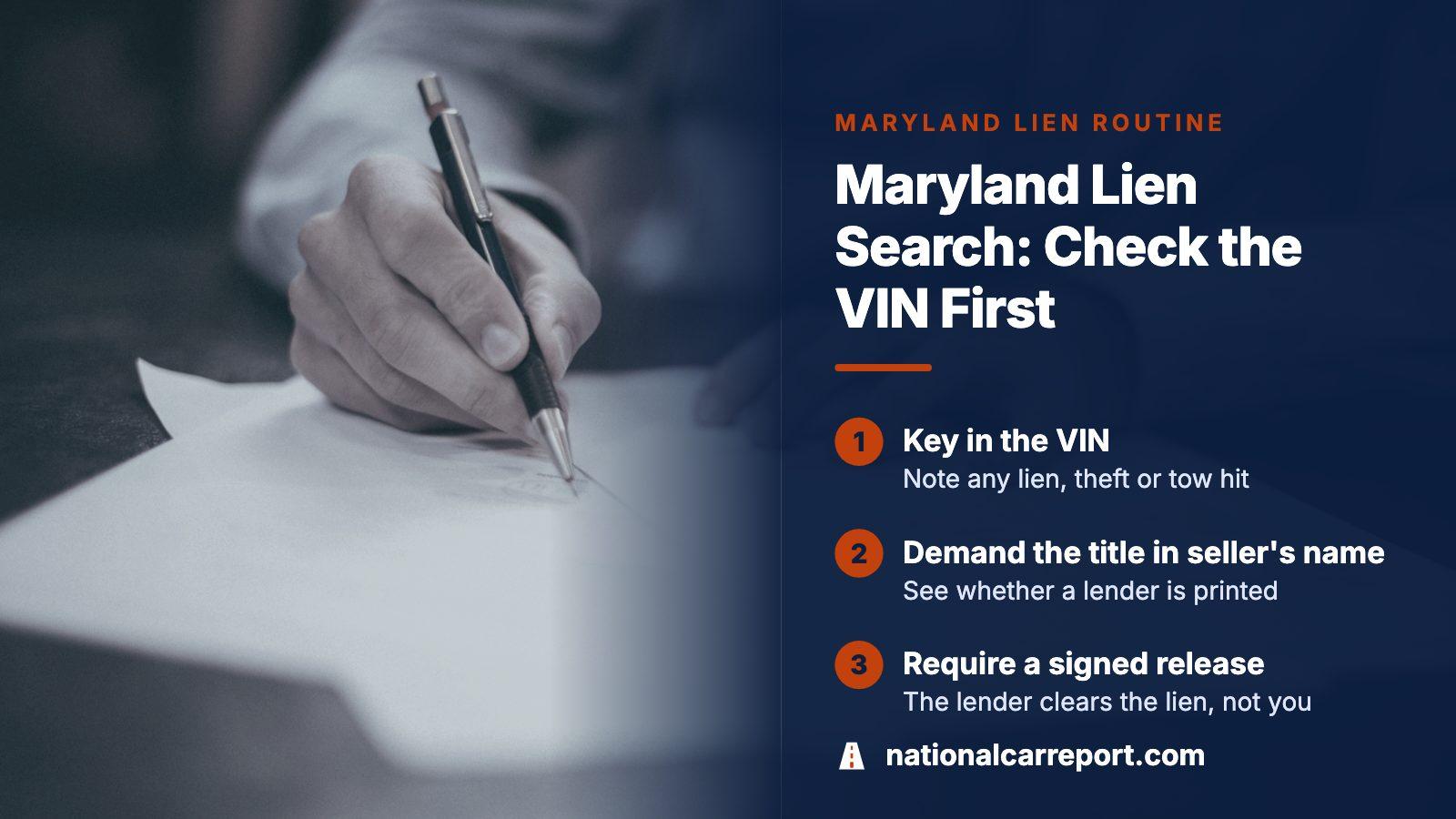
Before buying a Maryland car, key its VIN into our preview and note whether a lien, theft report or tow record comes back. Any of those has to be settled first. An empty result lowers the odds but proves nothing. Then ask for the Maryland title in the seller's own name, see whether a lender is printed on it, and require a signed release.
- Search key
- The 17-character VIN, read off the car
- Where a Maryland lien lives
- The certificate of title, recorded by the MVA
- Lender's paperwork window
- 10 days to file and keep the claim dated from the loan
- Cleared by
- A release form signed by the lender
What a VIN search turns up on a Maryland car
NationalCarReport looks at a car through the claims that can follow it: money owed, a theft report, a tow lot. Each of those attaches to the VIN, so one entry pulls up whatever was reported, whether it happened in Maryland, Virginia or farther away. For a lien search, those are the three records worth reading first.
- Liens: a lender's claim, where that detail reached a database
- Theft: a stolen report on file, and the car's recovery status
- Impounds: time the vehicle spent in a tow or storage lot
- Title brands such as salvage, which drag a car's value down
Our preview is a no-charge first screen of those records. Maryland treats the title, not any database, as the official record of who holds a claim.
How a Maryland lien gets onto the title
Maryland's Transportation Article tells an owner who takes out a loan on a car to sign the title's application section right away, listing the lender and its address, the amount borrowed and the date of the loan agreement, then hand the title to the MVA. The lender pays a filing fee. Once everything arrives, the MVA either endorses the title or issues a new one that names every lender, and returns it to the owner.
Timing affects a buyer. A lender whose papers and fee get to the MVA inside ten days is treated as secured from the day of the loan; one that files later is secured only from the day of filing. Once perfected in this way, the claim stands against the owner's other creditors and against the next person to buy or lend on the car.
Four checks to finish ahead of handing over payment
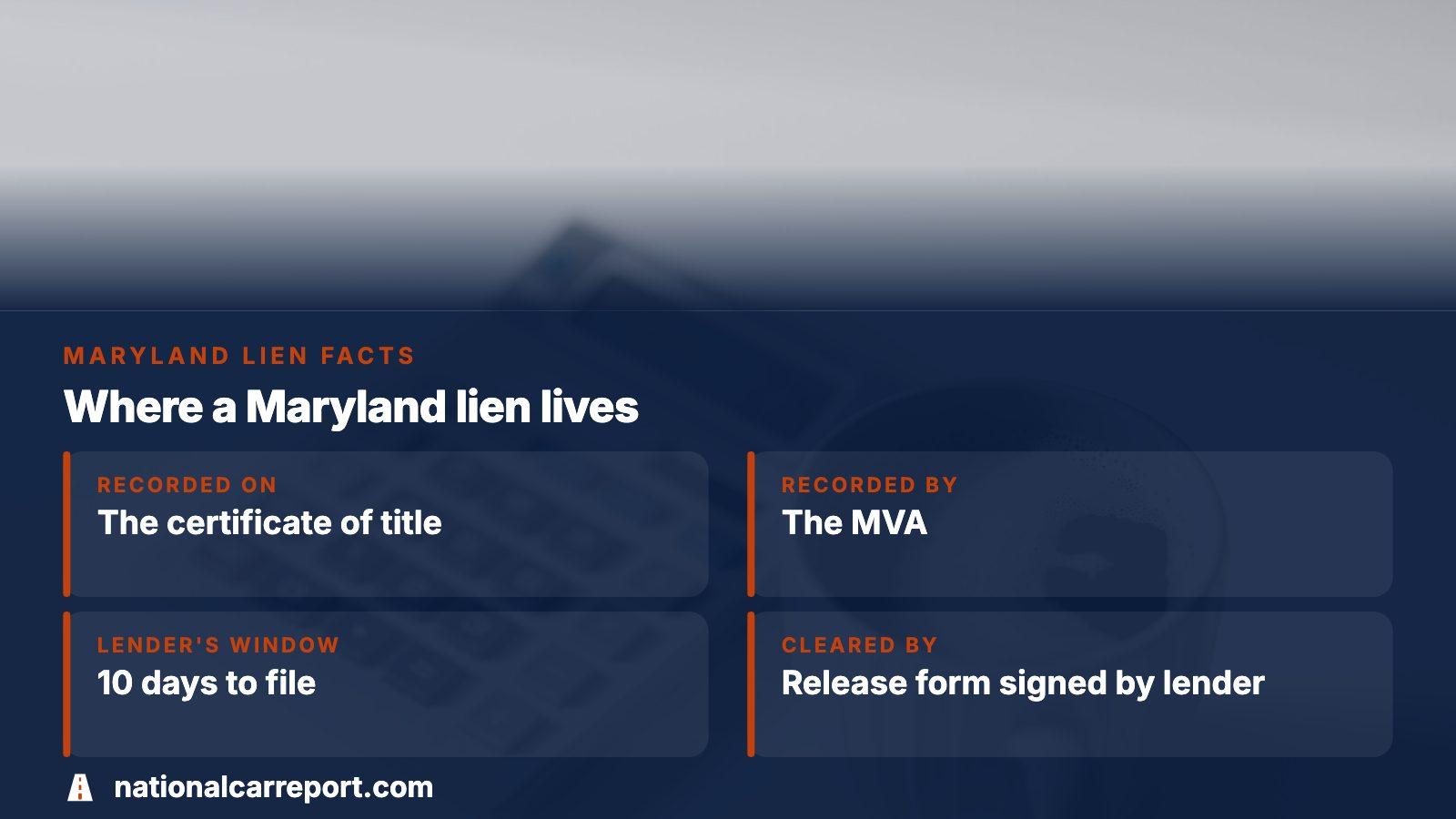
- Match the VIN stamped on the vehicle to the one printed on the seller's title and shown in the listing.
- Run it through the preview and write down whatever lien, theft or tow lines come back.
- Study the Maryland title: the seller's name should appear, with any lender named.
- When a lender is named, get its signed release, or watch the payoff happen yourself.
- Only after those, agree a price.
When the VIN, title and seller do not line up, stop. Do not haggle your way past it. A seller with straight paperwork seldom objects to being asked.
What each preview result tells a Maryland buyer
| What shows | What it suggests | Your next move |
|---|---|---|
| Lien shown | A lender may still be owed money on the car | Obtain a payoff letter and a signed release before paying |
| Theft entry | A stolen report was filed at some point | Get written proof the car was recovered and cleared; leave if that is vague |
| Impound entry | The car spent time in a tow or storage lot | Ask the reason and who paid the release fee |
| No entries | Nothing turned up in the data searched | Examine the title anyway and ask about any loan |
A blank preview helps but leaves gaps, since lien detail reaches national databases only when a lender or agency passes it on. The federal title database lists just five items, namely the titling state, brands, odometer, total loss and salvage. Liens are absent, so a blank there tells you nothing about a loan.
Claims the title will not show
Maryland's title rules for lenders leave out some kinds of claim. A lien the law gives a repair shop or parts supplier is outside that system. So are liens the law gives the federal government, Maryland or a local government, and a lien from a court attachment. A dealer's own stock held for sale is excluded too.
Why a clean title is not the whole answer
A debt from a repair bill or owed to the government might never be printed on the certificate. Ask the seller plainly whether anything is owed on the car, and when you buy from a dealer, get that answer written on the bill of sale.
Buying a car that arrived from out of state
Many used cars in Maryland were first financed elsewhere. According to the statute, a lien that already existed when the car crossed the line is judged under the law of wherever the car sat when the lien began. Where the parties expected the car to live in Maryland and it arrived inside 30 days, Maryland law governs.
A lender named on the earlier state's title keeps its claim in Maryland. A lender missing from that title, in a state that does not note liens on titles, keeps it for 4 months, and past that point only if it filed in Maryland before the window closed. In short, a car that came from another state calls for the VIN search plus a look at where it was titled earlier.
How a Maryland lien comes off
Once the debt is cleared, the lender has to sign the MVA's release form and send copies without delay to the owner and the MVA. A licensed dealer that paid off the loan for the owner can also be copied, if the owner authorized that in writing. After the MVA holds both the release and the title, it removes the lender's right or issues a replacement title.
- Keep a copy of the signed release; a spoken assurance is not enough
- Check that the MVA has actually received it before trusting a clean title
- If the seller still owes money, pay the lender directly and keep the receipt
- Do not pay cash to a seller who cannot say who the lender is
Owners who want the details of their own loan can send a written request to the lender named on the title, which the law obliges it to answer.
Maryland report pricing and the next step
Browsing the preview costs nothing. When a VIN merits a deeper look, the full report is a one-time charge for one car, with packs for a longer shortlist, and no subscription comes with it. The pricing page lists the options; the sample report illustrates how results are arranged.
From there the paperwork is the MVA's business. Hold the money until the title, the lender's release and the VIN all agree. Fees, forms and turnaround times shift, so confirm them with the MVA itself. Its own pages would not open for us while we wrote this, so none of those details appear here.
Where this information comes from
- Maryland Transportation Article 13-202: perfecting a security interest — Basis for how a lender's claim is perfected, and the rules for cars brought in from another state.
- Maryland Transportation Article 13-203: owner creates a security interest — Covers the application, the title delivery and the 10-day dating rule.
- Maryland Transportation Article 13-205: release of a security interest — Who must receive the release and what the MVA does with it.
- Maryland Transportation Article 13-201: what the lien rules leave out — Lists the repair, government and attachment liens outside the title system.
- NMVTIS: understanding a vehicle history report — Shows the five items a federal title report covers, which do not include liens.
Sources and photos: Facts checked against the sources above in November 2026. Photos by Scott Graham, tim and Ben Wicks on Unsplash; diagrams by NationalCarReport.
Keep reading
- Vehicle Lien Check by VIN: Nationwide Lien, Theft and Impound RecordsThe same check for a car from any state, not only Maryland.
- DMV Lien Release Search: How to Confirm a Lien Is GoneHow to tell whether a lender has really let go of its claim.
- Car Lien Holder Search: How to Find the Lender Behind a VINFinding out which lender holds a claim on a car.
- Baltimore Impound Lookup: Find a Towed Car, Then Check Its VINIf the check shows an impound, start with the Baltimore tow records.
Frequently asked questions
How do I do a Maryland lien search on a used car?
Find the VIN on the car, run it through the preview for lien, theft and tow-yard entries, then ask the seller for the Maryland title in their name. That title names any lender, so the document answers what a database may not. If a lender is listed, get its release in writing.
Does a Maryland car lien check show every lien?
No. What shows depends on what lenders and agencies reported. Certain claims, like those held by a repair shop or a government body, fall outside the title system. Read a clean result as encouraging, then check the title and ask the seller directly whether money is owed.
The seller says the loan is paid, yet the title names a lender. Now what?
Request the lender's signed release. Maryland obliges a lender to sign one once the debt is satisfied and to send copies to the owner and the MVA. Until the MVA has cleared its record, assume the claim is live and keep your payment back.
Can I buy a car that still has a lien?
It can be done, but only with the payoff handled correctly, best of all by paying the lender directly and walking away with a release. Giving the seller money and counting on them to pay the lender later is how buyers end up owning a car with a claim still attached.
Is the lien check free?
Browsing the preview costs nothing. Our pricing page shows each option for the full report, which you pay for one time and which does not renew. Neither takes the place of reading the title and holding the lender's release.
Now check the car itself
The guide explains what to look for. The report shows what this VIN has on record.