THE SHORT ANSWER
Run the city's Autura tow search with the VIN, plate or Tow Reference ID. A car held by the city is at 6700 Pulaski Highway (6 a.m. to 10 p.m. daily) or 410 Fallsway (open all hours), both shut on holidays. Bring registration or title plus photo ID, and expect to pay by credit card only. A VIN check is a separate step: it reads the car's record, not its location.
- Find the car
- City tow tracker, by VIN, plate or Tow Reference ID
- Towing Division line
- 410-396-9958
- Payment
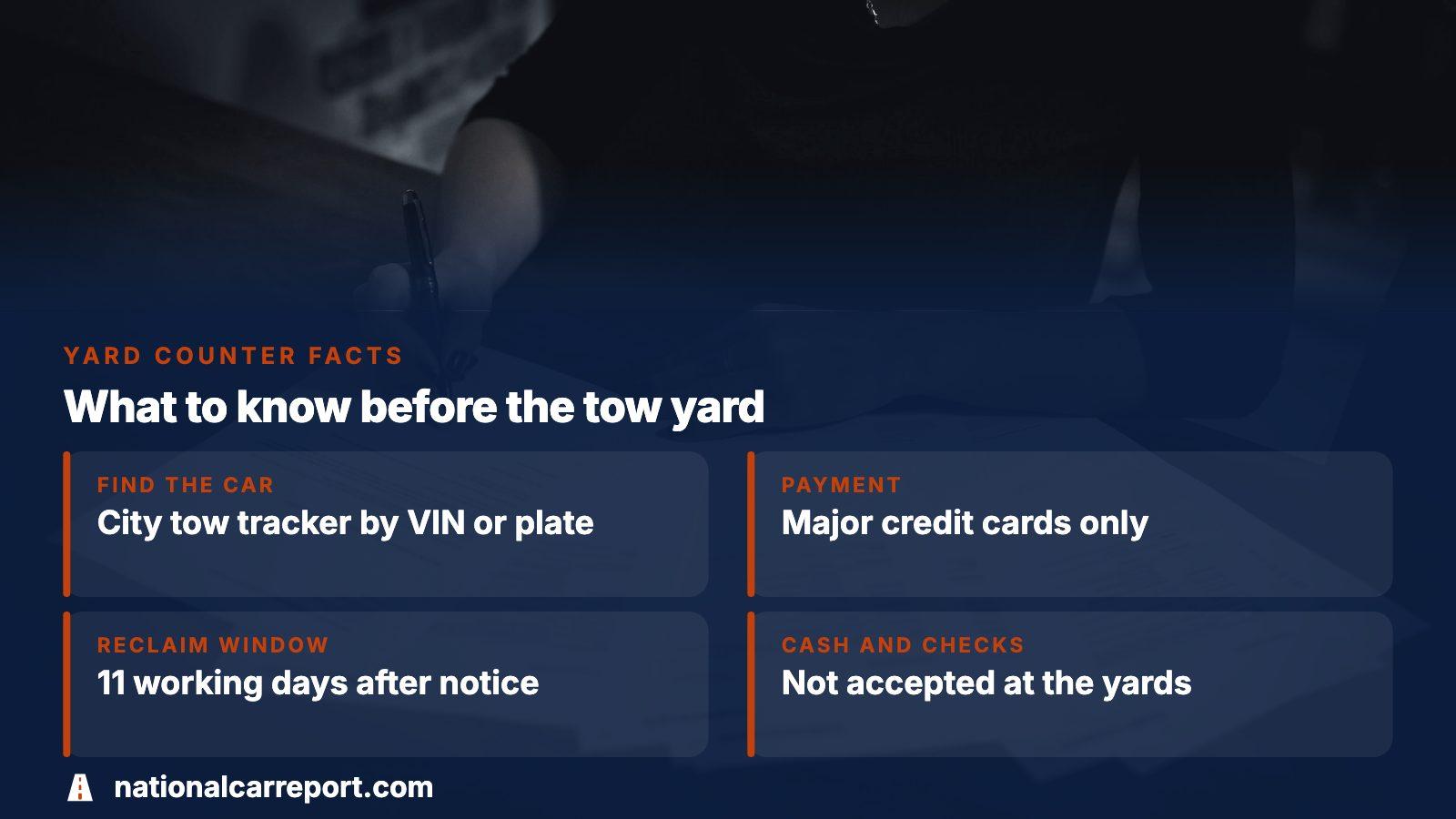
- Major credit cards only, no cash or checks
- Reclaim window
- 11 working days after notice is received
Search the city's tracker before you drive to a yard
Baltimore City's Towing Division asks owners to confirm a car's location before going anywhere. The tracker accepts a VIN, a license plate, or a Tow Reference ID. After a parade, race or street closure the car may sit in a temporary lot, so the search comes first.
| Yard | Address and phone | Retrieval hours |
|---|---|---|
| Pulaski Highway | 6700 Pulaski Highway, Baltimore, MD 21237; 410-396-9958 | 6 a.m. to 10 p.m., seven days; shut on City, State and Federal holidays |
| Fallsway | 410 Fallsway, Baltimore, MD 21202; 410-396-4639 | Around the clock, seven days; shut on City, State and Federal holidays |
Requirements differ between the yards, so the city advises phoning for a live operator first.
Papers each yard asks for
- Pulaski Highway, ownership: a current registration card, title, title receipt or registration receipt showing the registered owner's name.
- Pulaski Highway, identification: a driver's license, state ID or passport. With a temporary license or no current one, bring two substitutes from the city's list of five, such as a notarized birth certificate or a voter registration card.
- Fallsway: the city lists valid photo identification and nothing else, so call to learn whether more is needed.
A car that cannot be driven out must leave on a truck you arrange and pay for; a private towing company is allowed.
Signed-over titles are refused
Pulaski Highway turns away a title signed over by the previous owner. When buying a car that sits in a yard, the registered owner has to be the one who claims it.
How the release bill adds up
The city posts its rates as separate lines, and the yard totals them at the counter.
| Charge | Amount |
|---|---|
| Tow, east of Charles Street | $130 |
| Tow, west of Charles Street | $140 |
| Tow, vehicle with 6 to 9 wheels | $305 |
| Tow, vehicle with 10 or more wheels | $440 |
| Storage, each day after the first 2 | $15 |
| Storage, vehicle with 6 or more wheels, per day | $30 |
| Initial storage charge | $50 |
| Administrative fee | $40 |
Payment goes on a major credit card; the yards take neither cash nor checks. Unpaid parking and traffic tickets tied to the plate roll into the release payment. The city warns against paying them online or by phone while the car is impounded, because Towing's records lag a payment made elsewhere. Pay at the counter, where everything lands in one bill.
The 11-working-day clock and what an auction leaves behind
The city must mail a certified notice to the last registered owner and any secured party within 7 days of taking custody. From the day it arrives, the owner has 11 working days to reclaim the car. After that the law treats the owner as having surrendered every right and agreed to a public auction, and the city states there is no exception.
A sale does not close the account. If the auction price falls short, the last registered owner owes the difference, and state law limits the storage-and-preservation share to $300. The city adds that a flag fee may land on other tags in the owner's name and must be paid before the Motor Vehicle Administration lifts it. Listings appear on govdeals.com.
A lender gets the same letter
Any secured party is notified alongside the owner and loses its claim on the same terms. If a financed car vanished from the street, ask the lender whether a notice arrived.
Cars hauled from a private lot
A car missing from the search may have been taken from a private parking lot. Maryland makes the tower report such a tow to local police within 1 hour, so a record may exist even when the city's tracker shows nothing. The owner must also receive a certified and first-class mailing within 7 days, with no notice charge if the car is collected within 48 hours of reaching storage.
- The tower needs the lot owner's authorization, backed by photos of the violation.
- Missing registration display alone allows a tow only after 72 hours have passed since a violation notice was placed on the car.
- A lot tow is generally capped at twice the locality's public-safety impound towing charge, with storage following its daily rate. The state's $250 and $30-a-day figures are fallbacks where no local limit exists, so ask the tower for its rates in writing.
When no yard, lot or tow company has the car
If the tracker, the lot's signage and the tower all draw a blank, treat the car as possibly stolen. Baltimore Police take emergencies at 911 and run a Telephone Reporting Unit at 410-637-8875, open 7 a.m. to 10 p.m. daily, for crimes with no known suspect that did not just happen. The department's page names larceny categories but not stolen vehicles, so ask the operator which route fits a missing car. Keep the temporary case number, then use the Permanent Report Number issued after review for follow-ups.
Contesting a tow or claiming damage
The towing page describes no appeal process, so ask the Towing Division which rule covers your tow. City Code section 31-46 says an owner who claims a car impounded as abandoned within 48 hours of removal must be told in writing of the right to contest it before a hearing officer, with 10 days to apply. Paying the accrued charges neither waives the hearing nor admits the tow was authorized.
Damage inflicted in a city yard goes to the Law Department. A claim must arrive within one year of the incident, by hand or certified mail, at 100 N. Holliday Street, Suite 101, the Department's Central Bureau of Investigation. Regular mail does not count.
What a tow search cannot tell a buyer
A yard lookup says where a car is and what you owe. It is silent on what happened before the tow or after the release. The federal title database, NMVTIS, reports title brands, the last odometer figure, insurer salvage or total-loss rulings, transfers to salvage or junk yards, and sometimes theft. Its consumer page lists no impound or tow records. Coverage reaches 87 percent of the country's vehicles, only a little more than half the states feed it records, and the page concedes that a search may wrongly show no junk or salvage history.
- A seller who cannot say who paid the release bill or when the car left the yard.
- A lien or a title change appearing soon after a tow.
- A city auction purchase: the buyer gets a sales receipt and may apply for a salvage certificate or title, so ask which one the seller holds.
- A theft entry on a car the seller calls merely towed.
Run the VIN check before money changes hands
- Read the VIN stamped on the vehicle and compare it against the seller's title.
- Type it into NationalCarReport. Before paying anything you see which record types the VIN has on file.
- If the preview flags an impound, lien or theft entry, buy the report: one payment, with sets of three, five or ten for buyers weighing several vehicles. Amounts are on the pricing page.
- Call the agency named in the entry and ask for release paperwork.
No subscription follows. The report will not say which Baltimore yard holds a car right now, because that is the city tracker's job. It records history. Before cash changes hands, put the paper title beside the number stamped on the car.
Where this information comes from
- Baltimore City DOT: Towing Division — The tracker, both yards, retrieval papers, the fee list, card-only payment and the unclaimed-car timeline.
- Baltimore City Law Department: Claims — The one-year filing limit and where a damage claim must be delivered.
- Baltimore City Code 31-46: Reclaim by owner — The written notice of a hearing right and the 10-day window to apply.
- Maryland Transportation Article 25-206.1 — Who owes the shortfall after an auction and the limit on storage and preservation costs.
- Maryland Transportation Article 21-10A-04 — Notice, timing and default price ceilings for tows from private parking lots.
- Baltimore Police: File a police report — Emergency and non-emergency reporting, eligibility limits and the case-number steps.
- NMVTIS: for consumers — What the federal title system reports and where its coverage falls short.
Sources and photos: Facts checked against the sources above in November 2026. Photos by Nikolai Kolosov, Jakub Żerdzicki and Dimitri Karastelev on Unsplash; diagrams by NationalCarReport.
Keep reading
- Impound Lookup: Find a Towed Car, Then Check Its VIN for Impound RecordsWhy impound records live in local files, not one national search.
- Report a Stolen Car: Police Steps, Insurance and a VIN Theft CheckWhat to gather and who to call when the car is missing and not towed.
- Vehicle Lien Check by VIN: Nationwide Lien, Theft and Impound RecordsCatching a lender's claim that surfaces after a tow.
- Stolen Car Check by VIN: Nationwide Theft, Lien and Impound RecordsChecking a VIN for theft entries before you buy.
Frequently asked questions
How do I find my towed car in Baltimore?
Use the city's Autura tracker with the VIN, plate or Tow Reference ID. If it names a yard, phone first: Pulaski Highway at 410-396-9958 or Fallsway at 410-396-4639. No result can mean a private-lot tow or a theft.
Can I pay a Baltimore impound bill with cash or a check?
No. The city accepts major credit cards only. Unpaid parking or traffic tickets are added to the release payment, so settle them at the yard counter instead of online or by phone.
How long before Baltimore auctions an unclaimed car?
After the certified notice reaches the owner, 11 working days remain to reclaim the car. Once that passes, the law treats it as given up for public auction. Phone the Towing Division the day a letter arrives.
Can someone else collect my car for me?
The city's page asks the registered owner for identification at Pulaski Highway and does not say who else may collect at either yard. It lists a Towing Release Authorization Form without explaining it, so ask the yard before sending a friend.
Will a VIN check show Baltimore impound records?
A report can list impound, lien and theft entries recorded against a VIN, and the free preview shows which record types exist. It cannot locate the car, and the federal title database carries no impound records.
Now check the car itself
The guide explains what to look for. The report shows what this VIN has on record.