THE SHORT ANSWER
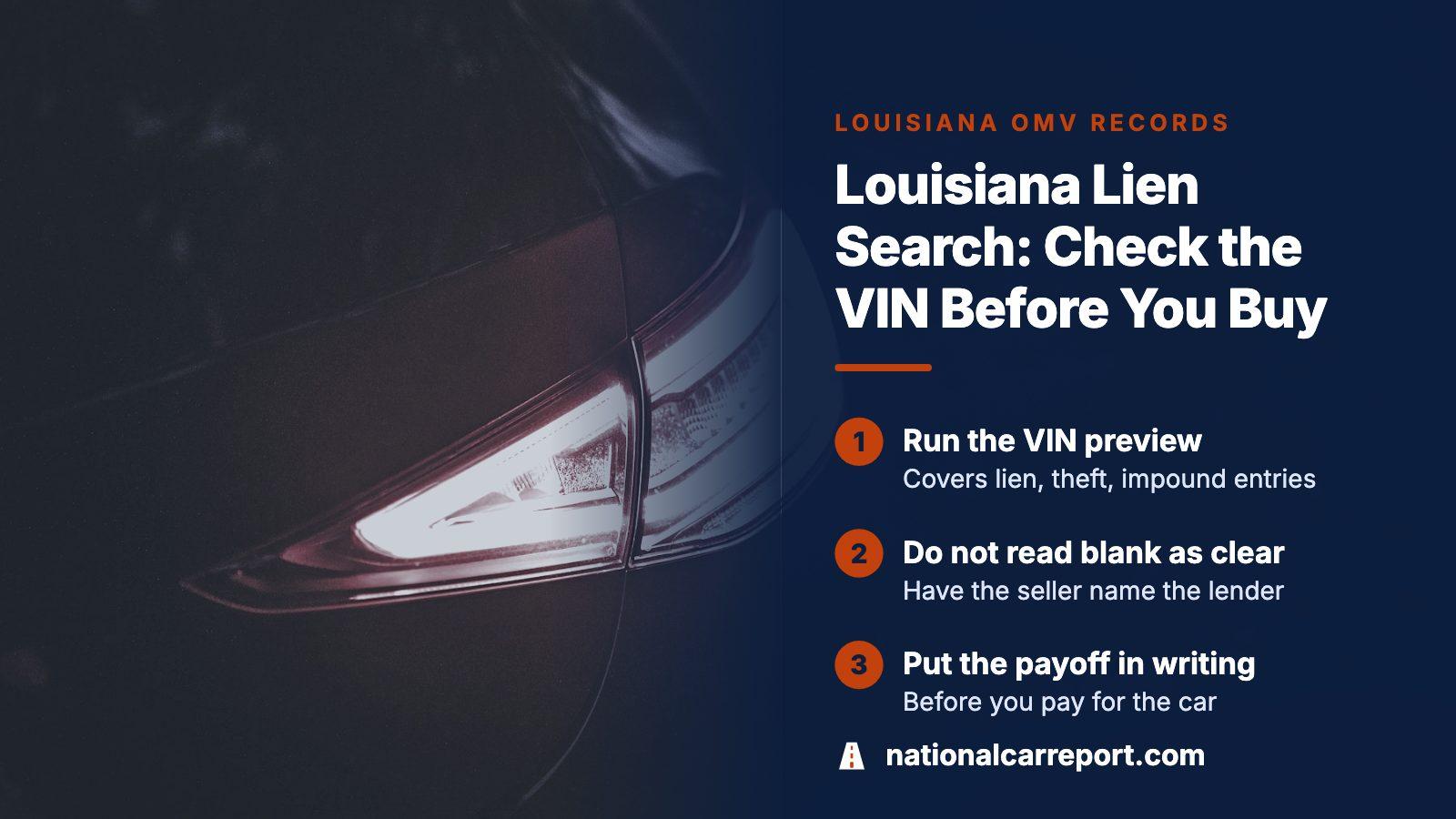
Copy the 17-character VIN off the Louisiana vehicle itself, then enter it in the free preview. The search covers lien, theft and impound entries filed against that number. If a lender shows up, assume the loan could be open. If nothing shows, that is not clearance: have the seller name the lender and put the payoff in writing before you pay.
- Search key
- The VIN, taken from the car itself
- Who records Louisiana liens
- The Office of Motor Vehicles (OMV), part of the Department of Public Safety
- Lender participation
- Electronic lien and title use has been mandatory for lenders since January 1, 2010
- State title history request
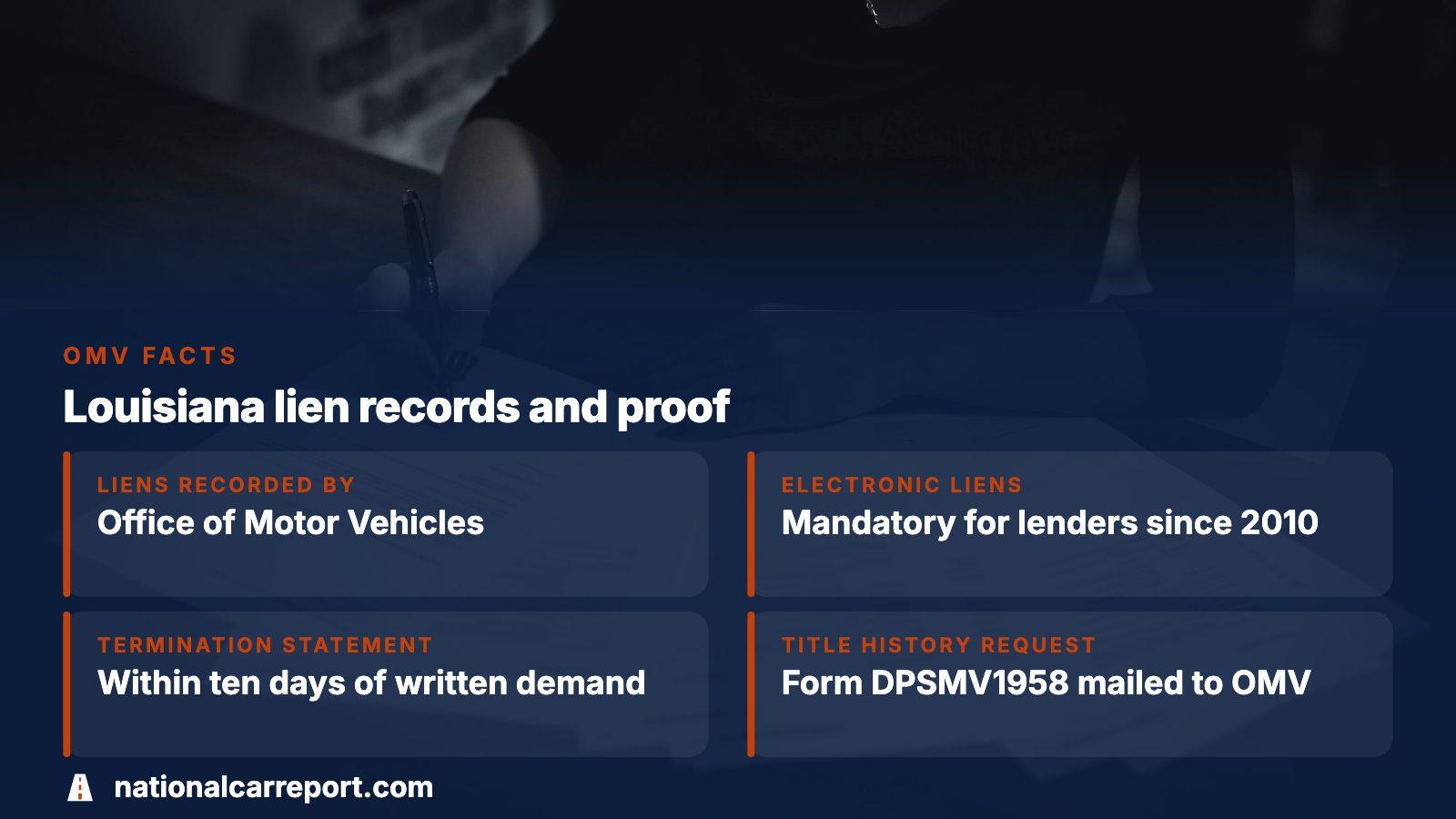
- Form DPSMV1958, mailed to OMV
What a VIN search can surface on a Louisiana car
Sellers rarely lie about a loan on purpose. More often a refinance moved the debt to a new lender and nobody mentioned it, or the seller assumes a title in the glovebox settles everything. Every record that matters is filed under the VIN, so that is where the check begins. Preview first. The paid report earns its cost only if the preview turns something up.
- Lien records, when a lender's claim reached a source the search reads
- Impound records, which show whether a tow yard held the car and sold it
- Theft records, including whether a stolen car was recovered
- Salvage or flood brands that cut the value, which matters in a state with a long hurricane history
How the OMV puts a lender on the record
The OMV treats a lien as a filing, submitted with the titling papers, that shows a creditor's interest in the vehicle. If a bill of sale or invoice points to financing, the file has to include a lien instrument. Three types are accepted: a UCC-1 financing statement, a UCC-3 that amends or ends an earlier one, and a plain security agreement. Each must name the lender, the borrower and the car, down to the VIN.
The VIN works as the key because the lender's claim lives in a document built around the vehicle description. State policy asks for year, make, model, body style and VIN on every instrument.
What the state charges a lender to record a lien
Louisiana's lien policy lists $15.00 for a UCC instrument and $10.00 for any other lien document. The $10.00 includes a $5.00 cancellation fee collected up front, so the lender owes nothing further at release. These are state-to-lender fees, not charges to a car buyer.
Four moves to search a Louisiana car
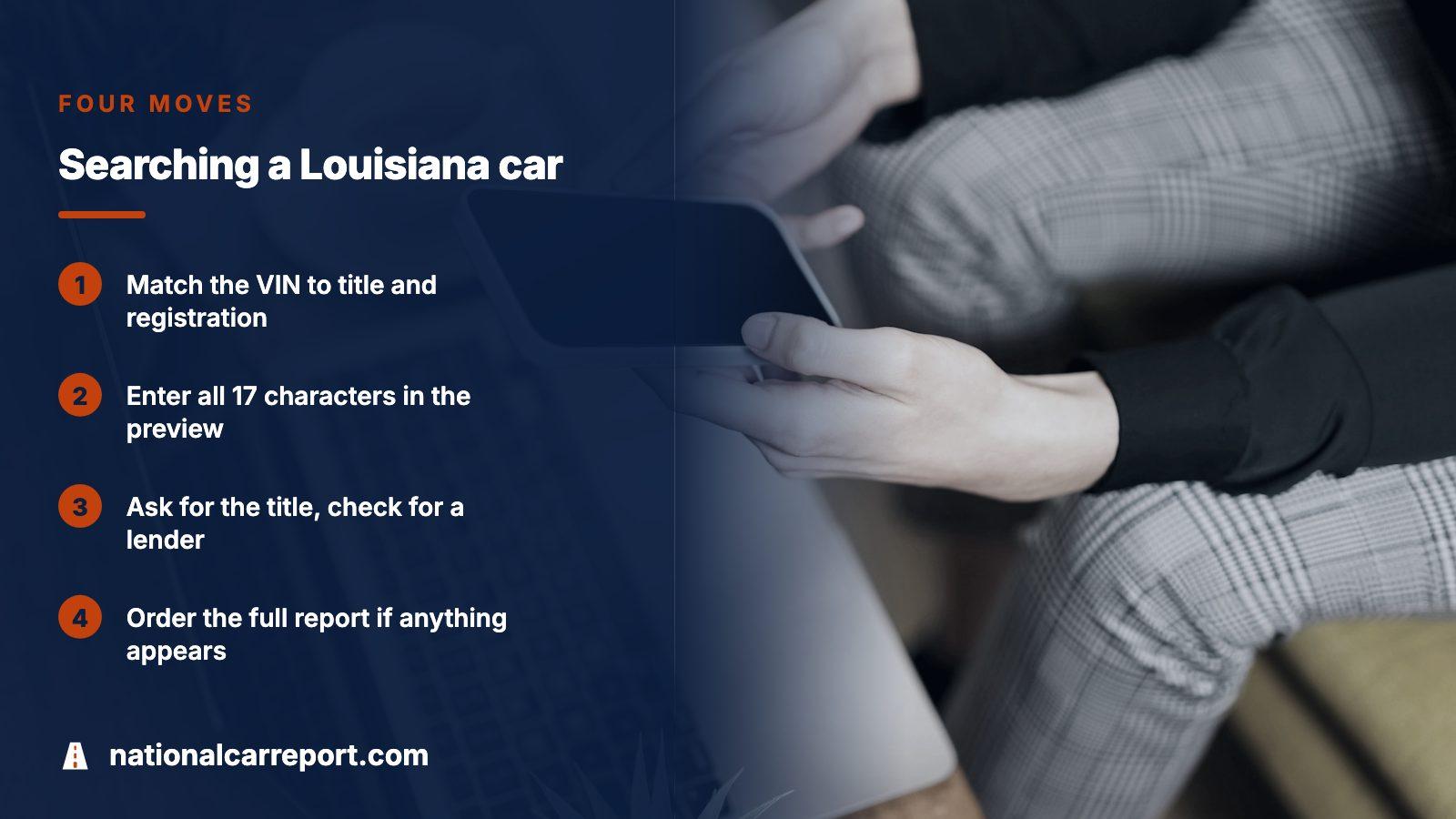
- Once you have the VIN, check that it agrees with what the title and registration say. If the two disagree, nothing else matters until the seller explains.
- Enter all 17 characters in the preview and go through each entry it returns.
- Ask to see the title. A lender's name printed on it, or no paper title at all, calls for payoff figures.
- If something appears, or the seller's account wobbles, order the full report before paying.
When no paper title exists
Louisiana lenders record liens electronically. State law has made the electronic lien and title program mandatory for them since January 1, 2010, and a lender joins through a participating public tag agent. A lien recorded this way produces no paper title. Title data flows overnight to the agent, who passes it along to the lender.
For a buyer, that means a seller without a title in hand may be telling the truth. The record can sit in the lender's system until payoff. At payoff the lender messages its agent, the lien lifts, and a clean paper title goes out by mail. Until then the seller has nothing clean to sign over, whatever the bank statement says.
Making sense of a Louisiana result
| What appears | What it usually means | What to do next |
|---|---|---|
| A lender is named | A loan may still be open | Get a payoff letter dated near the sale |
| Impound entry, car sold at the yard | The earlier owner may not have chosen to sell | Ask for the paperwork behind the ownership change |
| Theft entry, no recovery noted | The car may still count as stolen | Pause until a written clearance exists |
| Salvage or flood brand | A total loss or water damage happened | Price it as branded and inspect the wiring |
| Nothing at all | No record was found, which is not proof of no loan | Ask about financing anyway |
Cars that come from another state
Some states let the lender keep the title until the loan is paid. Louisiana calls a car registered under that arrangement a foreign title held by the lienholder. New residents have 30 days to register, and the OMV will take proof such as a non-negotiable copy of the other state's title, a registration listing owner and lien, a statement from the issuing state's titling office, or a validated title application.
If you are buying one of these, the seller likely has no paper title to sign over. The route to a clean title runs through the lender in the other state. Get the lender's name, call it yourself, and keep the payoff figure in writing. A VIN search earns its keep here, since the claim may sit in whichever state last issued a title.
What the OMV accepts as proof of payoff
Phone calls and screenshots do not count. For a lost title, or a lien never released on the title, the OMV takes a lender's satisfaction of lien stating the debt on the last title record is paid in full. It needs the lender's name, address and phone plus the make, year, model and VIN, and it must be on letterhead or notarized. A returned loan note stamped paid, with a lender representative's signature, is also taken.
- If the lender was bought by another institution, a statement from the new owner confirms the purchase
- If the lender closed, the OMV points owners to the controlling institution, and failed-bank records go to the FDIC
- A lender must file a termination statement (form DPSMV 1901) within ten days of the borrower's written demand
- Once a termination statement is on file, the OMV sets an LT flag, so the next title transaction does not need a separate satisfaction
Getting the state's own title history
A VIN search is a screen, not a legal opinion. For an expensive car, or when the preview shows a lender, you can ask the OMV for the state record using form DPSMV1958, the Title History Request Form. It asks for the VIN and a reason, and you choose the scope: the most recent title transaction, the two most recent, or every document on file, certified or plain. Mail it with a check or money order to the OMV's document unit in Baton Rouge. The form states $10.00 per vehicle, with certified copies costing extra by the page.
The mail route is slow, so keep it for high-value purchases. The federal title database will not substitute: its consumer page lists brand history, odometer readings and some theft data, with no mention of liens.
Cost and next move
The preview costs nothing and asks only for the VIN. If it flags a lender or another problem, the complete report costs a single fee for one vehicle and never turns into a subscription. Multi-car packs and today's rates are listed on the pricing page.
Whatever the screen says, do not pay on a handshake. Hold out for the lender's name, a payoff letter with a recent date, and either a clean title or a pending electronic release. A seller who cannot supply any of those can wait.
Where this information comes from
- Louisiana OMV: Recording Liens on Vehicles (Policy 35.00) — Lien definition, accepted instruments and recording fees.
- Louisiana OMV: Acceptable Proof of Lien Cancellation (Policy 35.01) — What counts as written proof of payoff.
- Louisiana OMV: Lien Termination Statements (Policy 35.02) — Termination statement timing and the LT flag.
- Louisiana OMV: Electronic Lien and Title — How paperless lien recording works and who must use it.
- Louisiana OMV: Foreign Title Held by Lienholder (Policy 16.00) — Registering a financed car titled in another state.
- Louisiana OMV: Title History Request Form — The state's route to a title record by VIN.
- U.S. Department of Justice: NMVTIS consumer information — What the federal title system covers and its limits.
Sources and photos: Facts checked against the sources above in November 2026. Photos by Maurice Sahl, Jakub Żerdzicki and Dimitri Karastelev on Unsplash; diagrams by NationalCarReport.
Keep reading
- Vehicle Lien Check by VIN: Nationwide Lien, Theft and Impound RecordsThe same search for a car from any state.
- DMV Lien Release Search: How to Confirm a Lien Is GoneHow to tell whether a lender has really let go.
- Car Lien Holder Search: How to Find the Lender Behind a VINFinding the lender behind a claim so you know whom to call.
- Electronic Lien and Title (ELT): What a Car Buyer Should KnowMore on titles that exist only as a record in the system.
Frequently asked questions
How do I do a Louisiana lien search?
Pull the VIN from the car, run the preview, and read what it returns on liens, theft and impounds. Then ask the seller who financed it. The OMV records the lien and only the lender can release it, so a written statement from that lender is the last word on whether anything is owed.
Can I check a Louisiana car lien with only a license plate?
Not here. Lien documents describe the car by VIN, so the VIN is what the search needs. With only a plate in hand, look for the VIN on the dash or in the paperwork, and search that number.
The seller says the title is electronic. Is that real?
It may well be. Louisiana lenders record liens electronically, and no paper title is printed. It also suggests the loan is open. Ask for the lender's name and a dated payoff figure, and hold the sale until the lender confirms a release is on its way.
Does a blank result mean the car has no lien?
No. Blank means nothing was found, not that no loan exists. A lender may have filed recently or in another state. Weigh the result against the seller's title, a call to any lender named, and a state title history request if the price justifies the wait.
What proves a Louisiana lien has been paid off?
The OMV accepts a lender's satisfaction of lien, on letterhead or notarized, naming the car by make, year, model and VIN. So does the borrower's loan note if it comes back stamped paid with a lender's signature. A verbal promise or a seller's own receipt is not the same thing.
Now check the car itself
The guide explains what to look for. The report shows what this VIN has on record.