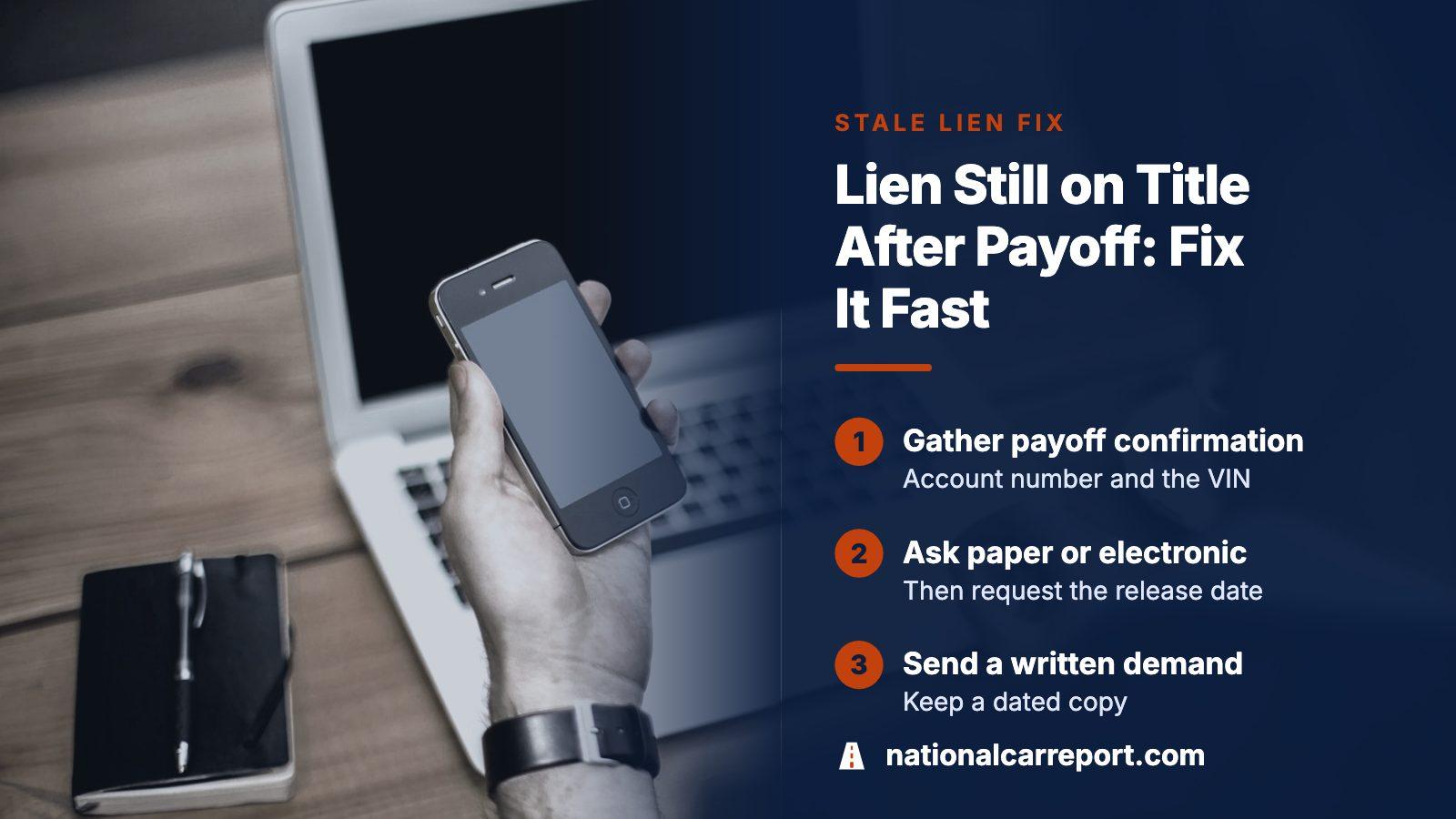
THE SHORT ANSWER
Paying off a loan does not erase the lien by itself. The lender must send a release to the state, either on the paper title or through an electronic record. Deadlines are state rules: Texas gives lenders 10 days after payment, and Washington sets a $100 penalty after a 10-day demand. If nothing arrives, demand the release in writing.
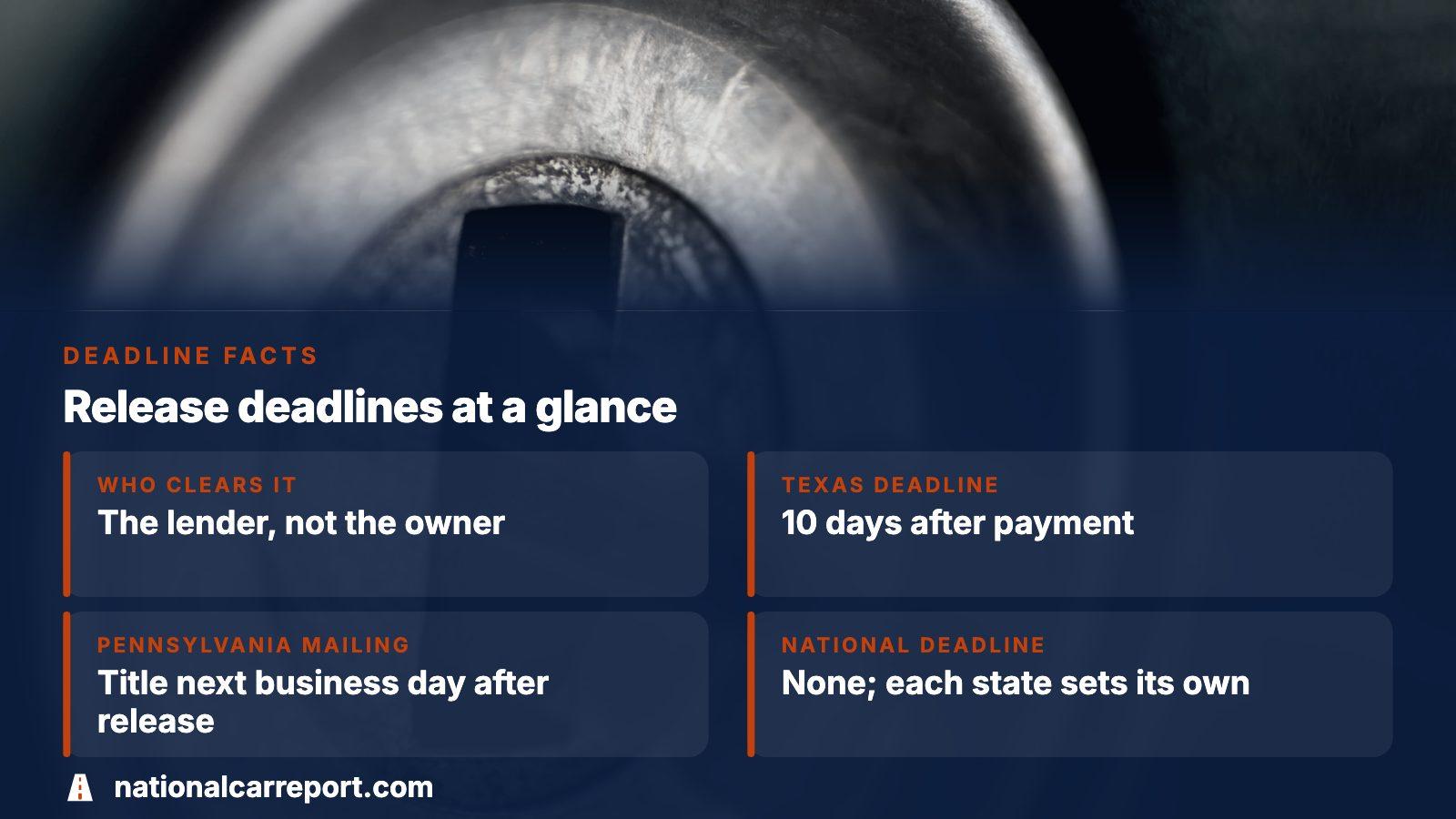
- Who clears it
- The lender, not the owner
- Texas lender deadline
- 10 days after payment
- Pennsylvania title mailing
- Next business day after release
- No national deadline
- Each state sets its own
Why the lender still shows after the last payment
A title is a state record, and the lender's name sits on it as a security interest. The state cannot drop that name on your say-so. Only the party named can release it, so the last payment starts a clerical task on the lender's side: sign off the paper title, or send an electronic release. When that task stalls, the record keeps showing a debt that no longer exists.
The delay is rarely dramatic. A loan that was sold to another servicer, a lender that merged or changed its name, and a payoff that went through a dealer all leave the release waiting in somebody's queue. None of it means you still owe money. It does mean the record is wrong until the release lands.
First find out which kind of lien record you have
States split into paper-title and electronic-title handling, and the fix depends on which one holds your car. Texas describes both on its lien page. With a paper title the lender mails the title to you. With an electronic lien the state keeps the record, the lender coordinates the removal and tells you when it is done, and you do nothing.
| Record type | What the lender does | What you should receive |
|---|---|---|
| Paper title with lien | Signs off the lien and mails the title | The title itself, with the release |
| Electronic lien | Sends an electronic release to the state | Notice of removal, then a paper title |
| Dealer paid off a trade-in | Releases the lien to the dealer | Nothing; the title goes to the dealer |
If you cannot tell which you have, call the lender and ask whether it holds your title or reports electronically. The answer decides whether you are waiting on the mail or on a state processing step.
The deadlines we could read, and the ones we could not
No federal clock forces a lender to act. Each state decides, and many state pages do not state a number at all. Three official sources gave us timing.
- Texas: the lienholder has 10 days after receiving your payment to release the lien.
- Washington: the statute orders a release once nothing more is owed, and it makes the lender liable for $100 if it fails to act within ten days of a proper demand and you lose out because of it.
- Pennsylvania: for electronic liens the lender must release immediately on payoff, and the state prints and mails the paper title the next business day.
California's title page gives owners a 10-day window to report a new owner or lienholder to DMV, but it names no deadline for a lender after payoff. For other states, check the motor vehicle agency's own title page, because we would rather leave a number out than guess one.
How to demand the release without losing time
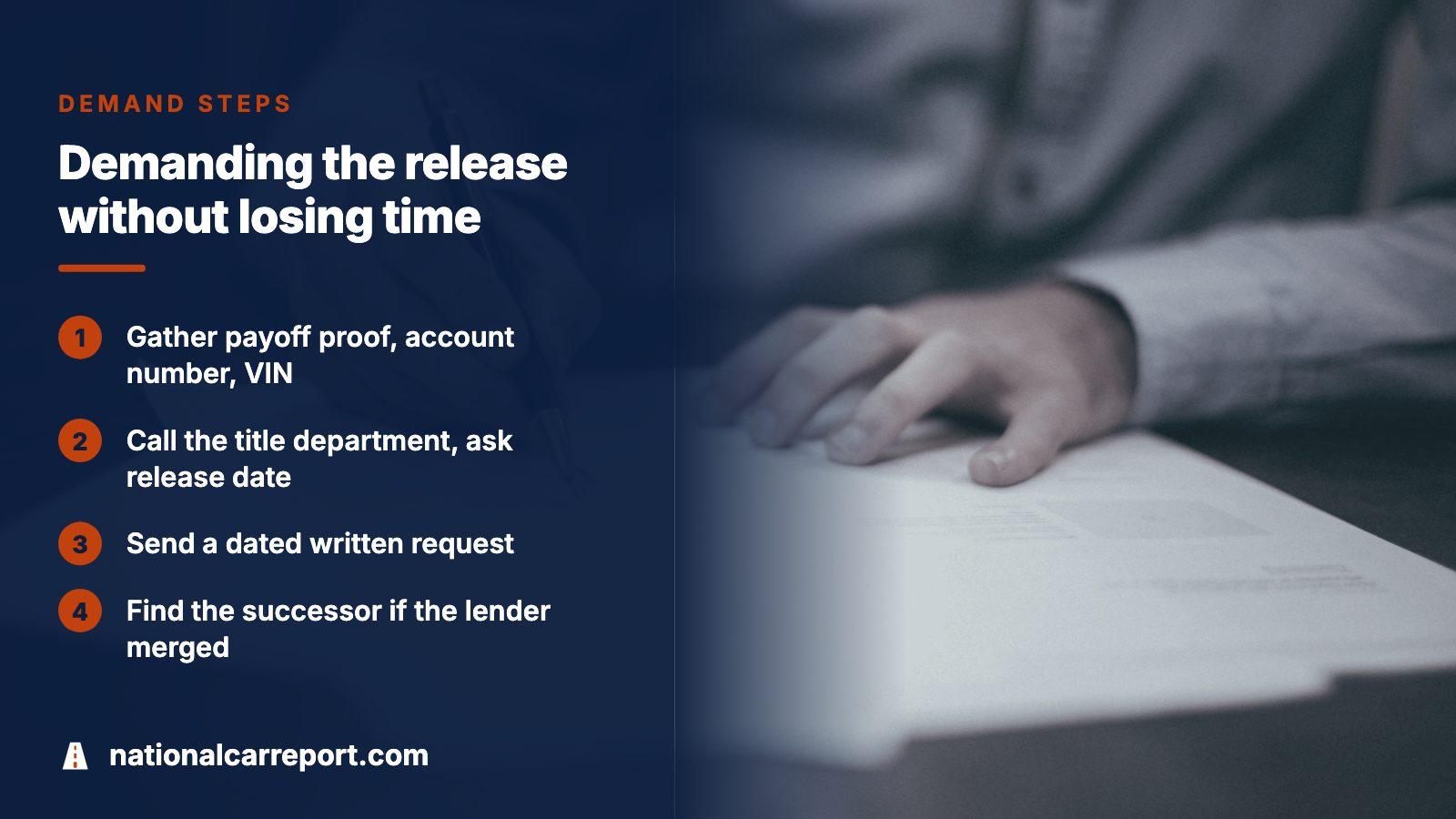
- Gather the payoff confirmation, the loan account number and the VIN.
- Call the lender's title department and ask for the release date and the method used, paper or electronic.
- Follow with a written request that names the car, the payoff date and what you want, then keep a dated copy.
- If the lender has merged or been renamed, find its successor. California DMV publishes a list of lenders that closed, merged, changed names or were acquired.
- Once the release is in hand, take it to the state agency if your state requires you to apply for the clear title.
Why the written demand matters
In Washington the lender's $100 liability depends on a proper demand and a ten-day silence. A dated letter is how you start that clock anywhere, even where the state has not set one.
When the title is lost or the release never reached you
Plenty of owners discover the problem only when they go to sell. At that point two things can be true: the lender did release the lien and you lost the paper, or the release was never filed. The state agency can tell you which.
Texas spells out the lost-title case. If the old lien is still on record, you need the lender's original release letter, and a fax or photocopy will not do. The replacement application is Form VTR-34, which every recorded owner signs. It runs $2 mailed or $5.45 at a counter, and you wait 30 days after any earlier certified copy. Pennsylvania's counter will issue a duplicate title without the lien if the lender filed Form MV-38O or a notarized statement on company letterhead. The fee is waived when an electronic release is on file and the title has not reached you ten days later.
Selling or trading while the record is stale
A buyer who runs a lien check will see the lender, whatever your loan balance says. That can stall a private sale, and dealers will ask for the release before they cut a check. Do not offer to hold the deal open on a promise. Get the release first, or at minimum show the buyer the lender's written confirmation and let a bank or the state handle the final transfer.
California shows how a payoff and sale fit together: for a private sale or loan payoff, the seller or lienholder signs the title and the buyer submits it to DMV. Whatever your state, a sale that closes without the lender's release attached tends to end up as the buyer's problem, and then as yours.
Checking that the lien is really gone before you act
The federal title database does not settle this alone. Under the Justice Department rule, states send the VIN, any brands, the name of the titled owner, salvage purchase data and odometer readings. A lender's name is not on that list, so the national title report is not the place to prove a payoff.
NationalCarReport's preview is where a nationwide VIN check helps on this page: it shows whether any lien, theft or impound record is attached to the car across states, so you see what a buyer or dealer will see before they do. Treat it as a screening step and match it against your state's own record. The preview is free, and the full report is a single payment; see the pricing page.
Where this information comes from
- TxDMV: Removing a lien — Texas 10-day release rule, paper and electronic lien handling
- TxDMV: Replacing a lost title — Lost-title rules when a paid-off lien is still recorded
- PennDOT: Mandatory electronic lien and titling FAQs — Electronic release, next-business-day title and duplicate title paths
- California DMV: Title transfers and changes — Lienholder reporting and the list of renamed or closed lenders
- Washington Legislature: RCW 46.12.675 — Duty to release and the $100 liability after demand
- GovInfo: 28 CFR 25.54 — What states report to the national title system
Sources and photos: Facts checked against the sources above in November 2026. Photos by Alejandro Escamilla, Scott Graham and Derek Nelson on Unsplash; diagrams by NationalCarReport.
Keep reading
- How to Remove a Lien From a Car Title After PayoffThe step-by-step fix once you hold the release.
- Car Lien Release Letter: What It Is and How to Get OneWhat the lender's release letter is and what to ask it to say.
- Car Lien Holder Search: How to Find the Lender Behind a VINFind who is named on the title when the lender has changed.
- Vehicle Lien Check by VIN: Nationwide Lien, Theft and Impound RecordsScreen any VIN for reported liens before you buy or sell.
Frequently asked questions
How long does a lender have to release a lien after I pay off my car?
It depends on the state, and no federal deadline exists. Texas gives the lienholder 10 days after it receives payment. Pennsylvania requires an immediate electronic release. Washington's statute sets no payoff clock but adds $100 liability after a ten-day demand. Check your own motor vehicle agency.
Do I have to do anything if the lien is electronic?
Usually not. In Texas the lender coordinates the removal with the state and notifies you, and the state then converts the record to a paper title. If weeks pass with no notice, call the lender and ask for the release date, then confirm with the state.
Can I sell the car while the lender still shows on the title?
You can try, but buyers and dealers will see the lien and usually insist on a release first. Get the lender's written release or have the lender sign the title, because a sale closed without it can unwind or leave the buyer with a title they cannot transfer.
What if the lender went out of business or was bought?
Find the successor institution. California DMV, for one, keeps a published list of lenders that closed, merged, changed names or were acquired, which helps trace who now holds the record. Then send your demand to that successor with the payoff proof.
Will a VIN check show that my lien was released?
Not reliably. A VIN check shows liens that were reported, and the national title data does not list a lender's name. Use the report to see what a buyer sees, then confirm the release itself with the lender and your state agency.
Now check the car itself
The guide explains what to look for. The report shows what this VIN has on record.