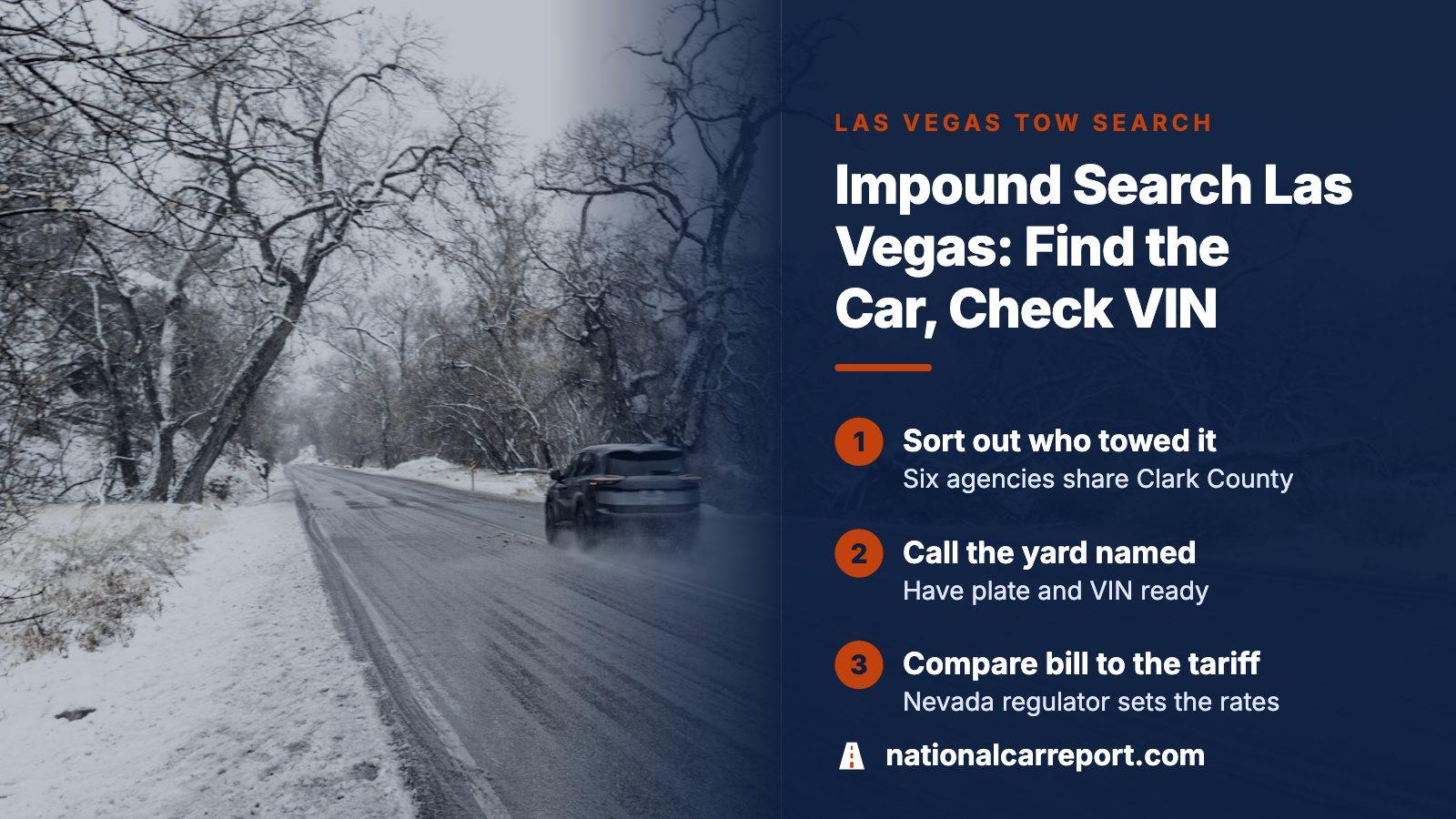
THE SHORT ANSWER
Sort the tow first. A crash or traffic stop brings in Las Vegas Metropolitan Police or another Clark County agency, while a lot owner's order sends the car to the company named on the sign. Call that yard with the plate and VIN. A VIN check does a different job: it reads one car's recorded impound, lien and theft history and cannot tell you which lot holds it today.
- Tow regulator
- Nevada Transportation Authority, Las Vegas office 702-486-3303
- Police agencies
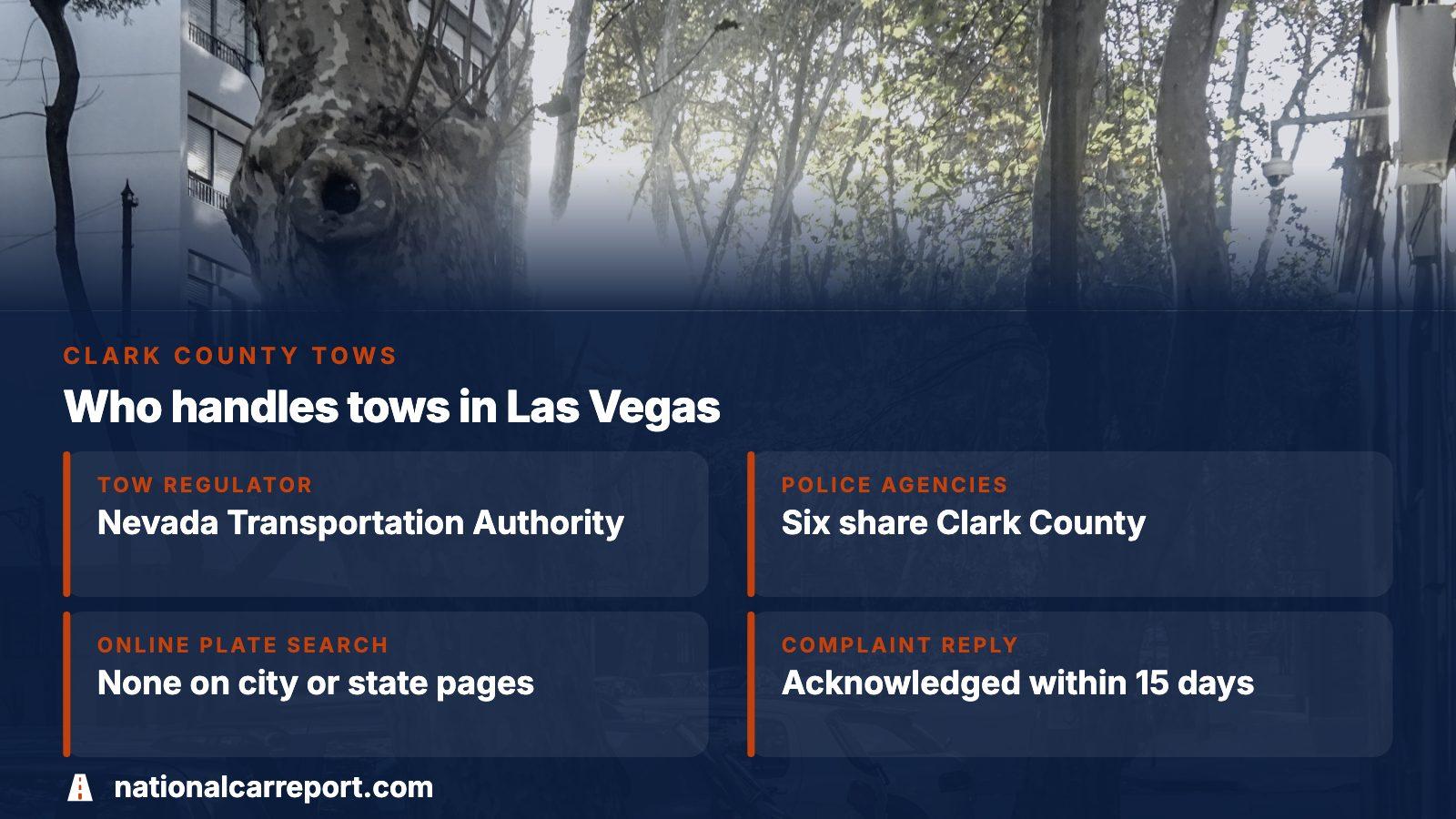
- Six share Clark County, led by Las Vegas Metropolitan Police
- Online plate search
- None on the city parking or state tow pages
- VIN check
- Reads recorded impound, lien and theft entries
Sort the tow before you call anyone
Whoever gave the order decides where the car went, and a call to the wrong office burns an hour. Most Las Vegas tows fall into one of three situations.
| What happened | Who ordered the tow | Where to ask first |
|---|---|---|
| Stopped, arrested or wrecked on a public road | A law enforcement agency | The agency whose officer was at the scene |
| Parked in a lot or garage that forbids it | The property owner or manager | The company on the posted sign, or the property office |
| Reported stolen, then found | Police, often with an insurer involved | The police report number, then the insurer |
Police tows: six agencies share the county
Nevada's storage-lot statute for cars that police direct to a lot, NRS 706.4489, applies to Clark County alone and names six agencies: Las Vegas Metropolitan Police, which covers both the city and the county, plus Nevada Highway Patrol and the police departments of North Las Vegas, Henderson, Boulder City and Mesquite.
Which one took your car depends on where it was stopped. Phone that agency with your plate, your VIN and the last place you saw the car, and ask whether it runs an online lookup of its own.
Insurer-designated lots
The state regulator posts a list that pairs insurers and rental companies with a designated storage lot. Its June 2025 update shows two Las Vegas addresses: 4810 Lamb Boulevard (89115) for most insurers and 1200 A Street (89106) for AAA Nevada and several rental brands. If your insurer already has a claim open, a call to it can confirm whether either lot applies to your car.
Private-lot tows and the state regulator
Towing a car without its owner's agreement is called non-consent towing, and the Nevada Transportation Authority regulates tow companies in Nevada. Each carrier files a tariff with the authority, and the authority's site posts those tariffs company by company.
That makes the sign in the lot, or the name on your invoice, a useful lead. Find the company on the authority's list, open its tariff and read the rates it filed. Some entries carry flags such as discontinued service or pending revocation, which deserve a second look before you pay.
Calling the yard: what to have in hand
- The plate number and the VIN. A registration card or insurance card prints the VIN if the car itself is out of reach.
- Year, make, color and model, in case the yard files by description.
- The police report number, if an officer was involved.
- Ownership papers: registration, title or an insurance card with your name on it.
No city or state page reviewed for this guide sets a document list, release hours or accepted payment for Las Vegas yards. Each yard decides, so ask before you drive over. Ask for the total in writing, and whether storage is still adding up by the day.
Reading the bill against the tariff
The authority's model tow tariff has companies itemize every charge, and its template asks for written support on each one, attached to the bill. One posted tariff, from a carrier in Laughlin, shows the kinds of lines to look for.
- An administrative fee on tows ordered by law enforcement.
- Hookup by truck class, with separate day and night columns.
- An after-hours charge.
- A lien fee once the car has sat past a set number of hours or business days.
- Daily storage, with separate lines for evidence, secured, unsecured, inside and oversize holds.
- A cut to storage for a stolen car released within 5 days of recovery.
Rates differ from carrier to carrier, so treat that list as a layout, not a price guide. A charge you cannot match to a line in the company's own tariff is the one to question.
Disputing a tow or a bill
Complaints about a tow company go to the Nevada Transportation Authority on its tow form. Sign and date it, attach receipts, invoices or photos, and deliver it to the Las Vegas office at 3300 W. Sahara Avenue, Suite 200 (89102), or submit it online and email the supporting papers. A form that is unsigned, incomplete or hard to read cannot be processed.
- Within 15 days, an investigator acknowledges the complaint.
- Inside 20 days of receiving the complaint, the company gets a copy.
- The company then gets up to 15 days to reply.
- Both sides then hear what the investigation found.
The Las Vegas office answers at 702-486-3303. None of the pages reviewed here describe a court hearing for Las Vegas tows, so if your tow notice mentions one, follow the deadline printed on it.
When no yard has the car
If the police and the tow companies come up empty and no sign marked a private tow, treat the car as stolen. The authority's tips sheet for owners, revised in 2008 and so a little dated, lists what a police report needs: year, make, color, model, plate and VIN, photos, copies of the registration and insurance, a list of what was inside, and phone numbers where you can be reached.
It adds three habits worth keeping. Tell the agency at once if your address or phone changes, since a car whose owner cannot be reached may be sold. Contact your insurer and the DMV too, since most of them keep stolen and recovered lists. And ask tow companies whether they take police tows, then hand them a copy of the report.
Buying a car that sat in an impound lot
A tow bill shows what the car cost to retrieve, not what its record says. A car that cleared an impound lot can still carry theft, lien or salvage entries that a seller never mentions.
Why the federal title screen falls short
NMVTIS, the Justice Department's title database, reports brand history, the latest mileage on record, insurer salvage or total-loss rulings and hand-offs to junk or salvage yards. Its consumer page says nothing about impound or tow records, and it admits a search can miss history because some entities do not report. The system holds about 87 percent of vehicles nationwide, and over half the states contribute.
- When was the car released, and who paid the tow and storage bill?
- Did a lender or an insurer step in soon after?
- Does the VIN stamped on the car match the title and the report?
Running the VIN check
- Photograph the VIN stamped on the car, then match it against the title or registration.
- Enter it at NationalCarReport, and the preview lists which kinds of records are held against it.
- If the preview flags impound, lien or theft entries, the full report is bought in one go. Sets of 3, 5 or 10 come as bundles for anyone sizing up several vehicles.
- Call any agency an entry names and ask for the release paperwork.
The preview itself is free; the report behind it is paid once, with nothing recurring. What it costs is listed on the pricing page. An impound with no release story, a lien that appears right after it, or a theft record on a car you mean to buy are reasons to walk away. A clean result still leaves the stamped VIN and the title to inspect in person.

Where this information comes from
- City of Las Vegas: Parking — Shows the city's parking pages cover tickets and permits, with no tow lookup.
- Nevada Transportation Authority: File a complaint — Tow complaint steps, office address, phone and investigation timeline.
- Nevada Transportation Authority: sample posted tow tariff — One carrier's tariff in the model format, used to show typical bill lines.
- Nevada Transportation Authority: designated vehicle storage lots — The June 2025 list pairing insurers and rental companies with Las Vegas lots.
- Nevada Transportation Authority: Clark County law enforcement master acceptance — Names the six agencies covered by the Clark County storage-lot statute.
- Nevada Transportation Authority: Recovering your stolen vehicle — Owner tips for a stolen-vehicle report and for tow companies; revised in 2008.
- NMVTIS: for consumers — What the federal title system covers, its coverage figures and its limits.
Sources and photos: Facts checked against the sources above in November 2026. Photos by Zoshua Colah, Alejandro Escamilla and Nikolai Kolosov on Unsplash; diagrams by NationalCarReport.
Keep reading
- Impound Lookup: Find a Towed Car, Then Check Its VIN for Impound RecordsThe national picture: why impound records sit in local files, not one database.
- Report a Stolen Car: Police Steps, Insurance and a VIN Theft CheckWhat to do when neither an agency nor a yard has your car.
- Nevada Title Check: What the DMV Won't Release and What to Run InsteadThe title side of a Nevada purchase, once the tow question is settled.
- Theft Recovery Vehicle: Stolen, Lien and Impound Checks Before You BuyWeighing a car that was stolen, recovered and put back on sale.
Frequently asked questions
How do I find out if my car was towed in Las Vegas?
Work out who ordered the tow. After a crash or traffic stop, call the agency whose officer was there; Las Vegas Metropolitan Police covers the city and county. For a lot, call the company on the posted sign. Have the plate, VIN and vehicle description ready when you phone.
Is there an online impound search in Las Vegas by plate or VIN?
The city's parking pages and the state tow regulator's pages offer none. The city's ticket portal looks up parking citations by ticket number plus plate or VIN, which is not a tow lookup. Agencies and tow companies may run tools of their own, so ask when you call.
Who regulates Las Vegas tow companies?
The Nevada Transportation Authority regulates tow cars, which it also calls non-consent towing. Its Las Vegas office is at 3300 W. Sahara Avenue, Suite 200, phone 702-486-3303. It posts each carrier's tariff and takes tow complaints on a signed form.
Does a VIN check show impounds?
NationalCarReport's full report lists impound entries where records exist, beside liens and theft records. The federal NMVTIS title system's consumer page is silent on impound and tow records. No check shows where a car is parked today, so call the yard or agency for that.
How much does the VIN report cost?
Entering a VIN brings up a free preview of which record types exist. Buying the full report is one transaction with nothing recurring, and a bundle of 3, 5 or 10 exists for people comparing vehicles. The pricing page has the current amounts.
Now check the car itself
The guide explains what to look for. The report shows what this VIN has on record.