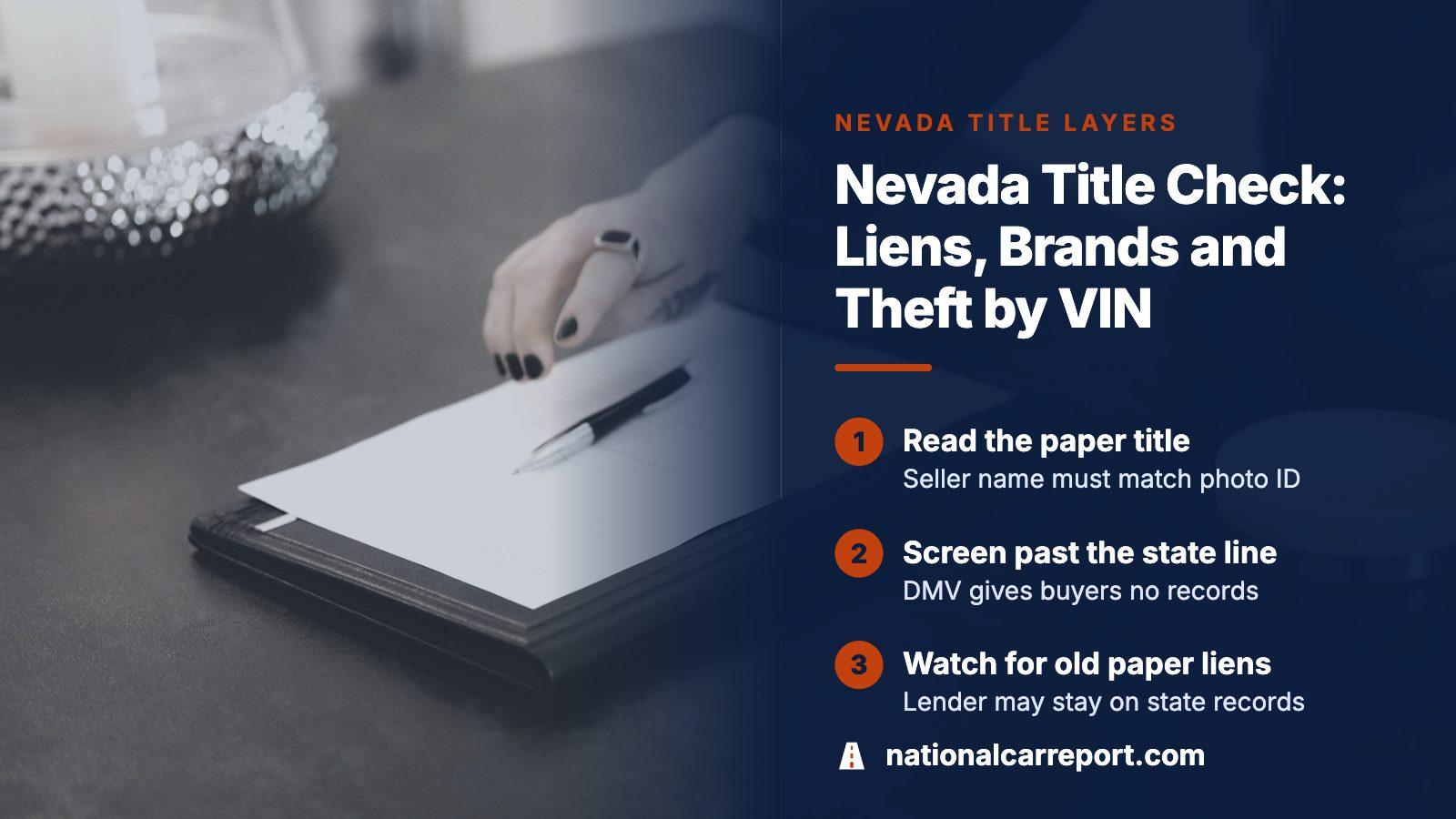
THE SHORT ANSWER
Nevada's DMV gives buyers no vehicle records, so check in two layers. First, read the paper title: the seller's name must match their photo ID, the brand and odometer lines must be filled in, and every lender must be released. Second, run the VIN through national screens for theft, salvage, flood, liens and impounds. Walk away from any seller without a title in their own name.
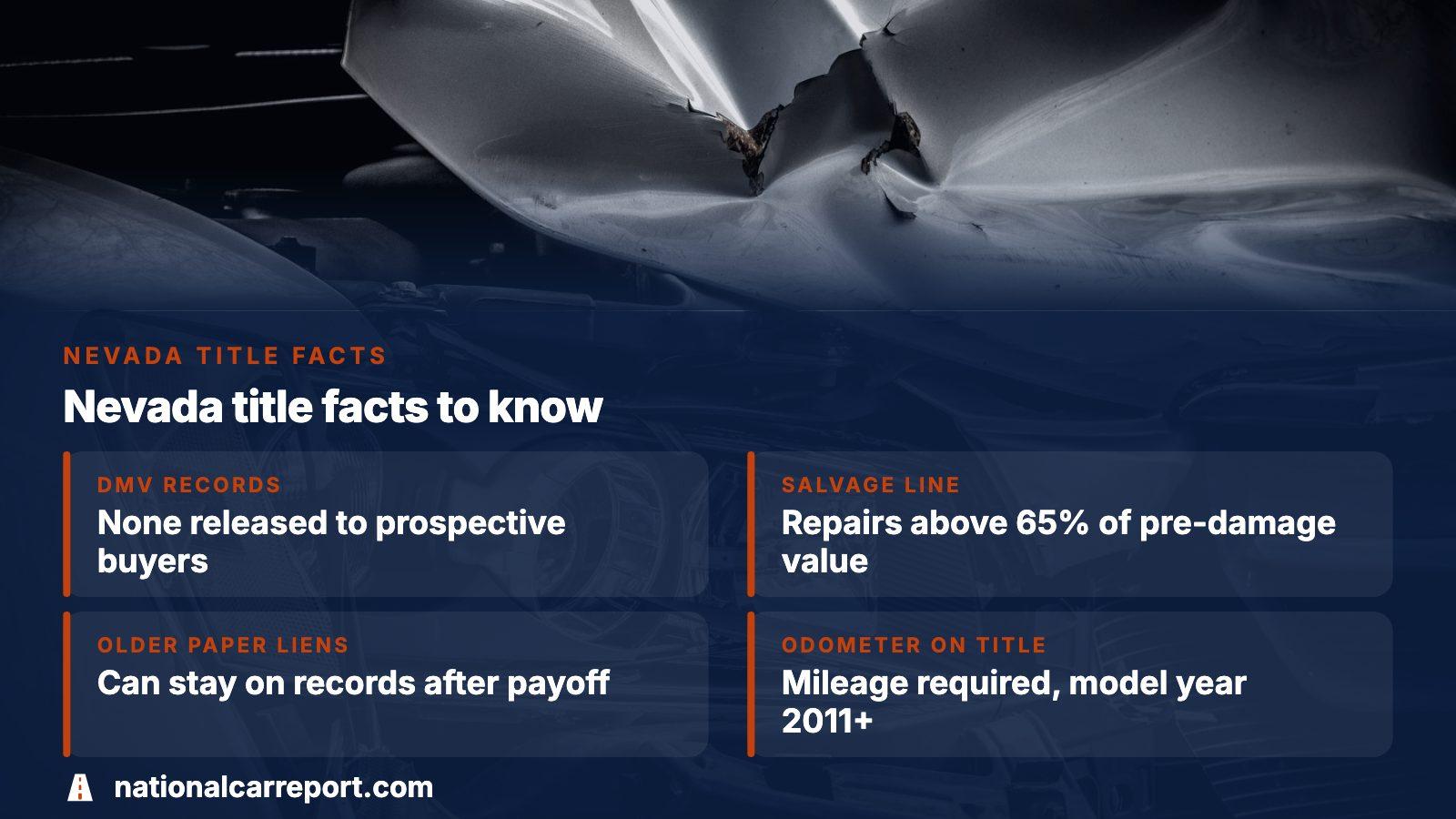
- DMV records for buyers
- None released to prospective buyers
- Salvage line
- Repairs above 65% of pre-damage value
- Older paper liens
- Lender can stay on state records after payoff
- Odometer on the title
- Mileage required at sale, model year 2011 and newer
What the Nevada DMV releases to buyers: nothing
Nevada offers buyers no state lookup. The DMV says it provides no vehicle records to prospective buyers and discloses no owner information to them. Records on abandoned or crash-involved vehicles go only to authorized parties such as insurers, tow yards and attorneys.
So a Nevada title check draws on two open sources: the paper in the seller's hand and national databases keyed to the VIN, which the DMV itself lists for buyers. NationalCarReport works the second half, reading theft, lien and impound entries against the title instead of replacing it.
Which source answers which question
| Question | Where the answer lives | What it leaves out |
|---|---|---|
| Is the seller the titled owner? | The title in hand, read against a photo ID | Anything before the seller bought the car |
| Does a lender still hold a claim? | A signed release or payoff letter | A VIN report may list a lien, but only the lender closes it |
| Was it branded in another state? | National title data (NMVTIS) inside a history report | Entities that never reported |
| Stolen or written off? | NICB's lookup for stolen and salvage cars, at no charge | Damage nobody reported |
| Open safety recalls? | NHTSA recall search (no fee) | Title, liens and past owners |
| Ever in a tow lot? | The seller's account, plus impound entries in a report | The DMV releases no abandoned-vehicle records |
The paper-title gap that hides old loans
Most Nevada lenders handle loans opened after July 1, 2017 through electronic lien and title. At payoff the lender notifies the DMV, and a clean title is printed and mailed to the owner at the address the lender holds. Older loans can sit on a paper title: the lender signs it off and hands it over but never tells the DMV, so the lender stays on state records until the owner files that signed title.
A seller's claim of a paid-off loan therefore proves little. Any lien must be cleared before ownership can change, and take-over-payment deals are illegal in Nevada. Hold these before paying:
- A title naming the seller, never a bill of sale alone.
- The lender's signature in the release section, or a notarized lien release.
- For a loan still open, the lender's approval and its letter showing the VIN.
Brand rules: orange titles, Rebuilt and the 65 percent line
Nevada treats a car as salvage when repairs would exceed 65 percent of its pre-damage market value, paint excluded, or when water rose above the door sill and reached the cabin, trunk, engine bay or wiring. A car 10 model years or older escapes the label if it needs only a hood, a trunk lid and up to two of the doors, grille, bumpers or lamp assemblies.
- Orange salvage title: no registration, and no sale to a private person until the car is rebuilt and inspected.
- Rebuilt: the brand rides every later title and cannot be removed. A new roof, floor pan, cowl or rear clip forces it.
- Non-repairable: parts and scrap only.
Sellers must disclose salvage, rebuilt or reconstructed status in writing. Hiding or washing a brand is a felony when the car is worth $250 or more, and a buyer who sues can recover the greater of $5,000 or triple the actual damages.
Screening past the state line
A Nevada title reports only what a state recorded. NMVTIS, the Justice Department's national title system, adds brands from other states, the most recent mileage entry, insurer write-off findings and salvage-yard transfers, plus some theft data. Coverage reaches roughly 87 percent of vehicles, with about 20 million salvage or total-loss records. More than half the states report into it, which leaves gaps.
Each state sets its own brand rules, so one state may label a car that the next leaves clean. A car recovered after a theft may keep a total-loss label anyway. The Justice Department advises pulling the state title record too, but Nevada does not release it to buyers, so the seller's title and lender paperwork carry extra weight.
Flood cars, stolen cars and swapped VINs
The DMV warns that flood cars get title washed and shipped nationwide, surfacing in all 50 states under titles from any state, sometimes listed as damaged by no service at all. It says cash-only, limited-time social media deals are often scams to move stolen cars, or cars with switched VINs or altered odometers.
- Photograph the seller's ID and keep their contact details.
- Deal only with the person who answered your first message.
- Have the VIN checked at a DMV inspection station, or run VIN history when you cannot meet there.
- Walk away when there is no title.
On a suspected flood car, press the carpet for dampness and silt, look for rust on unpainted screws and green corrosion on wiring, and distrust a heavy air-freshener smell.
Impound and lien-sale history behind a clean title
A tidy title can come out of a tow yard. Nevada limits lien sales to licensed garages holding a signed work order and to tow companies or storage businesses holding a property release. The owner must be notified, and the car goes to public auction. Landowners and property managers cannot lien or sell an abandoned vehicle themselves.
Ask the seller whether the car was ever towed or stored, and who sold it. The DMV releases no abandoned-vehicle records to the public, so a report's impound entries and the seller's papers are what a buyer has. A shifting story is a bigger warning than a lien-sale title alone.
The check in order, before money moves
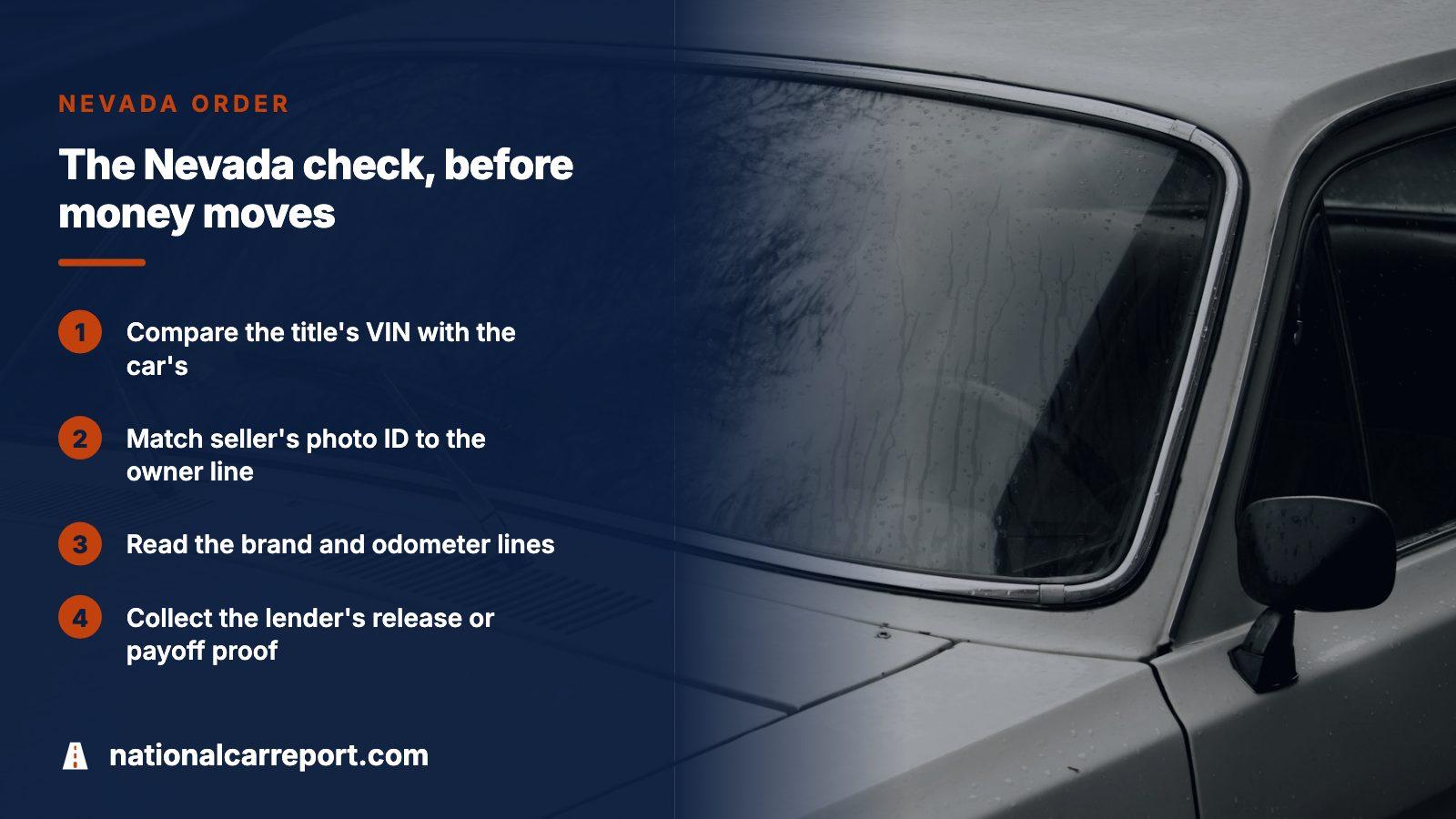
- Compare the title's VIN with the one on the car: the tag at the dash corner by the driver, and the sticker on the door post.
- Match the seller's photo ID to the owner line; if two owners are joined by AND, both must sign.
- Read the brand and odometer lines. Mileage must be filled in at sale for model year 2011 and newer.
- Run the free preview on the VIN, then the stolen-and-salvage and recall lookups.
- Collect the lender's release or payoff proof.
- Open the full report when anything turns up that the seller did not mention.
Walk-away signs
A title in someone else's name, a bill of sale offered instead of a title, an earlier private sale in the chain of a 2011 or newer car, or a seller who refuses to meet at an inspection station.
What the report costs and where it fits
Paying comes after the preview, and it happens once: a single report, or a multi-report bundle for anyone weighing several Nevada cars. There is no subscription. Amounts are on the pricing page.
In Nevada the report earns its place through lien, impound and theft entries beside brands and odometer readings from other states, the ground the DMV leaves to the buyer. It does not replace the signed title or the lender's release. Run the VIN before the deposit, and leave if the title and VIN disagree.
Where this information comes from
- Nevada DMV: vehicle title and ownership — Source for the title rules, private-sale checklist, odometer duty and lender approval.
- Nevada DMV: salvage vehicles — Gives the 65 percent line, orange and Rebuilt titles, written disclosure and penalties.
- Nevada DMV: flood-damaged vehicles — Explains title washing and the inspection cues for water damage.
- Nevada DMV: loan payoffs and lease buyouts — Covers electronic and paper liens, and who may sell through a lien sale.
- Nevada DMV: records — Confirms that vehicle records are not released to prospective buyers.
- Nevada DMV: register a vehicle — Lists the DMV's private-sale scam warning and its protective steps.
- U.S. Department of Justice: NMVTIS for consumers — Describes what the national title system holds, its coverage and its limits.
Sources and photos: Facts checked against the sources above in November 2026. Photos by Annika Wischnewsky, Tigran Shishmanyan and Clark Van Der Beken on Unsplash; diagrams by NationalCarReport.
Keep reading
- Vehicle Lien Check by VIN: Nationwide Lien, Theft and Impound RecordsWhat a lender's claim looks like on a record and how to prove a payoff.
- Stolen Car Check by VIN: Nationwide Theft, Lien and Impound RecordsScreening one VIN for theft before the deposit.
- Las Vegas Impound Search: Find a Towed Car, Then Check Its VINTracing a Las Vegas tow-lot car and what that past means for the title.
- PricingReport and pack options, one payment, no subscription.
Frequently asked questions
Can I run a Nevada title search by license plate or owner name?
Not through the DMV. It discloses no owner information to prospective buyers and takes record requests only through official channels with identification and a notary. A buyer's dependable starting point is the VIN, which ties to brands, theft, liens and impounds.
Is there a free Nevada title check?
In parts. NICB's stolen and salvage lookup and NHTSA's recall search cost nothing, and a free preview of a VIN shows what exists. The DMV offers buyers no lookup, and the full report is bought once, after the preview. None of these replaces the signed title.
What should I do if the seller has lost the title?
Have the seller fix it before the sale. A Nevada-titled car with no lien can get a duplicate by mail or at a DMV office in about 2-3 weeks. A financed car needs the lender's help, and an out-of-state title must be replaced by that state. Never pay against a bill of sale alone.
Can I buy a Nevada car with an orange salvage title?
Only from the owner if you are a licensed rebuilder, wrecker or dealer. A private sale is illegal until the car is rebuilt and inspected. A car 5 model years old or newer needs DMV authorization before repairs begin, and the finished car carries a Rebuilt brand on every later title.
What do I need to register a privately bought car in Nevada?
The signed title, a Nevada liability policy in the exact names on that title, and a smog report under 90 days old where one applies. A car never titled in Nevada also needs a vehicle inspection certificate. Turbo Title starts the process online, but original papers still go to a DMV office.
Now check the car itself
The guide explains what to look for. The report shows what this VIN has on record.