THE SHORT ANSWER
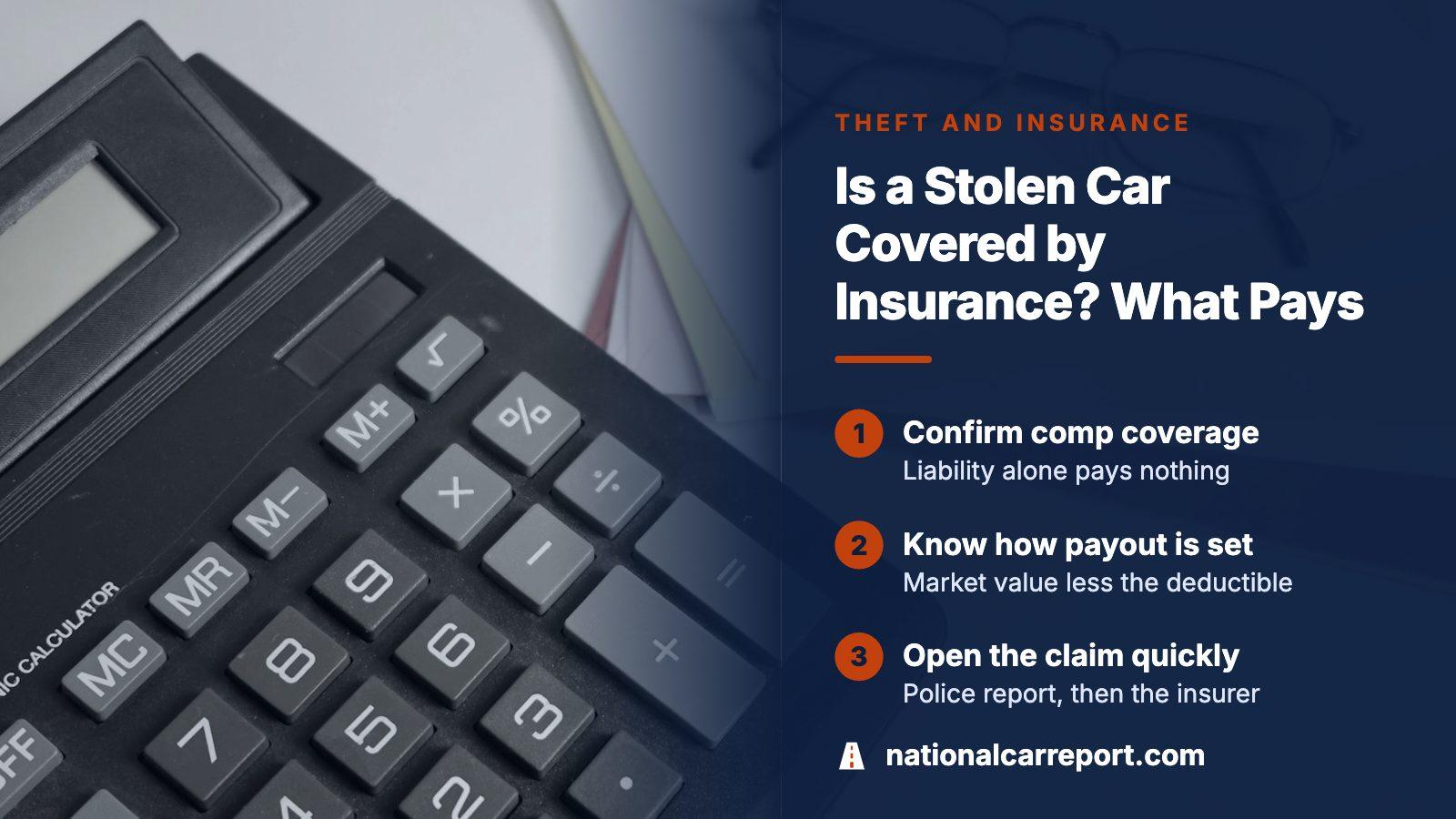
A stolen car is covered only when the policy includes comp coverage. A liability-only policy pays nothing toward the car itself. The payout is market value just before the theft, less the deductible, which may fall short of what you paid or still owe. Report the theft to the police, then open the claim within 24 hours. A paid claim can leave a stolen-salvage brand on the car's title record.
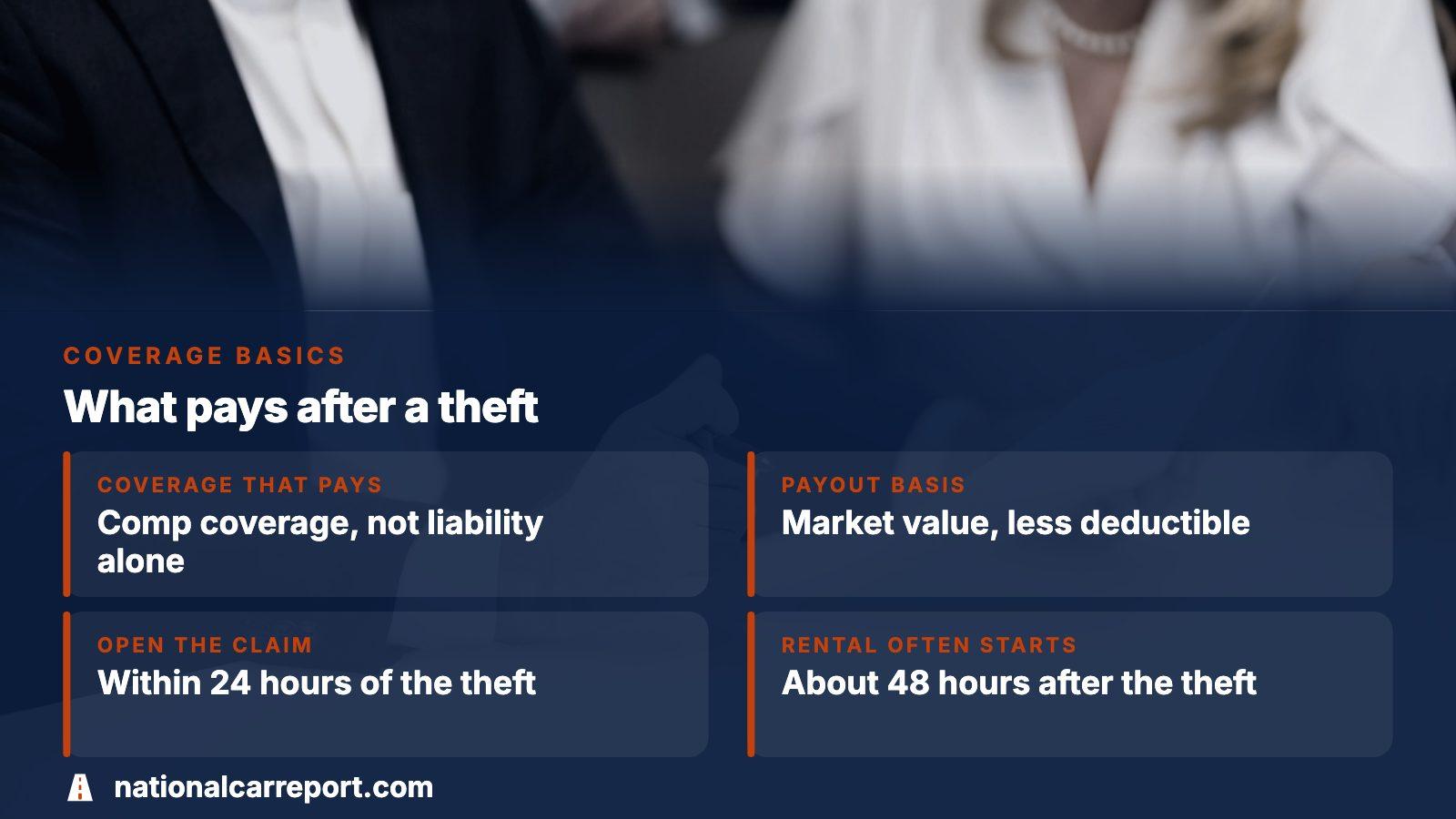
- Coverage that pays
- Comp, not liability alone
- Payout basis
- Market value, less deductible
- Open the claim
- Within 24 hours of the theft
- Rental often starts
- About 48 hours after the theft
Only comp coverage pays when a car is stolen
Car insurance comes in layers, and theft sits in an optional one. The layer the law requires is for the harm you do to others and their cars; your own car sits outside it. Theft, fire, flood, vandalism and hail fall under comp coverage, which you add yourself.
Wisconsin's insurance regulator says comp pays when the car, or pieces of it like the battery and tires, are stolen. Dealers and lenders will likely require comp and collision on a financed or leased car, so a loan often means you already have it. On a car you own outright, nobody makes you carry it, so read the declarations page and confirm before you need it.
How the insurer sets the payout
When the car never comes back, the claim is settled as a total loss. The insurer pays the car's value as of the moment before it disappeared, which can differ a lot from the price you paid. California defaults to fair market value, the figure a knowledgeable buyer and seller would agree on without pressure. New York's wording is retail value plus sales tax, less depreciation and deductions.
| Piece of the payout | How it works |
|---|---|
| Starting figure | Actual cash value, or the repair cost if that is lower |
| Taxes and fees | California: a total-loss settlement includes taxes, license and transfer fees |
| Deductible | Subtracted before you are paid; the amount is on your declarations page |
| Value dispute | Most standard policies have an appraisal clause: each side hires an appraiser and an umpire settles any split |
A loan changes who gets the check
On a financed car, the settlement check may name both you and the lienholder, and the loan stays yours no matter what happened to the car. California's insurance department says the borrower remains responsible for the balance even when the car is stolen. If the payout falls short, the lender expects the difference from you. Gap coverage exists for that shortfall, and on a lease it is usually folded into the payments.
From an NHTSA owner complaint
An owner of a 2019 Hyundai Sonata, financed since it was new, told NHTSA that police said teenagers took the car after almost two years of payments. The insurer's payout did not clear the loan, so 1,000 dollars was still owed to the lender, and the next car needed a down payment.
The takeaway: ask the lender for a payoff figure the day you file, then compare it with the insurer's offer before you accept.
Rental days, towing and the car that turns up
Most insurers reimburse rental costs after a theft, up to the limit written in the policy. In California the transportation benefit can start on its own about 48 hours after the theft, and it stops once the car is found, the claim is paid or the set period expires, whichever arrives first.
From an NHTSA owner complaint
A 2015 Kia Soul was stolen from its owner's workplace in November 2021, the owner told NHTSA. The insurer called it a total loss with more than $10,000 in damage, but the owner still paid a $500 deductible, lost five days of wages and expected to pay for extra rental time. The owner's verdict: "a complete nightmare."
Get the daily rental limit and the number of days in writing, because a replacement search can outlast them.
New York says a recovered car brings its own costs for the insurer: damage from the theft, the tow, sensible storage fees and a stand-in vehicle. California adds that reasonable towing is the insurer's bill unless it named a tow company beforehand. That matters when the car is held at an impound lot.
The first day: police report, then the claim
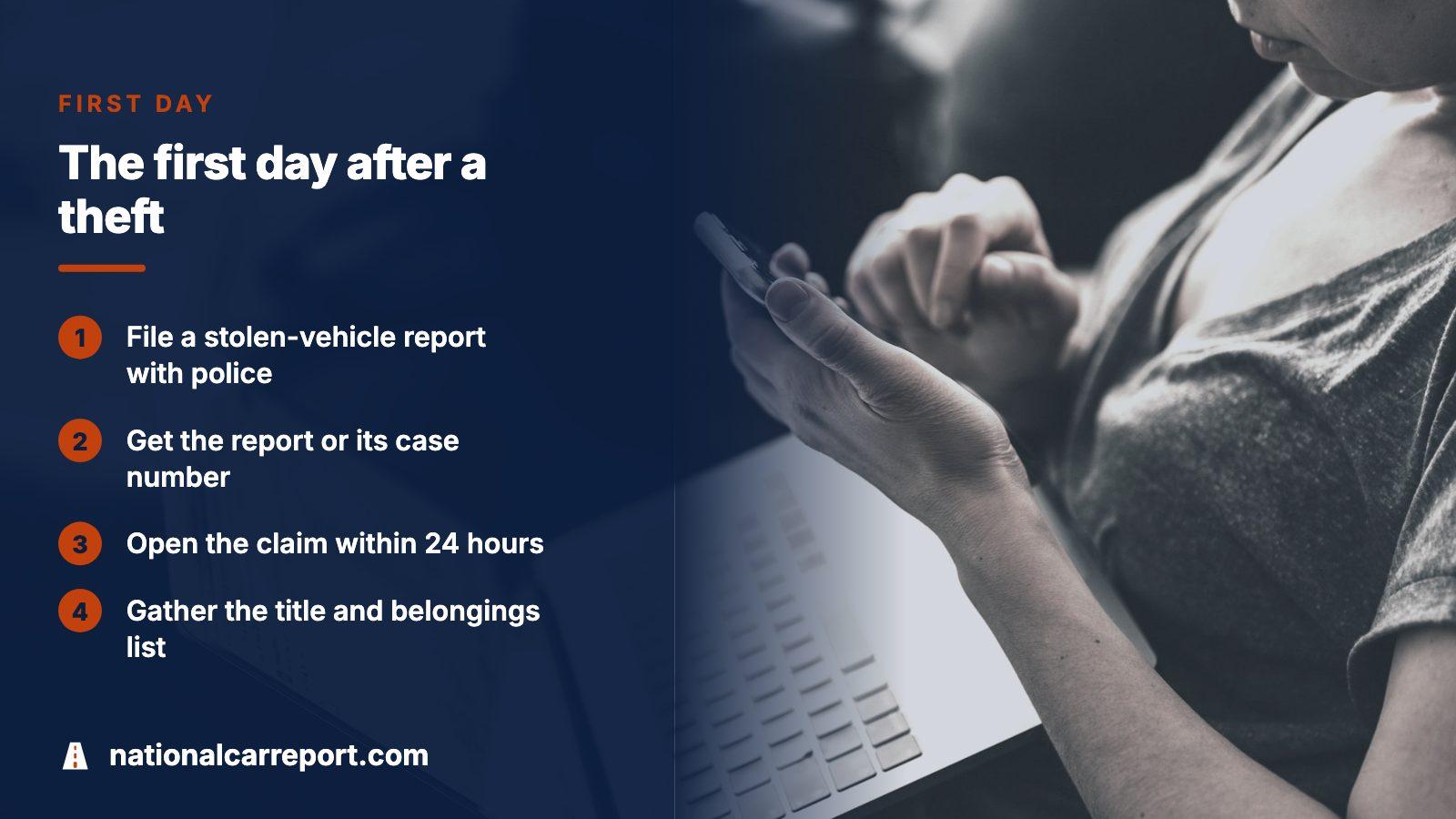
- File a stolen-vehicle report with the police. Have the plate number, make, model, color, VIN and any marks that set the car apart.
- Get a copy of the report or at least the case number. Your insurer will ask for one of them.
- Open the claim within 24 hours, as Wisconsin's regulator advises.
- Gather the title, a description of the car and a list of anything personal that was inside. Know where every key was before the theft.
- If you spot the car before the police do, call them and the insurer immediately.
File the report even if you doubt the policy will pay. Wisconsin's regulator notes that it protects you if the car is later used to hurt someone.
Belongings and add-ons inside the car
Personal property is usually a separate claim. Wisconsin's regulator warns that an auto policy may pay nothing for items stolen with the car, or only a small amount, while a homeowners or renters policy can cover things like clothing, luggage and gifts. List each item while you still remember it. Add-ons bolted to the car belong on that list too: California's department says non-factory stereos, phones, wheels and tires often get little or no coverage unless you paid for extra protection.
How long the insurer has to answer
Deadlines come from state rules and your policy, so they differ. California and New York show the range; your own state's insurance department will have its own page.
| Step | California | New York |
|---|---|---|
| First contact | Acknowledge and start investigating within 15 days of notice | Insurer inspects the car and puts a fair offer on the table inside six business days, if the car can be seen |
| Decision | Accept or deny within 40 days of proof of claim; a police report counts as proof | A written explanation if the claim is unsettled after 30 days |
| Payment | Within 30 days after settlement is reached | Within five business days after both sides agree |
If the insurer goes quiet, California tells claimants to call the company, then the Department of Insurance when the delay looks unreasonable. A theft report made up to collect a payout is fraud, and California lists it among the schemes it tracks.
What a paid theft claim leaves on the VIN record
Insurance settles the money, but the car keeps a history. Texas lists the title brands of the national title system, NMVTIS, on its salvage page, and one is named "Salvage - Stolen." It marks a car that was reported stolen, had a claim paid and was then reported as salvage by the state holding the record. The Texas page tells buyers to contact that state and confirm the car is no longer considered stolen.
A nationwide VIN check follows that trail. After your own claim, running the VIN shows the theft and insurance entries the next buyer will see. Before you buy, it shows theft records, title brands, salvage and insurance history, liens and impounds on that exact vehicle.
What a check cannot settle
A VIN check cannot say whether your own policy would pay a theft claim, and it cannot file one. That answer sits on your declarations page and with your insurer. A theft nobody reported will not appear either.
Looking up a VIN begins with a preview at zero cost. Getting the whole record is a one-time purchase, and bundles for shoppers comparing several cars sit on the pricing page.
Where this information comes from
- Wisconsin OCI: Vehicle Theft Prevention — Steps after a theft, the 24-hour claim advice, belongings and the effect on premiums.
- New York DFS: Filing Claims Under Your Own Policy — How a stolen car is valued, rental and recovered-car costs, and claim deadlines.
- California Department of Insurance: So You've Had an Accident, What's Next? — Actual cash value, loans and gap coverage, theft transportation benefits and settlement timing.
- TxDMV: Salvage Vehicles — The Salvage - Stolen brand and how an insurer's decision reaches the title record.
- Triple-I: Auto insurance basics, understanding your coverage — Which coverage pays for theft, lender requirements and gap insurance on a lease.
- NHTSA owner complaint 11442639 — owner experience, paraphrased
- NHTSA owner complaint 11518456 — owner experience, paraphrased
Sources and photos: Facts checked against the sources above in November 2026. Photos by Cht Gsml, Michal Biernat and Carrie Allen www.carrieallen.com on Unsplash; diagrams by NationalCarReport.
Keep reading
- Report a Stolen Car: Police Steps, Insurance and a VIN Theft CheckThe police-report steps in full, for an owner whose car has just gone missing.
- Do Stolen Cars Get Recovered? What the Theft Data ShowsWhat recovery looks like once a theft has been reported.
- Theft Recovery Vehicle: Stolen, Lien and Impound Checks Before You BuyWhat a theft-recovery history means for a title and for a car's value.
- Stolen Car Check by VIN: Nationwide Theft, Lien and Impound RecordsRun a nationwide theft, lien and impound check on a car before you buy.
Frequently asked questions
Does liability-only insurance cover a stolen car?
No. The law requires coverage for harm you do to others, not for your own vehicle. Theft is paid under optional comp coverage, so liability alone leaves the car itself unprotected. Check your declarations page now, since coverage added after a theft does not reach back to it.
How much does insurance pay for a stolen car?
The market value of the car just before the theft, less your deductible. In California a total-loss settlement also includes taxes plus license and transfer fees. The figure can sit below what you paid or still owe. A policy may include an appraisal clause if you dispute it.
Do I still owe my car loan if the car is stolen?
Yes, until the lender is paid in full. The lienholder may be named on the settlement check, and any shortfall is yours unless gap coverage applies. Ask the lender for the payoff figure so you can compare it with the insurer's number.
Will my rates go up after a stolen car claim?
They can. Wisconsin's insurance regulator says any reported stolen-vehicle claim may raise your premiums, and repeated theft incidents may lead an insurer to decline renewal. Ask your agent how a claim is likely to affect your next renewal.
Can a VIN check show that a car had a theft claim?
It can show theft records, title brands such as a stolen-salvage brand, insurance and salvage entries, liens and impounds tied to that VIN. It cannot show a theft nobody reported or say what your own policy covers. Use it before you buy, then confirm the car in person.
Now check the car itself
The guide explains what to look for. The report shows what this VIN has on record.