THE SHORT ANSWER
Yes, most stolen cars are found. NICB's 2023 tally recovered over 85 percent of passenger vehicles, and California's 2025 count was 84.0 percent across all vehicle types. Many turn up within two days. Motorcycles and commercial trucks come back less often, and the cars that return range from untouched to burned. Recovery does not erase the theft from a car's records, so search the VIN before you buy a car with that past.
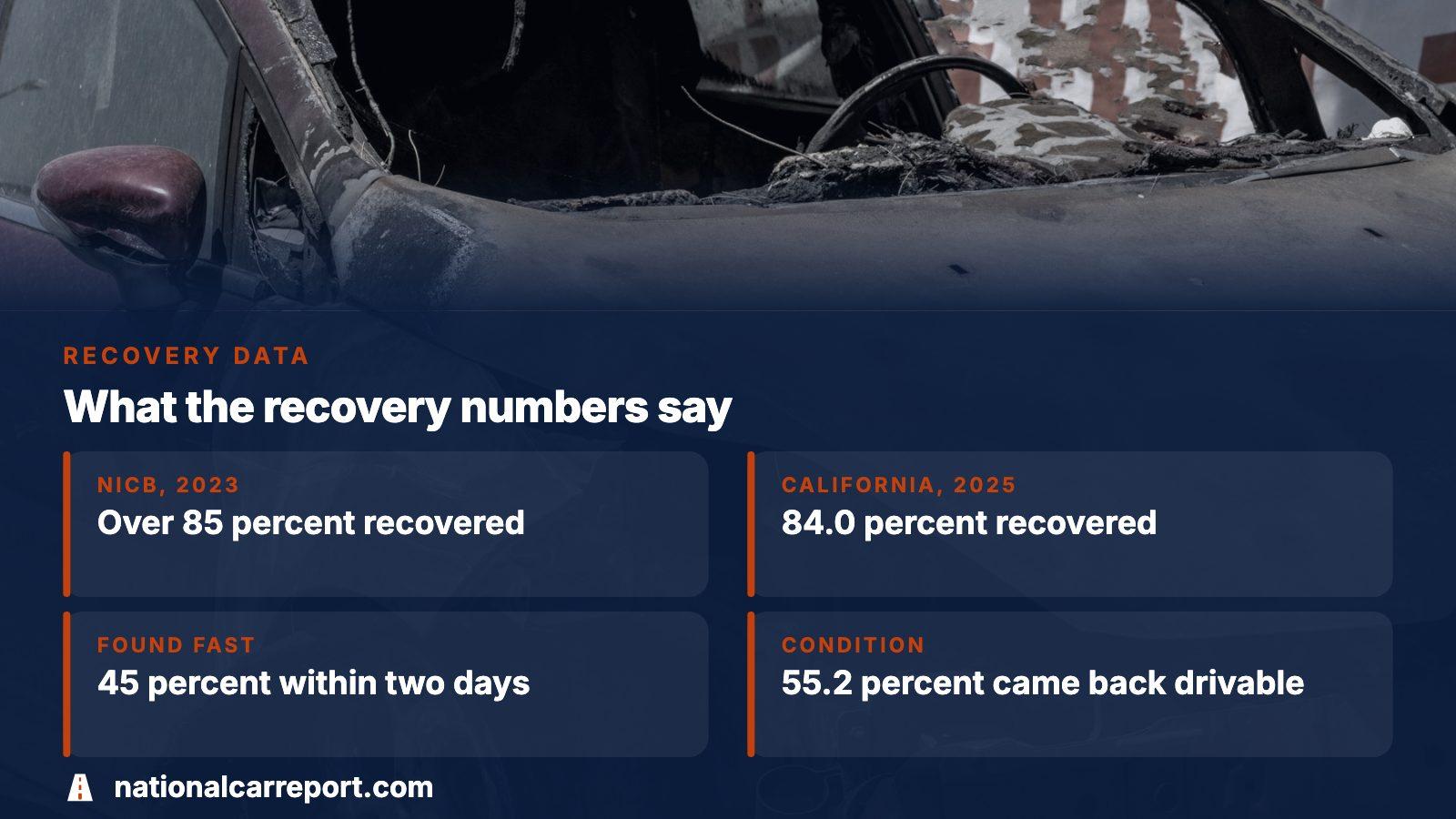
- NICB, 2023
- More than 85 percent of passenger vehicles recovered
- California, 2025
- 84.0 percent of stolen vehicles recovered
- Found fast
- 45 percent of recoveries within two days
- Condition
- 55.2 percent came back drivable in California
Three counts, three answers
Nobody keeps a single national recovery rate, so the answer comes from several counts. NICB's report on 2023 thefts found that over 85 percent of passenger vehicles reported taken were later recovered, by police or by other means. NICB's theft-prevention page says 21 percent of the vehicles stolen in 2025 remain unrecovered. California publishes the most detailed state figures, built from state justice and highway patrol systems.
| Count | Year | What it found |
|---|---|---|
| NICB, passenger vehicles | 2023 | More than 85 percent recovered |
| NICB, theft-prevention page | 2025 | 21 percent unrecovered |
| California, every vehicle type | 2025 | 84.0 percent recovered, 111,661 of 133,372 |
Why the percentages never quite match
The denominators differ. NICB's 2023 figure covers passenger vehicles only, while California counts every kind of vehicle, motorcycles included. Timing plays a part as well, because a count that closes before a late-year theft turns up would file that car as unrecovered.
Maryland's state police report adds a third yardstick. For 2023 the recovered vehicles there were worth 55.0 percent of the value reported stolen. That is a share by dollars, not by cars, so it cannot be set beside the other figures without care.
Many recoveries come within days
Speed is where the data is clearest. Of the stolen vehicles that do come back, NICB says 34 percent turn up on the day of the theft, and 45 percent are home within two days. Maryland's report describes where they tend to surface: on an ordinary street as if parked, or in a field in rural areas. Surveys it cites say about half of the recovered cars had a key or fob inside when found.
From an NHTSA owner complaint
The owner of a 2016 Kia Optima told NHTSA that the car left the dealer with its anti-theft software update on May 5, 2023. It was taken from the driveway on May 8, and local police recovered it on May 12. The owner reported damage inside and out, and said the thieves started it with a USB cord despite the update.
A recovery in four days is a good outcome, yet it can still leave a car with repairs a later buyer never hears about. That is why the paperwork matters.
What shape a recovered car is in
California's 2025 sheet sorts its 111,661 recovered vehicles by condition.
- 55.2 percent were intact and drivable.
- 27.3 percent were intentionally burned or wrecked.
- 6.6 percent were stripped of minor parts.
- 3.8 percent were missing major components.
So a little over half could be driven away, and more than a quarter were deliberately ruined. The word recovered covers every group, which is why a listing that says only that tells you almost nothing about the car.
Which vehicles rarely come back
Type matters more than most buyers expect. California's 2025 recovery share ran from 62.6 percent for motorcycles up to 92.5 percent for automobiles.
| Vehicle type | Recovered in California, 2025 |
|---|---|
| Motorcycles | 62.6 percent |
| Commercial trucks | 80.0 percent |
| Personal-use trucks and SUVs | 89.3 percent |
| Automobiles | 92.5 percent |
Motive explains part of the gap. Maryland's report sorts thefts into resale or parts, a ride, use in another crime, and export. Cars taken for a ride or a second crime are generally not destroyed and mostly come back. Chop shops and export can destroy a vehicle outright, often leaving the owner with a total loss, and the report says a large portion of Infiniti and Lexus models taken by organized fob-reprogramming groups are not recovered.
How a recovered car reaches its next buyer
Recovery leaves loose ends. NMVTIS, the federal title-data system, notes that a car not recovered within 30 days may be labeled a total loss by its insurer. If the car is found afterward in fine shape, that label is not reversed, and the car can be offered for sale as a sound runner.
Recovered is not the same as clean
States disagree on which events earn a brand, so whether a theft leaves a mark on the title depends on where it was issued. The insurer's record and the police file can say more than the title does.
What a theft search can and cannot see
NICB's VINCheck is the usual first stop. Enter the 17-digit VIN and it tells you whether member insurers have the car on file as stolen without a recovery, or as salvage or flood damaged. A single IP address is capped at five searches within any 24-hour stretch, and the insurers behind the tool hold 92.49 percent of U.S. earned premium. It reads insurance records, not police files, and NICB itself warns against relying on it alone when buying. A car that was found again may therefore return nothing.
Impound entries, lien records and title brands live in separate databases. NationalCarReport pulls them into one report. Enter the VIN to see the free preview; the full report is one payment, and the packs are listed on the pricing page.
When the seller says the car was stolen once
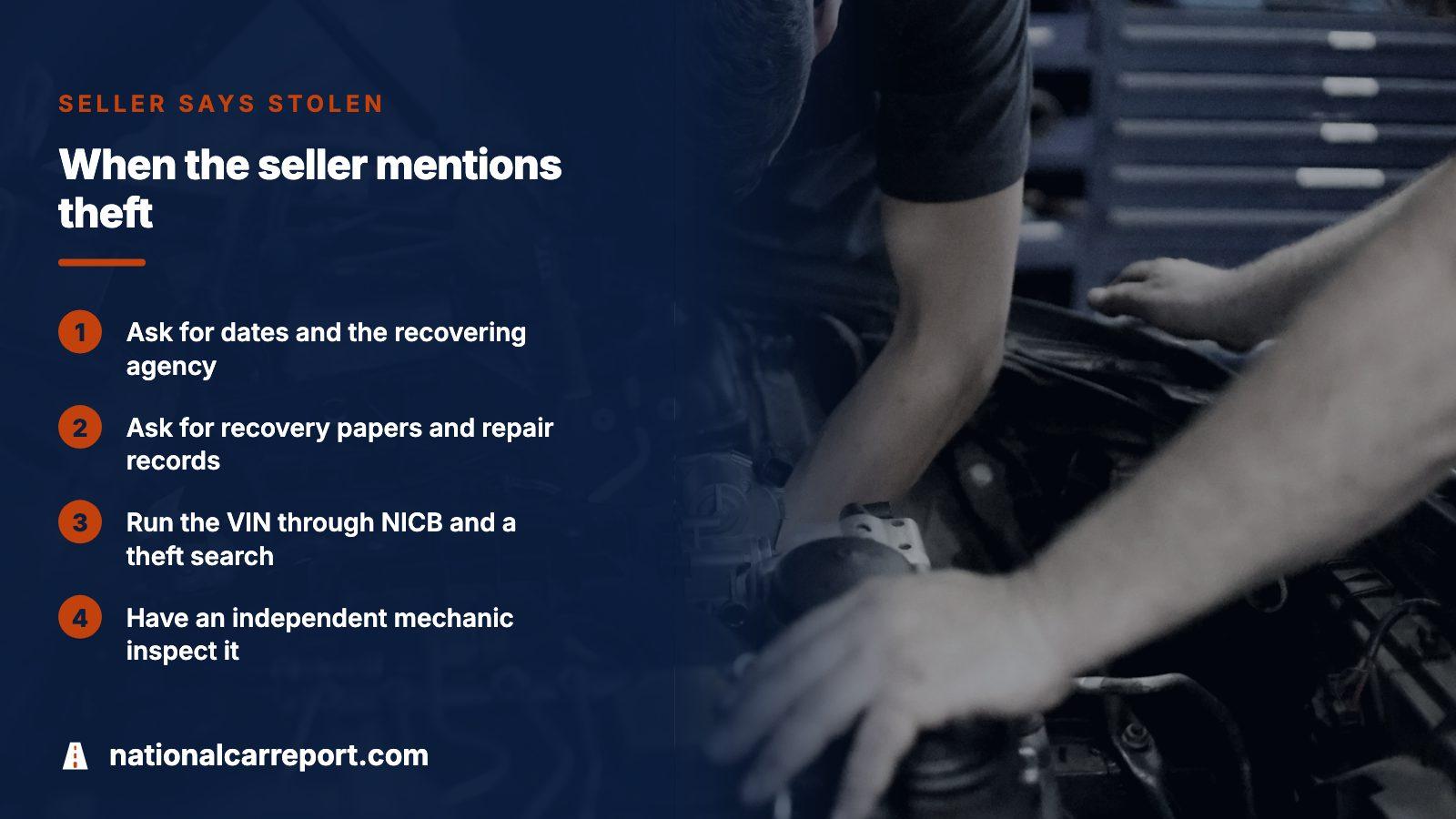
- Ask for the dates: when it was taken, when it was found, and which agency recovered it.
- Ask to see the police recovery paperwork, any insurer settlement and every repair invoice.
- Run the VIN through NICB, then through a full theft, impound and lien search.
- Have an independent mechanic inspect it, starting with the ignition, wiring and airbag module.
- If a lien shows, ask the lender for a written release first.
Walking away is a fair result when the seller cannot say where the car was found or what was repaired.
Where this information comes from
- CHP: 2025 California Vehicle Theft Facts — Statewide counts of stolen and recovered vehicles, split by vehicle type and by condition when found.
- NICB: 2023 Vehicle Theft Trends Report — The recovery share for passenger vehicles and how quickly recovered ones turn up.
- NICB: Prevent Vehicle Theft — The 2025 share of stolen vehicles still unrecovered.
- Maryland State Police: 2024 Vehicle Theft Prevention Council report — Recovery by value, why thefts end the way they do, and where cars are usually found.
- NMVTIS: Information for consumers — How an insurer's total-loss label after 30 days stays on a car that is found later.
- NICB: VINCheck — What the insurer-based theft search covers, its search limit and what it leaves out.
- NHTSA owner complaint 11522011 — owner experience, paraphrased
Sources and photos: Facts checked against the sources above in November 2026. Photos by Will Truettner, Mustafa Sheikhmouss and engin akyurt on Unsplash; diagrams by NationalCarReport.
Keep reading
- Where Do Stolen Cars End Up? Found, Stripped, Exported or ResoldThe five endings for a stolen car, including the ones that never come home.
- Theft Recovery Vehicle: Stolen, Lien and Impound Checks Before You BuyWhat to check before buying a car that was stolen and found.
- Report a Stolen Car: Police Steps, Insurance and a VIN Theft CheckThe police and insurer steps when the missing car is yours.
- Stolen Car Check by VIN: Nationwide Theft, Lien and Impound RecordsRun the theft, lien and impound check on a car before you pay.
Frequently asked questions
How likely is a stolen car to be recovered?
Most are. NICB's 2023 tally recovered over 85 percent of passenger vehicles, and California got back 84.0 percent of all vehicles stolen in 2025. The odds fall for motorcycles and commercial trucks, and for cars taken by organized groups, so the answer for one vehicle depends on its type and on why it was taken.
How long does it take to find a stolen car?
Often only days. Among vehicles that are recovered, NICB data show 34 percent turn up the day they are taken, and 45 percent inside two days. If a car stays gone past 30 days, its insurer may write it off, yet the car can still surface later.
Does a recovered stolen car show up on a VIN check?
It can, but not always on the free insurer search. NICB's VINCheck searches for thefts that never ended in a recovery, so a car that came home may not appear there. A wider search of theft, impound, lien and title records is likelier to show the history. No search catches a theft that was never reported.
Does a recovered car have a salvage title?
Not automatically. States differ on what they brand, and an insurer's total-loss label on a theft claim is not removed if the car returns undamaged. Read the title and the insurer-reported records together, and ask what the repair invoices cover.
What should I do first if my car is stolen?
Call the police at once, with the plate number, VIN, make, model and color ready, then contact your insurer. NICB says quick reporting improves the chance of recovery. Keep the police report, because insurers often ask for it before they process a claim.
Now check the car itself
The guide explains what to look for. The report shows what this VIN has on record.