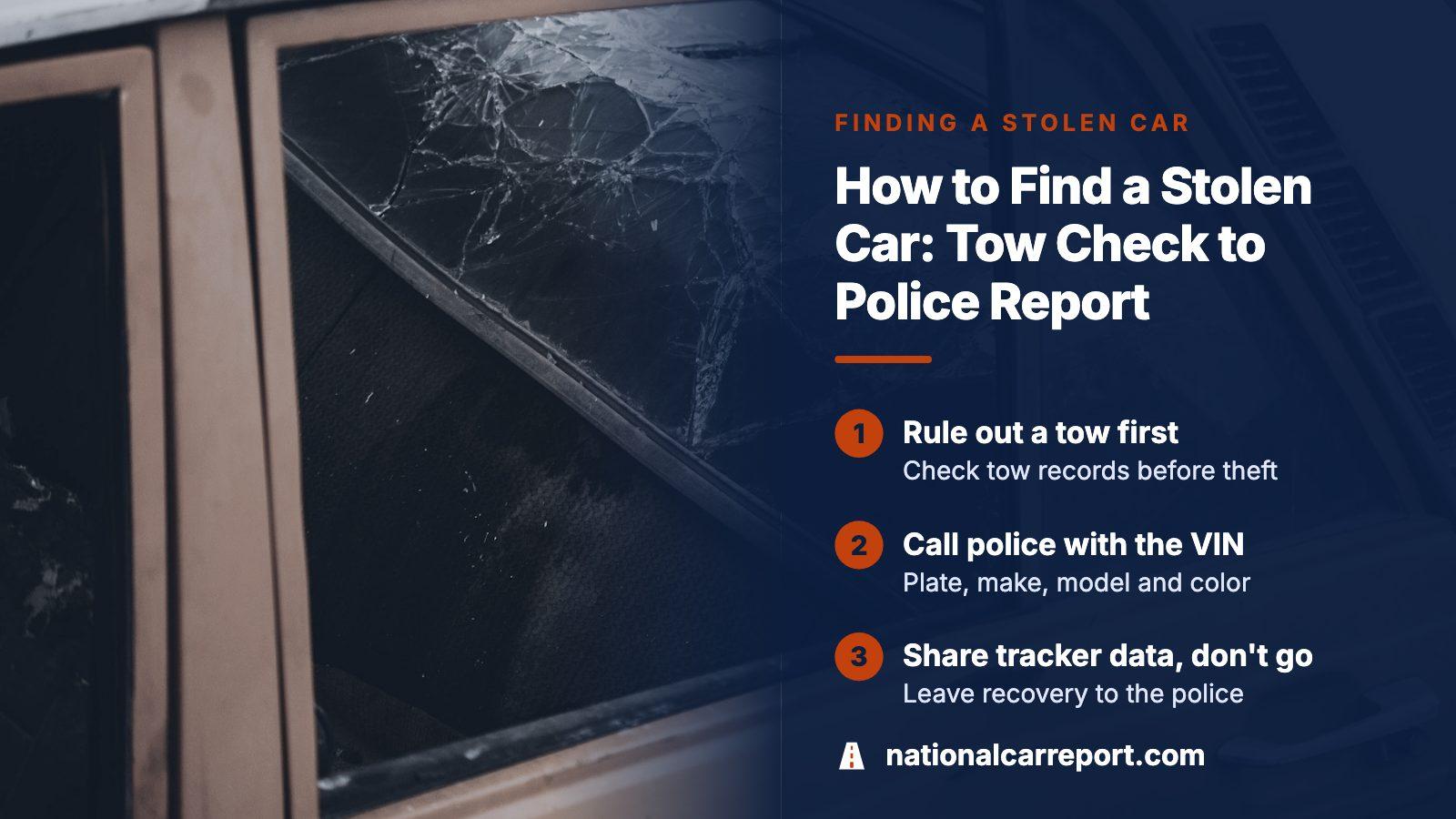
THE SHORT ANSWER
Check that the car was not towed, then call the police and give them the VIN, plate, make, model and color. The report is what lets officers look for it, and NICB says an immediate report improves recovery chances by 34% over the first day. Tell your insurer within a day. If a tracker shows a location, hand it to the police instead of going there yourself.
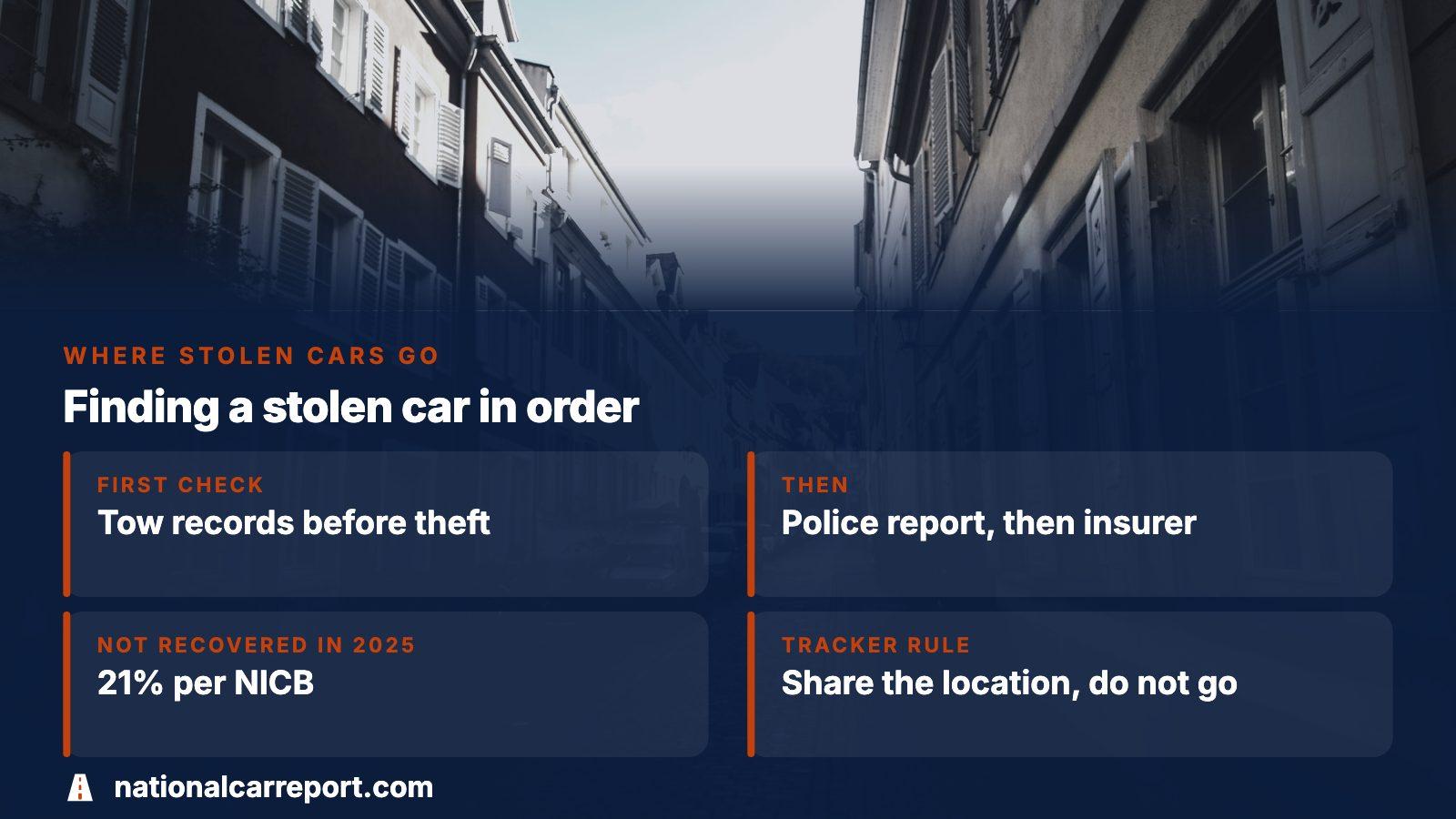
- First check
- Tow records, before theft
- Then
- Police report, then insurer
- Not recovered in 2025
- 21% (NICB)
- Tracker rule
- Share the location, do not go
Rule out a tow before you call it a theft
From the curb, a towed car and a stolen car look identical, and only one of them needs a police report. Texas's licensing agency, for one, tells the owner of a car gone from a parking lot to call the number posted on the tow-away sign.
Police can settle the rest. Rules differ by state, but Texas shows how it can work: a storage lot that accepts a private-property tow has two hours to notify the local police agency, and the notice includes the plate and the VIN when known. A short call may answer the question there, and it is worth asking in any state.
- Look for a tow-away sign and call the number on it.
- Ask the police whether a storage lot has reported your plate or VIN.
- If you owe on the car, ask the lender whether it was repossessed.
- Ask anyone who has a spare key.
The first call: what police need and what to write down
Once a tow is ruled out, phone the police at once. NHTSA says the officer may want the VIN, the plate, what the car is and what color, plus any feature that sets yours apart from others like it.
- Keep the VIN in your phone, so you can read all 17 characters aloud without hunting for paperwork.
- Describe the car, including any dent, decal, roof rack or aftermarket part.
- Write down the case number and the department that took the report.
- Call your insurer; NHTSA's guideline is within 24 hours of the theft.
Speed pays, and insurers usually want that police report in hand before they open a theft claim. The full routine, including what happens when there is a loan, has its own guide.

The national odds: most stolen cars come back
| Measure | NICB figure |
|---|---|
| Thefts in 2025 | 659,880, down 23.2% from 2024 |
| Not recovered, 2025 | 21% |
| Thefts reported, first half of 2026 | 268,415, about 21% fewer than a year earlier |
| Metro area with the most thefts, first half of 2026 | Los Angeles-Long Beach-Anaheim, 21,540 |
| Highest rate among states and districts | D.C., 181.94 per 100,000 people |
Put plainly, a stolen car is more likely to be found than not, though roughly one in five never is. The direction is encouraging: every state logged fewer thefts in the first half of 2026 than the year before. Among the ten metro areas with the biggest totals, Chicago's was the only one that rose, by 2%.
When the call comes and the car is in a tow yard
A recovery can end at a tow lot. One owner's account to NHTSA shows how fast it can move once a report is on file.
From an NHTSA owner complaint
The owner of a 2017 Hyundai Tucson wrote that thieves smashed a window on Nov. 17, 2022 and tried to take the SUV; police wrote a report at the scene. Six days later someone came back, broke another window and drove it away. The owner reported the theft, and the SUV was recovered the same evening. Two days after that, at the tow yard, the owner collected belongings and documented a stripped steering column. By the owner's account, the thieves had also hit another vehicle and left the SUV in an intersection.
Ask the officer which lot holds your car, what it wants to see, and what each day of storage adds. Texas lots ask for photo ID and proof of ownership and charge storage by the day. Document the damage while you are there, as this owner did.
Trackers: a lead for the police, not an invitation
NICB names aftermarket GPS units and air tags as tools that make a stolen car easier to find. NHTSA describes recovery systems as devices that help law enforcement see where the car is, and possibly catch the thief, which puts the police at the end of the signal. For an owner who spots the car first, NHTSA's instruction is to call the police and the insurer immediately.
So the sensible use of a tracker is a screenshot and a phone call. Give the dispatcher what changes the response:
- Your case number, if you already have one.
- The address and time of the latest location ping.
- Whether the signal is moving or sitting still.
- Photos of the car and any marks that identify it.
Then stay put and keep your phone on. Arriving first puts you between the officer and someone who has already stolen a car.
A recovery can take days, and the car may be hurt
From an NHTSA owner complaint
Owners of a 2016 Kia Optima had the maker's anti-theft software installed at a dealer on May 5, 2023. On May 8 the car was stolen from their driveway. The local police department recovered it on May 12. The owners say a USB cable stood in for the key, and the car came back damaged inside and out.
Four days passed between theft and recovery, and the owners still had a damaged car to deal with. Finding it is the first step, not the last. Ask the police for a copy of the recovery paperwork too, and keep it with the original case number.
While you wait: insurer, rental and the VIN record
NICB advises telling the insurer once the police report exists. Rental reimbursement can pay for a rental while the investigation runs, but only if your policy includes it, and some insurers may deny a claim when a theft traces back to habitually leaving keys in an unlocked car. Keep a log of each call: who, when, what was said.
A car that comes back wrecked can pick up a record. In NICB's wording, a salvage result marks a car its insurer declared a total loss, and insurers are among the groups federal law requires to report to NMVTIS, which tracks total-loss and salvage history. A written-off recovery can therefore follow the VIN to its next owner. Police come first, but NICB also accepts tips about vehicle crime.
The same VIN, from the buyer's side
NICB pitches VINCheck as a way to avoid unknowingly buying a stolen or salvaged car. Before paying for any used car, compare what each lookup can say about theft:
| Lookup | What it can show | What it misses |
|---|---|---|
| NICB VINCheck | Cars that participating insurers reported stolen and not recovered, plus salvage and flood; five searches a day per IP address | Police records and insurers that do not participate |
| NMVTIS-based report | Title state, brands, odometer, total loss and salvage | Theft is not one of its five indicators |
| NationalCarReport report | Theft entries next to lien and impound records for one VIN, after a free preview | A theft nobody has reported |
Start with NICB's search, since it costs nothing, and remember a clean answer is no guarantee. When you are close to paying, the NationalCarReport preview shows whether theft, lien or impound entries exist. The report itself is a one-time purchase, with prices on the pricing page.
Where this information comes from
- NHTSA: Vehicle theft prevention — steps after a theft and what recovery systems do
- NICB: Prevent vehicle theft — 2025 theft totals, unrecovered share and claim guidance
- NICB: VINCheck lookup — what the insurer-record search covers and leaves out
- NMVTIS: Understanding an NMVTIS vehicle history report — the five indicators and who must report
- Texas TDLR: VSF notification process — storage lots must tell local police about private-property tows
- NHTSA owner complaint 11494936 — owner experience, paraphrased
- NHTSA owner complaint 11522011 — owner experience, paraphrased
Sources and photos: Facts checked against the sources above in November 2026. Photos by Abolfazl Ranjbar, Jakub Żerdzicki and Karwin Luo on Unsplash; diagrams by NationalCarReport.
Keep reading
- Report a Stolen Car: Police Steps, Insurance and a VIN Theft CheckThe reporting steps in full, from the officer's questions to the insurer call.
- Do Stolen Cars Get Recovered? What the Theft Data ShowsHow often stolen cars come back, and what happens to the ones that do.
- Impound Lookup: Find a Towed Car, Then Check Its VIN for Impound RecordsHow to search for a car held in an impound or tow lot.
- Stolen Car Check by VIN: Nationwide Theft, Lien and Impound RecordsRun a VIN for theft, lien and impound records before buying a used car.
Frequently asked questions
Where is my stolen car right now?
Only the police, or a tracker you own, can answer that. Confirm it was not towed, since a storage lot may already have reported it. Then file the report with the VIN and plate, and give officers any tracker location instead of acting on it yourself.
How do you track down a stolen car without a tracker?
You rely on the report. Officers work from the plate, VIN and description you give them, so make those exact. NICB notes that the VIN matters so much in recovery that some insurers discount for engraving it on the windows.
Should I go and get the car if a tracker shows where it is?
NHTSA's advice for an owner who finds the car before police do is to contact the police and the insurer immediately. Pass along the address, the time of the ping and whether it is moving.
How soon do I have to tell my insurer about a theft?
NHTSA says to file the claim within 24 hours. NICB adds that the police report usually comes first, so call the police and then quote the case number. Check the policy for rental coverage, which applies only when the policy includes it.
Can a VIN check show whether a used car is stolen?
It can show part of the picture. NICB's free VINCheck reads insurer records of thefts not recovered but skips police records, and federal title data carries no theft indicator. A clean result lowers the risk without removing it, so compare the VIN stamped on the car too.
Now check the car itself
The guide explains what to look for. The report shows what this VIN has on record.