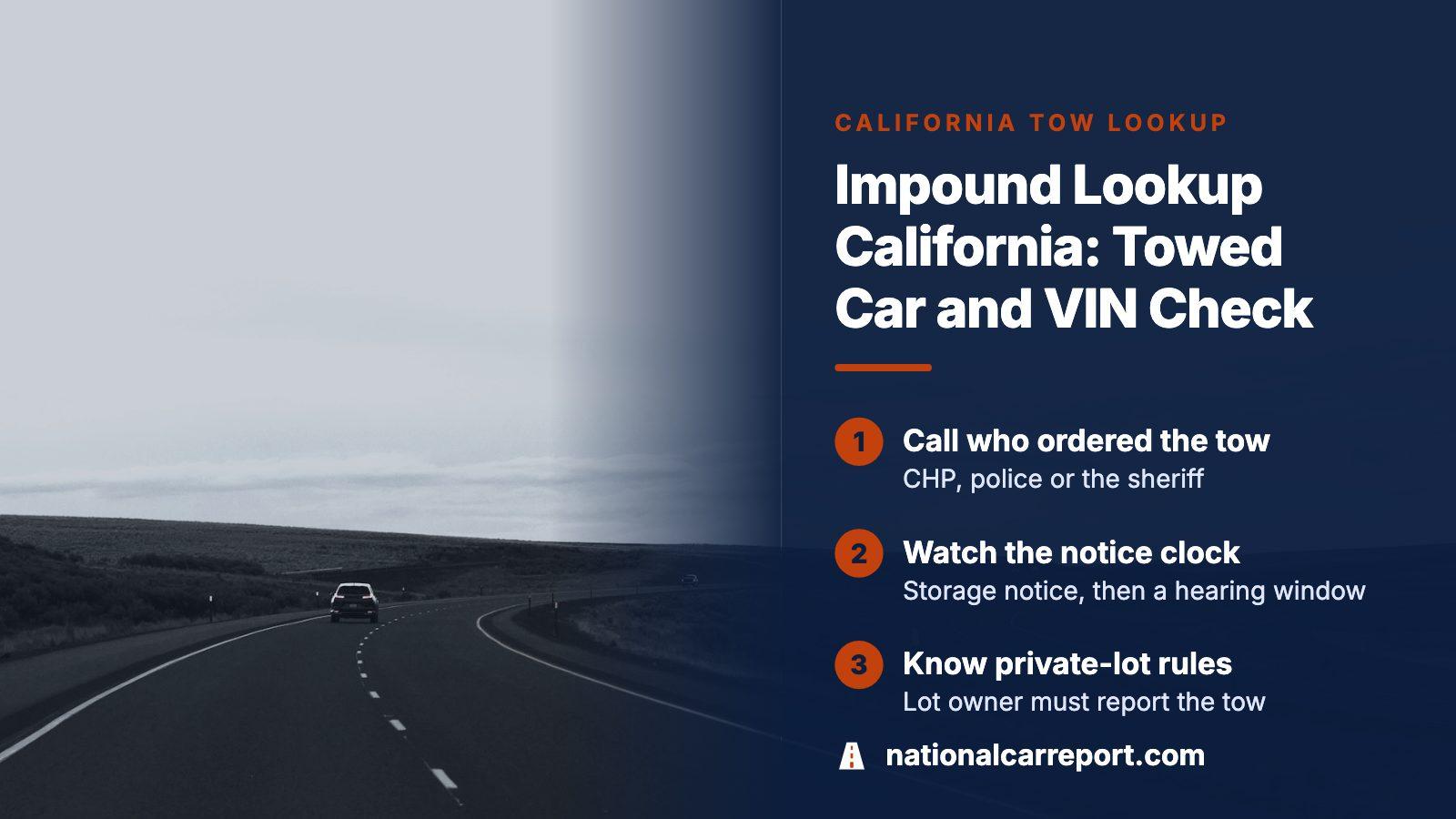
THE SHORT ANSWER
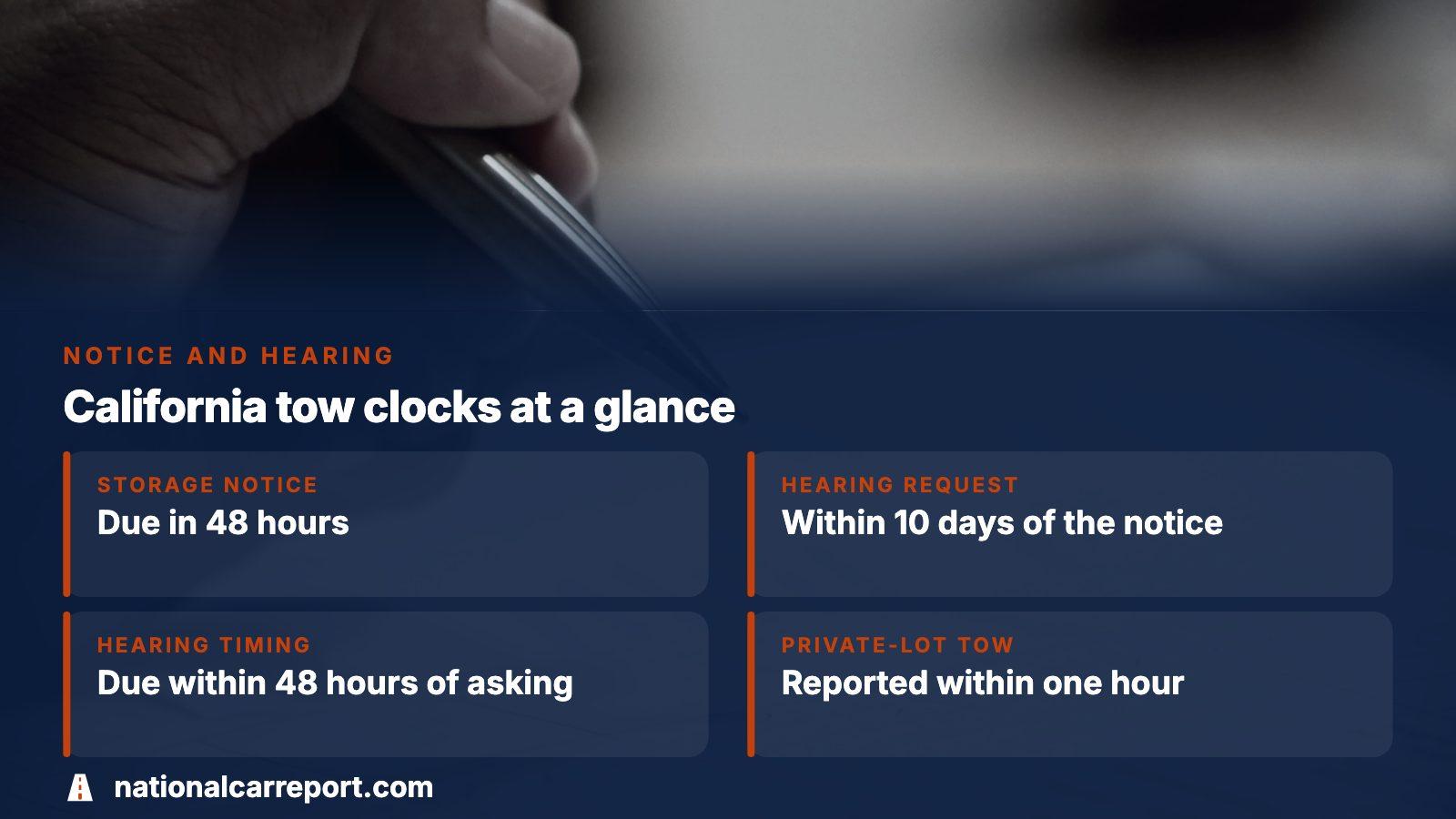
Phone the agency that ordered the tow: the CHP office for freeway and state-road tows, local police or the sheriff for city streets. A private lot owner has to report a tow to local law enforcement within one hour, so that call can find those cars too. Public agencies must send notice within 48 hours, and you then have 10 days to ask for a hearing.
- Storage notice
- Due in 48 hours, weekends and holidays excluded
- Hearing request
- Within 10 days of the notice date
- Hearing
- Due within 48 hours of asking
- Private-lot tow
- Reported to local law enforcement within one hour
Start with who ordered the tow, since no one list covers California
The CHP, city police, county sheriffs and private property owners all move cars here, and the state pages we read send owners back to whoever called the truck. Work out the likely source, then make one call with the plate, the VIN and your best guess at when the car vanished.
| How the car left | Who has the record | First move |
|---|---|---|
| Stalled, crashed or left on a freeway | The CHP office covering that road | Ask whether it was stored or impounded |
| Parked or stopped on a city street | City police or the county sheriff | Call the agency's tow line with the plate and the block |
| Taken from an apartment, store or office lot | The tow company, plus local law enforcement | Ask the lot manager who towed it, then confirm with police |
| No agency has anything | Possibly a theft | File a police report, then recheck |
CHP tows split into stored cars and impounded cars
The label decides who can hand back your keys. A stored car, say one left on a freeway past four hours or wrecked beyond driving, can be collected straight from the tow company by the registered owner or an agent. An impounded car, such as one towed because the driver had no valid license, was held for investigation or lacked paid registration, needs sign-off from the CHP office behind the tow.
- If you are unsure of the reason or the yard, call the CHP office that handled the call.
- Yards on the CHP rotation must take a valid bank card, though checks are optional for them.
- Personal belongings come back on request, at no charge, during business hours.
- A gate fee can be added outside posted hours, which the CHP puts at after 6 p.m. on weekdays and all weekend.
The 48-hour notice and the 10-day hearing window
When a public agency orders a car stored, Vehicle Code 22852 hands the registered and legal owners a written notice and a chance to challenge the tow.
- The agency mails or delivers its notice within 48 hours, not counting weekends and holidays.
- The notice gives the agency's phone, the storage address, the car's description and the legal reason for the tow.
- Ask for a hearing in person, in writing or by phone, but get the request in inside 10 days counted from the notice date.
- The hearing is due no later than 48 hours after you ask, skipping weekends and holidays, before someone other than the person who ordered the tow.
When the hearing officer finds no reasonable basis for the tow, the agency that ordered it absorbs the bill. Never asking, or skipping the hearing, counts as having had one. Abandoned-vehicle abatement, investigative impounds and private-property tows sit outside this rule.
Thirty-day holds after a license stop
A driver caught with a suspended or revoked license, or none ever issued, can lose the car for 30 days under Vehicle Code 14602.6. The agency must keep a published phone number with round-the-clock impound information, and its release counter has to stay open during regular public hours. That number is your lookup.
Early release is possible if the car was stolen, if an unlicensed garage or parking-service employee was driving it, if the seizure was not allowed, or if the driver gets a license reinstated or obtains one along with the right insurance. Whoever collects it shows a valid license and current registration. The registered owner pays towing, storage and administrative charges. A lender listed as legal owner is owed certified mail within 2 working days; if the agency is late, it can bill that lender for no more than 15 days of impound.
Towed from a private lot: the rules that favor the car owner
Section 22658 governs apartment, shopping and office lots. Among its grounds for removal: a large sign at every entrance that bans public parking and names the tow firm and the police number, or 96 hours since a parking citation.
- Whoever authorizes the tow has one hour to tell local law enforcement, which is why a police call can locate your car.
- The tow company needs written authorization first and must give you a copy before you pay.
- If your car has not left the property, the driver must release it on request; once hooked up, up to half the usual tow charge may apply.
- Charges above the higher of the local police-tow rate or the CHP-approved rate are excessive, and the operator owes four times the amount.
A property owner who skips the sign, waiting-period or stated-grounds rules owes double the tow or storage charges. Release inside 24 hours of arrival means one day of storage, and a yard that turns away cash or a valid bank card commits a misdemeanor.
If nobody claims the car: lien sales and surplus fees
A yard owed money can sell the car through a lien sale. The state splits cases at $4,000 of value, and each side has its own procedure, so ask which one applies. Above that line, the lienholder applies to the DMV, which mails owners and other interested parties by certified mail; an opposition form returned inside 10 days of that mailing stops the sale. If it goes ahead, a notice goes out 20 days beforehand, and the owner gets a 10-day redemption period afterward.
Check for surplus after a lien sale
If the car sold for more than the bill, the extra is not the yard's to keep. The DMV lookup takes a plate or the last 5 digits of the VIN and reports excess fees from the past 3 years. Refund applications go by mail, and checks typically follow 4 to 6 weeks after approval.
What a VIN check adds that a tow lookup cannot
A tow lookup tells you where a car sits today. A VIN search shows what has been recorded against it, and those records do not stop at a state line. If a used car may have sat in a California yard, see its impound, lien and theft entries first.
A gap in the federal title database
The Justice Department's NMVTIS page for consumers lists title brands, the latest odometer reading, insurer salvage and total-loss findings, transfers to salvage yards and, in some cases, theft history. It never mentions impound, tow or lien records, so a clean federal title report says nothing about a past impound.
Run the preview, then read it for red flags
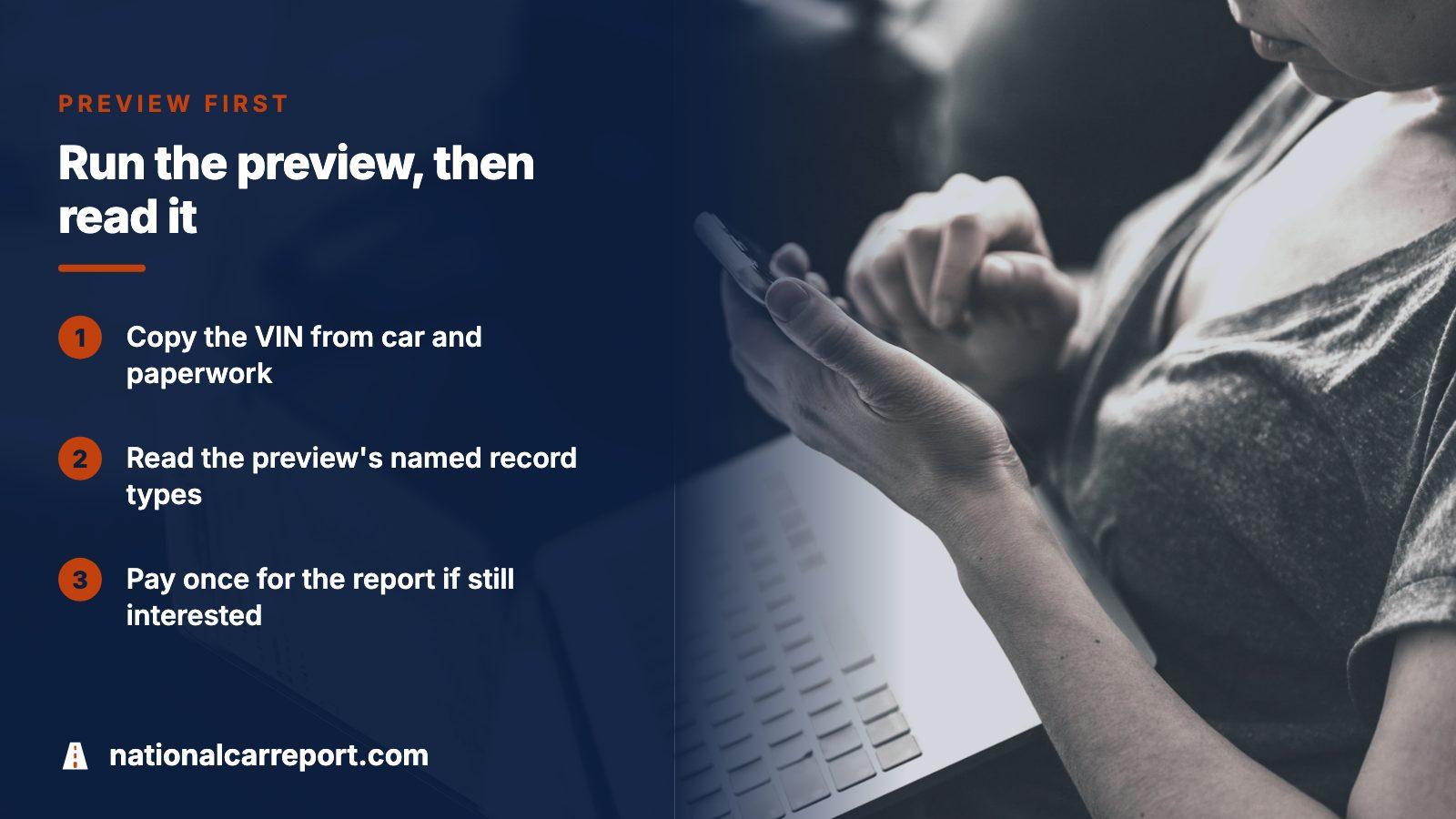
- Copy the VIN from the vehicle and from its paperwork. A mismatch ends the conversation.
- Enter it on NationalCarReport and read the preview, which names the record types on file and costs nothing.
- If the car is still a contender, pay once for its report; shoppers chasing several impound auction cars can take reports in threes, fives or tens. No plan follows the purchase. The pricing page lists the amounts.
- An impound the seller never mentioned: ask which agency held the car and why, and get the release papers in writing.
- An impound with a lender's claim behind it: settle the lien before the title moves.
- A theft entry on a car for sale: ask for police recovery paperwork, and walk away without it.
- A clean preview: still match the stamped VIN to the paper title in person.
Where this information comes from
- CHP: Rotation Tow Program FAQ — How the CHP separates stored cars from impounded ones, and who may release each.
- California Legislature: Vehicle Code 22852 — The storage notice, the hearing request window and who pays if the tow was unjustified.
- California Legislature: Vehicle Code 14602.6 — The license-offense impound, early release cases and the lender's notice.
- California Legislature: Vehicle Code 22658 — Signage, authorization, payment and excessive-charge rules for private-lot tows.
- California DMV: Lien sale procedure for vehicles valued at $4,001 or more — Notice steps, the opposition window and the redemption period after a sale.
- California DMV: Lien Sale Excess Fees Lookup — How to search for surplus sale money and claim a refund.
- NMVTIS: For consumers — What the federal title database reports and what it leaves out.
Sources and photos: Facts checked against the sources above in November 2026. Photos by John Kakuk, Michal Biernat and Masjid MABA on Unsplash; diagrams by NationalCarReport.
Keep reading
- Impound Lookup: Find a Towed Car, Then Check Its VIN for Impound RecordsHow tow records work city by city, and where a national search fits.
- LA Impound Lookup: Search a Los Angeles Tow, Then Check the VINA city-level walk-through for cars towed in Los Angeles.
- SF Impound Lookup: Find a Towed Car, Know the Costs, Check the VINThe Bay Area version, with its own lot and hearing rules.
- Vehicle Lien Check by VIN: Nationwide Lien, Theft and Impound RecordsFinding a lender's claim that can sit behind an impound.
Frequently asked questions
How do I find out if my car was towed in California?
Call the agency that probably ordered the tow: the CHP office for freeway and state-road tows, or local police or the sheriff for city streets. A private lot owner must report a tow to local law enforcement within one hour, so police may know where the car went.
How long do I have to contest an impound in California?
For a tow ordered by a public agency, request a storage hearing inside 10 days of the notice date. The hearing is due within 48 hours of your request, excluding weekends and holidays. Private-lot tows follow other rules.
Does the impound yard have to take credit cards?
Yes. A yard must accept cash or a valid bank card in the payer's own name, though store-brand cards are excluded. The CHP says operators need not take checks. After a private-lot tow, a yard that refuses can owe four times the tow and storage charges.
Will an impound appear in a federal title report?
The federal consumer page lists brands, odometer readings, salvage findings and some theft data, but no impound or tow records. A NationalCarReport preview shows at no charge whether impound, lien or theft entries exist for a VIN.
What happens if no one claims an impounded car in California?
The yard can pursue a lien sale. For a car valued above $4,000, the owner gets DMV notice by certified mail, 10 days to oppose, notice of the sale 20 days ahead and a 10-day redemption window afterward.
Now check the car itself
The guide explains what to look for. The report shows what this VIN has on record.