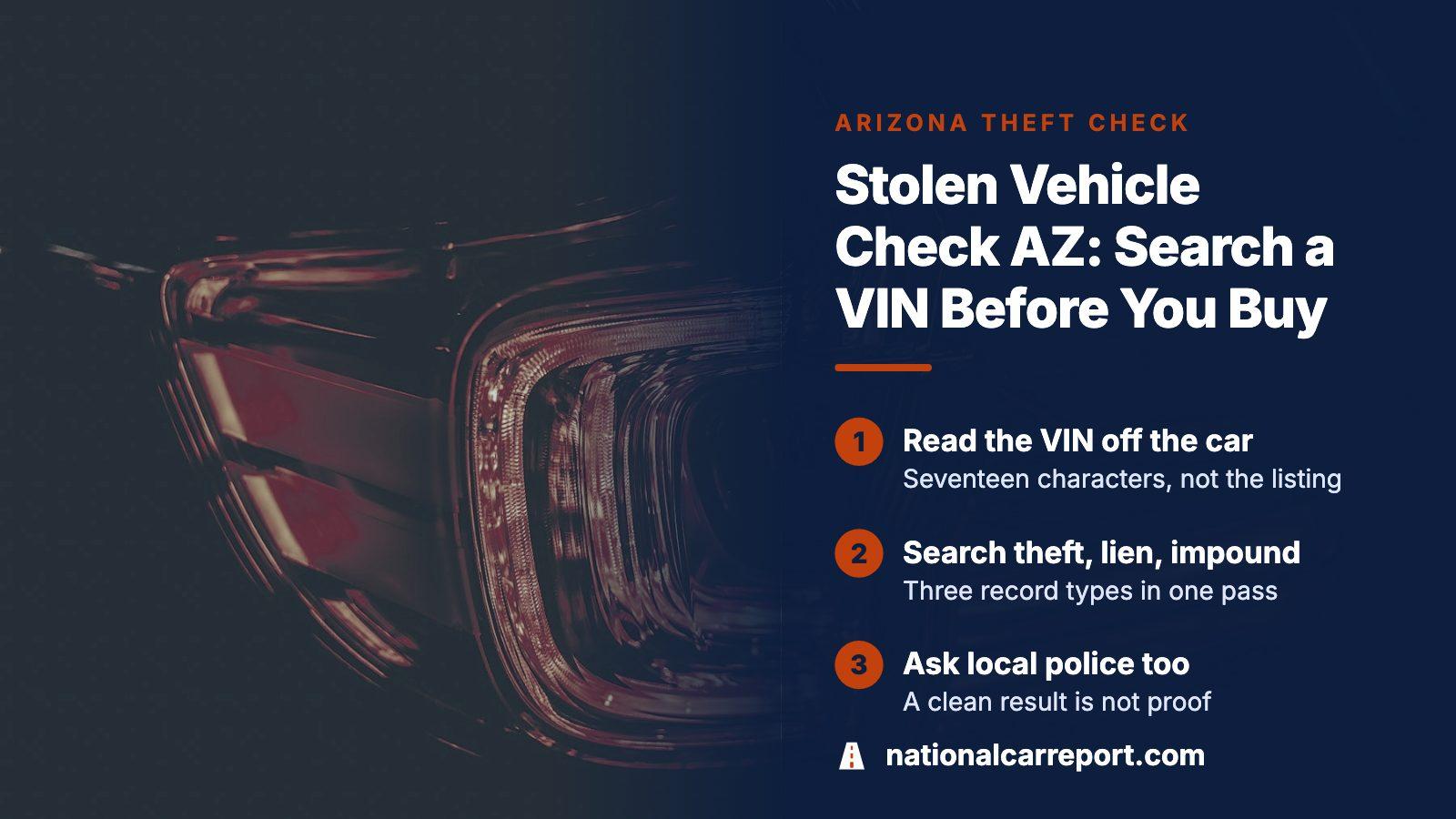
THE SHORT ANSWER
To check an Arizona car for theft, read the 17-character VIN off the vehicle, search it for theft, lien and impound entries, and ask local police whether it sits on a theft report. The state's auto-theft task force writes for owners rather than buyers, so you assemble the answer from several records. A clean result lowers risk without proving legitimacy: match the VIN to the title and inspect the car.
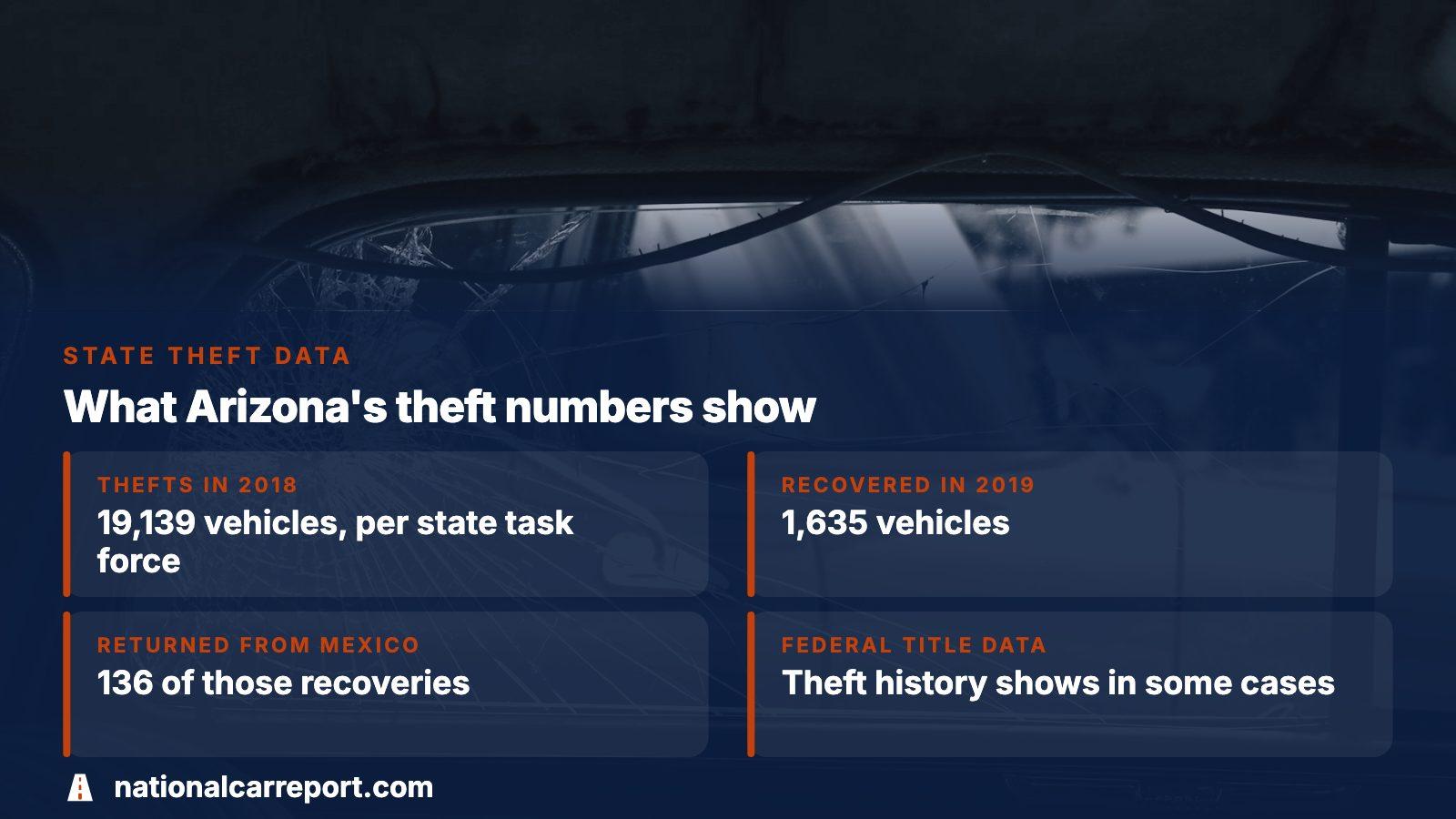
- Arizona thefts, 2018
- 19,139 vehicles, per the state task force
- Recovered in 2019
- 1,635, with 136 returned from Mexico
- Federal title data
- Theft history appears in some cases
- NationalCarReport preview
- No charge; the report is bought once
Four places that can tell you an Arizona car is stolen
No single desk answers this for an Arizona buyer. Each record sees a different slice of the car's past, and stolen cars slip through the gaps.
| Source | What it can tell you | Where it stops |
|---|---|---|
| Police in the seller's city or county | Whether an officer finds the VIN on a theft report | Silent on liens, tow records and write-offs |
| NICB VINCheck | Flood, unrecovered-theft and salvage flags attached to a VIN, as the FTC describes it | Limited to what that tool records |
| NMVTIS, the federal title system | Title brands, the latest odometer reading, insurer write-offs, sometimes theft history | Around 87 percent of America's vehicles are in it, so a blank answer proves little |
| NationalCarReport preview and report | Theft, lien and impound entries for the VIN across the country, beside title brands | Only what each source has reported |
What Arizona's theft numbers mean for a buyer
The state's vehicle theft task force publishes totals going back decades. Arizona recorded 56,876 stolen vehicles in 2002, its peak on that page, and 19,139 in 2018, more than 56% under the 1997 count. In 2017 and 2018 the state fell out of the national top ten.
For 2019 the page reports 1,635 recoveries, 136 of them repatriated from Mexico. That second number matters to buyers: a car can be taken, driven south, found and returned, then listed for sale with a theft record behind it. The newest figures date from 2019, so treat them as history, not a current rate. Nationally, the page quotes 794,019 thefts for that year.
Running the check on an Arizona car
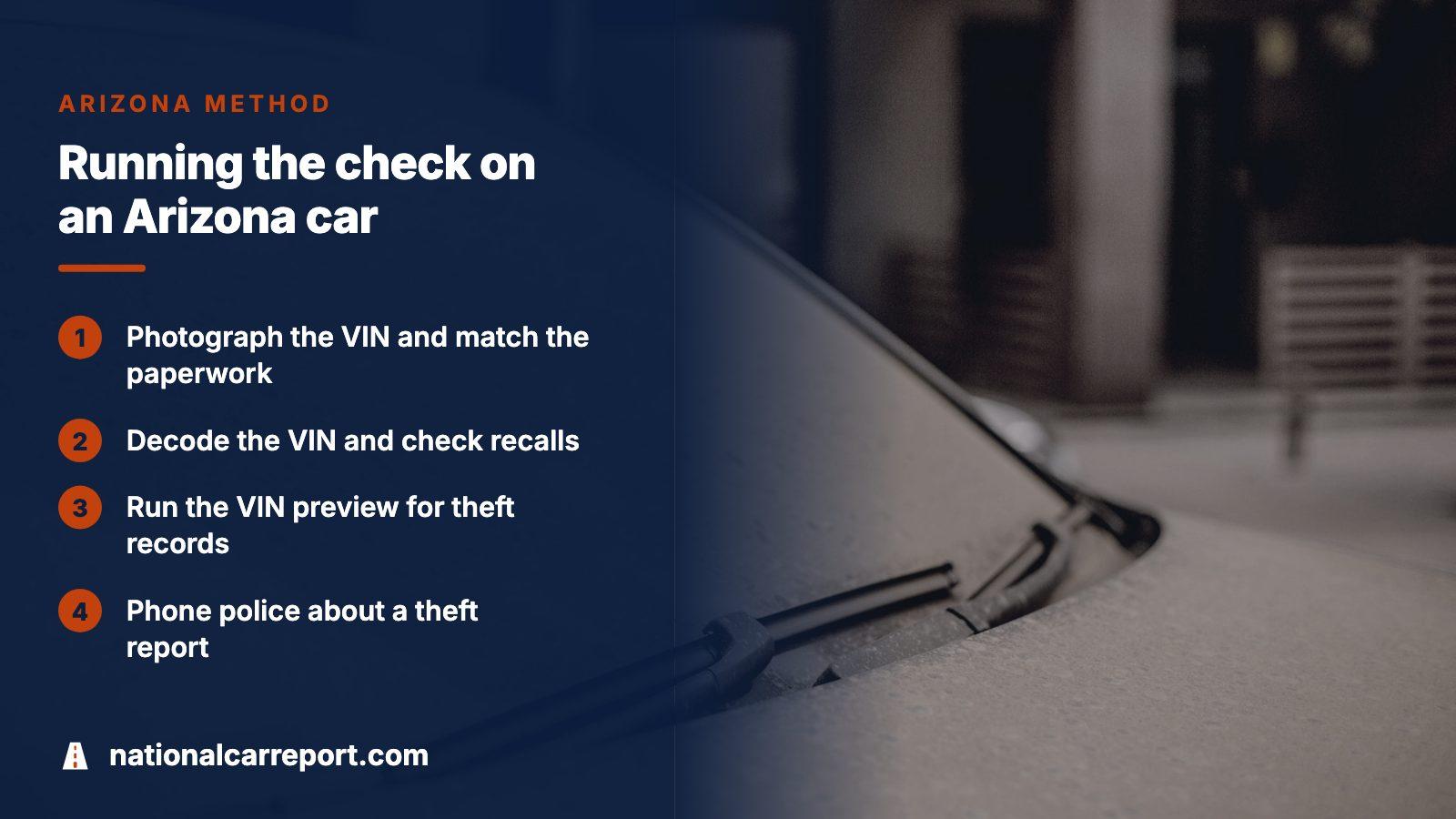
- Photograph the VIN where it is stamped or labeled, then check it against the paperwork: title, registration and the ad itself. One wrong character is reason to stop and ask the seller why.
- Decode the VIN, for example with NHTSA's decoder, and see whether the make, model and year match the car you are inspecting.
- Look up open recalls at NHTSA, which charges nothing, and search the VIN at NICB for flood, theft and salvage marks.
- Enter the VIN at NationalCarReport. The free preview lists the theft, lien and impound records that exist before you pay.
- Phone the police or sheriff where the seller lives and ask whether the VIN is on a theft report. Note the officer's name and the date.
- Compare the seller's name with the title. If everything lines up, buy the full report and inspect the car with it beside you. The FTC advises pairing any history report with an independent inspection.
When the VIN matches and the car is still stolen
Some thieves skip hiding the number and borrow one. A clone is a stolen car wearing the VIN of an honest car sharing its make, model and year, so decoding works and the paperwork looks plausible. The Justice Department's title-system page cites Operation Roadrunner, which recovered about 250 cloned vehicles, and says Arizona, Florida and Virginia caught clones together before issuing new titles.
A decode cannot expose this, since the number genuinely belongs to a car like yours. Records can: entries under that VIN describing a different history from the car you see, or mileage that drops between entries. Arizona law also draws a hard line on tampered numbers. A car offered for sale with a VIN that was destroyed, removed, covered, altered or defaced is to be pulled by a peace officer and held for twenty days, and the agency logs the removal in the state crime information database within three business days.
Reading what comes back
| Result | What it suggests | Your move |
|---|---|---|
| Reported stolen, not recovered | An active theft report on the VIN | Stop, and give police the VIN and the listing |
| Theft entry, then recovered | The car returned in unknown condition | Ask for insurer papers and repair invoices; inspect the frame, VIN labels and airbags |
| Stolen vehicle certificate of title | Arizona's ownership document for a car stolen and never recovered | Ask how the car resurfaced, and check with police |
| Salvage or nonrepairable brand | Repair judged uneconomical, or a parts-only car | Price it as branded; a nonrepairable title can be reassigned only twice, then gets no further transfers |
| Lien listed | A lender may still hold a claim | Get the lender's written release first |
| Impound entry | Time spent in a tow yard | Ask who released it, when and why it was towed |
| VIN differs between car and title | Tampering or a paperwork error | Stop, and ask an officer to look at both |
| Nothing found | No entry in the sources searched | Still ask an officer; federal data has gaps |
What Arizona law says about holding a stolen vehicle
The vehicle theft statute, A.R.S. 13-1814, covers controlling someone else's car when you know, or have reason to know, it is stolen. It is a class 3 felony, and the test includes reason to know, not just actual knowledge.
Section 13-2305 lists inferences a court may draw unless the conduct is satisfactorily explained: recent possession of stolen property, a price far below fair market value and, for dealers, dealing outside the regular course of business. Section 13-1814 carries those inferences into the reason-to-know paragraph, so an unexplained bargain counts for something.
Buying a car that was stolen once and recovered
A theft record does not always end a car's road life. Arizona's title statute sets the route for recovered cars and shows what to ask a seller for.
- An insurer that takes over a total-loss car has 30 days, counted from the owner's signed-over title with liens cleared, to apply for the special title.
- A recovered car that came back intact qualifies for a title once an affidavit notes any airbag that deployed or was removed. The insurer must pass the purchaser a copy.
- If airbags or structure were compromised, no standard title issues. The best outcome is a restored salvage title, and it requires a level three inspection.
- A seller aware of a salvage title has to say so ahead of closing, on paper or electronically. Hiding a damaged airbag system deliberately is a class 1 misdemeanor.
Federally, an insurer is allowed to declare a car a total loss after 30 days without recovery. The label sticks even after the car is found intact, so a total-loss entry beside a theft entry can describe a sound car or a wrecked one. Paperwork and an inspection tell you which.
Price, and your next step
At NationalCarReport you type in a VIN and the preview lists the records that exist, with nothing to pay. The full report is a one-time purchase, available as a single report or as a pack, and no subscription follows. For the amounts, see the pricing page.
If a theft entry appears
Step away from the sale and give police the VIN and the listing. The Arizona Vehicle Theft Task Force accepts anonymous tips about stolen vehicles at (602) 223-2364, and 911 is the line for a theft in progress. Leave the seller alone.
A lien or an impound entry alone is different. The car may still be sold, but only against paperwork from the lender or the tow yard.
Where this information comes from
- Arizona DPS: Arizona Vehicle Theft Task Force — State theft totals, 2019 recoveries including cars returned from Mexico, and the anonymous tip line.
- Arizona Legislature: A.R.S. 13-1814 — Vehicle theft by controlling a car you have reason to know is stolen, and the felony class.
- Arizona Legislature: A.R.S. 13-2305 — The inferences about stolen property, including a price far below market value.
- Arizona Legislature: A.R.S. 28-2091 — Stolen, salvage and nonrepairable titles, recovered-theft affidavits and seller disclosure.
- Arizona Legislature: A.R.S. 28-3511 — Impounding a car offered for sale with an altered or covered VIN.
- NMVTIS: For Consumers — What the federal title system reports, its coverage gaps, VIN cloning and Arizona's results.
- FTC: Buying a used car — What NICB VINCheck covers, the no-charge NHTSA recall lookup and the case for an inspection.
Sources and photos: Facts checked against the sources above in November 2026. Photos by A n v e s h, JavyGo and sippakorn yamkasikorn on Unsplash; diagrams by NationalCarReport.
Keep reading
- Stolen Car Check by VIN: Nationwide Theft, Lien and Impound RecordsThe nationwide version of this check, covering theft records from every state.
- Arizona Title Check: Six Steps to Run on a Used Car Before You PayHow Arizona titles, brands and transfers sit alongside a theft search.
- Where Do Stolen Cars End Up? Found, Stripped, Exported or ResoldWhat happens to stolen cars after the theft, including cross-border routes.
- Vehicle Lien Check by VIN: Nationwide Lien, Theft and Impound RecordsHow a lender's claim shows up beside a theft entry and what to do about it.
Frequently asked questions
Is there a public stolen car database for Arizona?
The state's vehicle theft task force page gives owner advice rather than a lookup for buyers, and the national title system includes theft history only in some cases. The practical route is a VIN search, then a call to police in the seller's city.
What happens if I buy a stolen car in Arizona?
Arizona treats controlling a vehicle you know, or have reason to know, is stolen as a class 3 felony, and a price far below market value is one inference the law lists. Outcomes depend on the facts of each case, so ask a lawyer.
Does a stolen vehicle check also show liens and impounds?
The NationalCarReport preview lists which theft, lien and impound entries exist for a VIN, and the full report shows them beside title brands. They are separate records: a car can carry a lender's claim or a tow entry with no theft flag, and the reverse.
Does a clean result mean the car is not stolen?
No. Some reporting to the federal title system is still incomplete, so a blank may only mean nothing was filed. A cloned VIN also decodes cleanly because the number is genuine. Add an officer's answer and a hands-on inspection.
Do cross-border thefts matter to an Arizona buyer?
Of the vehicles the task force recovered in 2019, 136 came back from Mexico, and it files courtesy reports for cars stolen there. A car with a cross-border theft behind it may have records in more than one place, so run the VIN and ask police.
Now check the car itself
The guide explains what to look for. The report shows what this VIN has on record.