
THE SHORT ANSWER
Confirm that the VIN on the vehicle and the VIN on the title are identical, then run it in the preview to surface title brands, liens, theft and impound records. Ask the Arizona MVD what its own record says about the owner and any lender. Treat a clean result as a screen rather than proof, and finish before payment, because the new title must be applied for within 15 days.
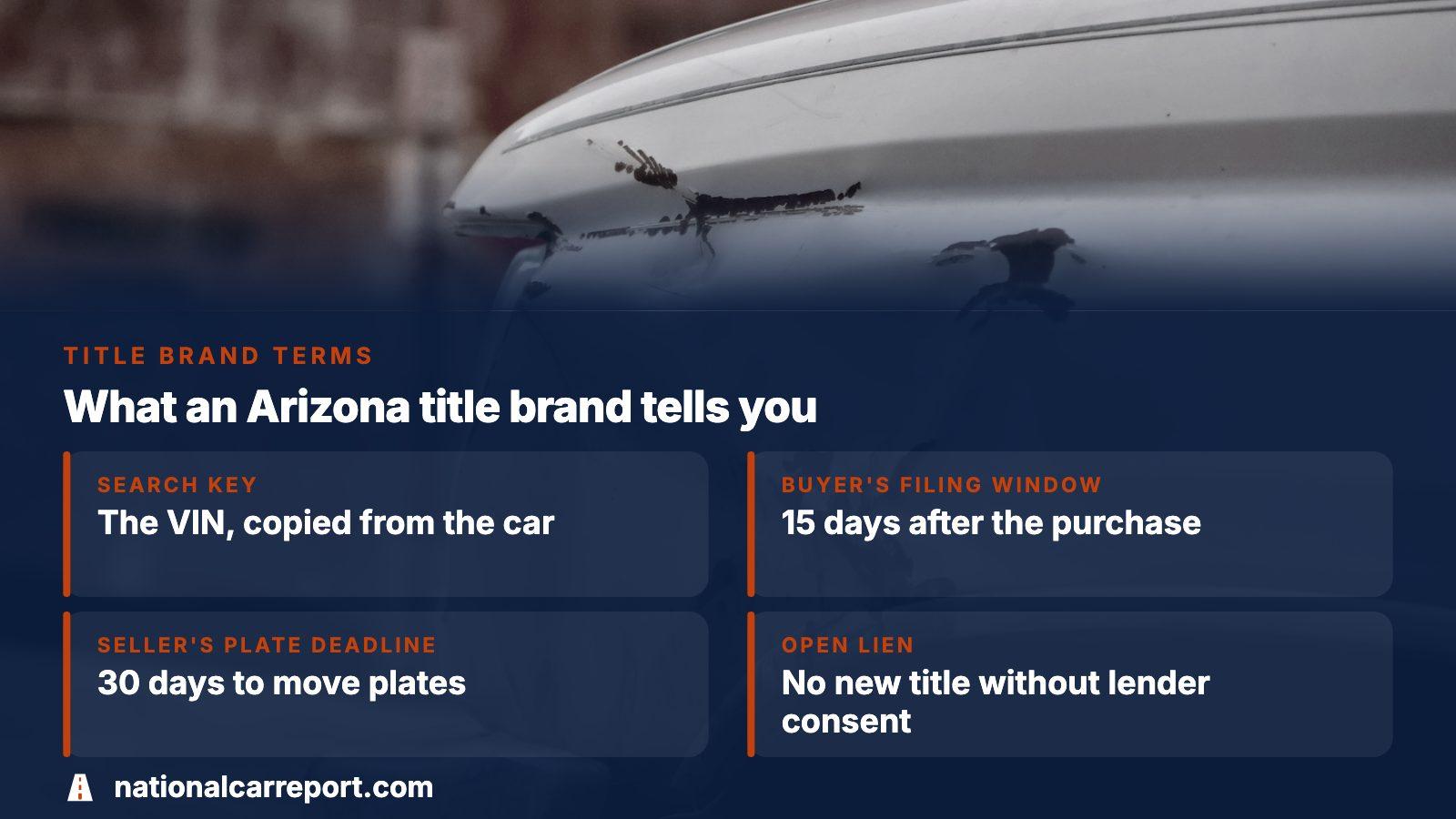
- Search key
- The VIN, copied from the car itself
- Buyer's filing window
- 15 days after the purchase
- Seller's plate deadline
- 30 days to move or surrender plates
- Lien rule
- No new title while a lender's claim is open, unless the lender agrees
What an Arizona title check has to cover
NationalCarReport reads a car through three records: who has a claim on it (liens), who reported it lost (theft) and who has held it (impound). An Arizona title covers the first and part of the second. It names an owner, carries any brand and notes a lender's claim. Police reports and tow lots sit elsewhere.
- Ownership: whose name is on the title, and whether that person can sign it over
- Brand: salvage, restored salvage, nonrepairable or stolen-vehicle status
- Liens: a lender's claim that holds up a new title
- Theft and impound: held in other records, found by a VIN search
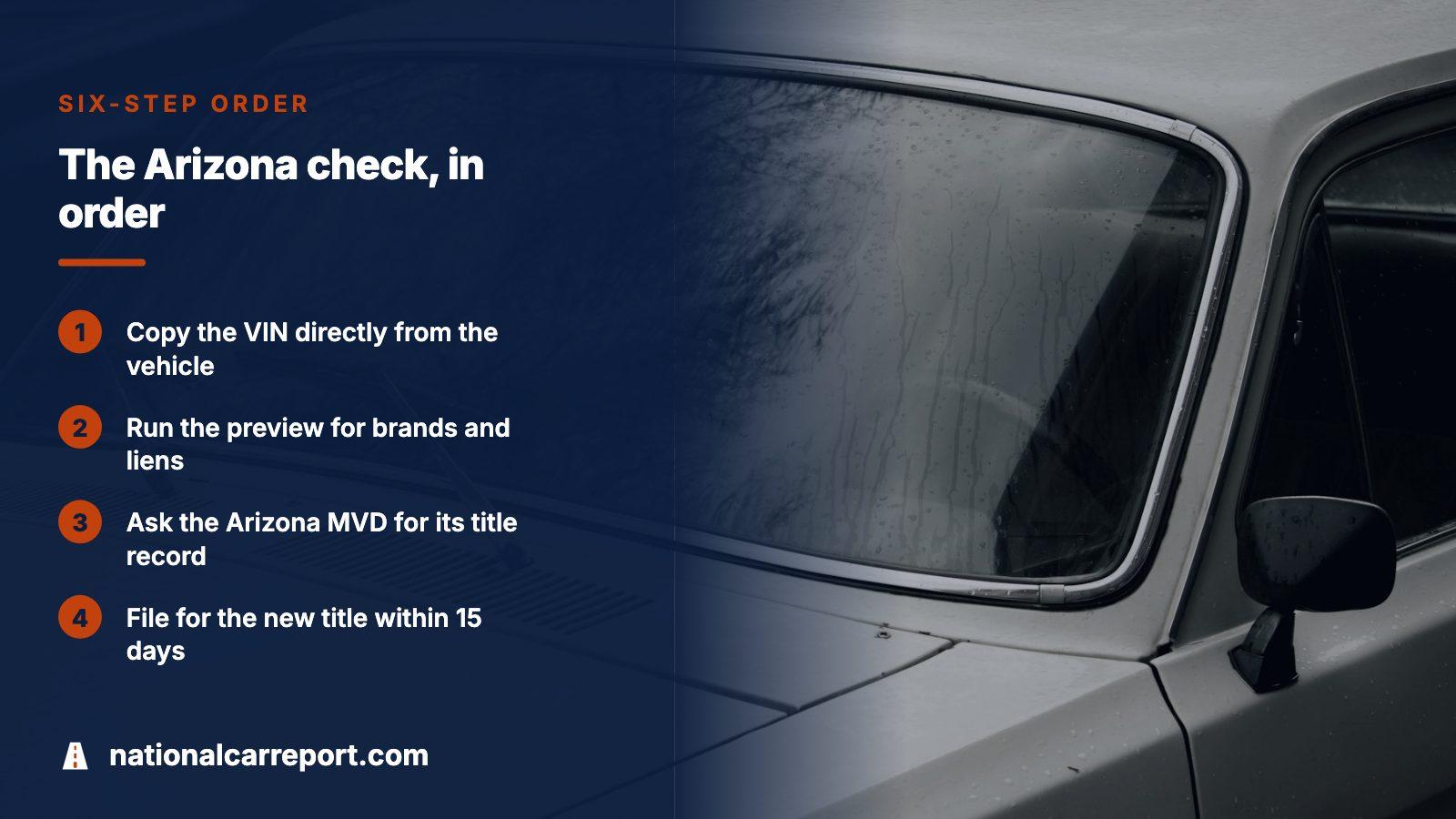
The six steps, in the order to run them
- Copy the VIN directly from the vehicle, not from the listing, then test every character against the title. A single mismatch is a reason to stop.
- Run the VIN in the NationalCarReport preview and note any brand, lien, theft or impound hit.
- Put the same VIN through NICB's lookup for flood, unrecovered theft and salvage flags, and through NHTSA's recall list.
- Ask the Arizona MVD for its record of the title: owner, lender and brand. Its online services sit at AZMVDNow.gov, so look there for lookups open to buyers.
- Examine the paper title with the seller present: a brand word, a lender's entry, the seller's exact name and the odometer statement.
- Complete the transfer, then file for the new title within 15 days of the sale.
What each source shows, and what it leaves out
Each lookup is built for one field, so use them as cross-checks.
| Source | What it shows | What it leaves out |
|---|---|---|
| Arizona MVD record | Owner, lien entries and brand as the state holds them | Other states' title records |
| National title report from an approved provider | Brand history, latest odometer, insurer total losses, salvage-yard transfers, some theft history | Reporting gaps can produce a false clean result, and liens are not among the listed contents |
| NICB's VIN lookup | Flood damage, unrecovered theft and salvage declarations, per the FTC | Ownership, lender and mileage data |
| NHTSA recall list | Unrepaired safety recalls on the VIN | Title, theft and lien data |
| NationalCarReport report | Brands, liens, theft and impound records on one page, plus odometer and salvage history | Only as current as what was reported, so the MVD record still decides ownership |
Reading the brand on an Arizona title
Arizona law sets up special title types for damaged and stolen cars. The buyer's task is to spot which one, if any, is on the table.
- Salvage: stolen, wrecked, flooded or otherwise damaged beyond what an owner, lender or insurer thought worth repairing. A seller aware of the title must disclose it clearly ahead of closing, on paper or electronically.
- Restored salvage: a rebuilt salvage car cannot change hands until the MVD inspects it and issues a restored certificate. That status must be disclosed too.
- Nonrepairable: the word is branded on the front of the title, registration is cancelled, and the MVD does no further transfers.
- Stolen vehicle: issued to the owner of a car stolen and never recovered.
A brand does not always travel
The Justice Department notes that states define brands differently, and that a car retitled in a state that skips the earlier record can lose a brand from its paper title. A national check guards against that.
Liens: what Arizona does when a lender is still listed
The MVD holds off on a new title whenever the current one carries a lien, unless the debt is paid off or the lender agrees to the transfer in writing or electronically. A live loan is cleared before the transfer, with the payoff going straight to the lender.
After repayment the lender must release its claim and tell the owner. One that keeps a title past 15 business days after the final payment can be fined by the MVD following a hearing. An owner who paid but cannot find the lender can ask the MVD to clear the record, using proof of payment and an affidavit describing the search.
Old claims
The MVD may drop a lien left unsatisfied for 12 years, but only on noncommercial vehicles, and not on travel trailers, motor homes or mobile homes. Do not rely on that when buying; ask the lender for a release.
Theft and cloned VINs: what a clean title can hide
A title proves paper, not history. The Justice Department's title-system page describes cloning: a stolen car wears a real VIN lifted from a different vehicle of matching make, model and year, hiding the theft from buyers, titling agencies and police. One multistate case it cites recovered about 250 cloned vehicles.
Insurers sometimes write off a vehicle as a total loss when it has not turned up after 30 days, and that designation stays on the record even once the car is recovered undamaged. The same page lists Arizona with 99 percent of vehicles identified as stolen recovered, naming the state motor vehicle administrators' association as the source.
When the VINs disagree
If the number on the car differs from the number on the title, or the label on the car looks altered, stop and do not pay. That is a police matter, not a paperwork fix.
Impound records and the altered-VIN rule
Arizona requires an officer to impound a car offered for sale with a VIN that has been destroyed, covered, altered or defaced. That impound lasts 20 days, and the agency must log it in the state crime information database within three business days. The owner, plus anyone else with a stake in the vehicle, can ask for a hearing.
An impound entry is a question for the seller, not a verdict. Ask why the car was held and who paid to release it.
The paperwork checklist for the day of sale
- The seller signs the title or a transfer form, with a warranty of title, and hands it over along with the car.
- The seller provides an odometer statement unless the car is exempt: 10 model years old (2010 or earlier models), 20 model years old (2011 or later models), or rated at 16,000 pounds or more.
- The buyer files for the new title inside 15 days, and the MVD collects use tax before processing the transfer.
- The buyer displays a temporary or valid plate until the MVD record names the new owner.
- The seller moves or surrenders the plates, or files a plate-destruction affidavit, within 30 days.
- A car from another state needs its old plates, registration and ownership papers handed in, and the MVD may inspect it.
What the preview and report cost, and where to go next
The preview is the part that costs nothing; it lays out what a VIN returns before you pay. A full report is a single purchase, and nothing renews afterward. Pack sizes are 3, 5 and 10, handy when several cars are in the running. Amounts are on the pricing page, and the sample report shows the layout.
Run the VIN before the deposit, take what it finds to the MVD, and treat any hit you cannot explain as grounds to leave the deal.
Where this information comes from
- Arizona Revised Statutes 28-2058: transfer of title and odometer statement — Source for the 15-day filing window, the plate deadline and the odometer exemptions.
- Arizona Revised Statutes 28-2091: salvage, stolen and nonrepairable titles — Defines the brands, the salvage disclosure duty and the nonrepairable title rules.
- Arizona Revised Statutes 28-2132: indication of lien — Shows why a new title waits on a lender's release or consent.
- Arizona Revised Statutes 28-2134: satisfaction of lien — Covers the lender's duty after payoff, the fine for holding a title and the affidavit route.
- Arizona Revised Statutes 28-3511: impoundment of vehicle — Source for the altered-VIN impound rule, the 20-day hold and the database entry.
- Department of Justice: NMVTIS for consumers — Source for what the national title system covers, its gaps, cloning and the total-loss label.
- FTC: Used cars — Describes the NICB and NHTSA lookups and why a history report is not an inspection.
Sources and photos: Facts checked against the sources above in November 2026. Photos by Owen Michael Grech, Tigran Shishmanyan and Everett Pachmann on Unsplash; diagrams by NationalCarReport.
Keep reading
- Stolen Vehicle Check in Arizona: Theft, Lien and Impound Records by VINTheft records for an Arizona car, and what a recovery looks like.
- Vehicle Lien Check by VIN: Nationwide Lien, Theft and Impound RecordsThe nationwide version of the lien step, for a car from any state.
- Impound Lookup: Find a Towed Car, Then Check Its VIN for Impound RecordsFinding a car that was towed or held, and what to ask afterward.
- PricingOne report or a pack, paid once, with no subscription.
Frequently asked questions
How do I run an Arizona title search?
Start with the VIN from the car. Run it in the preview for brands, liens, theft and impound records, then ask the Arizona MVD for its record of the owner and any lender. Hold both up against the title in the seller's hands.
Is there a free car title search in Arizona?
Only parts of one. The preview is free and shows what a VIN returns, and NHTSA's recall list is free too. Neither replaces the MVD's own record of ownership and liens. Anything beyond the preview is a paid report, bought once.
How long do I have to put an Arizona title in my name?
A buyer has 15 days after the purchase to apply. Carry a temporary or valid plate until the MVD record shows you as the owner. Confirm the current fee and required documents with the MVD before you go.
Can I buy an Arizona car that still has a lien?
Only if the lender is paid or agrees to the transfer. Until then the MVD withholds a new title, so pay the lender directly and have the release in hand. A promise to settle later leaves the claim on a car you now own.
What does a nonrepairable title mean in Arizona?
The word nonrepairable is branded on the front of the title, the registration is cancelled, and the MVD makes no further transfers or paper titles for that car. Ownership can be reassigned no more than two times.
Now check the car itself
The guide explains what to look for. The report shows what this VIN has on record.