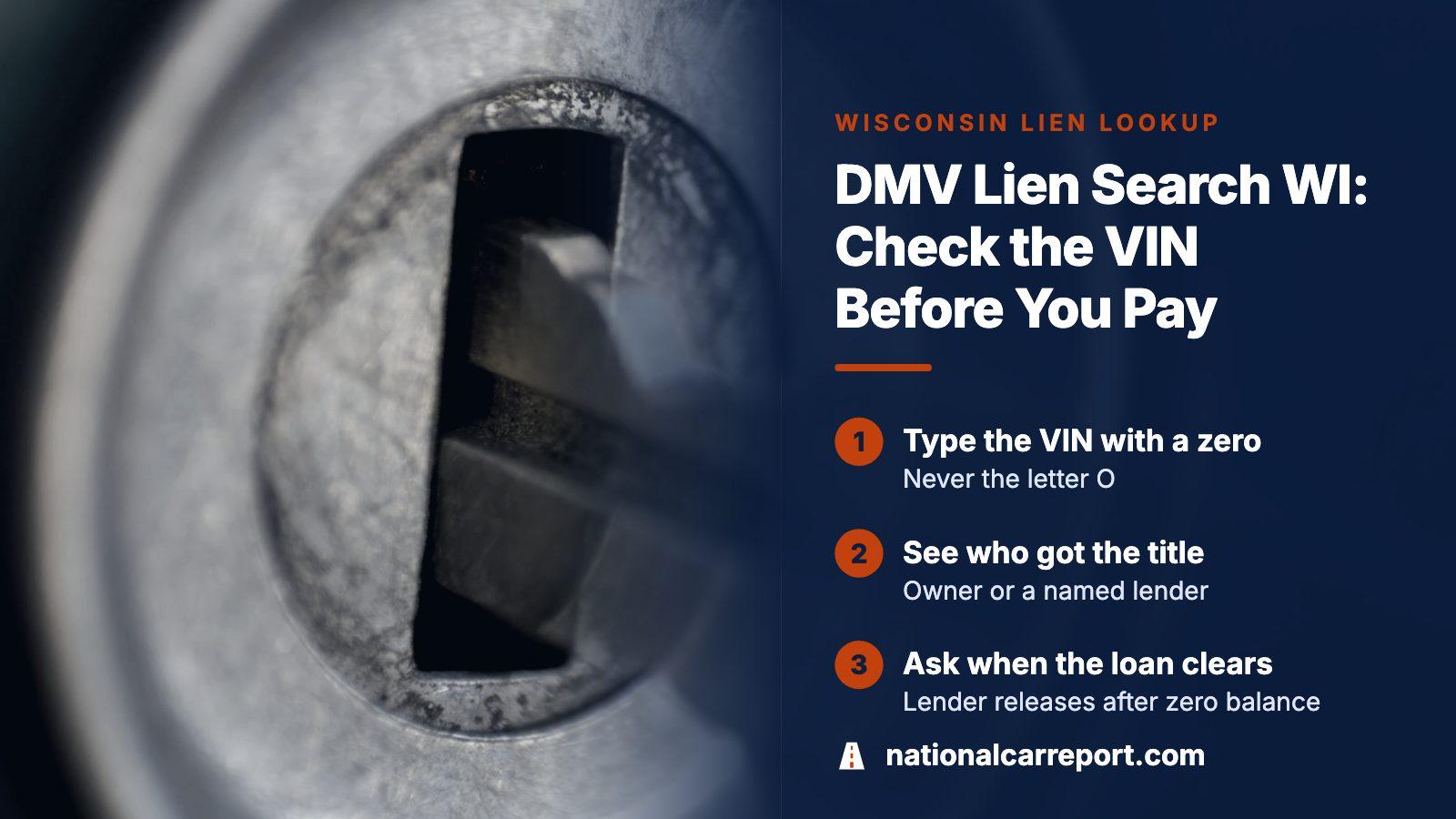
THE SHORT ANSWER
For a Wisconsin lien check, enter the VIN in the state's lien holder lookup. It reports who got the title, the owner or a lender, and names a business lender. A lender holding the title means a loan is still open. Next, run the VIN in the preview for lien, theft and impound records from beyond Wisconsin. Neither result replaces the signed title and the lender's release in the seller's hands.
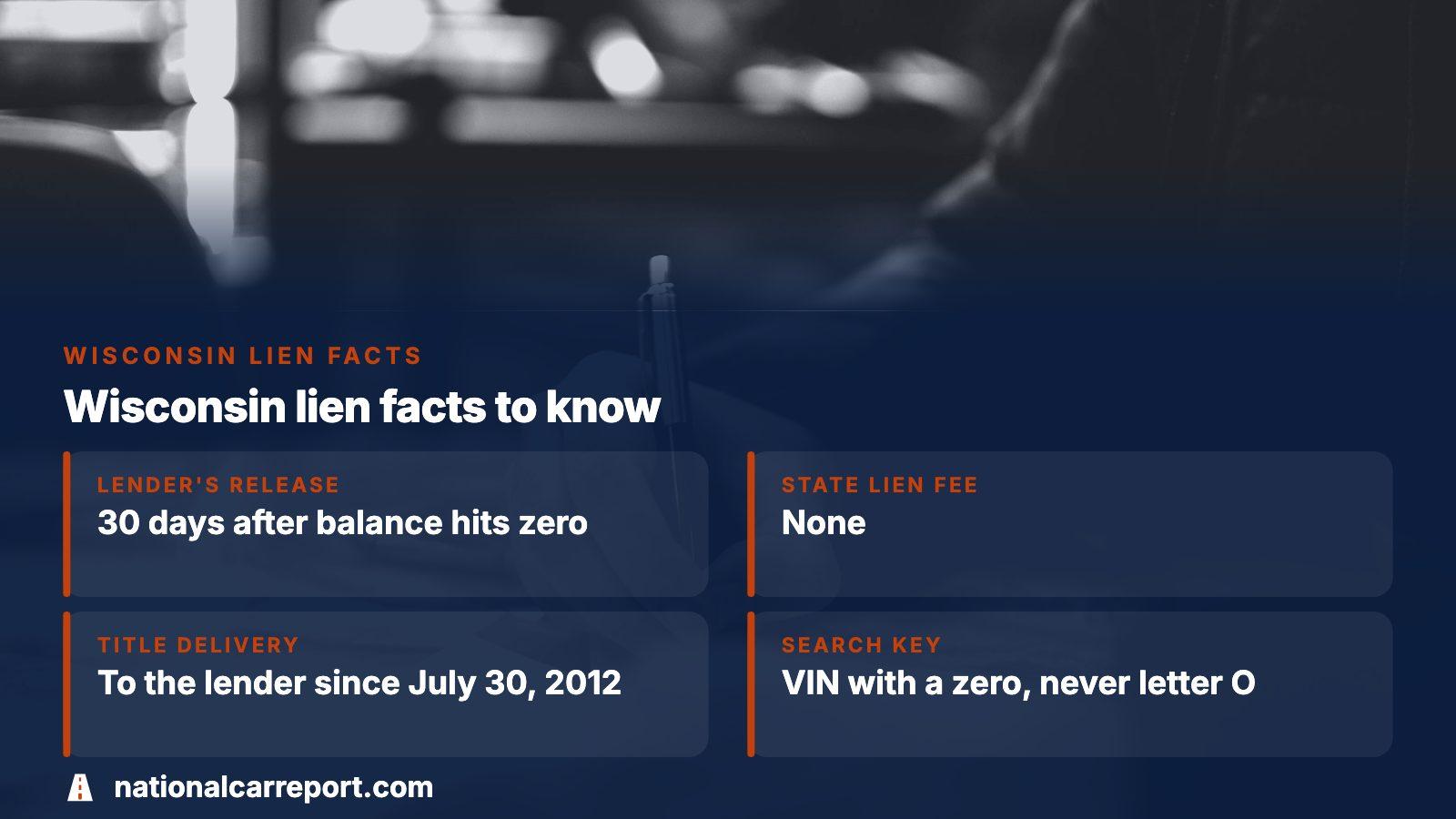
- Search key
- The VIN, typed with a zero, never the letter O
- Title delivery since July 30, 2012
- To the lender, with the owner holding a Confirmation of Ownership
- Lender's release window
- 30 days after the loan balance reaches zero
- State fee to remove a lien
- None
What WisDOT's lien search shows for a VIN
Enter a VIN in the state's online lien holder lookup and it answers a single question: did the title go to the owner or to a lender. If the loan came from a bank, credit union or dealer finance arm, you also get that lender's name and address. A personal loan stays hidden, because an individual lender's details are not displayed.
Use the number zero where the letter O would go. Q and I never appear in standard VINs, so either one signals a typo. When the lookup finds nothing, WisDOT points to its title transfer search, which shows whether a title was issued recently.
Why a Wisconsin seller may have no title to hand you
Loans recorded from July 30, 2012 onward send the title to the lender. The owner is given a Confirmation of Ownership instead, a document with no power to move ownership. The real title reaches the owner by mail only after the loan is paid.
Older loans work the other way. The owner received the title with the lender's claim printed on it, so paper in the seller's hand can still carry an open lien. Read the title as well as the lookup.
A quick test on the driveway
Ask to see the title. A Confirmation of Ownership, or a lender named as recipient in the lookup, means the loan comes first and the lender is paid before the car changes hands.
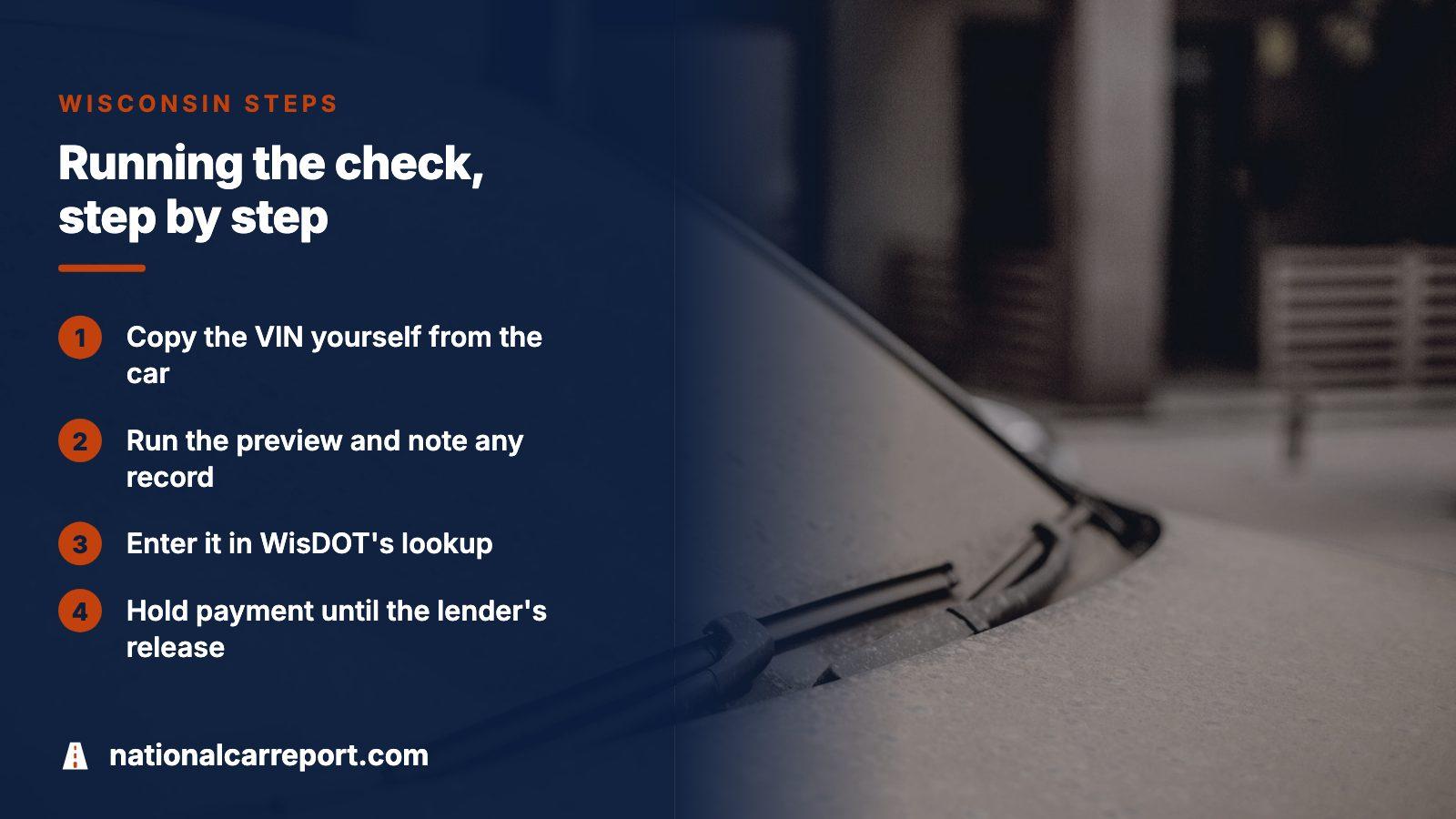
Running the check, step by step
The two lookups cover different ground, so run both before any money moves.
- Copy the VIN yourself from the car rather than the ad, and confirm it matches the paper the seller shows.
- Enter it in the NationalCarReport preview and note any lien, theft or impound record.
- Enter it in WisDOT's lookup. Write down who received the title and, for a business lender, its name.
- Ask the seller to name the lender, then call that lender yourself for a payoff figure.
- Hold the money until you have the lender's release, or a state record showing the lien gone.
What each result means and what to do
| What you see | What it suggests | Your move |
|---|---|---|
| Title went to a lender | A loan is open and the lender holds the title | Get a payoff figure and pay through the lender |
| Title went to the owner | No lender holds it now, though an older lien may be printed on it | Read the title and match the seller's name |
| A bank or finance company is named | Someone is owed money on this car | Call it using the details WisDOT shows, not a number from the seller |
| Seller admits a loan, no lender appears | Possibly a personal loan, which WisDOT hides | Ask for the loan paperwork and a signed release |
| No record for the VIN | A typo, or a very recent title | Recheck the VIN and try the title transfer search |
| Preview shows a lien, theft or impound record | An event the title may not mention | Ask for a written explanation; leave if a theft was never recovered |
If the seller's loan is still open
An open loan does not end the deal, but the order of payment decides who owns the car. WisDOT tells a seller with a loan to get the title first, which means paying the loan off. If a lien is still on the title, the buyer needs the lender's release along with it.
A safer route is to meet at the lender, let your money clear the balance there, and collect the release. Then run the lookup again. Once the lender's claim is gone from the state record, WisDOT says the owner need not wait for the mailed title to sell.
- Lender's deadline: 30 days after the balance reaches zero, or 10 days if a written request comes after the debt is gone
- Fee and wait: no state fee to remove the lien, then up to six weeks for the new title
A payoff letter is not a release
WisDOT's lender guidance calls a payoff letter a note for the customer, not something to file with the DMV. The release is the separate step that clears the record.
Tow, repair and storage claims that follow a car
A lender is not the only party that can claim a car. A Wisconsin mechanic, self-storage facility or towing company owed money for its services can ask WisDOT for a title, or to junk the vehicle.
That route requires certified mail to every owner and lender, with at least 20 days for the car to be reclaimed, which can mean paying the unpaid bill. If nobody comes, a sale follows. For landlord, storage and tow sales, WisDOT warns that a lender's lien with no release supplied carries onto the new owner's title.
An impound record in the preview is therefore a cue to ask who paid the bill, whether the lender was told and where the release is.
Signs the seller is not who the title says
WisDOT describes unlicensed dealers who sell cars never titled in their own names, a habit it calls title jumping, and lien trouble tends to follow. Typical signs:
- Several vehicles for sale at once, online or on a makeshift lot
- A car titled to a friend or relative the seller says he represents
- No title to show, or no plates on the car
- A viewing at a gas station or shopping center instead of the seller's home
Selling more than five vehicles a year takes a dealer license. WisDOT's advice: if the title is missing or the name differs, shop elsewhere. Its lender guidance adds that where the loan was recorded after that 2012 date, just the first lender can ask for a duplicate paper title, so a seller with an open loan cannot order one alone.
What national records add, and what they leave out
Wisconsin's record is the authority on a Wisconsin lien. The federal title system adds brands, the latest reported odometer readings, insurer total-loss rulings, and cars passed to salvage or junk yards. Liens are not on that list, and the Justice Department warns that a clean search can be wrong, since not every source reports yet.
That is why the NationalCarReport preview is a screen, not a clearance. It looks for lien, theft and impound records tied to the VIN, which helps when a car was titled elsewhere first, but a quiet result is not a release.
Cost, then the finishing steps
Only the preview costs nothing, and it shows what the VIN returns before any payment. The full report is a single purchase, one report or a bundle for comparing cars, with no renewal. The pricing page has the single-report and pack options; the sample report previews what you get.
Once the paperwork lines up, plan to title and register within two business days of buying, if the car will be driven. WisDOT takes the original title, not a photocopy. Its selling form MV2928 is not a valid bill of sale, so write one listing the VIN, odometer reading, price, date and both signatures.
Where this information comes from
- WisDOT: Lien holder search — Source for what the lookup shows, how titles go to lenders after July 2012, the Confirmation of Ownership and lien removal.
- WisDOT: Selling your vehicle — Source for the seller's duty to hold the title, the lender's release and the dealer license threshold.
- WisDOT: Selling a vehicle, points to remember — Source for the buyer's titling deadline, the original-title rule and the bill of sale note.
- WisDOT: Lien Holder Processing FAQs — Lender-facing guidance on release deadlines, payoff letters and who may request a replacement title.
- WisDOT: Involuntary lien transfers and abandoned title process — Explains how repair, storage and tow businesses can seek a title, and the notice they must send.
- WisDOT: Unlicensed car dealers — Lists the habits of unlicensed sellers and the state's advice for buyers.
- NMVTIS: For consumers — Shows what a federal title record covers and warns that results can be incomplete.
Sources and photos: Facts checked against the sources above in November 2026. Photos by Derek Nelson, JavyGo and Owen Michael Grech on Unsplash; diagrams by NationalCarReport.
Keep reading
- Vehicle Lien Check by VIN: Nationwide Lien, Theft and Impound RecordsThe nationwide version of this check, for a car from any state.
- DMV Lien Release Search: How to Confirm a Lien Is GoneHow to confirm a lender has really let go of its claim.
- Impound Lookup: Find a Towed Car, Then Check Its VIN for Impound RecordsFinding out whether a car was held at a tow or storage yard.
- PricingOne report or a pack, paid once, with no subscription.
Frequently asked questions
How do I do a DMV lien search in Wisconsin?
Open WisDOT's lien holder lookup, enter the VIN with a zero instead of the letter O, and read who received the title. A lender's name means a loan is open. Then run the preview for lien, theft and impound records, and ask the seller for the title or the lender's release before paying.
Is there a free Wisconsin lien search?
The preview costs nothing, while the report is a one-time purchase. WisDOT runs its own lien lookup at its DMV site, so check that page for current terms and availability. Neither one stands in for the lender's release, which is the step that actually clears the car.
Can I buy a Wisconsin car that still has a lien?
Yes, if the lender is paid first. Send the quoted balance to the lender, give the seller whatever remains, and get the release in writing. Handing the seller the full price against a promise to pay the lender later leaves the claim attached to a car you now own.
How long does a Wisconsin lender have to release a lien?
WisDOT's lender FAQ gives 30 days once a payoff brings the balance to zero. If a written request arrives after the debt is gone, the window shortens to 10 days. The DMV prints titles on Tuesday, Thursday and Saturday.
What if the lien search shows nothing but the seller admits a loan?
The state hides a personal lender's name and address, and a lien from before July 30, 2012 sits on the paper title instead. Ask who holds the title, request the loan paperwork, and run the preview too. If the seller will not let you contact the lender, walk away.
Now check the car itself
The guide explains what to look for. The report shows what this VIN has on record.