THE SHORT ANSWER
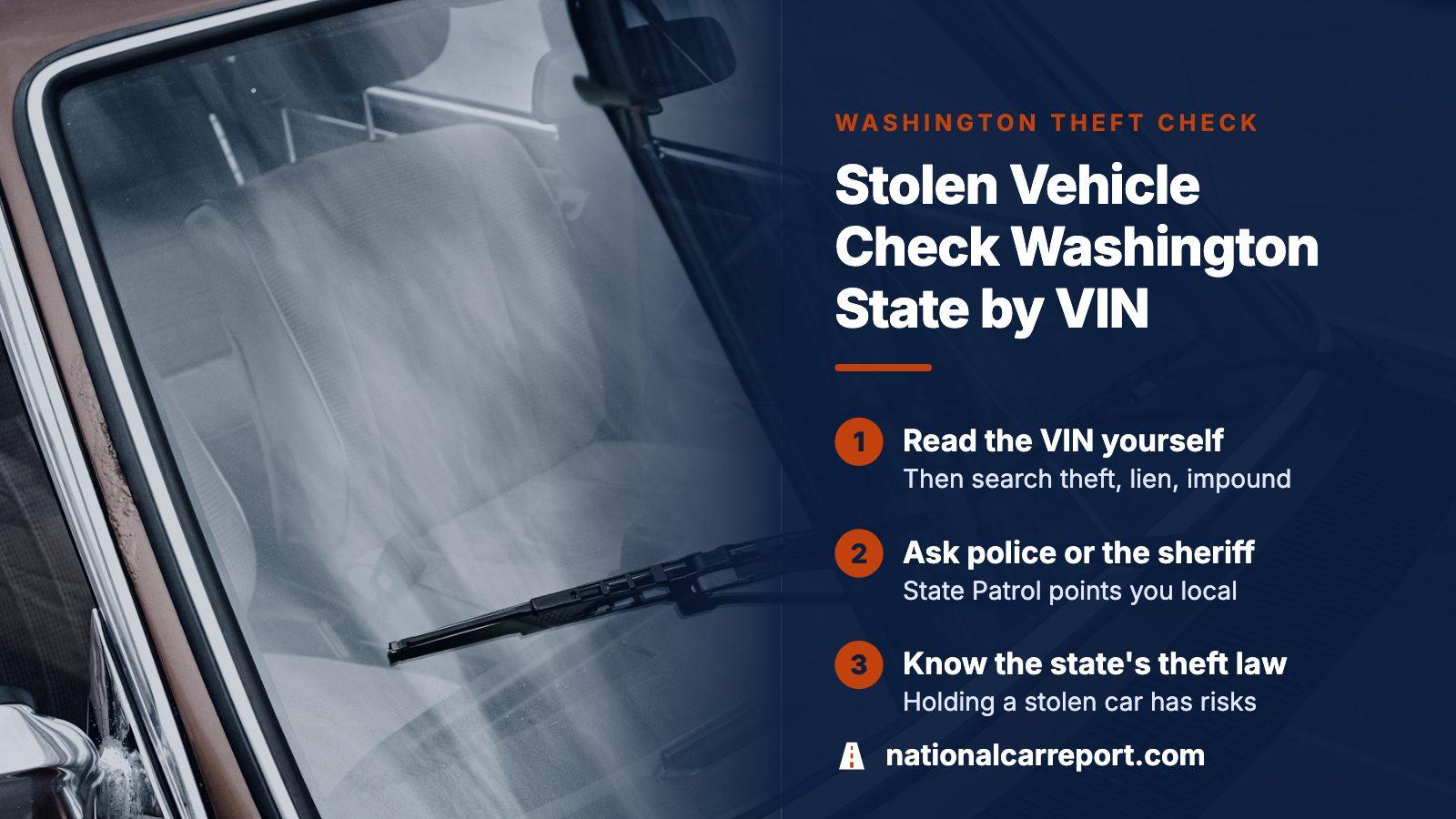
To check a car for theft in Washington, read the 17-character VIN off the vehicle, search it for theft, lien and impound entries, then ask the police or the sheriff's office near the seller whether the car shows as stolen. The State Patrol says a buyer needs no VIN inspection for that. Neither step proves a clean history, so compare the stamped VIN with the title and inspect the car.
- State Patrol advice
- Ask local police or the county sheriff
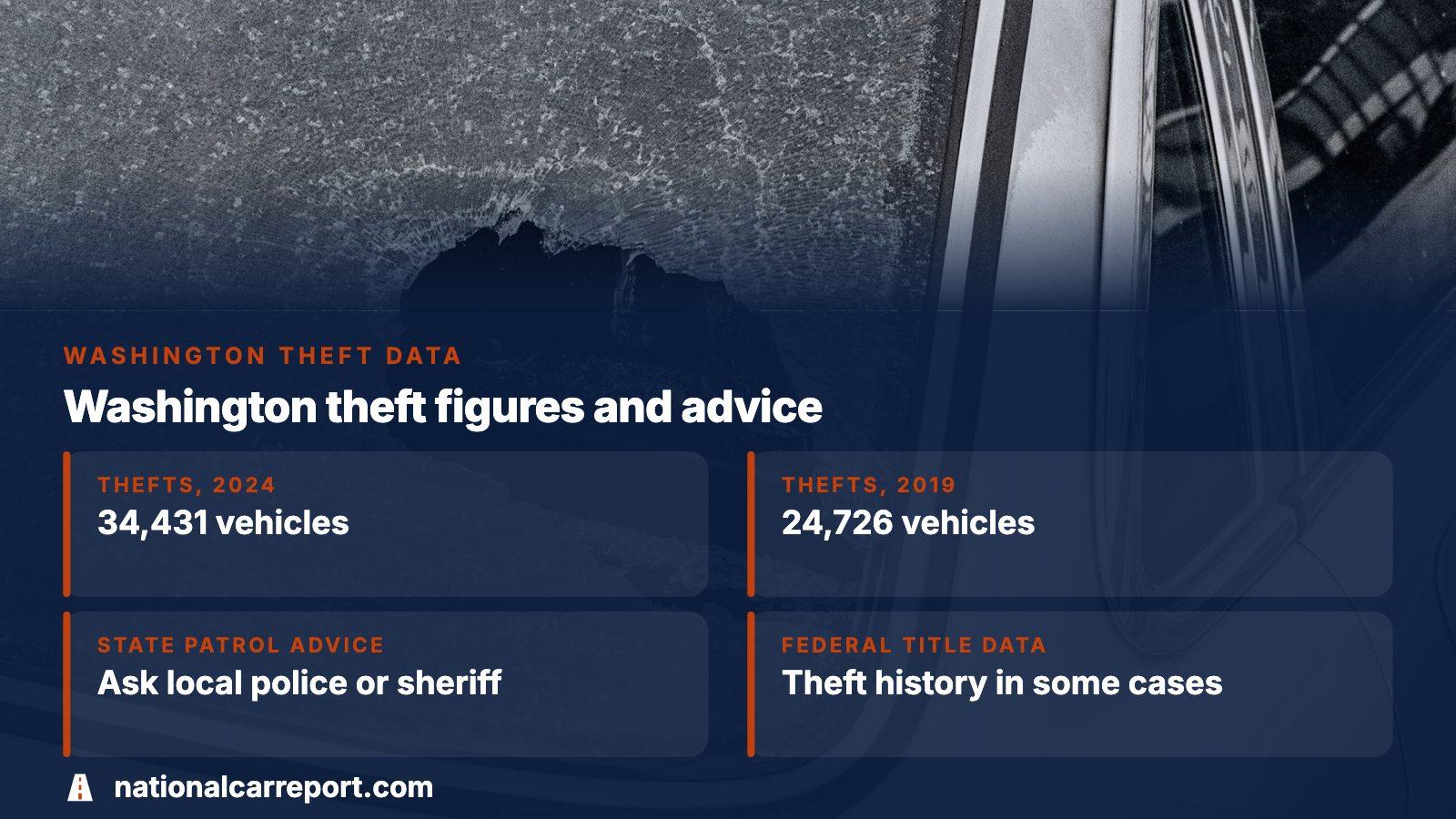
- Washington vehicle thefts, 2024
- 34,431, up from 24,726 in 2019
- Federal title data
- Theft history only in some cases
- NationalCarReport preview
- No charge; the report is bought once
Who can tell you a Washington car is stolen
No single desk answers this for a buyer in Washington. Police create the theft entry, the Department of Licensing controls the title, and the federal title database sees only part of either. The table shows what each place can say about one VIN, and where it runs out.
| Source | What it can tell you | Where it stops |
|---|---|---|
| Local police or county sheriff | Whether the car shows as stolen, which is the route the State Patrol names for buyers | The State Patrol's guidance covers theft status only |
| State Patrol VIN inspection | Whether the stamped number is real and matches the title, once DOL sends a car for inspection | Ordered through titling rules, not offered as a stolen-car lookup |
| NMVTIS, the federal title system | Current title details, brand history, the most recent reported mileage and insurer write-offs | Theft history appears only in some cases |
| NationalCarReport preview and report | Theft, lien and impound entries for the VIN, nationwide, next to title brands | Limited to what each source has reported |
What Washington's theft numbers mean for a buyer
In August 2025 the state's association of sheriffs and police chiefs published a comparison built on FBI figures. Between 2019 and 2024, vehicle thefts in Washington climbed from 24,726 to 34,431, a rise of 39.25%. Measured per 100,000 residents, the rate moved from 320.80 to 432.65, up 34.87%, while the national rate rose 15.99% across the same years.
Those totals count reports. They say nothing about the car you are standing beside. What they do suggest is a larger pool of vehicles that have a theft record somewhere in their past, some recovered, some repaired, some listed for sale again. Washington law even sets up a dedicated inspection path for cars whose VIN was altered or removed.
Running the check on a Washington car
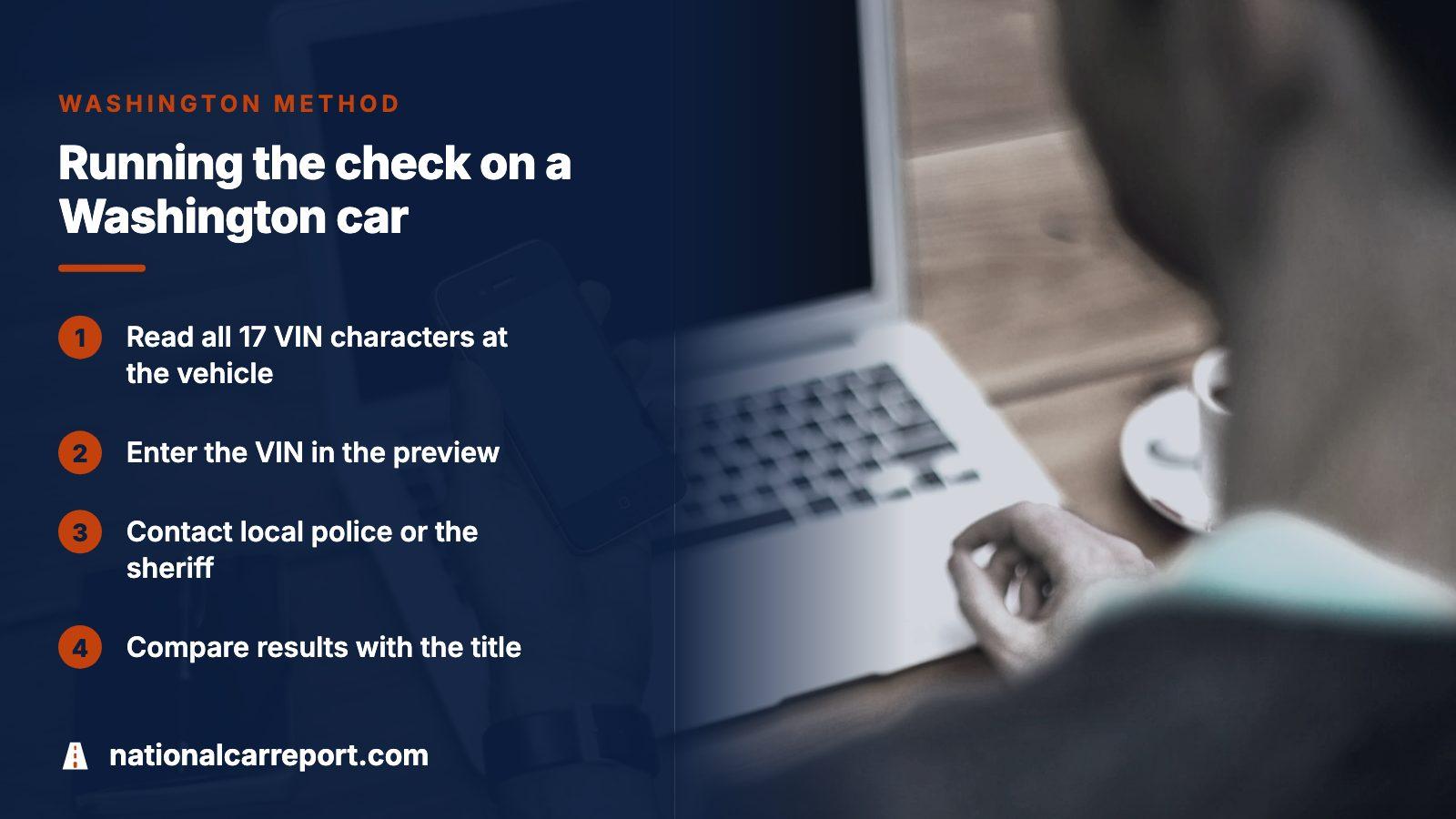
- Begin at the vehicle: read all 17 characters of the VIN there, then set that number against the title and the registration. A single character off is reason enough to stop and ask the seller why.
- Enter the VIN at NationalCarReport. The preview costs nothing and lists which theft, lien and impound records exist for that car before you pay.
- Contact the police department or county sheriff's office near the seller and ask an officer to confirm the car does not show as stolen. Write down who answered and the date.
- Set the results beside the title: the seller's name, any brand, any lender listed.
- If the preview and the officer both look right, buy the full report so every entry is in front of you, then inspect the car with it in hand.
Where the State Patrol's VIN inspection fits
The State Patrol inspects vehicles when the Department of Licensing asks it to, with the stated aim of deterring auto theft and the trade in stolen parts. A licensing agent decides at titling whether a car needs one. The inspector confirms the number on the car is real and matches both the title and the registration. Three main situations trigger it:
- A car declared a total loss in Washington and later rebuilt, or one arriving with another state's papers showing a total loss and no valid registration since.
- A first-time title on a street rod, kit car, custom build, assembled vehicle or homemade one, or a car handled as ownership in doubt.
- A car whose VIN was altered, defaced, obliterated or is missing. The State Patrol assigns a new number, stamps it on the car, and DOL treats it as the official VIN.
A rebuilt salvage car that passed gets a marking on the driver's door post, and anyone who strips it off commits a class C felony. If a car's history shows a total loss and that marking is absent, ask the seller to explain before anything else.
Reading what comes back
| Result | What it suggests | Your move |
|---|---|---|
| Reported stolen, not recovered | The car sits on an active theft record | Stop the purchase, give the VIN and the listing to police, and do not confront the seller |
| Theft entry with a recovery | The car came back in unknown condition | Ask for repair invoices and inspect the frame, the VIN plate and the wiring |
| Impound entry | The car spent time in a tow lot | Ask who released it, on what date, and whether fees were paid |
| Lien listed | A lender may still hold a claim | Get the lender's written release before paying the seller |
| Total-loss or salvage brand | An insurer wrote the car off | Price it as branded and ask for the State Patrol inspection papers if it was rebuilt here |
| VIN differs from the title | Tampering or a paperwork error | Stop, and ask an officer to look at the car and the documents |
| Nothing found | No entry in the sources searched | Still get the officer's answer and inspect the car |
What Washington law says about holding a stolen car
The state's vehicle statute is brief: a person who possesses a stolen motor vehicle commits a class B felony. Its text says nothing about what the possessor knew. A separate statute on stolen property in general speaks of knowingly holding goods known to be stolen, and adds that a thief who was never caught or identified is no defense for the person holding them. Neither passage tells you how a case against one particular buyer would end, so treat that as a question for a lawyer.
A different rule applies when a seller has no title. Under the ownership-in-doubt procedure, a buyer can register a car without a title for three years or obtain a bonded title, and the bond has to be worth one and a half times the car's value as DOL values it. Anyone who held an interest in the car can go to court during that period. A buyer who needs this route has already taken on the problem, so the VIN search is the easier moment to learn that.
Cost, and your next move
No money changes hands for the preview: you enter a VIN and see which records exist. Going further means paying once for the full report, and larger bundles of 3, 5 or 10 are offered to people shopping around. Nothing auto-renews. Check the pricing page for what each option costs today.
Two checks, not one
A clean preview and an officer's answer cover different ground. Do both before money moves, keep a note of who confirmed what and when, and treat any mismatch between the plate on the car and the figures printed on the title as a stop sign.
If a theft entry appears, walk away and hand the VIN and the listing to police. If a lien or an impound entry appears, the car may be sellable once the claim is cleared, but only against paperwork from the lender or the lot.
Where this information comes from
- Washington State Patrol: VIN Inspections — The State Patrol's own answer on checking a car for theft, who gets a VIN inspection and why.
- Washington Legislature: RCW 46.12.560 — When a title application needs a State Patrol inspection and what the inspection must verify.
- Washington Legislature: RCW 46.12.680 — The ownership-in-doubt route, its three-year period and the bond size.
- Washington Legislature: RCW 9A.56.068 — The state's possession-of-a-stolen-vehicle statute and its felony class.
- Washington Legislature: RCW 9A.56.140 — The general stolen-property statute, its knowledge element and the thief-conviction point.
- NMVTIS: For Consumers — What the federal title system reports and its limited theft coverage.
- WASPC: Washington crime trends compared to national trends — Washington and national vehicle theft figures for 2019 and 2024.
Sources and photos: Facts checked against the sources above in November 2026. Photos by Max Tokarev, Alejandro Escamilla and Kenan Reed on Unsplash; diagrams by NationalCarReport.
Keep reading
- Stolen Car Check by VIN: Nationwide Theft, Lien and Impound RecordsThe nationwide version of this check, covering every state's theft records.
- Seattle Impound Lookup: Find a Towed Car, Then Run a VIN CheckFinding a towed car in Seattle and what a tow record means for a buyer.
- Vehicle Lien Check by VIN: Nationwide Lien, Theft and Impound RecordsHow a lender's claim sits beside a theft entry and what to do about one.
- Theft Recovery Vehicle: Stolen, Lien and Impound Checks Before You BuyWhat a recovered stolen car leaves behind in its title and repair history.
Frequently asked questions
Is there a public stolen car database for Washington State?
The State Patrol's guidance for buyers does not point to a public search page. It says a commissioned officer, reached through city police or a county sheriff, can tell you whether a car shows as stolen. A VIN search then adds theft, lien and impound entries from beyond Washington.
Do I need a State Patrol VIN inspection before I buy a car?
No. The State Patrol inspects cars when DOL requires it at titling, such as rebuilt total losses, altered or missing VINs and certain first-time titles. A buyer who only wants theft status confirmed is told to see a police officer instead, and a full inspection is not required for that.
What happens when a car's VIN was altered or removed?
Before such a car can be titled in Washington, the State Patrol must inspect it. The patrol assigns a new VIN, stamps it in a visible spot, and DOL uses that number as the official one. A buyer meeting a car with a missing or changed number should pause and ask why.
Will a stolen car check also show liens and impounds?
The NationalCarReport preview lists which theft, lien and impound entries exist for a VIN, and the full report shows them beside title brands. They are separate records: a car can carry a lender's claim or a tow entry without any theft flag, and the reverse.
Is a clean result proof that the car is safe?
No. A search returns what its sources have recorded, and the federal title system carries theft history only in some cases. Pair the VIN search with an officer's answer, a comparison of the car's VIN and the title, and a physical inspection before you pay.
Now check the car itself
The guide explains what to look for. The report shows what this VIN has on record.