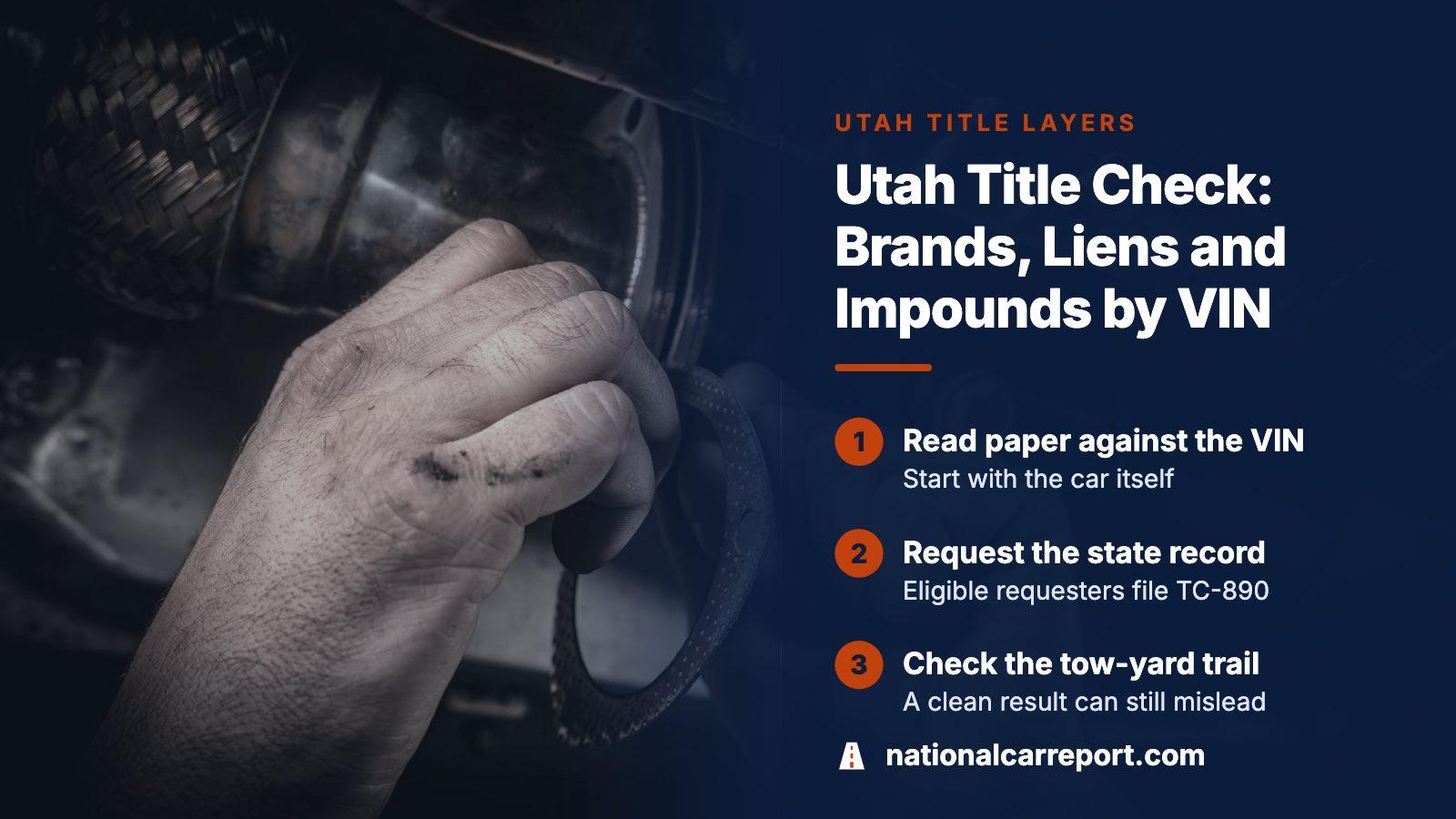
THE SHORT ANSWER
To check a Utah title, read the paper against the car's VIN, then screen that VIN nationally for brands, odometer history, total-loss and salvage entries, theft, liens and tow-yard records. Utah's own title record goes to eligible requesters who file a signed release application, so a buyer should not count on it. Running the VIN preview costs nothing; the paid report is a single purchase afterward, with amounts on the pricing page.
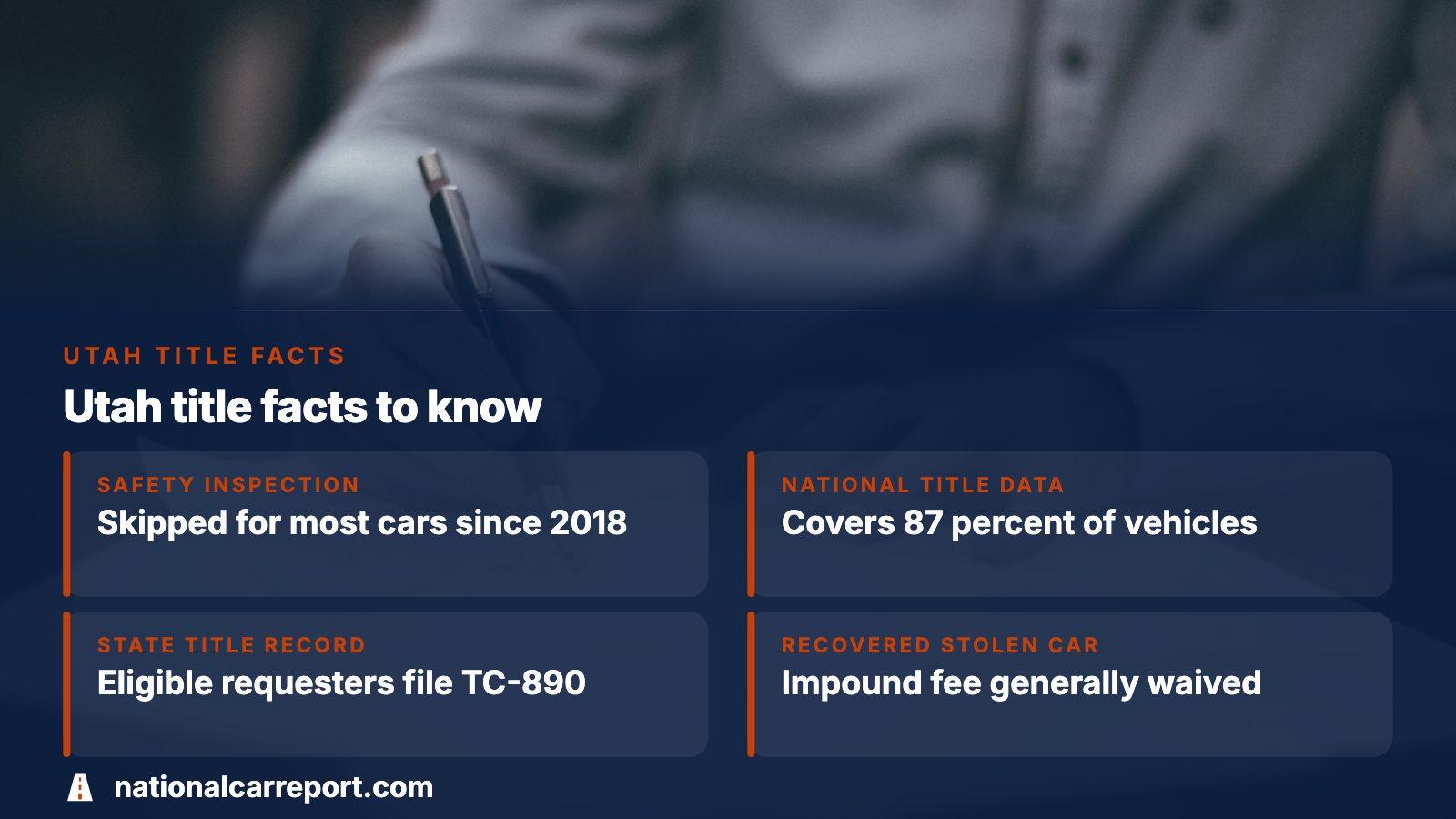
- State title record
- Eligible requesters file Form TC-890; a fee applies per record
- Safety inspection
- Skipped for most cars since 2018; salvage cars pass once
- National title data
- Covers 87 percent of U.S. vehicles, with gaps
- Recovered stolen car
- Impound fee generally waived when theft was reported
What Utah itself will release about a title
The route the Justice Department lists for Utah's own title record is a request form, not an instant lookup. Its state-by-state guide says anyone eligible under the federal Driver Privacy Protection Act and Utah statutes can request a motor vehicle record on form TC-890, the Release of Protected Record Application. The signed form goes to the Division of Motor Vehicles with payment and any supporting papers, at a fee per record shown on the form.
Whether a private buyer qualifies as eligible is a question for the Utah DMV. Ask first and allow time for the mail; the paper title and the VIN screens below can start today.
What each layer of a Utah title check answers
No one source settles a Utah car. Each row pairs a worry with the layer that answers it.
| You want to know | What answers it |
|---|---|
| Does this paper belong to this car? | Title VIN against the VIN on the vehicle |
| Has any state branded it, or an insurer written it off? | National title data: brands, total-loss and salvage entries |
| Can the mileage be trusted? | Latest reported odometer readings in that data |
| Is it in a tow lot right now? | The Tax Commission's impound search, run on the VIN |
| Was it stolen and then recovered? | Theft entries in a history report, plus tow and release paperwork |
| Does a lender still have a claim? | Lien entries in a report, closed only by the lender's written release |
Five signals from the federal title system
NMVTIS, the Justice Department's national title system, takes reports from the agencies that title cars, from recyclers, junkyards and salvage yards, and from insurers, all under a federal reporting duty. Its vehicle report is brief and rests on five signals:
- The state that currently holds the title and the date it was last issued, which tests the paper in your hand.
- Brand history carried over from other states, so a salvage or flood label crosses state lines with the car.
- Odometer readings, handy for spotting a number that drops between entries.
- A total-loss finding, which generally means severe damage.
- A salvage history, which signals the same.
A clean result is good news but a narrow one: repair histories and recall data fall outside it.
Where a clean result can still mislead
Coverage is incomplete. By the Justice Department's figures, about 87 percent of vehicles on U.S. roads are in the system, with around 20 million salvage and total-loss records, while participation among states is partial (more than half report), so a search can still come up empty for a car with a past. A damage-to-value threshold may brand a car salvage in one state and not the next, and flood damage is branded in certain states and left unlabeled in others.
A stolen car that returns
If a stolen car is not found within 30 days, its insurer may label it a total loss. Should it surface later in perfect shape, the label stays and the car may be sold running well. A total-loss entry beside a clean Utah title is worth asking about: theft may explain it.
The tow-yard trail on a Utah car
Utah's State Tax Commission runs an online Impound Vehicle Search. Enter a VIN, a plate and state, or a State Impound Form number, and a match shows the tow details and where the car is held. Release rules depend on the impound type:
- Private impound: photo ID and proof of ownership at the yard, plus towing and storage charges.
- State impound: a motor vehicle office first, for ID, proof of ownership, penalties and titling or registration fees, and a Letter of Impound Release. Then the yard, with that letter and ID.
- State removal: the yard directly, with ID and proof of ownership, plus towing and storage charges.
These instructions speak to owners, but they show a buyer what paper should exist if the seller says the car was towed once.
A stolen car that came back, and one that never left
Utah Highway Patrol says an owner whose stolen car is recovered must still visit the DMV for release paperwork before the yard lets it go. The administrative impound fee is usually dropped when the theft was reported, though towing and storage charges typically stay with the owner. Either way the car collects records, and a VIN report reads them together.
Cloning is the opposite case. In Operation Roadrunner, authorities took back roughly 250 cloned vehicles that had been stolen. Thieves had swapped in VINs removed from other vehicles of one make, model and model year, so titling offices, police and buyers saw plausible paperwork. Checking the title's VIN against two spots on the car catches crude swaps, but a careful clone can pass, so a history that contradicts the seller deserves a harder look.
Salvage rebuilds and Utah's thin inspection rules
Registration renewal no longer requires a safety inspection for most passenger vehicles, a change dated January 1, 2018. Salvage vehicles are one exception: a single safety inspection, at the first registration as salvage. Emissions testing is a separate requirement in five counties: Salt Lake, Davis, Weber, Cache and Utah.
So an ordinary Utah car may have no inspection history, while a salvage vehicle gets exactly one, at that first registration. Neither replaces a mechanic's eye. According to the FTC, history reports typically skip mechanical problems and cannot replace an independent inspection, and a mechanic's inspection is a different thing from a safety inspection, which usually screens only for unsafe conditions.
Running the check in order
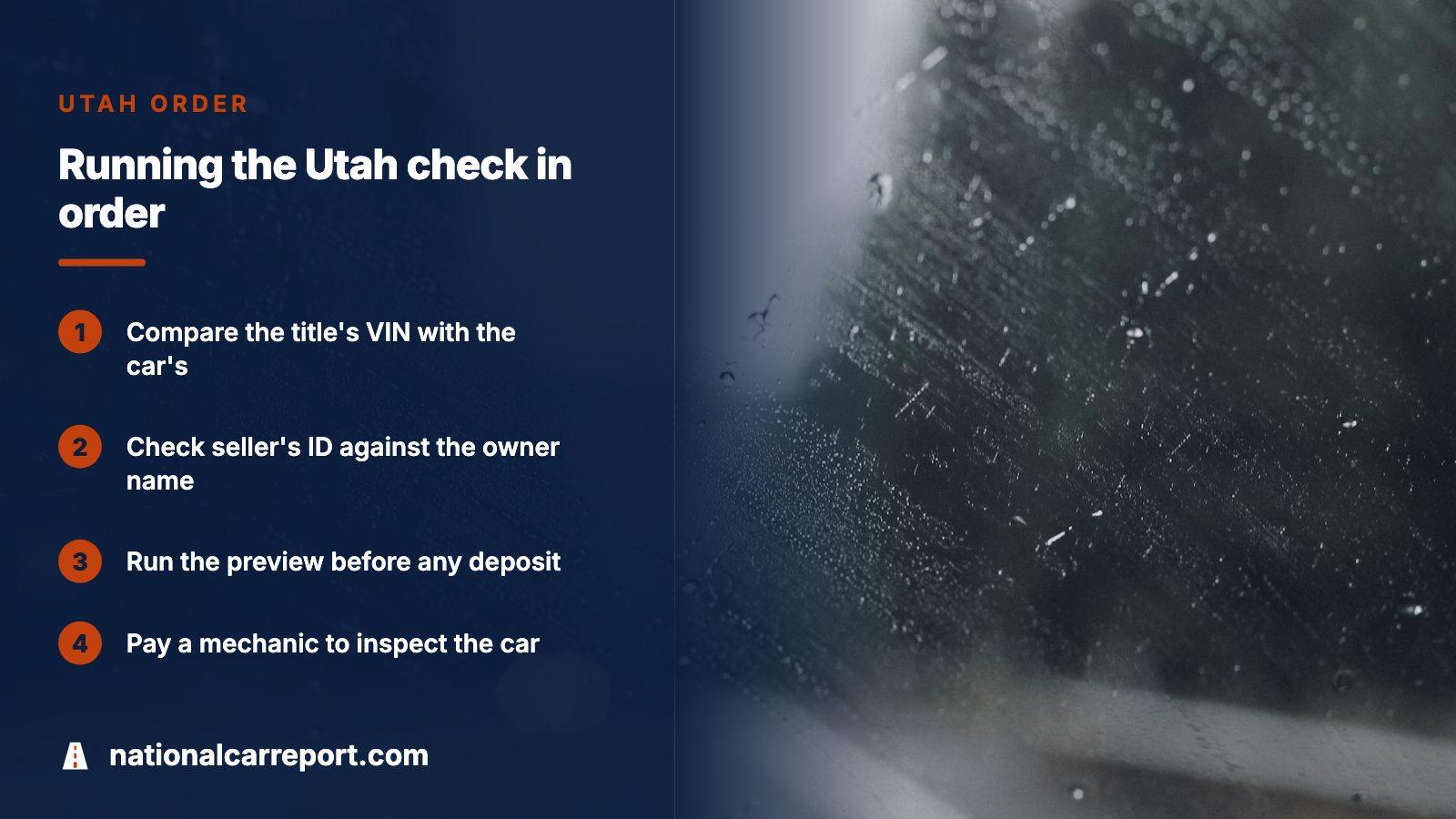
- Compare the title's VIN with the number on the car itself, at two separate spots, one character at a time.
- Check the photo ID the seller shows against the owner name on the title.
- Run the free preview on the VIN before any deposit or long drive.
- Enter the same VIN in the Tax Commission's impound search.
- Buy the full report if the preview hints at a brand, a total-loss or salvage entry, a lien, an impound or a theft record.
- If a lien shows, get the lender's written release and hold your payment until you have it.
- Pay a mechanic you pick to inspect the car and write up faults and repair costs.
Stop signs
A title in another person's name, a VIN that differs between paper and car, an odometer entry above today's reading, a lien the seller never mentioned, or an impound or theft record left unexplained.
What the report costs and where it fits
Utah buyers can preview a VIN without paying, to see which kinds of records exist before any money changes hands. The report itself is a one-time charge: buy one report, or take 3, 5 or 10 together if a short list of cars is in play. Nothing renews, and what each option costs is set out on the pricing page.
For a Utah purchase the report puts title brands and out-of-state odometer readings beside lien, impound and theft entries on one page. It does not replace the signed title, the lender's release or a mechanic.
Where this information comes from
- U.S. Department of Justice: NMVTIS for consumers — Source for coverage, state differences, the total-loss caveat and the cloning case.
- U.S. Department of Justice: understanding an NMVTIS report — Lists the five signals a title-system report covers and where its data comes from.
- U.S. Department of Justice: state vehicle record request information — Utah entry describing the TC-890 release application and where it is sent.
- Utah Highway Patrol: vehicle owner safety inspection information — Covers the 2018 change, the salvage inspection and the emissions counties.
- Utah Highway Patrol: find a towed vehicle — Explains DMV release paperwork and the fee treatment for recovered stolen cars.
- Utah State Tax Commission: Impound Vehicle Search instructions — Describes the lookup options and the release steps for each impound type.
- FTC: buying a used car from a dealer — Supports the limits of history reports and the case for a mechanic's inspection.
Sources and photos: Facts checked against the sources above in November 2026. Photos by Martin Fennema, Cole Keister and Scott Graham on Unsplash; diagrams by NationalCarReport.
Keep reading
- Vehicle Lien Check by VIN: Nationwide Lien, Theft and Impound RecordsHow a lender's claim appears on a record and what proof of payoff looks like.
- Impound Lookup: Find a Towed Car, Then Check Its VIN for Impound RecordsTracing a car through tow yards when a seller mentions a past tow.
- Stolen Car Check by VIN: Nationwide Theft, Lien and Impound RecordsScreening a single VIN for theft and recovery entries before a deposit.
- PricingReport and pack options, one payment, no subscription.
Frequently asked questions
Can I run a Utah title search by license plate?
The Tax Commission's impound search takes a plate and state, but a hit shows only tow and storage details. Title history is built from the VIN, which is how NationalCarReport works. Read the VIN off the title and off the car, and confirm they match.
Is there a free Utah title check?
Partly. Previewing a VIN is free and tells you which records exist. Utah's own record request uses Form TC-890 and charges a fee per record, as listed on the form. The full report is a single purchase after the preview. None of this replaces the signed title in the seller's hands.
Which Utah vehicles still need a safety inspection?
Salvage vehicles get one at first registration as salvage. Street-legal ATVs need one at first registration and every ownership change. Heavy commercial vehicles, buses, taxis and every tow truck are inspected each year. Most passenger cars have been exempt since 2018.
The title looks clean but the report shows salvage. What now?
States label cars differently, and a stay in a salvage yard does not oblige a state to brand a car. Ask the seller for the story and repair invoices, then have a mechanic look at the frame and wiring before you decide. Evasive answers justify walking away.
Is a clean report proof the car is sound?
No. The Justice Department treats a clean title-system report as good news but cautions about false negatives, and the FTC adds that mechanical faults usually do not appear in history reports. A clean report lowers one risk; a mechanic's written inspection covers others.
Now check the car itself
The guide explains what to look for. The report shows what this VIN has on record.