THE SHORT ANSWER
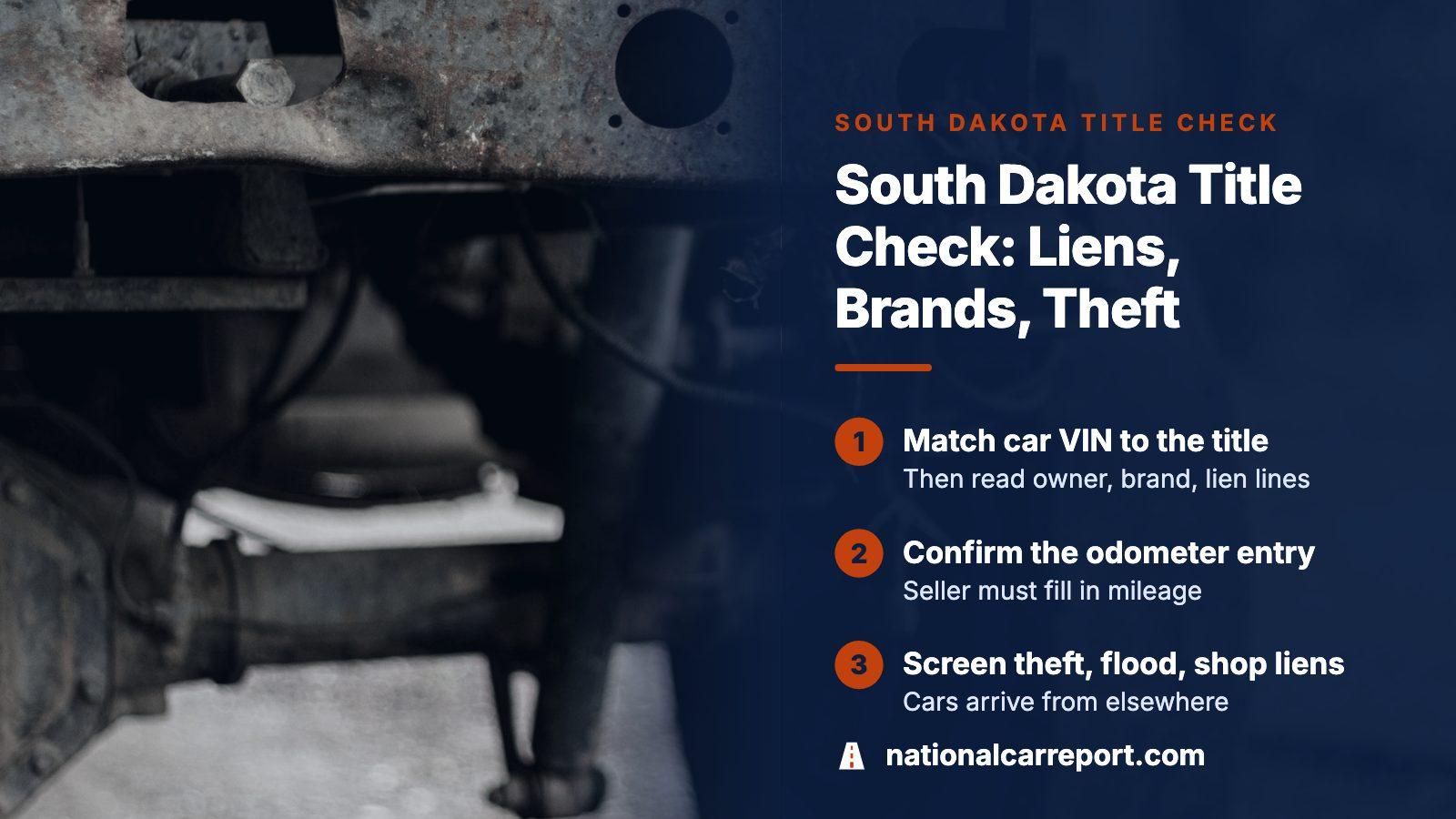
A South Dakota title check runs in this sequence: read the car's VIN and check it against the number on the title, go through the owner, brand and lien lines, and confirm the seller filled in the mileage. Next, screen the VIN against national theft, total-loss, flood, lien and impound records. Pay only against a signed title in the seller's name, or against a lender's written release.
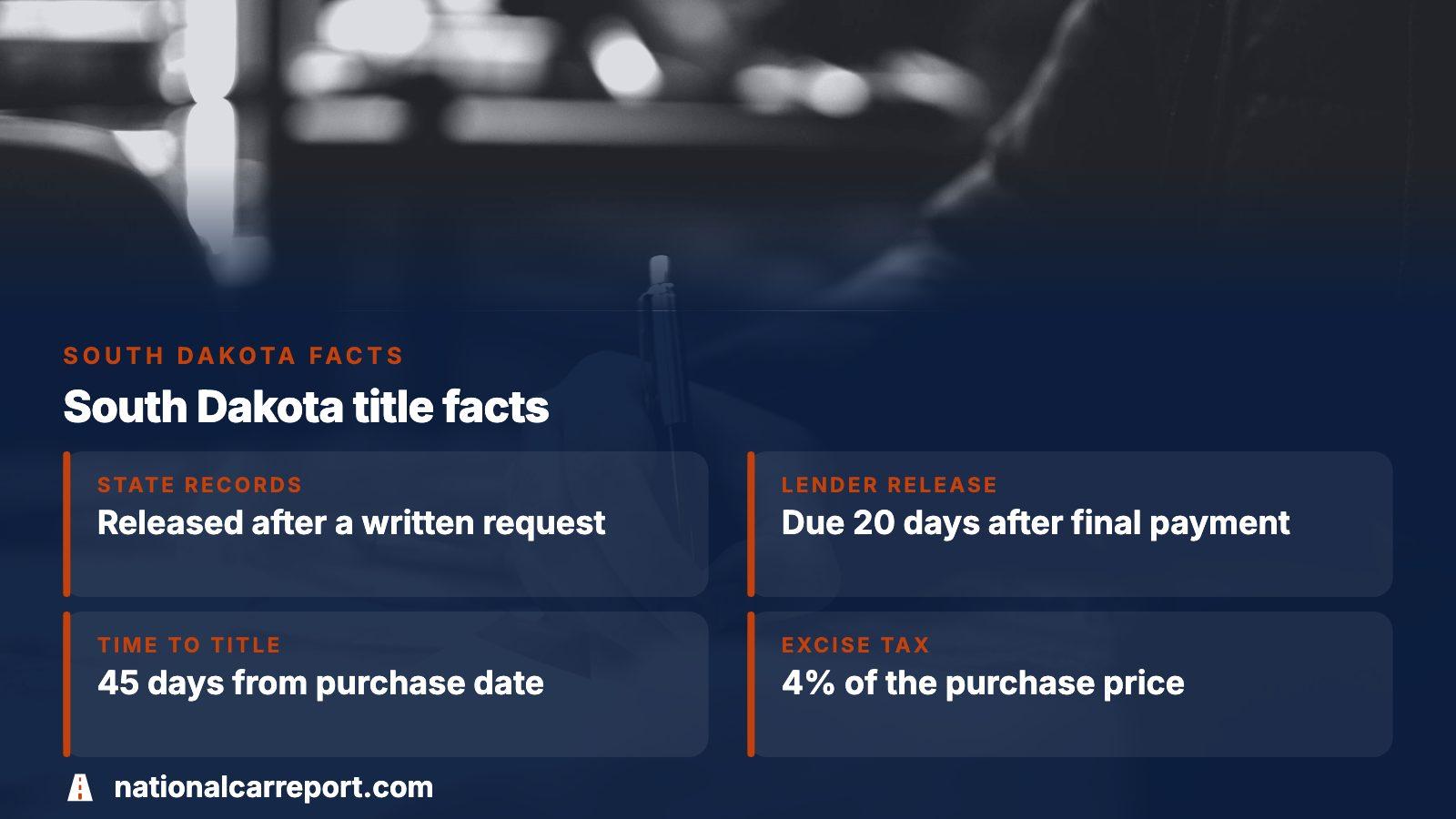
- State records
- Released after a written request
- Lender release
- Due 20 days after final payment
- Time to title a purchase
- 45 days from the purchase date
- Excise tax
- 4% of the purchase price
What a car title search in South Dakota can reach
The Department of Revenue keeps the title record, and county treasurers handle everyday titling. Motor vehicle records leave the Motor Vehicle Division only after a written request form, so do not count on a quick state lookup. State law also lets the department produce an abstract of a title's history, damage statements included, for a small fee on written request; the statute names five dollars, so confirm today's amount.
That leaves two working sources: the paper title in the seller's hand, and national records keyed to the VIN. NationalCarReport works the second, centered on theft entries, lender claims and impound history, where a South Dakota title may say nothing.
Which source answers which question
| Question | Where to look | What it leaves out |
|---|---|---|
| Stolen, not recovered? | NICB VINCheck, free | Police files and non-member insurers |
| Written off or flooded? | NICB, then a history report | Damage nobody reported |
| Branded elsewhere? | A history report on the national title system; the South Dakota title also names the earlier state | Sources that never file |
| Lender still owed? | Lien notation on the title, or a release quoting the VIN | Only the lender can close a claim |
| Open safety recalls? | NHTSA recall search by VIN | Repaired recalls and anything past 15 years |
| Tow lot or shop in the past? | The seller's account, plus impound entries in a report | Whatever the seller omits |
The check in order, before any money moves
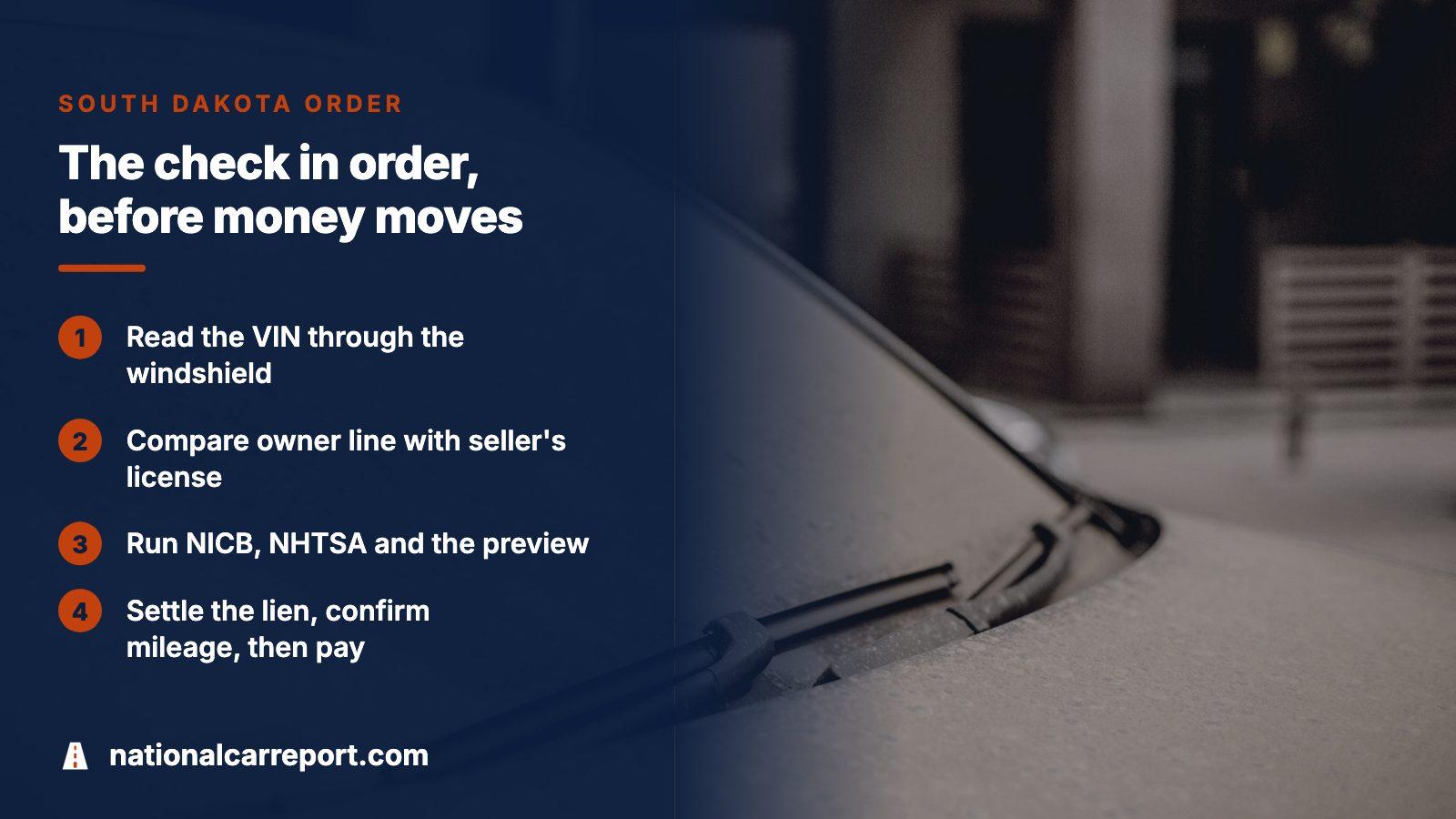
- Stand at the driver's corner of the dashboard, read the VIN through the glass, and match its 17 characters to the title. A mismatch ends the deal.
- Compare the title's owner line with the seller's driver license. If the seller is not the person named, stop and find out why.
- Look for a brand or previous-state notation. Cars from elsewhere carry that state's name and brand on their South Dakota titles.
- Run the public screens: NICB VINCheck and NHTSA's recall search.
- Run the NationalCarReport preview; open the full report if a lien, impound, theft or mileage line looks wrong.
- Settle the lien question below.
- Confirm the mileage entry is completed, then pay against the signed title.
Reading the lien line and the lender's release
Liens are noted on the title through the county treasurer. Once the loan is paid, the lender has 20 days to release the lien, free of charge, in a release that names the owner and quotes the VIN or title number. If the owner holds a paper title, the lender mails the release to the owner, who brings both to any county treasurer.
Electronic titles differ. While a lien is open, no paper title is normally printed, so a financed car's seller may have nothing to hand over. When the lender sends an electronic release, the state prints the title and mails it to the owner unless the lender instructs otherwise.
- A title showing no lien, or one with the lender's release attached.
- On an open loan, a lender's payoff letter and a plan to pay the lender directly.
Brands, and what South Dakota does with them
South Dakota calls a car a salvage vehicle when an insurer declares it a total loss from theft, fire, vandalism, collision, weather or submersion. The definition skips vehicles beyond 10 model years of age, so an older car that an insurer totals may never be issued a South Dakota salvage title. A brand from another state travels along: the earlier state's name and brand appear on the South Dakota title and every one after it.
| Paper | What put it there | What to take from it |
|---|---|---|
| Salvage title | Insurer total-loss ruling, or another state's salvage brand | Can be rebuilt and re-titled; ask for repair records |
| Rebuilt title | State inspection after a rebuild, with receipts for every part | The note rides on every later title |
| Junking certificate | Car headed for dismantling, or marked parts only | Cannot become a road title again |
| Recovered theft | Stolen car found with damage under the salvage line | No salvage mark, so ask what happened |
Dealers must post a damage notice on any car titled salvage or with a similar brand. If one skips it, the buyer can return the car for a full refund within ten days of receiving the title.
Theft, flood, shop liens and cars from elsewhere
A stolen car that turns up undamaged earns no salvage mark. South Dakota has the insurer inspect a recovered car within 45 days and, if the damage falls below the salvage line, the department issues a title noting the recovered theft. NICB's lookup lists insurer-reported theft, salvage and flood records from member companies only; it skips police files, and a clean answer guarantees nothing.
Garage history is easy to miss. A shop holding a car over an unpaid repair bill can apply for title once 30 days pass after certified-mail notice to the owner and any lender, and the car is then sold at public auction. Ask who owned the car before the seller, and read the report's impound entries next to the answer.
A South Dakota title can also belong to a car from anywhere. The state adds a $100 fee for titling without a state license or ID card or a physical address, and a mailbox or forwarding address does not count. Non-residents evidently do title cars here, so check for flood marks, rust and wear yourself and pay a mechanic to look underneath.
Signatures, mileage and the 45-day clock
A South Dakota seller has 45 days after delivering a used car to hand over the endorsed title, so you may be asked to pay before the paper exists. That is a deadline for the seller, not a cue for you to pay early. The title also carries a federal mileage statement that the seller completes before the title changes hands; falsifying it is a felony.
Once the car is yours, you have 45 days from the purchase date to title and register it. A late application adds a dollar a week, capped at $50, and the tax collects interest after 45 days and a one-time penalty after 60. Excise tax is 4 percent of the price, the title costs $10, and a lien notation costs another $10 if you finance.
Stop signs
The seller is not the titled owner, offers a bill of sale where a title belongs, or leaves the mileage line blank. The VIN on the car disagrees with the title. A lien is noted with no release. The seller cannot explain how they came to own the car.
What the report costs and where it fits
The preview is free and shows whether a VIN carries theft, lien, impound, brand or mileage entries worth following up. You buy the full report one time and nothing renews. Besides a single report, bundles sized three, five and ten suit anyone comparing several South Dakota cars. Prices are on the pricing page, so none are guessed here.
Treat the report as a second opinion on the title, not a replacement. Run the VIN before the deposit, and leave if the title and the VIN disagree.
Where this information comes from
- South Dakota Department of Revenue: motor vehicle — Source for the written-request rule for records, county treasurer titling and the seller's 45 days.
- South Dakota Department of Revenue: title, fees and registration — Gives the excise tax, fees, 45-day clock, lien release steps, electronic titles and the non-resident fee.
- South Dakota Department of Revenue: rebuilt vehicles — Explains the rebuilt inspection and the parts paperwork behind a rebuilt title.
- South Dakota Legislature: codified law chapter 32-3 — Statute text on brands, mileage entries, recovered theft titles, shop liens and title history abstracts.
- U.S. Department of Justice: NMVTIS for consumers — Describes what the national title system holds and why a clean search can be wrong.
- NICB: VINCheck — Free theft, salvage and flood lookup, with its daily search limit and its blind spots.
- NHTSA: check for recalls — Shows what a recall search by VIN covers and what it leaves out.
Sources and photos: Facts checked against the sources above in November 2026. Photos by Zoshua Colah, JavyGo and Owen Michael Grech on Unsplash; diagrams by NationalCarReport.
Keep reading
- DMV Lien Release Search: How to Confirm a Lien Is GoneHow to prove a lender's claim has been closed before you pay.
- Stolen Car Check by VIN: Nationwide Theft, Lien and Impound RecordsScreening one VIN for theft before the deposit.
- Impound Lookup: Find a Towed Car, Then Check Its VIN for Impound RecordsTracing a tow-lot past and what it means for the title.
- PricingReport and pack options, one payment, no subscription.
Frequently asked questions
Can I run a South Dakota title search from the VIN alone?
State records start with a written request to the Motor Vehicle Division, and statute allows a title history abstract for a small fee. The VIN alone opens the national screens for theft, salvage, brands from other states, liens and impounds. Use both; each covers the other's gaps.
Is there a free South Dakota title check?
In parts. NICB's VINCheck costs nothing and allows five lookups a day for each IP address, NHTSA's recall search shows open recalls, and a free preview shows whether a VIN deserves a closer look. None is the state title record, and the full report is bought separately, once.
How do I find out whether a South Dakota car has a lien?
Read the title for a lien notation and run the VIN through a report that lists liens. Only the lender can close a claim, with a release due 20 days after payoff. On an electronic title no paper exists until that release arrives, so ask who the lender is.
What if the seller has not received the title yet?
Slow down. A South Dakota seller has 45 days after delivering a used car to supply the endorsed title. Paying in full first puts your money ahead of the proof. Wait for the title, or pay the lender directly against a written payoff.
Does a South Dakota rebuilt title mean the car is unsafe?
It means the car was rebuilt and went through a Department of Revenue inspection, with receipts for each part. The note rides on every later title. It does not rate quality, so hire a mechanic to inspect it and weigh the price against clean-title cars.
Now check the car itself
The guide explains what to look for. The report shows what this VIN has on record.