THE SHORT ANSWER
For a tow ordered by San Antonio police, start with the SAPD Impounded Vehicles page on the city site, or phone the department's non-emergency line, and give the plate and VIN. For a tow from a private lot, call the number on the tow-away sign. A VIN check does not locate a car today. It reads what national records say about that vehicle.
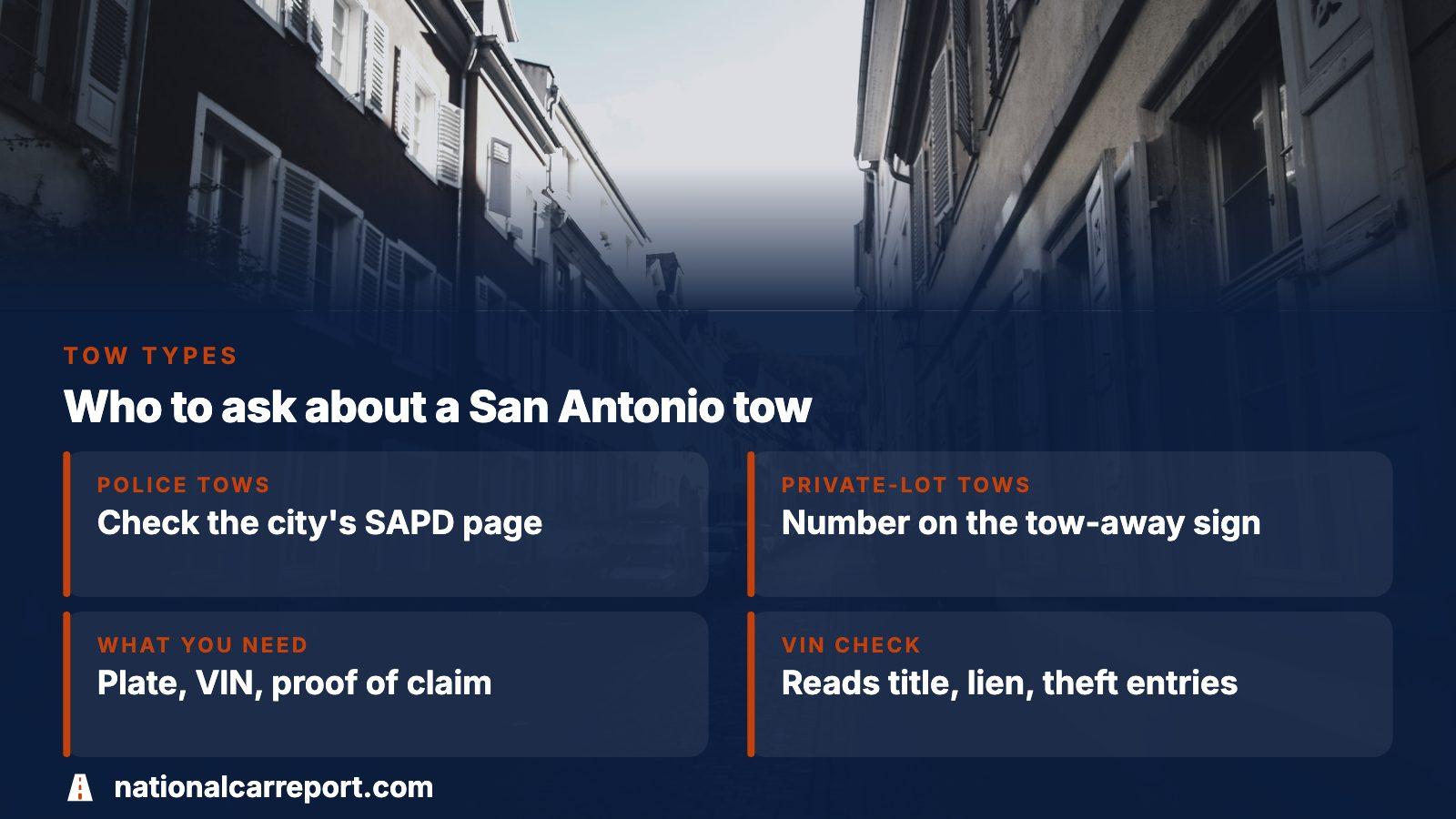
- Police tows
- Confirm the facility and any locator on the city's SAPD page
- Private-lot tows
- Number on the tow-away sign, then the licensed yard it names
- What you need
- Plate, VIN, and proof you own or may claim the car
- VIN check
- Reads recorded title, lien, theft and impound entries
Two kinds of tow, two places to ask
Before searching anything, work out who ordered the tow. In San Antonio, as in the rest of Texas, a car can leave its parking spot for one of two reasons, and the paperwork trail splits right there.
When a police officer orders the tow, the car goes to the storage facility the city contracts for police impounds. When a property owner orders it, because you parked where the sign said not to, a licensed private tow company takes it to its own yard. The lookup, the fees and the people you deal with differ, so a call to the wrong one costs you a morning.
| Who ordered it | Typical cause | Where to ask |
|---|---|---|
| Police | Wreck, arrest, blocked street, parking violation, stolen car recovered | The city's SAPD Impounded Vehicles page, then the facility it names |
| Property owner | Parked in a lot or space that forbids it | The number on the tow-away sign |
| Lender or repossession agent | Missed loan payments | The lender named on your loan papers |
What to confirm on the city's page
The City of San Antonio publishes an Impounded Vehicles page under the police department. Web listings point to it as the home of the facility details and a vehicle locator. That page refused an automated read when we tried to open it, so we have not verified its current contents, and you should treat it as the first stop rather than take our word on the details.
- The street address of the storage facility and whether it is open the hour you plan to arrive.
- Whether an online locator exists and what it asks for, usually a plate or VIN.
- Which documents the staff want before they release a car.
- What the posted charges are and which payment types are accepted.
- Whether anything changed lately, since the city has rebid its towing contract more than once.
Contract operators change. An address that was right two years ago may now belong to a different company, so go by the current city page, not by a forum post.
Have your details ready before you call
Any facility will ask the same handful of questions, and a search goes faster when you have the answers on paper. A plate number gets you a match in most systems. The VIN is the backup, and it is also the key to the history check later.
- The plate number and state, plus year, make, model and color.
- The VIN, from the registration, an insurance card, the title or a loan statement. If you do not have a copy, the printed number on the car itself works once you reach it.
- A government photo ID in your name.
- Proof the car is yours: title, registration or a bill of sale for a recent purchase.
- Current insurance if you intend to drive the car out.
If you are not the registered owner, ask the facility what authorization they accept. A notarized letter is common, but we did not confirm San Antonio's rule, so ask before you travel.

If a private lot had it hauled
Texas regulates towing companies and vehicle storage facilities through the state, and the rules cover private-property tows. The first step is the same everywhere: read the sign. A lot that tows cars has to post a notice with a phone number, and that number leads to the yard.
We could not open the state's towing consumer page from this machine, so we are not printing fee ceilings or deadlines here. Check the current figures on the state licensing agency's towing pages, and keep the tow ticket. It should show the company and what you were charged, and you will want it if you dispute the tow.
A car that disappeared from a lot with no sign anywhere is a different problem. If neither the police nor a tow company has it, the next step is a theft report, and our stolen car check page covers that route.
What a VIN check adds to the search
A towed-car lookup answers where the car is. A VIN check answers what the car's record says, and the two jobs rarely overlap. The facility's records belong to the facility. National records belong to the agencies and insurers that report them.
Enter the VIN at NationalCarReport and you get the recorded title status, any brand such as salvage or flood, lien entries, theft records and impound entries that were reported against that vehicle. The first look costs nothing. Going further means paying once, for one report or a bundle of several, as the pricing page lays out, with no recurring charge.
The check cannot tell you a car's current location, and an impound entry that was reported long ago does not mean the car is sitting in a yard now. It is history, useful for deciding whether to buy, release or pursue a car.
Why buyers run this on a car that was impounded
The seller mentions the car was in a tow yard once, or a listing photo shows a yard sticker on the glass. An impound is not a defect in itself, but it can sit next to things that are.
- A lien that was never cleared, which a lender could still enforce.
- A theft recovery, where the car may have been stripped or damaged.
- A wreck tow that the seller described as a minor scrape.
- A title brand that the seller does not mention.
- An abandoned car sold at a city or yard sale, usually with limited paperwork.
If any of that sounds like your situation, run the VIN before you pay a deposit.
What the federal title database does and does not show
The Department of Justice runs NMVTIS, the national title information system. The public lookup returns who holds the title now and any junk, salvage or flood label, the latest odometer figure, insurer total-loss rulings, and hand-offs to recyclers or scrap yards. Some results carry older theft entries.
Its own page describes the report as intentionally concise, so it leaves out much of what a state keeps. By its own estimate about 87 percent of vehicles nationwide are covered, with just over half the states supplying data. Reporting is patchy, so a search may come back clean when it should not.
It does not list impound or tow records among the things it shows, which is one reason an impound question needs its own source. Use NMVTIS for title and brand, the city or tow yard for a current tow, and a full VIN report to pull more records together.
What to do next
A short order of work
Find out who ordered the tow. Check the city page or the sign's number. Collect your ID and ownership papers. Run the VIN if you are buying or doubting the record. Keep every receipt.
Open the preview for your VIN first. If the car is yours and you are only trying to get it back, the city and the yard are the ones who can help, and the VIN check is optional. If the car belongs to someone else and you are weighing a purchase, the full report is worth reading before any money changes hands.
For more on how the Texas process works beyond one city, see the Texas towed car page.
Where this information comes from
- U.S. Department of Justice: NMVTIS consumer access — What the federal title search shows, its coverage and its limits.
- City of San Antonio: Impounded Vehicles (SAPD) — City page for police impound details; it refused an automated read, so confirm directly.
Sources and photos: Facts checked against the sources above in November 2026. Photos by Derek Nelson, Alejandro Escamilla and Karwin Luo on Unsplash; diagrams by NationalCarReport.
Keep reading
- Texas Impound Lookup: Find a Towed Car, Then Check Its VINHow towed-car searches work across Texas.
- Impound Lookup: Find a Towed Car, Then Check Its VIN for Impound RecordsThe general method for finding an impounded car.
- Stolen Car Check by VIN: Nationwide Theft, Lien and Impound RecordsWhat to do if no tow record exists.
- PricingHow the one-time report purchase works.
Frequently asked questions
How do I find out if my car was towed in San Antonio?
Work out who ordered the tow. For a police tow, begin with the SAPD Impounded Vehicles page on the city site, or call the department's non-emergency line with your plate and VIN. For a private-lot tow, call the number on the tow-away sign. If neither has the car, report it stolen.
Is there an online San Antonio towed car search?
Web listings say the city's police impound page offers a locator, but that page would not open for us, so we cannot confirm how it works today. Check the page itself and use the plate or VIN it asks for.
Does a VIN check show where my car is now?
No. A VIN check reads recorded history such as title, lien, theft and impound entries. It does not track a car's present location. Use the facility or the tow company to find where a towed car is stored.
What do I need to pick up an impounded car?
Expect to need a photo ID, proof that you own or may claim the car, and insurance if you will drive it out, plus payment of charges. Rules differ by facility and we did not confirm San Antonio's current list, so ask before going.
Can an impound show up on a vehicle history report?
It can, when an impound was reported to a data source. The federal NMVTIS page does not list impounds, so coverage depends on the report provider. A history check is useful for buying, not for locating a car today.
Now check the car itself
The guide explains what to look for. The report shows what this VIN has on record.