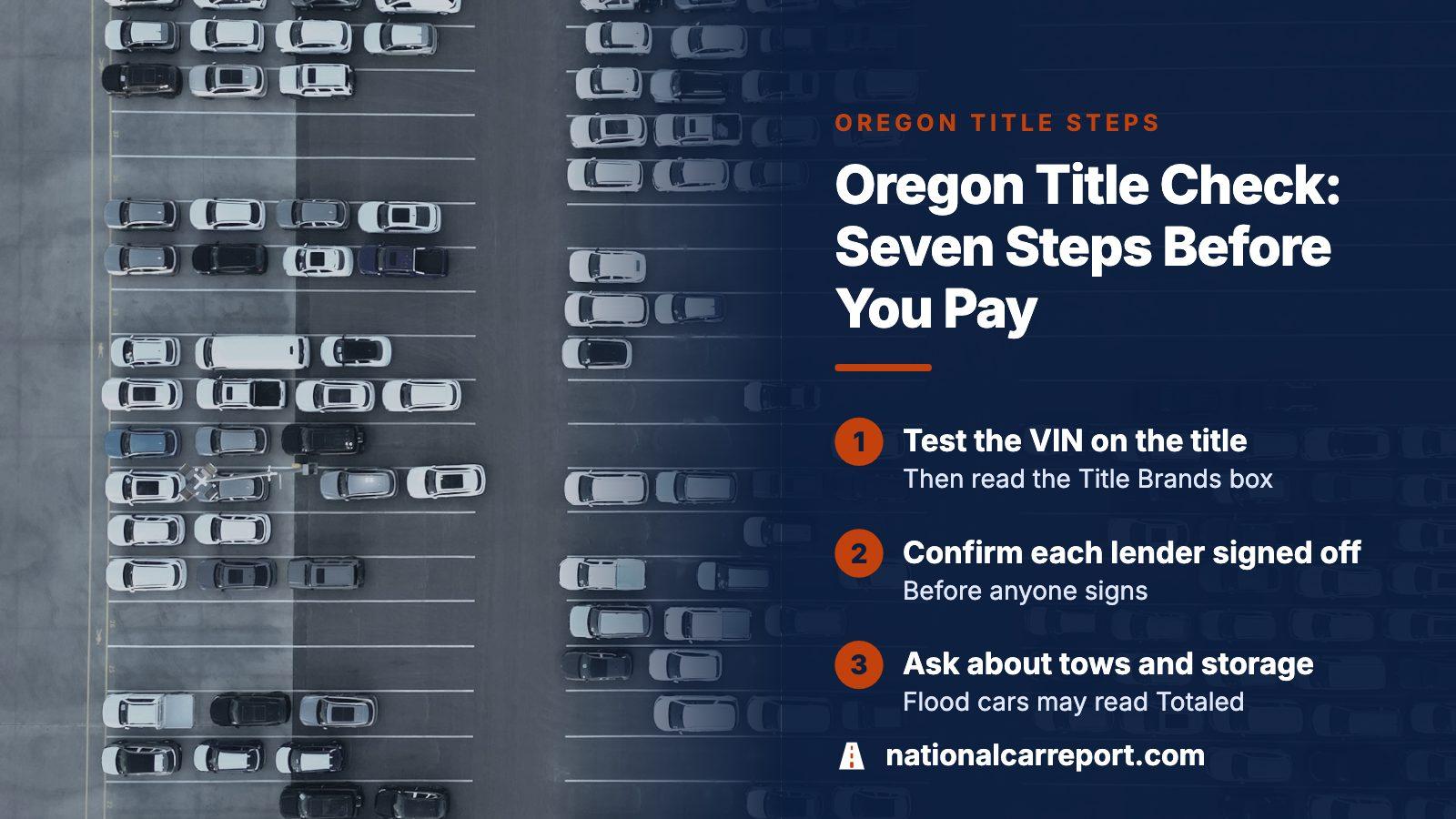
THE SHORT ANSWER
Hold the number stamped on the vehicle against the Oregon title, read its Title Brands box, and confirm each lender has signed off. Then run the VIN through the preview, NICB's lookup and an NMVTIS-based report for theft, brands and tows. Oregon DMV's buyer page describes no public VIN search of its own title file, so paper and national records carry the load. File for the new title within 30 days.
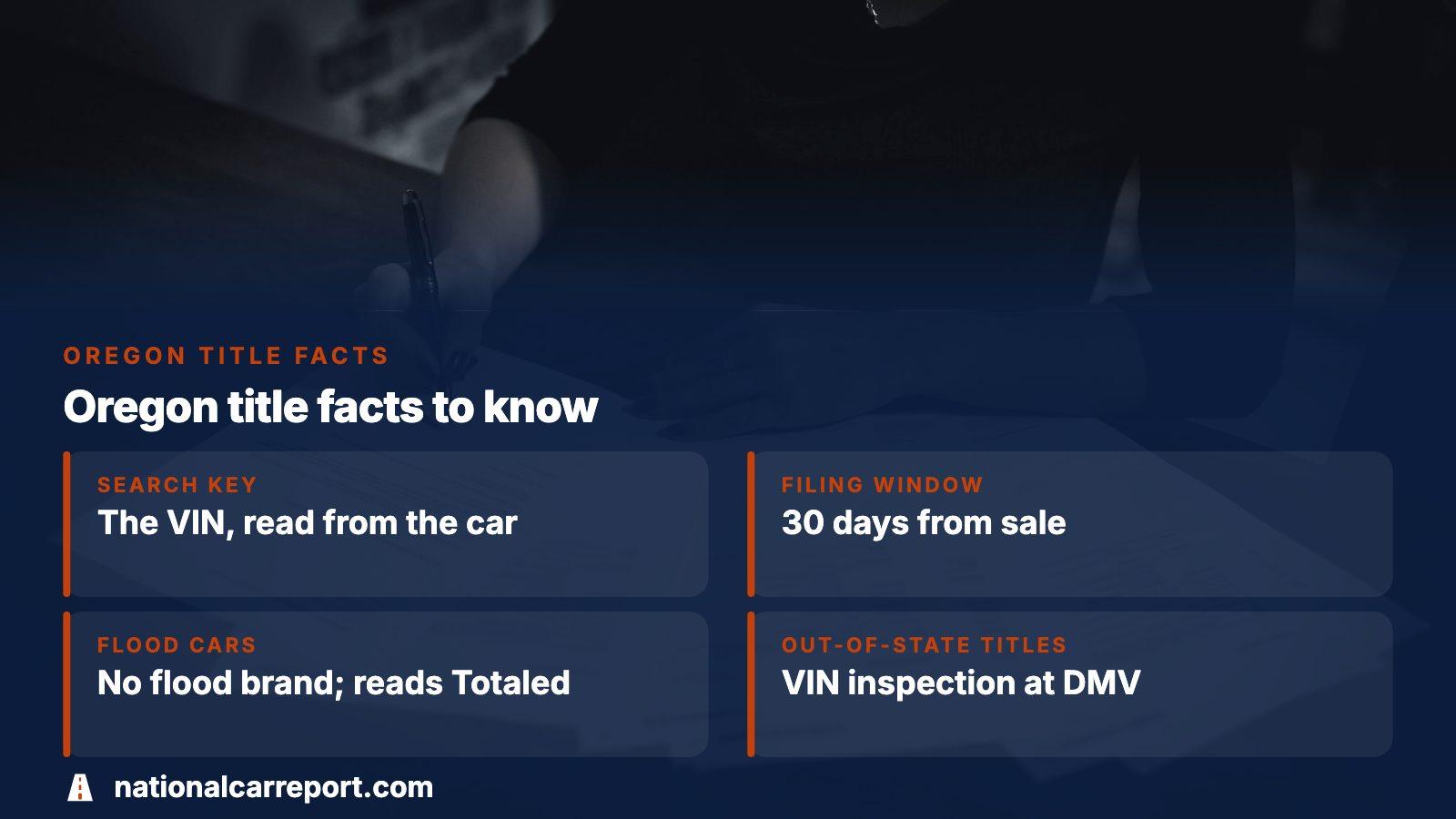
- Search key
- The VIN, read from the vehicle itself first
- Filing window
- 30 days from sale, then $25, rising to $50 after 60 days
- Flood cars
- Oregon has no flood brand; a flooded car reads Totaled
- Out-of-state titles
- A VIN inspection at DMV, $9
What an Oregon title check covers, and what it leaves out
NationalCarReport views a used car through three records that decide whether a seller can hand it over cleanly: a lender still owed, a theft report, a tow yard's claim. The Oregon title answers the first and carries the state's damage brands. Theft and tow entries hang on the VIN instead.
Oregon DMV's buyer page names four checks: the title's brands, an NMVTIS history, NICB's stolen-vehicle lookup and NHTSA's recall list. It lists no public search of the state's own title file, so the steps below pair paper with VIN-based records.
Step 1: Read the VIN off the vehicle and test the title
Start with the metal, not the screen. Read the number off the vehicle and test it, character by character, against the title and the ad. Oregon expects the title's VIN to match the vehicle, and DMV's VIN inspection exists to confirm that by physical examination.
A title from another state brings that inspection when you apply for the title. DMV charges $9; one done in another state costs nothing in Oregon, though that state may bill you.
If the numbers differ
Drop the price talk. The Justice Department defines cloning as a stolen car wearing another vehicle's VIN, same make, model and year, and cites a case that recovered about 250.
Step 2: Read the Title Brands box
Oregon titles have a Title Brands box, and the brands repeat on the registration card. Oregon has no flood brand: a flooded Oregon car that meets the totaled definition reads Totaled, while a flood car from elsewhere shows Flood and a state name.
| Brand | Meaning | Your move |
|---|---|---|
| Totaled | Met the state's totaled definition | Ask how it was repaired and re-titled |
| Reconstructed | Meets the reconstructed definition | Have the repairs inspected |
| Replica | Meets the replica definition | Ask what it was built from |
| Branded or Flood plus a state | Another state's damage or flood brand | Pull that state's record |
| Lemon Law Buyback | A maker repurchased it under Oregon law | Ask what the defect was |
A rebuilt car can carry assembled, reconstructed or replica wording, so look for all three, not just Rebuilt. Oregon titles omit the taxi, rental or police-use notes other states add.
Step 3: Test for liens before anyone signs
An Oregon seller cannot sell, donate or gift a car with an unpaid loan, and every owner on the title, lienholders included, must have let go of it. The lender either signs the title's front or supplies its own signed release.
A seller who says the bank has the title is describing a payoff that has not happened. Ask for the payoff figure and get the release in writing. A lien entry in a report is a prompt to ask; the release is the answer.
- A title with a matching VIN, plus the lender's signature or release
- A bill of sale when the title lacks the seller's name, with VIN, release wording, printed name, signature and date
- An odometer disclosure signed by both sides for cars from model year 2011 on that are under 20 years old
Step 4: Screen the VIN for theft
A paper title cannot say whether anyone reported the car stolen. NICB's VIN lookup, which the FTC says flags unrecovered theft, flood damage and salvage declarations, is the free national screen, and DMV's buyer page lists it too.
Oregon splits theft reporting by insurance: owners of insured cars call police and the insurer, not DMV, while an uninsured owner files a Stolen Vehicle Notification inside 60 days.
Read a hit carefully. A car unrecovered after 30 days can be labeled a total loss, and the label stays even if it later turns up undamaged. Have police confirm the current status.
Step 5: Ask about tows and storage
Impound history is the hardest record to reach by VIN. DMV will not release an abandoned vehicle's owner name or address, a tow from private property begins with the notice process in ORS 98.830, and a car left on a public road goes to local law enforcement. DMV's pages show no statewide tow search for buyers.
So the questions go to the seller and any tow company named on a notice. The preview's impound entries give you a starting point.
- The tow company's name and the date
- A receipt proving the storage bill was paid
- Whether the seller is the titled owner
Step 6: Pull the national record, then the Oregon one
NMVTIS, the Justice Department's title database, holds current title data, brand history, the last odometer reading, insurer total-loss rulings, salvage-yard transfers and sometimes past theft. Brands stay in it permanently, though title washing still happens when a state retitles a car without checking earlier states.
Expect gaps: about 87% of U.S. vehicles are in it, and a clean report guarantees nothing. Oregon DMV sells a certified Vehicle Title History letter for $22.50 listing every title transaction and prior owner, but the law at ORS 802.175 through 802.191 limits who may order one.
Step 7: Close the sale and title the car within 30 days
A buyer has 30 days from the sale to apply. Days 31 through 60 add a $25 late fee, and after day 60 it is $50. The seller must tell DMV about the sale through DMV2U within 10 days but stays the listed owner until the title moves.
Bring the original title, original lien releases, any bill of sale and the odometer disclosure. When the seller lost the title, a 2011 or newer car needs a replacement before you sign. DMV currently quotes 2 to 4 weeks for the new title.
A car from another state
Oregon will not title a vehicle another state judged junk. Terms like crushed, hulk, non-repairable, parts only, scrap or wreck on that title point that way, and the issuing state can say whether the status can be lifted.
Reading the results: what each finding calls for
| What turns up | What it may mean | Your next move |
|---|---|---|
| VIN differs from the title | A typo, or a swapped or cloned identity | Stop; call police if the stamping looks altered |
| Totaled, Reconstructed or Replica | A serious past loss or a rebuilt car | Price it as branded; inspect the repairs |
| Flood plus a state name | Flooded under another state's law | Check for water damage |
| Lender named, or no paper title | An open loan or a pending payoff | Get the payoff figure and a signed release |
| Theft hit | Possibly unrecovered or not cleared | Ask police to confirm the status |
| Tow or impound entry | A storage claim may be open | Ask for the company's name and a paid receipt |
| Clean everywhere | A good sign; reporting gaps remain | Still inspect the car |
No report replaces a mechanic's inspection. Each row is a reason to go back and look at the car again.
Cost: a no-charge preview, then a single payment
A preview comes first: for the VIN you type in, it lays out which sections a full report would fill, at no cost. Buying the report is a single transaction, not a subscription, and packs exist for anyone weighing several cars. The pricing page has the amounts. Run it after the paper steps and before the deposit, using the number read off the vehicle.
Where this information comes from
- Oregon DMV: Buying or selling a vehicle — Seller duties, lien releases, signatures, the 30 day and 10 day deadlines and DMV's list of pre-purchase checks.
- Oregon DMV: Titling your vehicle — Late fees, required documents, lost titles, out-of-state VIN inspections and current title wait times.
- Oregon DMV: Abandoned, stolen, totaled vehicles and title brands — The brand list, the missing flood brand, junk vehicles, stolen vehicle reporting and abandoned vehicle notices.
- Oregon DMV: VIN inspection — What the inspection compares, who needs one and the fee.
- Oregon DMV: Available records and fees — The certified title history letter, its fee and who may order it.
- Department of Justice: NMVTIS for consumers — What the national title system holds, its gaps, title washing, cloning and the 30 day total-loss label.
- FTC: Used cars — Describes the NICB and NHTSA lookups and says a report does not replace an inspection.
Sources and photos: Facts checked against the sources above in November 2026. Photos by Iain, Cole Keister and Dimitri Karastelev on Unsplash; diagrams by NationalCarReport.
Keep reading
- Vehicle Lien Check by VIN: Nationwide Lien, Theft and Impound RecordsThe lender questions from step 3, applied to any state.
- Stolen Car Check by VIN: Nationwide Theft, Lien and Impound RecordsTheft records by VIN and what to do with a hit.
- Impound Lookup: Find a Towed Car, Then Check Its VIN for Impound RecordsFinding a car that was towed or held, and what to ask afterward.
- PricingOne report or a pack, paid once, with no subscription.
Frequently asked questions
Is there an online Oregon title search by VIN?
DMV's buyer guidance points to the title brands, NMVTIS, NICB and NHTSA and lists no public VIN search of the state's title file. It does sell certified title-history letters to qualifying requesters. For most buyers, the paper title plus national records tied to the VIN is the practical route.
What does a Totaled brand on an Oregon title mean?
The vehicle met the totaled definition in ORS 801.527. The owner of a total loss has 30 days from the declared loss to hand the title to DMV or the insurer. DMV says a totaled car must be re-titled even if no repairs were done.
Can a car with an Oregon salvage title be registered?
Not while the salvage title stands: DMV cancels registration when it issues one, and that title costs $27. Applying for a regular Oregon title afterward requires a VIN inspection. A vehicle another state declared junk cannot be titled in Oregon at all.
What if the seller lost the Oregon title?
For a 2011 or newer car the seller obtains a replacement first, since the odometer disclosure belongs on it. For a 2010 or older car, the application has a Replacement Oregon Title box. A title from another state must be replaced by that state.
How long do I have to title a car I bought in Oregon?
Thirty days from the sale, then $25 for days 31 to 60 and $50 after that. Until you transfer the title, the previous owner stays listed as the owner, so waiting can leave them attached to a car you drive.
Now check the car itself
The guide explains what to look for. The report shows what this VIN has on record.