THE SHORT ANSWER
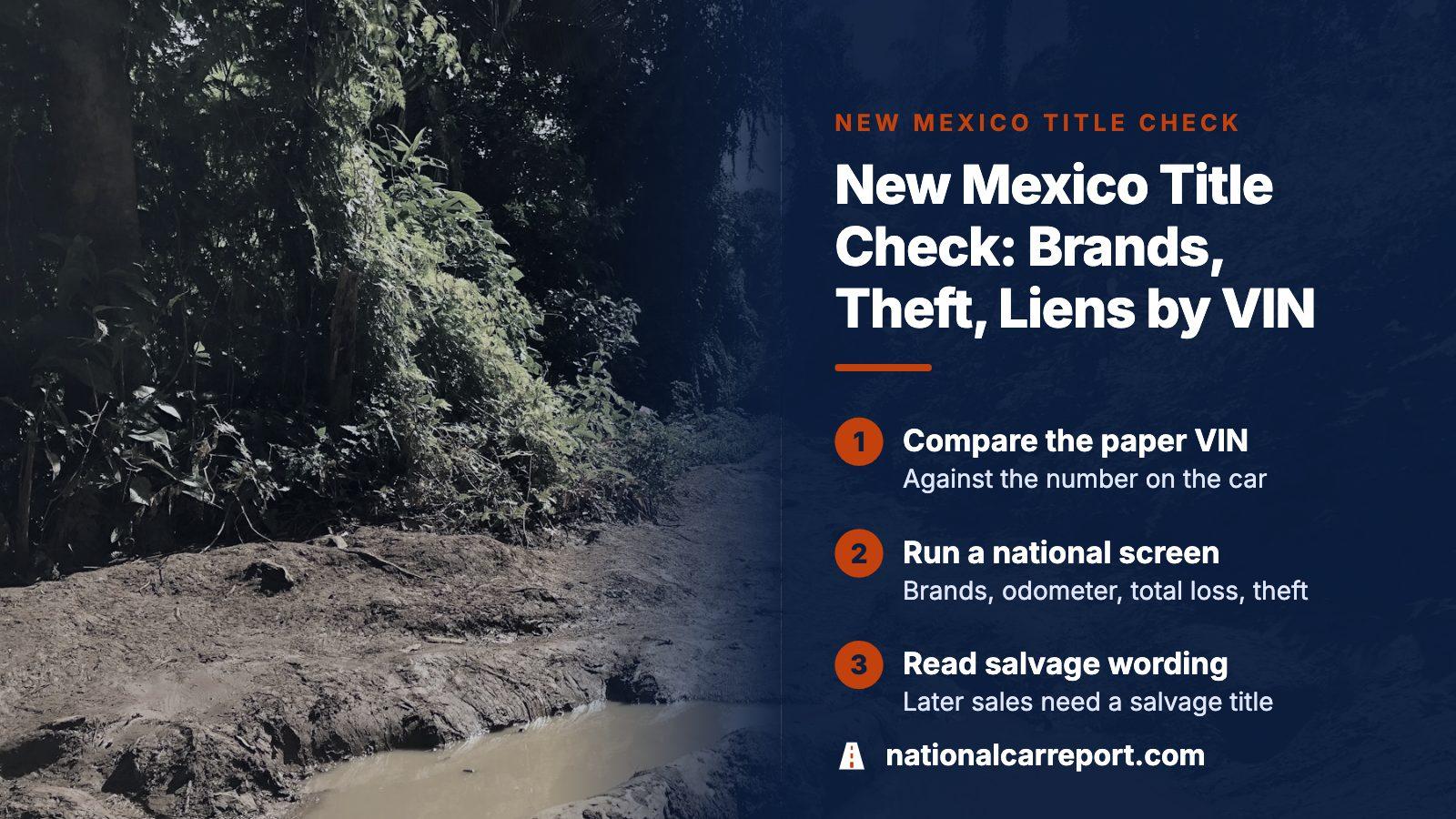
To check a New Mexico title, compare the VIN on the paper with the number on the car, then run that VIN through a national screen for brands, odometer history, total-loss and salvage entries, theft and liens. Previewing a VIN is free of charge, while the full report is bought once at the amounts on the pricing page. State rules add two warnings: salvage paper stays branded through every sale, and many Bernalillo County sales need an emissions test.
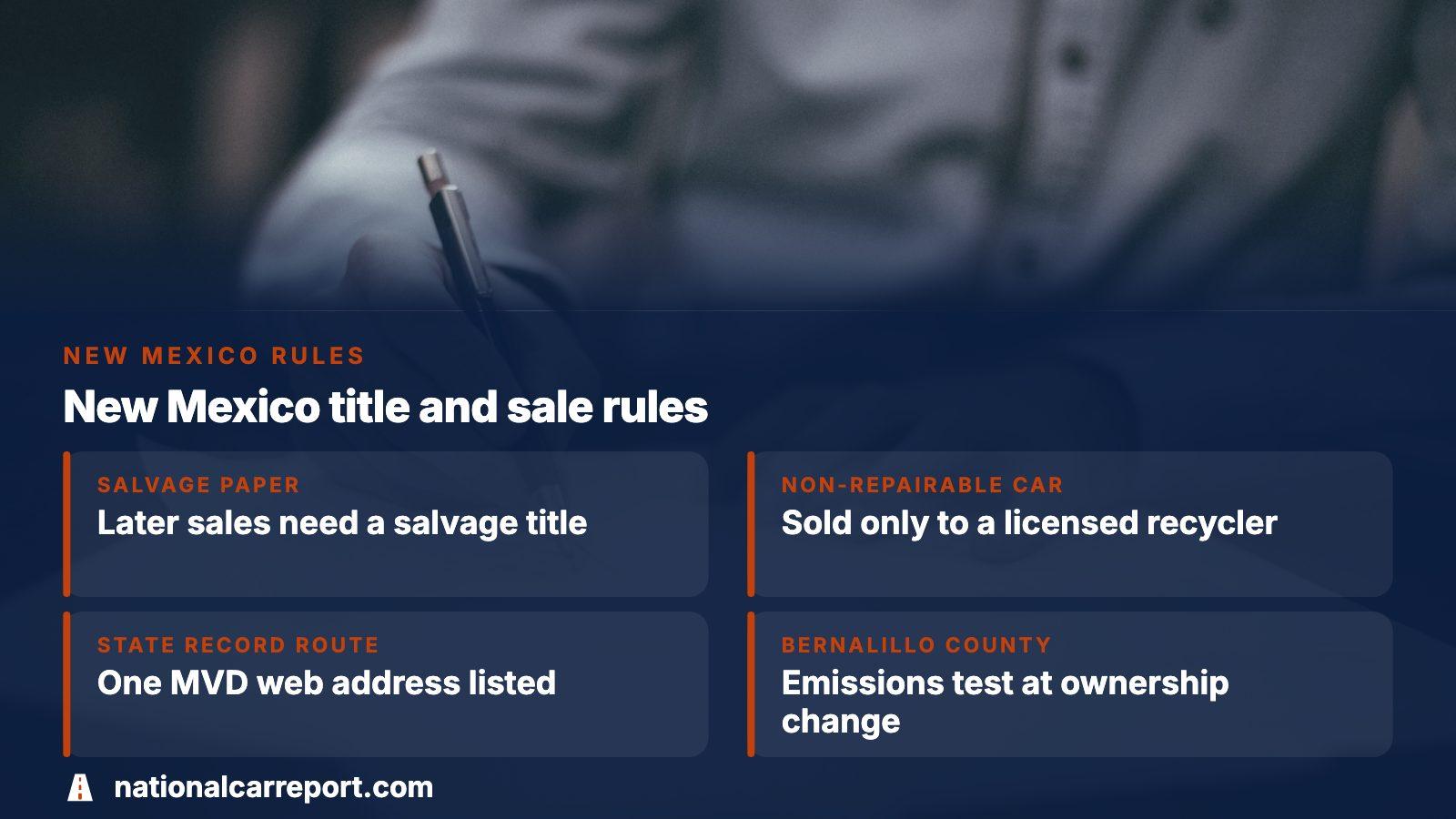
- Salvage paper
- Every later sale must use a salvage-branded title
- Non-repairable car
- Sold only to a licensed auto recycler
- State record route
- One MVD web address on the Justice Department list
- Bernalillo County
- Emissions test due at change of ownership
What a New Mexico title check covers, and what stays with the MVD
Two records sit behind any New Mexico title check. One is the paper in the seller's hand. The other follows the VIN, partly with the state and partly in the national title system the Justice Department oversees, which collects entries from titling agencies, salvage yards, recyclers and insurers and holds on to every brand any state has reported.
The state's own full record is the harder piece to obtain. The Justice Department's October 2024 list of ways to request state records gives New Mexico a lone web address in the MVD's dealer section, with no form number or fee beside it. The MVD's site refused automated reads when this page was researched, so ask the MVD directly whether an individual buyer qualifies to order that record, and for the price.
Running the check in four steps
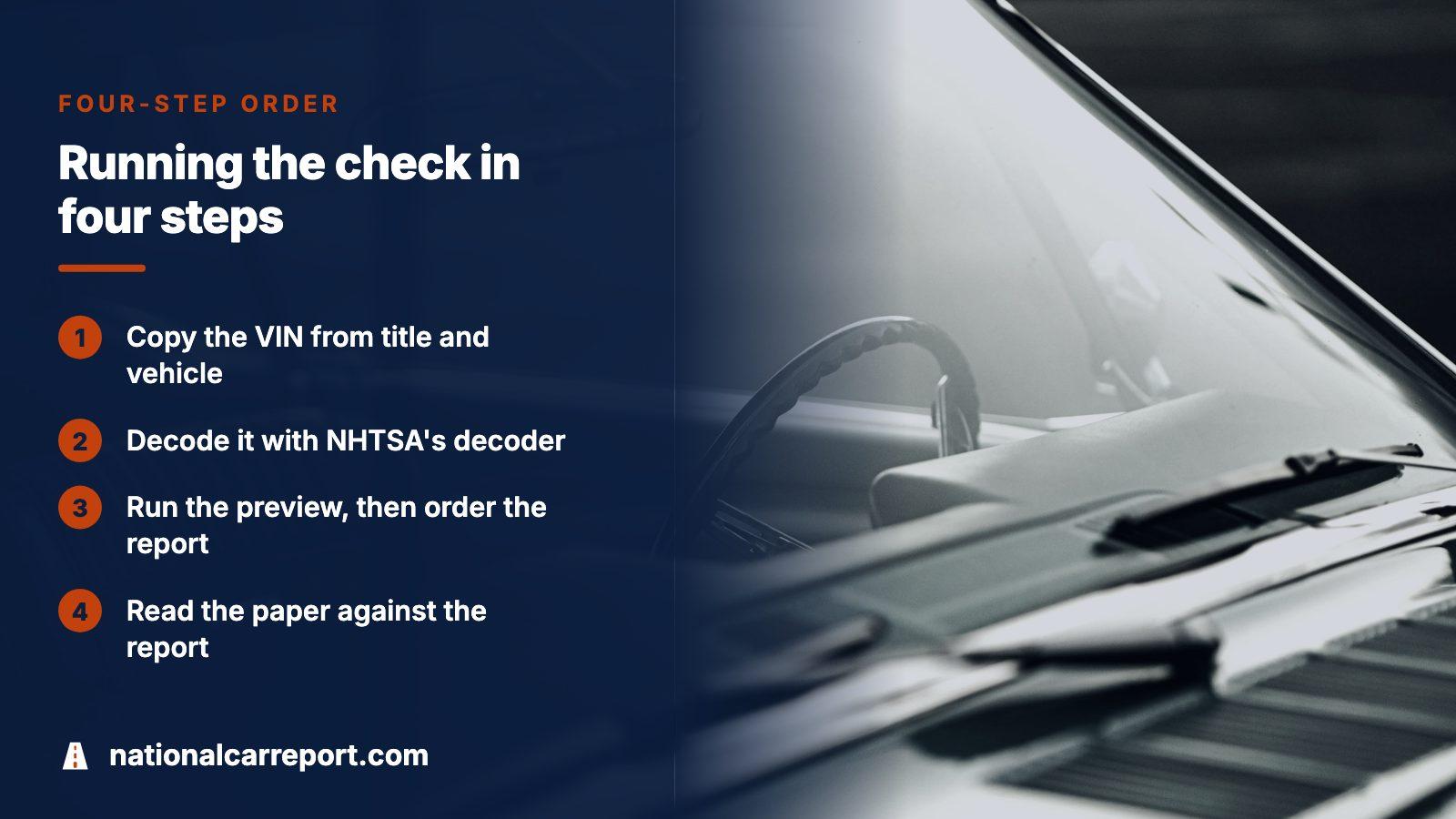
- Copy the VIN from the title, then hunt down the same number on the vehicle, in the dashboard corner nearest the driver or on the label fixed to the door frame beside the driver's seat. Even one character off should halt the deal until the seller accounts for it.
- Decode the number. NHTSA's decoder shows the details the manufacturer reported for that VIN, including the build plant, which tests whether the paper describes this car. It will not decode a year before 1981.
- Run the VIN preview, then order the report when the car makes your shortlist.
- Read the paper against the report line by line: brands, odometer figures, the state that last issued a title, any lender named, and every theft or tow entry. Send the seller each discrepancy as a written question.
How New Mexico brands salvage and non-repairable titles
New Mexico's administrative code, as the State Records Center publishes it, sets a firm paper trail for damaged cars. Salvage status turns on repair cost against market value, and the repair figure counts only work needed to make the car safe on the road. Racing stripes add nothing, and neither do medical bills or rental cars. An insurer's salvage or non-repairable declaration stands whatever the arithmetic says, so long as it fits the statute.
| Situation | What the code requires |
|---|---|
| A salvage car changes hands | The transfer must use a salvage-branded title |
| Title not yet marked | Seller inks SALVAGE or NON-REPAIRABLE diagonally across the front, about 45 degrees, characters half an inch tall at minimum |
| Insurer takes the car in a claim | Insurer obtains the salvage title or non-repairable certificate under its own name prior to any resale |
| Non-repairable car | May go only to a licensed auto recycler, and no more ownership certificates come from the MVD for that car |
| Stolen and never recovered | No salvage title needed |
The posted text carries old amendment dates, so ask the MVD whether the rule has changed before relying on a detail.
Red flags worth a call to the seller
- The report shows a brand the paper never mentions. States label damage differently and the national record keeps every brand, so a clean paper beside a branded record needs a written explanation.
- An odometer figure that drops between entries or sits below the last reported reading.
- A total-loss or salvage entry on a car advertised as accident-free. Insurers and salvage yards report under federal law, but a state need not brand a car just because a salvage yard once held it.
- A lender still named on the record. Ask for the lender's written release before paying, and keep a copy.
- A title issued only recently in a state other than the seller's home state, which is the pattern brand washing follows.
When theft and total loss show up together
Theft is where a clean-looking New Mexico paper can mislead most. The code does not call for a salvage title on a stolen car that was never recovered, and a recovered car earns one only if the damage meets the definition. A theft record can therefore be the only warning in the file.
A total-loss label can outlive the theft
Insurers may write off a stolen car as a total loss if 30 days pass without recovery, according to the Justice Department, and that label is not lifted if the car reappears intact. A total-loss entry on a recovered car is something to put to the seller, not a verdict. Request the recovery paperwork and any repair bills, then book a mechanic.
Cars arriving from another state or counting in kilometers
Federal rules require each state to run a title verification before issuing a title for a car brought in from elsewhere. The check tests the document, any junk or salvage history, the odometer against earlier readings and details such as the lender. The receiving state's own law still decides which brand the new paper wears.
Two New Mexico details matter for a car with history elsewhere. A seller whose odometer reads in kilometers may report converted miles on the title application, at 0.6214 miles per kilometer, but must attach a paper showing the true kilometer reading and the arithmetic. And the code lets authorized inspectors, bonded for $30,000, perform the VIN and safety-equipment inspections that the MVD accepts as its own.
Rules that attach to the sale in Albuquerque and Bernalillo County
A title check does not show emissions status, yet the sale itself can trigger a test. The City of Albuquerque requires a passing test for cars registered in Albuquerque-Bernalillo County from model year 1992 on (its wording: no more than 35 years old) with a weight rating below 10,001 pounds, and another test is due at change of ownership. Stations set their own prices, usually about $30 plus tax.
- Hybrids are tested. Dedicated electric vehicles and diesel vehicles are not.
- A new car kept by its original owner is exempt for 4 years after first MVD registration.
- A passing result stays valid for a year or two, according to the vehicle.
- A failed car gets one free retest within 90 days at the program's headquarters.
Agree who pays for repairs before you agree on the price, because a failed test lands between the handshake and the registration.
Cost, and the sensible next move
Begin with the VIN preview, which hints at which record types exist for the car. The report is a one-time purchase, never a subscription, covering one vehicle or a set of three, five or ten; the pricing page lists the amounts. A NationalCarReport report lines up title brands, odometer readings, salvage and total-loss entries, theft records, liens and impound entries for one VIN.
It does not replace the signed title, the lender's release or a mechanic, and the Justice Department urges an independent inspection alongside any history report. If the VIN decodes cleanly, the paper matches and the record shows no brand, theft or lien, move on to the road test. If anything conflicts, ask in writing and walk away from a vague answer.
Where this information comes from
- U.S. Department of Justice: NMVTIS for consumers — Backs the points on brands, state differences, false negatives and the 30-day total-loss label.
- U.S. Department of Justice: NMVTIS for states — Describes the title verification each state runs on a car brought in from another state.
- U.S. Department of Justice: state vehicle record request information — The New Mexico entry that lists only a web address for requesting the full record.
- U.S. Department of Justice: used car buying tips — Supports the advice to pair a history report with an independent inspection.
- New Mexico Administrative Code 18.19.3 (State Records Center) — Salvage and non-repairable title steps, the stolen-car rule, metric odometers and authorized inspectors.
- City of Albuquerque: vehicle emissions testing — Who is tested, the change-of-ownership test, exemptions, typical fee and the retest window.
- NHTSA: VIN decoder — What the decoder returns, where the data comes from and its pre-1981 limit.
Sources and photos: Facts checked against the sources above in November 2026. Photos by Frederick Rosa, Dylan Michaud and Scott Graham on Unsplash; diagrams by NationalCarReport.
Keep reading
- Stolen Car Check by VIN: Nationwide Theft, Lien and Impound RecordsScreening a single VIN for theft and recovery entries before a deposit.
- Vehicle Lien Check by VIN: Nationwide Lien, Theft and Impound RecordsHow a lender's claim appears on a record and what a release looks like.
- Impound Lookup: Find a Towed Car, Then Check Its VIN for Impound RecordsTracing a car through tow yards when a seller mentions a past tow.
- PricingReport and pack options, one payment, no subscription.
Frequently asked questions
Can I run a New Mexico title search by license plate?
NationalCarReport works from the VIN, not the plate. Read the VIN off the title and off the car, confirm they match, then run the preview. NHTSA's decoder then shows the make and year the manufacturer reported for that number, and any clash with the paper is your first red flag.
Does New Mexico release a full title record to buyers?
The Justice Department's list gives New Mexico a single web address in the MVD's dealer section rather than a form and fee. Whether a private buyer qualifies is a question for the MVD. Meanwhile a national VIN report covers brands, odometer figures and salvage entries.
What does a salvage brand mean for the next owner in New Mexico?
Once a title is branded salvage, every later transfer must use salvage-branded paper. A non-repairable car may be sold only to a licensed auto recycler, and the MVD stops issuing ownership certificates for it. Confirm the current rule with the MVD, since the posted code text shows old amendment dates.
Is a clean report proof that a New Mexico car is sound?
No. The Justice Department calls a clean title-system report good news but warns about false negatives, because reporting has gaps and a state need not brand a car just because a salvage yard once held it. A clean record lowers one risk. A mechanic's inspection covers the others.
Does buying a car in Albuquerque require an emissions test?
For cars registered in Albuquerque-Bernalillo County from model year 1992 on and rated below 10,001 pounds, the city says a test is required at change of ownership. Electric and diesel vehicles are exempt, and stations usually charge about $30 plus tax. Settle who covers a failed test before you buy.
Now check the car itself
The guide explains what to look for. The report shows what this VIN has on record.