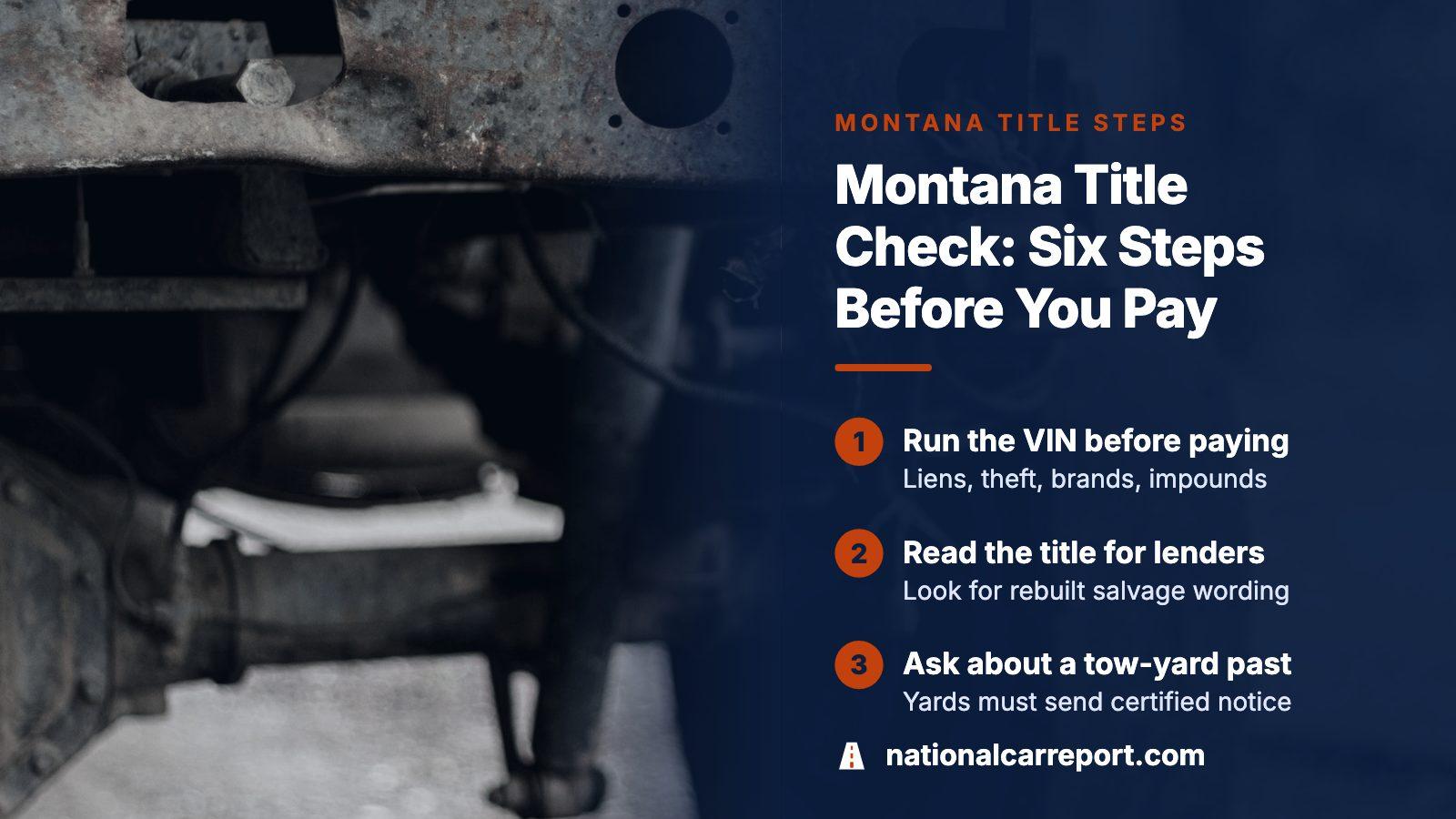
THE SHORT ANSWER
Run the VIN through a preview and a full report for liens, theft, brands and impounds, read the title for lender entries and any rebuilt salvage wording, and ask whether the car was ever towed. Montana gives the buyer 40 days after the transfer to file for the title, and $10 is added if that window is missed.
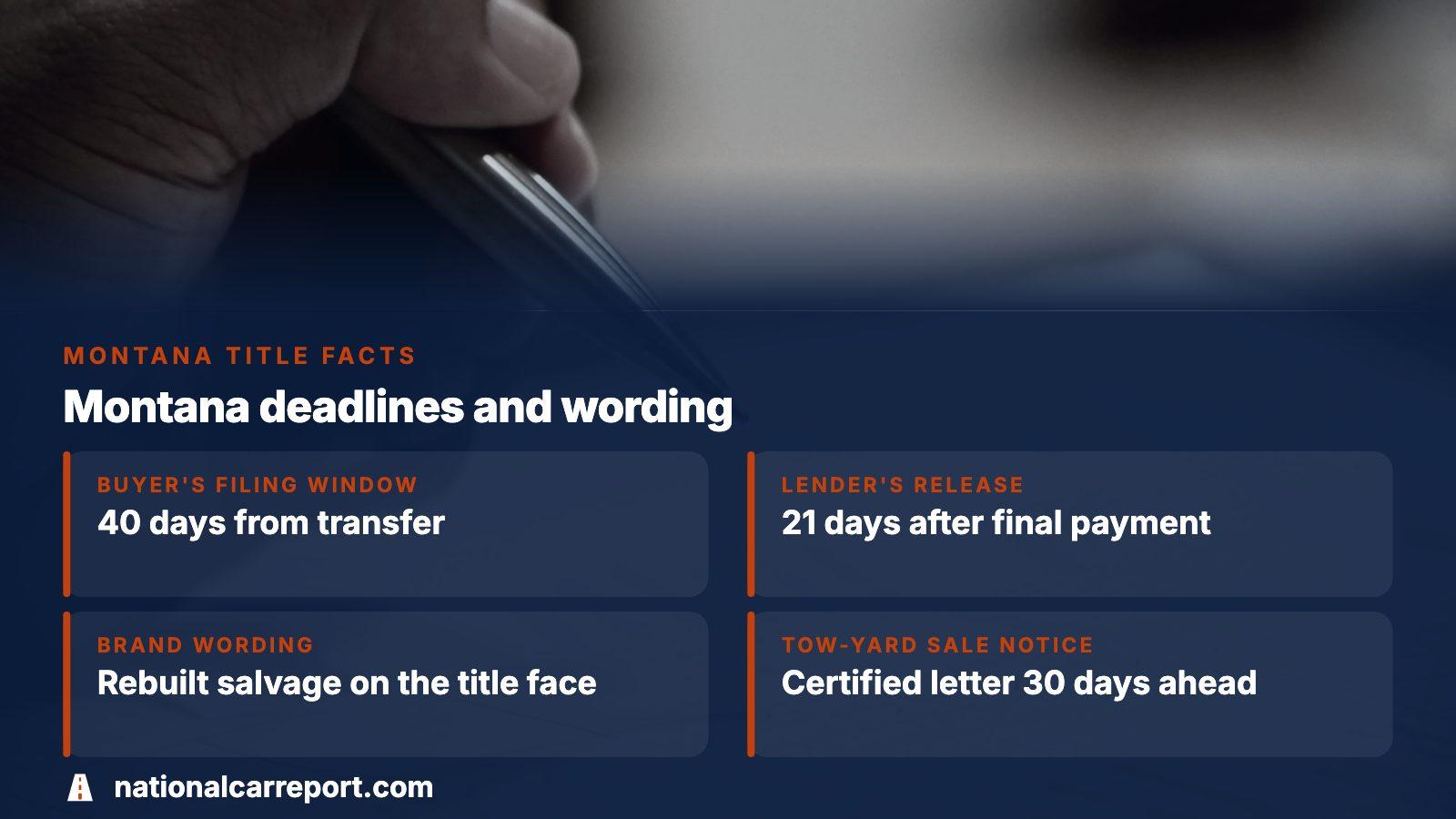
- Buyer's filing window
- 40 days from transfer, then a $10 late penalty
- Lender's release deadline
- 21 days after final payment, $25 a day if late
- Brand wording
- Rebuilt salvage, printed on the face of the title
- Tow-yard sale notice
- Certified letter at least 30 days ahead
What Montana runs after you pay, and why to run it first
NationalCarReport looks at a vehicle through three records: liens, theft reports and impounds. Montana looks at the same ground, but late. At the county treasurer's counter, or an authorized agent's, the clerk compares the VIN with the department's vehicle files and with state and national stolen-vehicle databases before entering the transfer.
By then the car is yours. An unsatisfied clerk can refuse the transfer, and an incomplete file stalls the title. Run these checks before the deposit.
The six steps, in the order to run them
Each step answers one question. Stop at the first failure.
- Compare the stamped VIN with the title and the ad; a mismatch pauses the purchase until it is explained.
- Read the title: owner's name, lender entries, brand wording. The seller must be the person named or hold written authority.
- Ask who financed the car and when the loan ended. Lenders get 21 days after the last payment to file a release.
- Run the VIN through the preview, then the full report, for lien, theft, impound and brand entries from every state.
- Ask whether a tow yard ever held the car, and its name. A car from a yard sale should trace to a certificate of sale.
- Have a mechanic inspect it, then sign and file for the title inside 40 days.

What a Montana title search can and cannot return
Montana keeps one central electronic file, opened when a title application, registration, lien or title is recorded. It holds the VIN, model year, brands, odometer where one applies and the owner's details. Records are open to inspection in business hours, but the department supplies information only to an applicant who pays the cost and shows identification, and it withholds personal details.
- A request will not yield a name or address, so the VIN becomes the key.
- The department may destroy the record of a car unregistered for 4 years with no active lien, so a long-parked car can have no state file left.
Not confirmed
NationalCarReport could not confirm whether the Montana Motor Vehicle Division offers an online title status page. Ask the MVD or a county treasurer which lookups exist.
Step 3 in detail: liens and the 21-day release clock
A lender's claim enters the electronic record once the owner signs an acknowledgment, and it is printed on any paper certificate. After two claims are listed, a new certificate may carry just a notice that more are on file with the Department of Justice, so a crowded title means asking for the rest.
Payoff does not clear the record on its own. The lender must file a satisfaction within 21 days of the final payment and owes the department $25 for each day it runs late. A seller who claims the loan ended last week may be reading a stale record.
Paid off, but the lien still shows
Treat the lien as open until the lender's release exists. Make the release a condition of payment, then run the VIN again.
Step 4: theft screens and brands from other states
The clerk checks stolen-vehicle files by VIN, and so should you. A theft report attaches to the number, not the paper, so a tidy title rules nothing out. The preview comes first. It costs nothing and previews what a report holds for that VIN; the full report then lists liens, impounds, theft and brand entries together.
Brands need the national view. Once a state reports one, it stays in the federal title system, so moving to Montana should not wash it off. That system has gaps: not every state reports, a reporting gap can flatter a car's record, and a total-loss label can linger on a stolen car later found undamaged. Put any hit to the seller before judging.
Step 5: a car with a tow-yard past
Police can take custody of a vehicle abandoned for 48 hours on a public highway, or 5 days on a city street or other property, and hire a tow operator to hold it. Ask about each stage:
- Notice: a certified letter to the registered owner and any lender, sent no less than 30 days ahead of an auction, or 60 days when the driver was arrested.
- Reclaiming: owner or lender can retrieve the car before the sale by proving ownership and paying removal and storage, which cannot be charged beyond 90 days.
- Sale: after the notice period the sheriff or city police may auction it, ending the former owner's claim.
- Title: the department issues the winning bidder a title on the strength of the certificate of sale.
Ask to see that certificate when a car came from such a sale. A vehicle in junk condition valued at $500 or less can skip notice and waiting entirely.
Reading the brand: what rebuilt salvage means in Montana
A Montana car once judged too costly to repair cannot simply return to the road. The owner has to take it before a department inspector, or a peace officer the department designates, with the salvage certificate, bills of sale and records showing where the replacement parts came from. The inspector confirms identity, receipts for the parts and no sign of theft. The face of the new title then reads rebuilt salvage. Skipping the process is a misdemeanor, fined up to $500.
Price the brand, then inspect
Ask for the inspection report and repair receipts, value the car as branded, and ask a mechanic to check the structure underneath. A rebuilt car with no paperwork behind it is cheap for a reason.
What each finding means and what to do
| Finding | What it can mean | Next move |
|---|---|---|
| Stamped VIN and title disagree | A typo, a swapped part or a cloned identity | Stop and do not pay; call police if the stamping looks altered |
| Lender listed, or no release | A loan still open, or a release filed late | Hold the money until the release exists |
| Theft entry on the VIN | The car may still be reported stolen | Ask the police agency to confirm the report's status |
| Rebuilt salvage on the title | Declared salvage once, inspected, then retitled | Get the inspection report and part receipts; price as branded |
| Tow or impound entry | A storage bill, or a sale from the yard | Get the yard's name and the certificate of sale |
| Clean everywhere | A good sign, though reporting gaps remain possible | Keep the mechanic's inspection |
Closing the sale, and what the preview and report cost
On a voluntary sale the seller endorses the title or authorizes the transfer on a department form so a county treasurer can enter it electronically. Forty days after the transfer the buyer's clock runs out: apply for the title and register before then, or pay a $10 late penalty ahead of registering in Montana. For a car 30 years old or older, ask for the original title back using the department's form.
The preview is free and shows what a report would hold for a VIN. A report is bought once and never renews. The pricing page lists amounts, and the sample report shows the layout. For a shortlist of cars, packs come in sets of 3, 5 or 10.
Where this information comes from
- Montana Code Annotated 61-3-220: Voluntary transfer of title — Source for the seller's and buyer's duties, the 40-day window and the late penalty.
- Montana Code Annotated 61-3-217: Records check on a title application — Source for the VIN check against state records and stolen-vehicle databases, and the hold on incomplete files.
- Montana Code Annotated 61-3-103: Security interests and liens — Source for how a lien is recorded, the notice on a crowded title and the 21-day release rule with its daily charge.
- Montana Code Annotated 61-3-101: Department records — Source for what the electronic record holds, who may obtain information and the four-year destruction rule.
- Montana Code Annotated 61-3-212: Retitling salvage vehicles — Source for the inspection, the rebuilt salvage wording and the fine.
- Montana Code Annotated 61-12-402: Notice for abandoned vehicles — Source for the notice rules, with the neighboring sections covering custody, reclaiming, sale and titling.
- Department of Justice: NMVTIS for consumers — Source for brands staying in the national record and for the limits of that record.
Sources and photos: Facts checked against the sources above in November 2026. Photos by Zoshua Colah, Mustafa Sheikhmouss and Masjid MABA on Unsplash; diagrams by NationalCarReport.
Keep reading
- DMV Lien Release Search: How to Confirm a Lien Is GoneWhat a lender's release looks like and how to confirm one.
- Impound Lookup: Find a Towed Car, Then Check Its VIN for Impound RecordsFinding a car held by a tow yard and what to ask next.
- Stolen Car Check by VIN: Nationwide Theft, Lien and Impound RecordsTheft entries by VIN and how to read a hit.
- PricingOne report or a pack, paid once, with no subscription.
Frequently asked questions
How do I check a Montana title online?
NationalCarReport could not confirm whether the Montana Motor Vehicle Division runs an online status page, so ask the MVD or a county treasurer. For brand, lien, theft and impound entries, the preview and a history report work from the VIN alone, whatever state issued the title.
Is there a free Montana title search?
Partly. The preview is free. The state gives record information to an applicant who pays the cost and shows identification, minus personal details. A full report is paid for once, no subscription attached, while a mechanic's inspection covers what no record can.
How long do I have to title a car I bought in Montana?
Forty days from the transfer. In that window the buyer applies for a title and registers the car, or registers it without surrendering the assigned title. Afterward a $10 late penalty is due before registration, on top of the usual fees.
Can a lien still show after the loan is paid off?
Yes, briefly. The lender has 21 days after the final payment to file its release and owes the department $25 for each late day. Ask for the release in writing, or hold payment until it exists, then rerun the VIN.
What happens to a towed car nobody claims?
Police mail a certified letter to the registered owner and any lender, no less than 30 days before a sale, or 60 when the driver was arrested. The owner may reclaim before the sale by paying costs, with storage capped at 90 days. After the sale the former owner has no claim.
Now check the car itself
The guide explains what to look for. The report shows what this VIN has on record.