THE SHORT ANSWER
Confirm the VIN on the car is the one on the Kansas title, read the lien and brand statements, and confirm any lender is paid and has released. Then run the VIN for national title, salvage, impound and theft records. The Kansas.gov title record search is limited to approved subscribers, so the paper and the VIN search carry most of the weight. Finish before paying, because the buyer has 60 days to register.
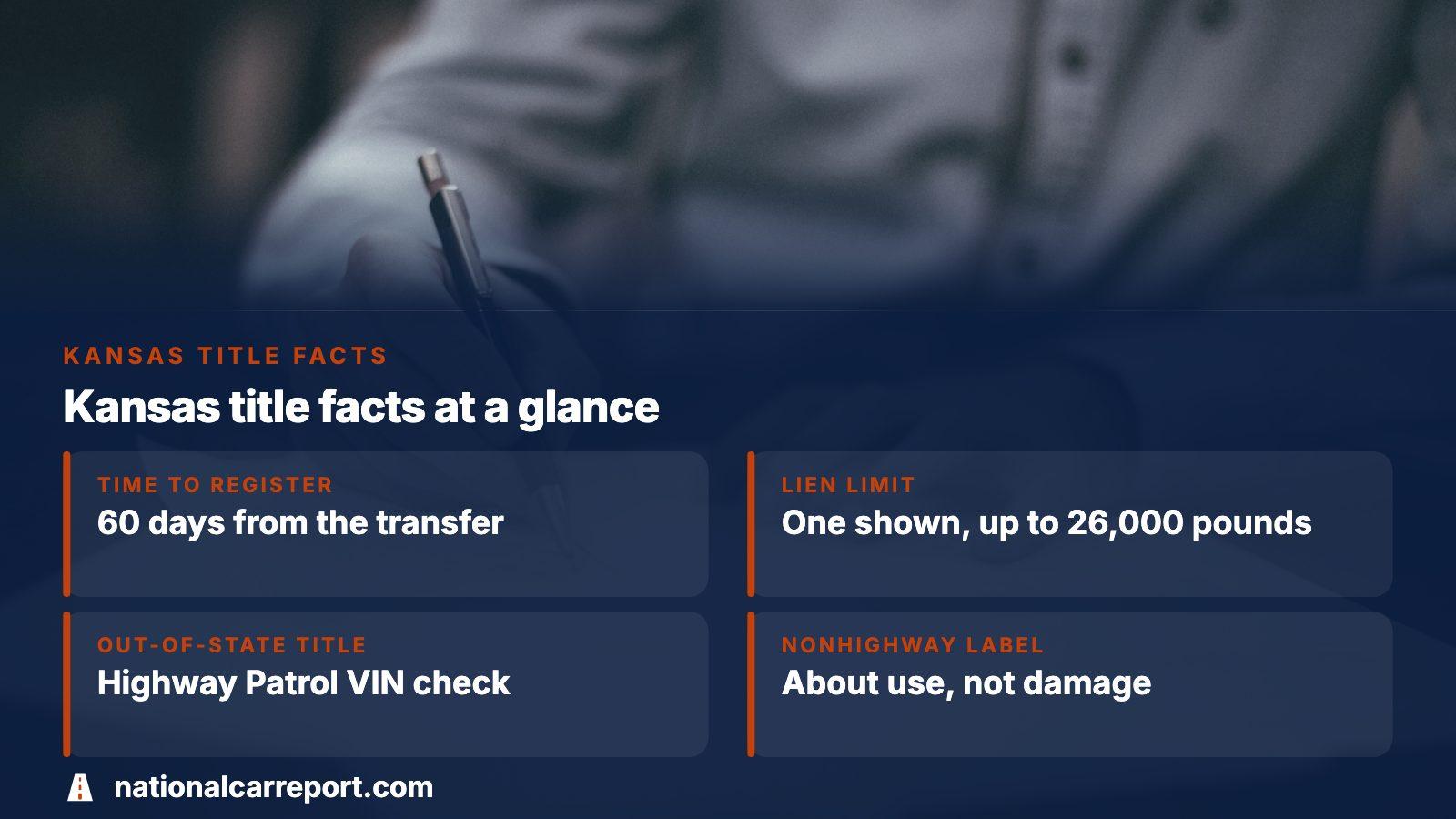
- Time to register
- 60 days from the transfer
- New title fee
- $10
- Liens on vehicles up to 26,000 pounds
- Only one may be shown
- Highway Patrol VIN check, out-of-state title
- $20 minimum
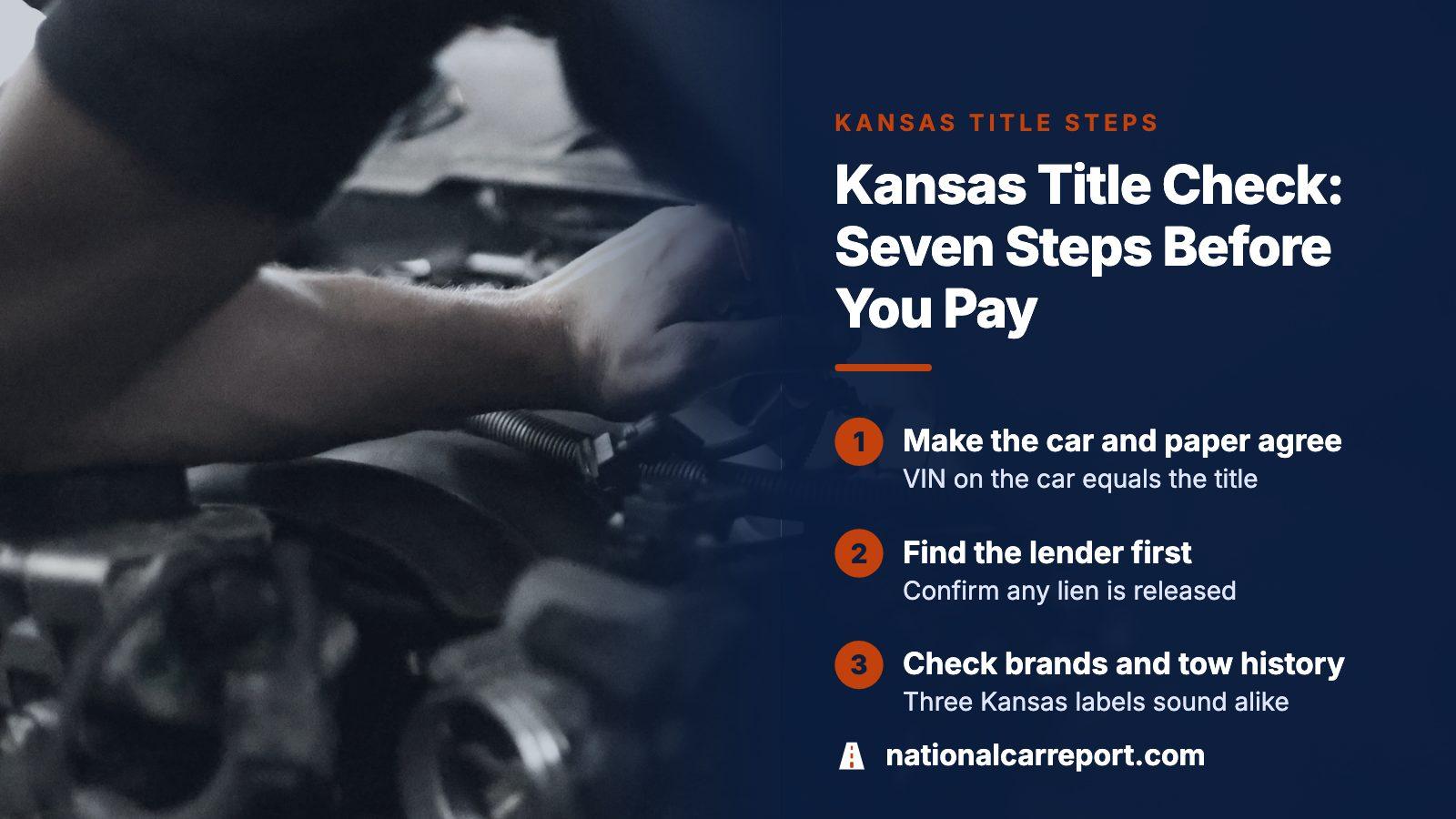
The seven steps at a glance
NationalCarReport reads a car the way a lender, a tow yard and a theft file would. Work down the list and stop at the first failure.
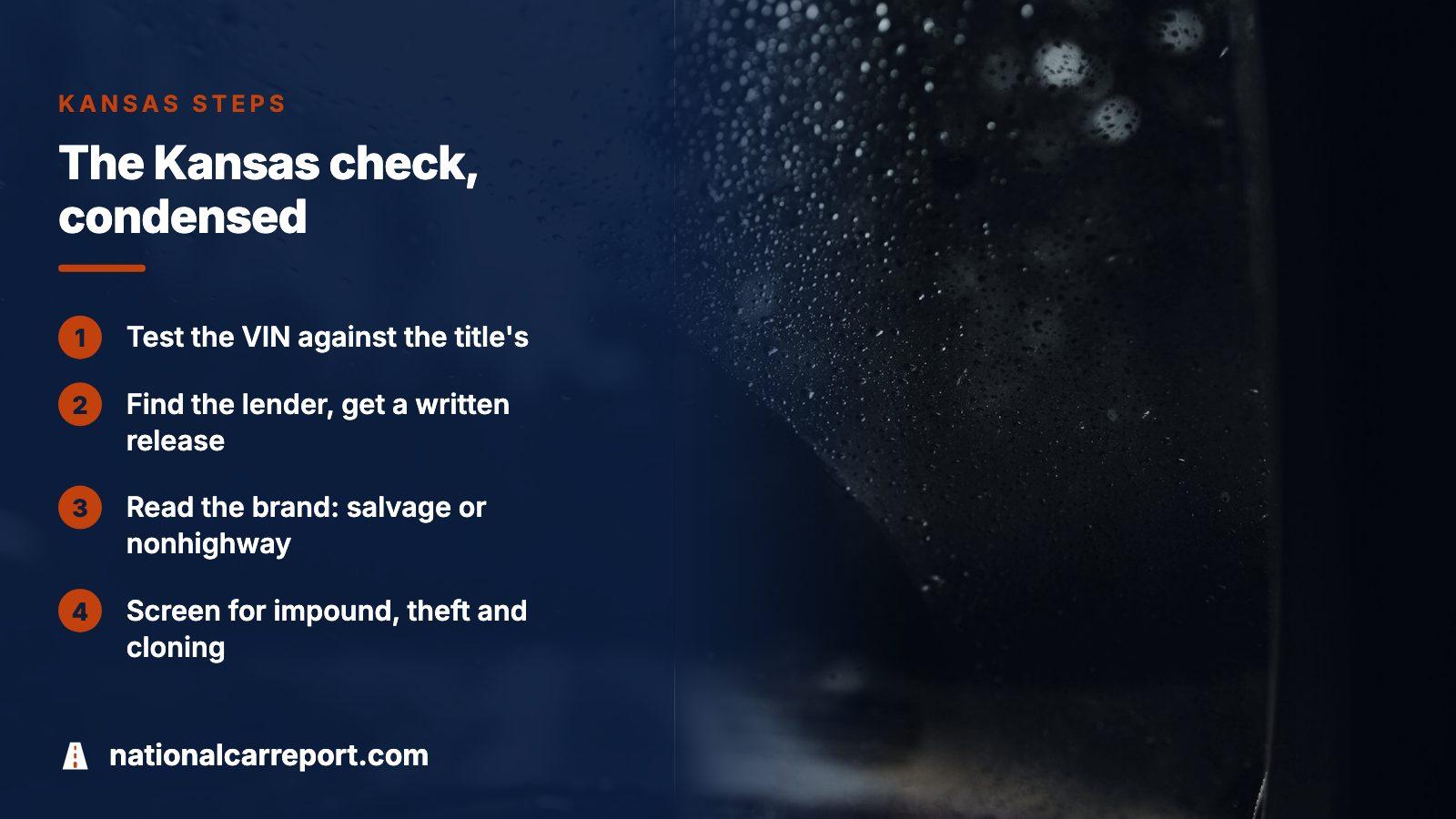
- Test the VIN on the car against the title's.
- Read the title face: owner, mileage entries, lender, earlier salvage status.
- Find the lender and settle the payoff with a written release.
- Ask for the state record and learn what it omits.
- Read the brand: salvage, rebuilt salvage or nonhighway.
- Screen for impound and tow-lot history.
- Screen for theft and cloning, then file inside 60 days.
Steps 1 and 2: make the car and the paper agree
Hold the car's VIN up against the one on the title, one character at a time. Any mismatch ends the discussion until someone explains it. Kansas agrees: a used car titled elsewhere gets no Kansas title until the Highway Patrol confirms the foreign VIN is genuine, a check billed at $20 an hour with a $20 minimum.
Then read the title's face. Each seller certifies mileage and price at every sale, and the back has a mileage entry per owner, so a blank or a correction deserves a question. The title must also say whether the car was ever titled as salvage or nonhighway.
A label on the door frame
A rebuilt salvage car inspected in Kansas wears a Highway Patrol notice on the left door frame, showing the VIN and stating that the car is a rebuilt salvage vehicle. If the seller says clean and the label disagrees, trust the label.
Step 3: find the lender before you pay anyone
Every lien goes on the title application, and the division issues no new title over an unreleased lien unless the lender consents in writing on its approved form. A vehicle rated 26,000 pounds or less can show a single lien, and a second one is void. A seller may agree in writing to hand over the signed title up to 60 days late; treat that as your cue to ask for the lender's name.
- Get the lender's name and payoff amount from the seller, then confirm both with the lender.
- Pay the lender directly, or release money to the seller only against a signed release.
- Keep the release, or the lender's written consent to the sale, with your title papers.
Step 4: the state record, and why most buyers never see it
Kansas.gov's title, registration and lien search is not a public tool. It sits behind a sign-in for subscribers who have certified in writing that their purpose is permitted. Its records live in three databases, work in process, current and history, that one search cannot cover together.
| Record | What it settles | What it leaves open |
|---|---|---|
| Seller's Kansas title | Owner, lender, mileage entries, earlier salvage status | Theft files, tow-lot sales, other states' brands |
| Kansas.gov record search | Pending, current and past title and lien entries | Needs a subscriber account and a certified use |
| National title data | Brands from reporting states, latest odometer, insurer write-offs, salvage-yard transfers | States that do not report |
| NationalCarReport preview and report | Lien, impound and theft entries beside brands and mileage | Anything not yet reported to its sources |
Step 5: read the brand, because three Kansas labels sound alike
For a late-model car, salvage starts when repairs would cost 75 percent or more of its value just before the damage. Late model means the damage year or any of the six model years before it. Older cars qualify when damage leaves them unregistrable without major repair, and insurer write-offs count too.
- Salvage: the owner applies for the title before the car changes hands and within 60 days of the determination.
- Rebuilt salvage: a car that held a salvage title earlier, then passed Highway Patrol inspection and wears the door-frame notice.
- Nonhighway: a label about use, not damage, covering off-road machines and cars never insured or registered.
Flood needs a second look: some states brand flood cars and others have no such label, so ask for the national record rather than expecting Kansas paper to say it.
Step 6: impound and tow-lot history
Impound is one way a clean-looking title gets made. When a Kansas agency or tow operator sells an unclaimed car, it must give the buyer a certification of compliance, and with it the buyer can obtain a Kansas title free and clear of every lien. The $20 form fee may be passed to the buyer.
So a lender's claim can end at a tow-lot sale and the new title looks ordinary. The tells sit in the history: an agency sale, a short gap between a tow and a new owner, a seller vague about how the car was acquired.
Ask for the certification
A seller who bought at an agency or tow auction holds a certification of compliance, not a lender's release. That is lawful, but the history behind the title belongs to the tow lot, so ask to see the form and run the VIN for impound records.
Step 7: theft, cloning and the national record
The title is not a theft record, so a national search belongs in the check. The federal title system pools brands, the latest odometer reading, insurer total losses and salvage-yard transfers, plus past theft for some cars. It flags two traps. An insurer may write off a car that stays missing 30 days, and the label survives a safe recovery. And thieves fit VINs copied from matching cars, which is how one investigation recovered about 250 cloned vehicles.
Coverage has holes. Coverage reaches about 87 percent of U.S. vehicles, but reporting is uneven: more than half the states send data, not all, so an all-clear can miss real problems. Use it to find trouble, not to prove there is none.
After the check: the 60-day clock and the title hand-off
The buyer has 60 days from the transfer to apply for registration, weekends and holidays included. Driving in that window needs temporary registration, which a county treasurer or a dealer can issue, and a late filing adds a $2 penalty. A new title costs $10.
A sale with no title assignment is void unless both sides agreed to a later hand-off inside that window. A seller can file a $10 form showing the title was assigned, which shields the seller if the buyer never registers.
- Title signed over, with lenders listed or none stated.
- Mileage and price certified in the seller's hand.
- A written release or lender consent for any loan.
- Brand and door-frame notice that match what you were told.
What the preview and the report cost
A preview of the results is free, so you can see what a VIN turns up before committing. One payment buys the full report and nothing renews afterward, and anyone comparing several Kansas listings can choose a pack instead. The pricing page lists the amounts, and the sample report shows how lien, impound and theft lines read.
Do this before the deposit. Take a lien or impound hit to the lender or the county treasurer, and walk away from any car whose title and VIN disagree.
Where this information comes from
- Kansas statute 8-135: transfer of ownership, titles and liens — Source for the 60-day registration window, the $10 title fee, the one-lien limit, the written-consent rule and the seller's title duties.
- Kansas statute 8-197: salvage and nonhighway definitions — Defines salvage, rebuilt salvage and nonhighway vehicles, including the 75 percent repair-cost line and the late-model rule.
- Kansas statute 8-198: salvage and nonhighway titles — Covers when a salvage title must be applied for, the Highway Patrol check for a rebuilt title and the door-frame notice.
- Kansas statute 8-116a: Highway Patrol VIN checks — Explains the check required on out-of-state titles, what it looks for and what it costs.
- Kansas statute 8-1109: certification of compliance on tow and agency sales — Source for the lien-free title a buyer can obtain after an impound sale and the fee on the form.
- Kansas.gov motor vehicle records: frequently asked questions — Describes the subscriber-only title, registration and lien search and its three databases.
- Department of Justice: NMVTIS for consumers — Source for what the national title system holds, its coverage gaps, the total-loss label and VIN cloning.
Sources and photos: Facts checked against the sources above in November 2026. Photos by Mustafa Sheikhmouss, Justin Cron and Scott Graham on Unsplash; diagrams by NationalCarReport.
Keep reading
- Vehicle Lien Check by VIN: Nationwide Lien, Theft and Impound RecordsWho holds a loan on a car, and how to confirm it is gone.
- Stolen Car Check by VIN: Nationwide Theft, Lien and Impound RecordsTheft records for any car, and what a recovered car carries afterward.
- Impound Lookup: Find a Towed Car, Then Check Its VIN for Impound RecordsHow to find a car held by a tow yard or an agency.
- PricingSingle reports and packs, paid once and never renewed.
Frequently asked questions
How do I do a Kansas title search?
Start with the seller's title and check that its number is the one on the car, then identify any lender and get a written release. Ask the county treasurer about the paperwork, and run the VIN for national title, impound and theft records. The state's record search is limited to subscribers, so the VIN search fills the gaps.
Is there a free Kansas title check?
Only in pieces. The preview is free for a first look at what a VIN returns, and the state's own record search is limited to subscribers with a certified use. Nothing free replaces a lender's written release. A full history report is a separate one-time purchase.
How soon must I title a car I bought in Kansas?
Sixty days from the transfer to apply for registration and a new title, weekends and holidays counted. A late application adds a $2 penalty, and the new title costs $10. Until you register, you need temporary registration to drive the car.
Can I buy a Kansas car that still has a lien?
Only if the lender is paid at the sale and its release or written consent reaches you. Kansas will not issue a new title over an unreleased lien without that consent on an approved form. A seller's promise to settle the loan later is a risk you would carry yourself.
What does rebuilt salvage mean on a Kansas title?
The car once held a salvage title and later passed the Highway Patrol check, which looks at the VIN and the history of its parts. The statute frames that check around the VIN and stolen parts, so book your own mechanic to judge the repair.
Now check the car itself
The guide explains what to look for. The report shows what this VIN has on record.